Exploring Ancient Architecture in Shanxi: Unmissable Treasures (Part 2)
Continuing from the previous travelogue, after our trip to Shuozhou, we drove straight to the ancient city of Pingyao. However, our interest was not in the city itself, but rather in the two renowned ancient monasteries outside Pingyao. Everyone knows the ancient city of Pingyao is beautiful — I don't deny that — but in fact, the two monasteries near Pingyao are even more worth seeing:
[Note: All indoor photos in this article are downloaded from the internet; outdoor photos are taken by me. Please help protect cultural relics!]
Location: Haodong Village, Pingyao County, Jinzhong City, Shanxi Province
Highlights: Five Dynasties architecture, Five Dynasties painted sculptures
Must-see rating: 4.5
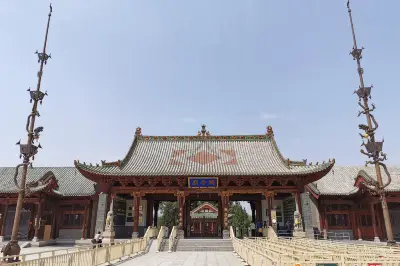
During the Five Dynasties period, various regional regimes ruled parts of Shanxi, among them the Northern Han. The Northern Han (951–979) was one of the Ten Kingdoms and the last of them, with its capital at Jinyang (present-day Taiyuan City, Shanxi). Its territory covered twelve prefectures, roughly today's central and northern Shanxi. Zhenguo Temple was built by the Northern Han imperial court, originally named "Jingcheng Temple", and it held a very high standard at the time.
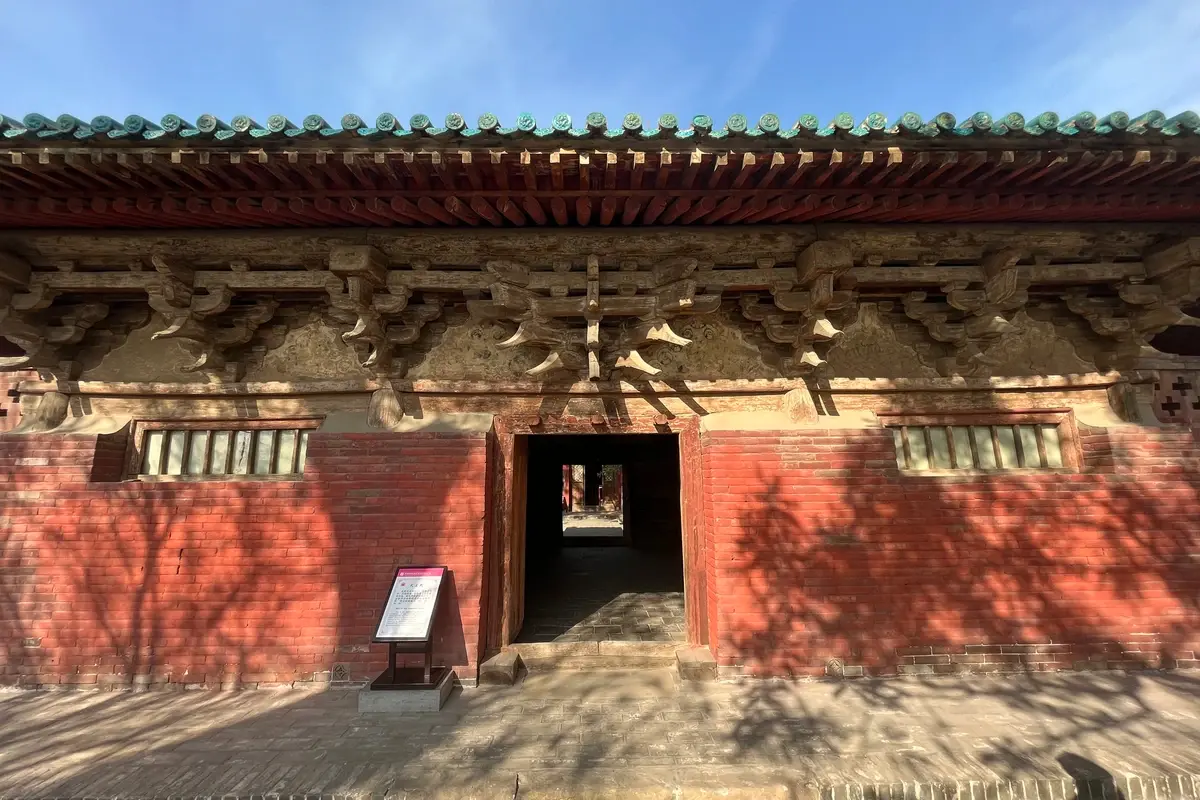
The Five Dynasties was an era of chaos and constant warfare, making it exceedingly rare for buildings to survive. The Wanfo Hall at the temple's center is one of China's oldest surviving timber structures and one of only three Five Dynasties buildings still standing in Chinese Buddhist temples. Built in the seventh year of the Tianhui reign of the Northern Han (963), it is hailed as a "millennium treasure". As the Five Dynasties period bridges Tang and Song, the architecture mostly inherits Tang styles, though slightly less grand and ornate, and it also shows many transitional links with Song and Jin architecture. You can compare it with Foguang Temple, Chongfu Temple, and others.
Inside Zhenguo Temple's Wanfo Hall are eleven painted sculptures, all originals from the Five Dynasties. Apart from a small number of Five Dynasties painted sculptures preserved in Dunhuang's Mogao Caves, these at Zhenguo Temple are the only surviving works of their kind in China, holding a very high place in Chinese art history and sculpture. The eleven figures include one Buddha, two disciples, two bodhisattvas, two attendants, two vajra guardians, and two donors. Each is vividly lifelike.
8. Shuanglin Temple
Location: Qiaotou Village, 6 km southwest of Pingyao County, Shanxi Province
Highlights: Ming Dynasty sculptural groups, Weituo statue
Must-see rating: 4.5
The exact construction date of Shuanglin Temple is unknown, but the oldest surviving stele is the "Gugu Stele" from the fourth year of the Dazhong Xiangfu reign of Northern Song (1011). Though the inscription is weathered and hard to read, the line "rebuilt the temple in the second year of Wuping" is still legible. The second year of Wuping (571) was during the Northern Qi, and since it was a renovation, the temple must have been founded earlier. The existing buildings and sculptures are mostly Ming Dynasty works. Although relatively recent, the temple houses an enormous collection of group sculptures on a grand scale — definitely worth seeing.
Shakyamuni Hall is one of Shuanglin Temple's main halls. Shakyamuni sits in the center, flanked by Manjusri and Samantabhadra. The four walls are decorated with a combination of full-round carving, high and low relief, arranged in layered, interconnected tableaux depicting episodes from the Buddha's life — from conception and birth to nirvana and his travels spreading the Dharma. Over two hundred figures of varied identities and expressions move among architecture, mountains, and rocks. The composition is ingenious, rich in the traditional flair of Chinese folk art.
In the Thousand Buddha Hall on the east side, there are over five hundred painted sculptures — a quarter of the temple's total. The main figure is the Water-Moon Avalokitesvara, serene and charming, poised naturally. To the sides stand Weituo and Yecha. The Weituo statue is especially distinctive, blending martial and scholarly air, full of dynamic tension — a rare artistic masterpiece of Ming Dynasty sculpture. Try mimicking his stance; it’s actually very hard! The hall's interior is filled with suspended statues and wall sculptures: five hundred bodhisattvas arranged in five or six tiers, riding clouds or mythical beasts, interacting harmoniously with the central figure. More than thirty donor figures are also sculpted beside windows and doors.
The Bodhisattva Hall, opposite the Thousand Buddha Hall on the west side of the middle courtyard, has a central Thousand-Armed, Thousand-Eyed Guanyin seated in lotus posture. Her figure is full and dignified, her expression gentle and elegant, her hands in countless mudras, delicately and flexibly shaped. Around her, over four hundred suspended bodhisattvas tread on colorful clouds as if in motion, their robes seeming to flutter, the whole wall alive with breeze.
[Travel Tips:]
1. If you visit Zhenguo Temple first and then Shuanglin Temple, be careful: the navigation may take you along a very rough small road, even a dead end. Try multiple navigation apps. The road from Pingyao Ancient City is much easier.
2. During the off-season, taxis are hard to find and buses are infrequent. It's best to rent a car. At Zhenguo Temple, we met a fellow traveler heading to Shuanglin Temple and gave her a lift. She was lucky; otherwise it would have been quite troublesome.
3. As for Pingyao Ancient City, we didn't spend much time. We just strolled its streets one evening and night. The 8 p.m. light show at the south gate is worth seeing.
9. Guangsheng Temple
Location: County Road 544, Hongdong County, Linfen City, Shanxi Province
Highlights: Feihong Glazed Pagoda, Yuan Dynasty murals
Must-see rating: 4.5
Guangsheng Temple was first built in the Eastern Han Dynasty, and after many rises and falls, the surviving structures are mainly from the Yuan and Ming periods. The temple is divided into Upper and Lower Temples, with the Water God Temple (a Yuan Dynasty Taoist shrine) next to the Lower Temple. The Upper Temple sits on a hill; you can walk or take a shuttle bus (taking the bus is recommended to save time and effort, round trip 20 yuan). Each temple has its own highlights.
The Feihong Pagoda is the most iconic structure of Guangsheng Temple. It is one of the five stupas housing Buddha relics and one of four ancient pagodas still standing in China. It is also the only known glazed pagoda to bear the craftsman’s inscription and the largest and most complete of its kind. It is said that the 1986 CCTV version of Journey to the West filmed the scene where Tang Monk sweeps the pagoda in "Sweeping the Pagoda to Clear Injustice" right here (though I don’t remember it clearly). The octagonal pagoda has 13 stories and stands 47.31 meters tall. The body is of grey brick, each story with projecting eaves. The exterior is entirely decorated with yellow, green, and blue glazed tiles, with the first three floors being the most exquisite.
Currently, only the ground floor of the pagoda is open. On the stairs leading to the second floor, you can vaguely see that the interior is structured like an Ashoka stupa, confirming it as a relic pagoda.
The Upper Temple’s halls and sculptures are mainly from Yuan and Song. The Amitabha Hall is an unusual Yuan structure with a glazed hip-and-gable roof, five bays wide and four deep. Inside, the three Western Pure Land saints: a cast bronze Amitabha in the center flanked by clay statues of Avalokitesvara and Mahasthamaprapta. Red scripture cabinets line the hall; the unique Zhaocheng Jin Tripitaka, a rare surviving edition, was originally kept here.
The Vairocana Hall (also called Tianzhongtian Hall) has a single-eave hipped roof with glazed edges, five bays wide and four deep. The lattice doors feature exquisite openwork carving, a masterpiece of wood art. Inside, three Buddhas and four bodhisattvas are enshrined, surrounded by eighty-eight Buddhas. On the north wall is a huge mural of the Twelve Enlightened Bodhisattvas — very much worth seeing.
The Lower Temple was built in the Yuan Dynasty; the rear hall dates to the second year of the Zhida reign (1309). Seven bays wide with a single-eave overhanging gable roof. Inside are clay statues of the Buddhas of the Three Times, plus Manjusri and Samantabhadra, all Yuan works. The hall’s interior walls were once fully covered with murals, but sadly, in 1928, most were stolen and sold abroad, now in the Nelson-Atkins Museum of Art in Kansas City, USA. A surviving fragment of 16 square meters on the upper gable wall depicts Sudhana’s 53 visits to spiritual teachers, finely painted and rich in color, dating to the hall’s construction.
Next door, the Water God Temple’s walls are covered with Yuan Dynasty murals on various themes. This is "the only surviving ancient mural in China whose subject is neither Buddhist nor Taoist." On the east section of the south wall is a famous mural titled "The Traveling Theater Troupe Led by Zhongduxiu Performs Here", the only known large Yuan Dynasty theater mural. It is invaluable for studying the history of Chinese drama and stage arts, acclaimed as another wonder of Guangsheng. Note: the temple is closed from 12:00 to 2:00 p.m., so plan your visit accordingly!
10. Thousand Buddha Hermitage (also known as Xiaoxitian or Little Western Paradise)
Location: Phoenix Mountain Peak, west of Xi County, Linfen City, Shanxi Province
Highlights: Ming Dynasty suspended sculptures
Must-see rating: 5
Xiaoxitian, officially the Thousand Buddha Hermitage, is a Chan Buddhist temple founded in the second year of the Chongzhen reign (1629) by Master Dongming of the Ming Dynasty. It was first named after the thousand Buddha statues in the main hall, and later renamed "Xiaoxitian" (Little Western Paradise) after an inscription above a gate reading "Entering the Western Paradise", and to distinguish it from another temple, "Daxitian" (Great Western Paradise), south of the town.
Though small, Xiaoxitian holds a hidden world within. It perches on a hill, reached by climbing long staircases and passing through a short tunnel. Small as it is, it lacks nothing essential for a temple, a testament to the ingenuity of its original planning.
The Upper Courtyard is the temple's highlight. Inside the Mahavira Hall, five interconnected niches line the front wall, housing Medicine Buddha, Amitabha, Shakyamuni, Vairocana, and Maitreya seated on lotus thrones, each robed in splendor, serene and compassionate. Ten major disciples stand on either side, beautifully sculpted with vivid expressions. The south gable wall features scenes from "The Three Saints of the West" and the "Four Heavenly Kings", while the north gable wall depicts the Thirty-three Heavens of Trayastrimsa on Mount Sumeru, stories of Buddha, and Jataka tales. The beams are adorned with eight vajra guardians, and the walls between beams are filled with suspended tableaux of the resplendent "Pure Land". Numerous heavenly beings, mythical birds, peacocks, parrots, and cranes glide on ethereal clouds, while twelve celestial musicians, graceful and light, perform music and dance. The entire hall is a layered spectacle of heavenly pavilions, colored bright, presenting a realm of immortals and Buddhas. The statues are so vivid and fluid that standing inside, you feel immersed, as if they are communicating with you — a truly wondrous sensation.
When visiting Xiaoxitian, be sure to scan the QR code inside the hall to listen to the audio guide; it will help you better understand the stories and figures depicted in these suspended sculptures. Also, remember to bring binoculars, otherwise many details in the far corners will be hard to see. This is very important!
That day, we set off from Xi County and also visited the famous Hukou Waterfall (Shanxi side). The waterfall was spectacular, though it was a bit overcast (the only cloudy day of the whole trip, sadly), so we missed the rainbow over the falls. Hukou Waterfall lies on the border of Shanxi and Shaanxi provinces; the views from both sides are similar, each with its own merits. The Shanxi side also has Dragon Cave (unfortunately closed recently).
11. Wanrong Dongyue Temple – Feiyun Tower
Location: Within Wanrong County, Shanxi Province (ancient Jiedian Town)
Highlights: All-wood frame pavilion
Must-see rating: 4
Most of this day was spent traveling, so the only ancient building we visited was this Dongyue Temple. Note: Shanxi has many Dongyue Temples — make sure to navigate to the one in Wanrong County to avoid mistakes!
Wanrong Dongyue Temple’s founding date is uncertain; it was rebuilt in the Yuan Dynasty and repeatedly renovated in the Ming and Qing. The greatest highlight stands right at the entrance: a towering all-wood structure named Feiyun Tower (Flying Cloud Tower).
The tower is 23.19 meters tall, square in plan, with three stories and four-tiered eaves, topped by a cross-shaped xieshan roof. The second and third floors have balustrades, each side projecting a porch that forms a cross plan. The main load is borne by four central columns 15.45 meters high that run through all three stories. These columns are linked by beams and brackets, creating a shaft-like structure. Each storey has soaring upturned eaves, supported by 345 sets of bracket clusters of varying configurations, plus 82 glazed ridges and 32 wing-like corner eaves. The exterior is intricate and graceful, full of variation. The dense dougong brackets — nearly 300 clusters — differ according to position: they come in five, six, or seven layers, with decorative bracket heads shaped like grasshoppers, cloud patterns, or dragon heads, and angled arms like elephant trunks or zither faces, all clustered like clouds. Together with the wing-like flying eaves, they greatly enhance the artistic form.
Gazing up at the roof from below, you suddenly understand the phrase "a towering building rising from flat ground". The majestic, soaring impression is beyond words. Each eave is adorned with many immortal figures — perhaps expressing the Taoist wish for transcendence. At each eave corner hangs a bronze bell. The day we visited was breezy, and whenever the bells chimed together, it felt like traveling through time. Though the other buildings of Dongyue Temple have little to offer, coming here just for Feiyun Tower is well worth the trip.
On the evening of our fifth day, we stayed in Yongji. We chose Yongji mainly for its better accommodation (Yongji is a county-level city) and its proximity to Ruicheng the next day. Yongji and Ruicheng are not far as the crow flies, but because of the Taihang Mountains, you have to drive a long detour. Yongji’s most famous attractions are Guanque Tower and Pujiu Temple. Guanque Tower is immortalized by Wang Zhihuan’s poem "Climbing Guanque Tower", though the current structure is a modern reconstruction. Pujiu Temple is famous as the setting of the Romance of the Western Chamber. If you're interested in classical poetry or that story, you can visit. We were pressed for time and skipped them.
12. Guangrenwang Temple
Location: High ground at the northern end of Zhonglongquan Village, 3 km north of Ruicheng County, Yuncheng City, Shanxi Province
Highlights: Tang Dynasty architecture
Must-see rating: 4
Guangrenwang Temple was founded in the fifth year of the Tang Dahe era (831) and is one of four surviving Tang Dynasty buildings in China. It is named after the Water God enshrined here, whose title is "Guangren Wang" (King of Vast Benevolence). Also known as "Five Dragon Temple" because five dragon springs once gushed out from its foundation. Due to Shanxi's arid climate, such folk rain-prayer temples, usually dedicated to water gods or dragon kings, are common.
The main hall of Guangrenwang Temple is a Tang Dynasty relic (by "relic" we mean the frame, style, beams, and columns are original Tang materials, though the walls have been completely rebuilt, so it looks rather new). The hall is five bays wide and four rafters deep, with a single-eave hip-and-gable roof and a rectangular plan. The central bay has a pair of plank doors, the side bays have vertical bar windows. The columns have a rounded entasis and are connected by architraves. On the columns sit two-step, five-tier double-bracket sets in cantilever style, without intermediate brackets between columns — a typical feature of early timber architecture.
In 2013, Guangrenwang Temple underwent a major dismantling and repair, after which the surroundings were given a complete makeover. Now it looks neat and tidy, almost like a plaza in a park, missing some of its original ancient charm. I only came here to tick the box of visiting a Tang Dynasty building.
13. Yongle Palace (Temple of Eternal Joy)
Location: Guwei Town, about 2 km north of Ruicheng County, Yuncheng City, Shanxi Province
Highlights: Yuan Dynasty murals, Yuan Dynasty architecture
Must-see rating: 5
Yongle Palace, originally named Dachunyang Wanshou Palace, was built in memory of Lü Dongbin, one of the Eight Immortals. Because it is located in Yongle Town, it is commonly called Yongle Palace. Constructed between 1247 and 1358, it is the largest and best-preserved Taoist temple complex in China, and together with Beijing’s Baiyun Guan and Chongyang Palace in Huyi, Shaanxi, it is considered one of the three ancestral temples of the Quanzhen School of Taoism.
The Yongle Palace we see today was actually relocated from its original site. The original site was Caixia Village in Yongle Town, on the north bank of the Yellow River southwest of Ruicheng. Because it lay within the Sanmenxia Reservoir’s flood zone, the buildings and murals were sawn into numbered blocks and meticulously reassembled at the new location, a process that took nearly ten years. You can still see the cut lines and seams on the murals.
The greatest highlight of Yongle Palace is the trio of Yuan Dynasty murals in its three main halls:
The Sanqing Hall (Hall of the Three Pure Ones), also called Wuji Hall, is the main hall. On the altar in the north center originally stood the Three Pure Ones: the Heavenly Worthy of Primordial Beginning, the Heavenly Worthy of Numinous Treasure, and the Grand Supreme Elder Lord, though the statues are now gone. The four walls are covered with a mural 4.26 meters high and 94.68 meters long, spanning 403.34 square meters, and featuring 286 figures.
The title "Chaoyuan Tu" (Picture of Paying Audience to the Prime) depicts a procession of immortals paying homage to Yuanshi Tianzun: eight main figures, each three meters tall (the South Pole, North Pole, East Pole, Jade Emperor, Gouchen, Wood God, Earth Goddess, and Golden Mother), form the center, while the rest are arranged in symmetrical ceremonial groups. Leading the way on the south wall are the Azure Dragon and White Tiger star lords, followed by 28 main deities including the Heavenly Emperor and Queen Mother. Around them, 28 lunar mansions, 12 signs of the zodiac, and countless heavenly troops and generals unfold across the painting. The main figures are solemn and composed, while the assembly stands in full roundness, each radiating spirit and life, none identical. Some converse, some listen, some ponder, some gaze, their expressions and postures echoing one another into an organic whole.
Stylistically, "Chaoyuan Tu" follows the tradition of Tang dynasty painter Wu Daozi, with predominantly rounded contours. In handling the drapery folds, the painters also used angular strokes, the brush moving without hesitation, creating a long rhythmic flow. They employed the "duijin lifen" technique (raised gold outline), applying raised lines to sleeves, jewelry, and floral ornaments, then gilding them, giving a three-dimensional effect. Although digital reproductions now exist, seeing the mural on site still feels profoundly different. It’s truly worth the trip!
Compared to the grandeur of the Sanqing Hall, the murals in the two rear halls are more genre-like. The Chongyang Hall is dedicated to Wang Chongyang, founder of the Quanzhen School, and his seven main disciples. Using a comic-strip format, the murals depict Wang’s life from birth to attaining the Dao and teaching his seven disciples. In the Chunyang Hall (also called Huncheng Hall or Lüzu Hall), the mural "Depictions of the Immortal Lord Chunyang's Wanderings and Manifestations" covers 203 square meters. It comprises "Offerings at a Daoist Temple" and "Ritual Music at a Daoist Temple" on the west and east ends of the south wall, "Eight Immortals Crossing the Sea" above the north door, and "Zhongli Quan Guiding Lü Dongbin" on the altar wall behind the north shrine — altogether 52 scenes tracing Lü Dongbin from birth to his mystical journeys. These vividly portray social life during the Song and Yuan eras and serve as valuable visual materials for understanding that period.
[Itinerary Summary]
1. Day 3: Shuozhou – Pingyao
2. Day 4: Pingyao – Hongdong – Xi County
3. Day 5: Xi County – Wanrong – Yongji
4. Day 6: Yongji – Ruicheng
Travel Information / Hotel Index / Guide Index / Flight Index / Website Navigation / Tour Index / Cruise Index / Corporate Travel Index / Affiliate & Distribution / Friendship Links / Corporate Gift Cards / Insurance Agents / Agent Cooperation / Hotel Partnership / Destination & Scenic Spot Cooperation / More Partnerships
About Ctrip / Ctrip Hot Topics / Contact Us / Careers / User Agreement / Privacy Policy / Business License / Safety Center / Ctrip Content Center / Intellectual Property / Trip.com Group / Algorithm Disclosure