Shanxi Travelogue: Jishan Ji Wang Temple
On May 23, 2024, at 12:00 noon, we returned to the hotel, picked up our luggage, and took a taxi to Hancheng Railway Station at 12:30. We boarded the 2:20 pm K610 train to Jishan, arriving at Jishan Station at 3:30 pm. Very few people got off, and exiting the station was quite strange. The square in front of the station was completely empty — no buses, no taxis, not even a tricycle. Only one private car was parked there. We went up and asked if he could give us a ride. The driver asked where we were going, and when we said Home Inn, he refused and just drove off. We had no choice but to pull our luggage to the nearby intersection to see if there were any vehicles. After a short wait, a taxi approached; we hurriedly waved, but the taxi simply turned toward the railway station, picked up a passenger waiting in the square, then came back to the intersection and let us get in. Fortunately, we finally made it to our hotel. What baffled us was how a county-level station could have such terrible transport support services. No buses, no taxis, no tricycles. We’ve traveled to so many places, but this was absolutely unique, a huge disappointment for travelers. If it weren’t for the intercity bus to Yuncheng that we could transfer to here, we probably wouldn’t have stopped. But since we did, we definitely had to visit Jishan’s Ji Wang Temple.
We reached the hotel around 4:00 pm. Fortunately, Ji Wang Temple was just across the street, a short walk away. After dropping off our luggage, we headed straight to the temple to visit before it closed.
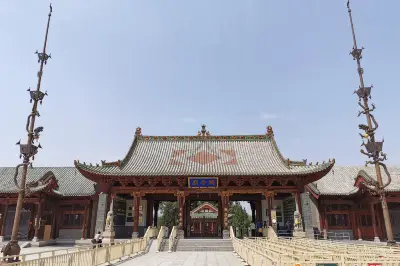
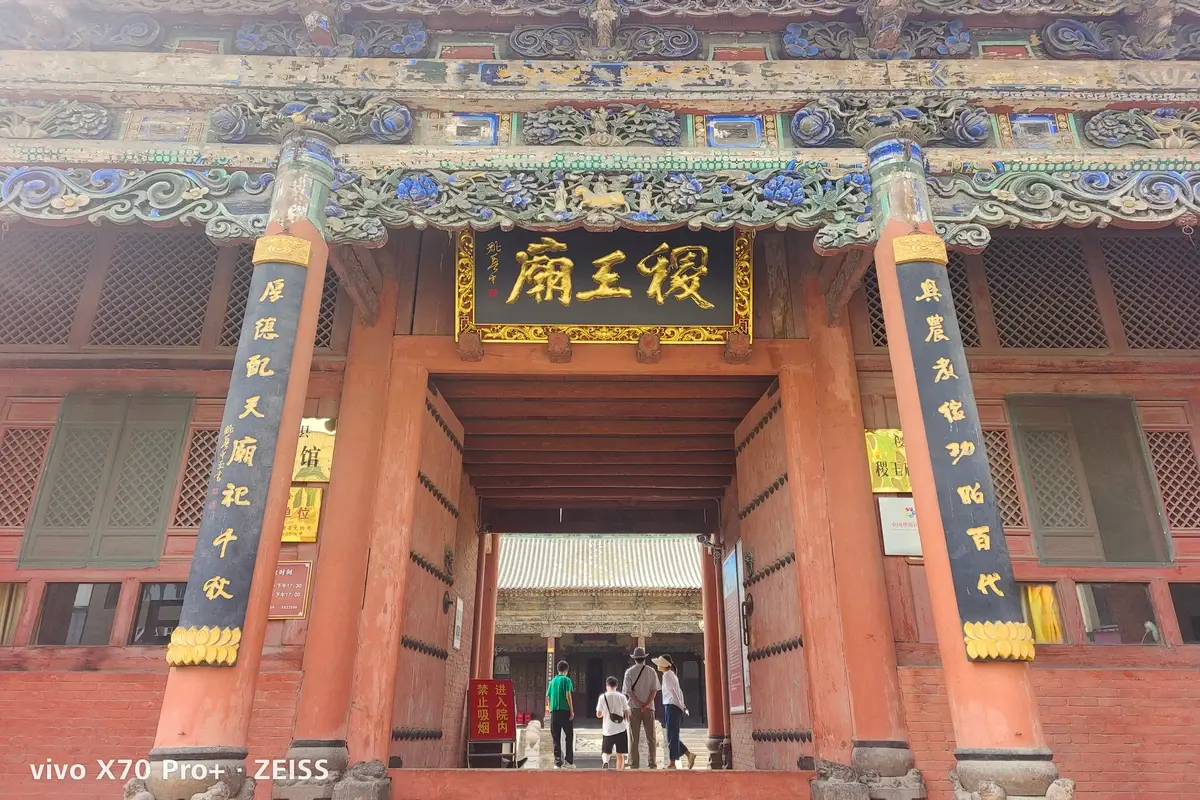
Jishan Ji Wang Temple, located in Jishan County, Yuncheng City, Shanxi Province, was first built during the Yuan Dynasty and reconstructed in the 23rd year of the Daoguang reign of the Qing Dynasty (1843). It covers an area of 4,100 square meters. The temple faces south, measuring 108 meters long from north to south and 38 meters wide from east to west. The layout follows the traditional Chinese symmetrical axis. The original mountain gate was destroyed long ago. From front to back, there are the Offering Hall, the Houji Hall, the Bagua Pavilion, and the Jiangyuan Hall, flanked by a bell tower and a drum tower. The Offering Hall is three bays wide and three bays deep, with a single-eave overhanging gable roof. It has no front or rear eave walls, opening directly to the Ji Wang Hall. On May 25, 2006, Jishan Ji Wang Temple was listed by the State Council of the People's Republic of China as a Major Historical and Cultural Site Protected at the National Level, part of the sixth batch.
The Houji Hall, built in the Qing Dynasty, is the main structure of the temple. It is five bays wide and five bays deep, roughly square in plan, with a steep 2-meter-high platform covering 380 square meters. It has two stories, a double-eave hip-and-gable roof, and stands about 30 meters tall. Surrounding the hall is a cloister with 20 stone-carved pillars. The two central pillars at the front feature coiled dragon relief carvings, completely intact, with bared fangs and claws, powerfully carved with exquisite skill. The other pillars are shallow flat carvings with rich and varied motifs, all finely crafted. Though the two carving techniques are quite different, each has its own merits, providing a striking contrast, both the work of master artisans. The glazed tile roof is magnificent, especially the ornately decorated main ridge. At the center of the ridge are three triple-eave pavilions; the sides are adorned with relief carvings of peony and herbaceous peony leaves, and the top features galloping horses; at the ends are dragon heads swallowing the ridge.
Inside Jishan Ji Wang Temple, the Offering Hall, Main Hall, and Jiangyuan Hall feature wood and stone carvings. The Offering Hall has an overhanging gable roof with glazed colored tiles. The front lintel is carved in relief with scenes of ancient farming activities: plowing, sowing, harvesting, and threshing. The Main Hall has a double-eave hip-and-gable roof and 20 stone pillars carved with floral motifs, of which the two front central pillars feature coiling dragon reliefs. The cloister stone balustrade is composed of 52 stone slabs carved with delicate floral patterns. There are no front or rear eave walls, leading directly to the Ji Wang Hall. The bracket beams at both ends are openwork carved with various farming-themed figures: oxen plowing fields, winnowing fans cleaning wheat, family members delivering meals, and joyful harvest scenes. The figures include officials, old farmers, strong laborers, mothers-in-law and daughters-in-law, and children; livestock such as oxen and goats; and farming tools like plows, hoes, and winnowing fans. Each group of scenes is separated by trees, flowers, or rocks. Inside the east and west gable walls are two large stone carvings. The west wall features a complete text of over 400 characters, a seven-character ancient poem titled 'Ode to the Completion of Ji Wang Temple,' composed by Li Jingchun, the magistrate of Jishan, in the 23rd year of the Daoguang reign (1843). The poem is archaic, the calligraphy handsome, and the carving technique superb—truly three masterpieces. The east wall bears a flat low-relief carving of the Eight Views of Jishan, combining poetry and painting.
Jishan Ji Wang Temple is grand in scale, combining architectural styles from the Yuan and Qing dynasties, with exceptionally fine stone and wood carvings that make it the premier Ji Wang temple in the Hedong region. It holds precious historical, scientific, and artistic value, providing valuable physical evidence for studying the historical evolution, architectural features, ancient agricultural production, and the art of stone and wood carving related to Ji Wang temples.
That afternoon, many students arrived by bus to visit, making the temple, normally tranquil, a bit noisy and chaotic, which somewhat affected our sightseeing experience. Around 6:30 pm, we finished our visit to Ji Wang Temple, went out, had dinner nearby, and returned to the hotel to rest.