Shanxi Travel Diary: Emperor Shun's Mausoleum in Yuncheng
On the morning of May 24, 2024, we had a nice breakfast at the hotel. At 8:30, we took a 7-yuan taxi to Jishan Bus Station. Online info suggested that intercity buses to Yuncheng departed from this bus station. When we arrived, the station's entrance was completely deserted—no taxis, not even any travelers. We were puzzled. Stepping inside, we found the station equally empty. Asking the staff, we were told that yes, the intercity bus leaves from here, but because the new bus station is far from the city center, boarding points have been set up in town, making the actual station look a bit forlorn. Modern urban planning really is bizarre: high-speed rail stations are built outside of town, and new bus stations are often on the outskirts, causing endless trouble for ordinary people and turning the stations into little more than decoration.
Enough about that. We bought tickets at the station, 13 yuan per person. So-called intercity bus—it's really just a regular coach with a different name. Around 9:10, a station employee led us to the roadside to wait. When the bus arrived, sure enough, it was already quite full of passengers. We made a mental note: in the future, find out where the actual pick-up point is to save time and money.
At 10:40 a.m. we arrived at Yuncheng Bus Station. Outside, we took bus no. 16 to the train station. By 11:30 we had checked into the Home Inn, a twin room with breakfast for 118 yuan. After settling in, near the train station we tried a local specialty for the first time: a 'mo' bun stuffed with your choice of various dishes, 4 yuan, where you pick from a dozen or so hot and cold dishes and stuff them into a split bun yourself—a very unique and fun way to eat. After lunch, we caught bus no. 16 outside the train station heading to Emperor Shun's Mausoleum.
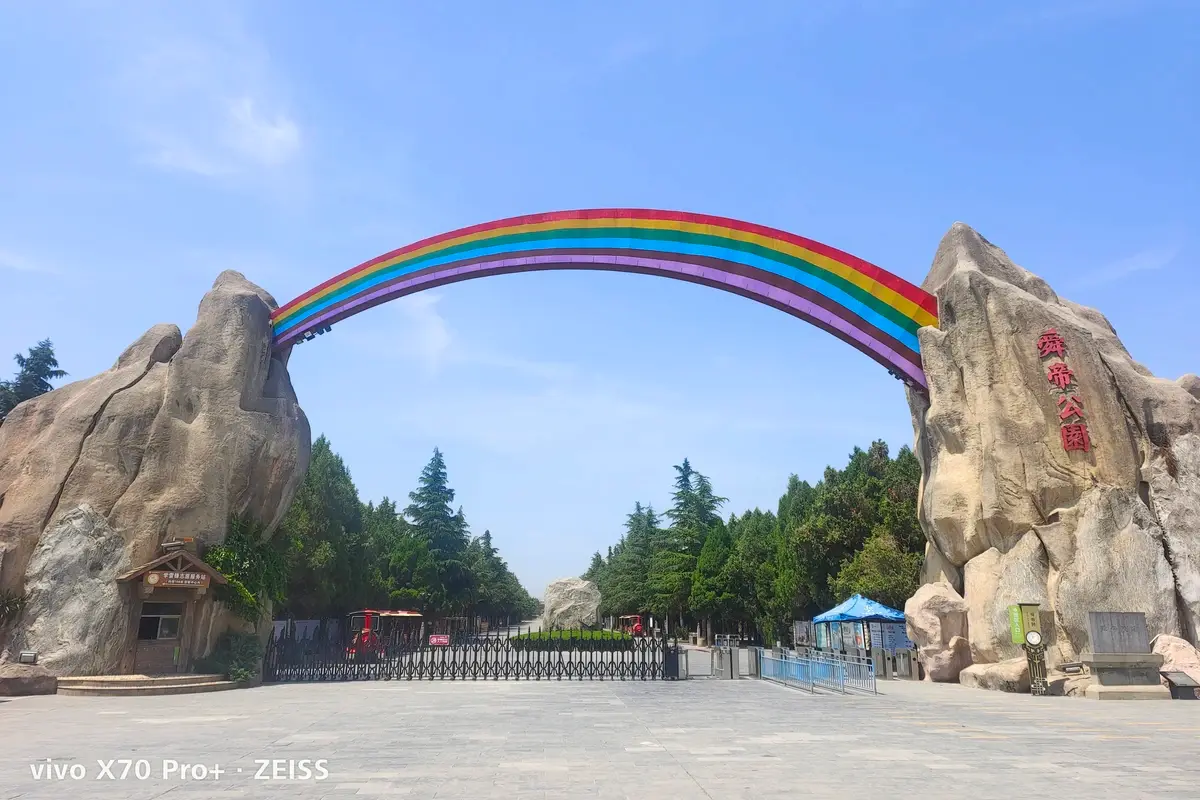
At 1:40 p.m. we reached the Emperor Shun's Mausoleum scenic area. From the drop-off point, we still had to walk a long scenic avenue to reach the ticket office. It was extremely hot, and the 1.5-kilometer walk left us drenched in sweat. Not a single other tourist in sight—nice scenery and a peaceful environment, exactly the way I like it.
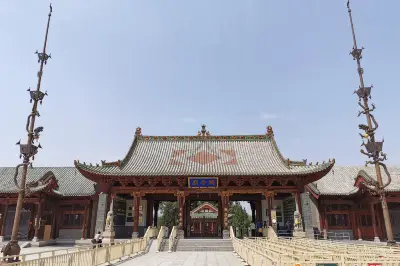
Emperor Shun's Mausoleum in Yuncheng is located at the western end of Ming Tiao Gang in Xiquma Village, Beixiang Town, Yanhu District, Yuncheng, Shanxi Province. It is the burial temple of Emperor Shun, one of the legendary 'Five Emperors' of Chinese antiquity. The mausoleum was first built in the 26th year of the Kaiyuan era of the Tang Dynasty (738 AD). In May 2006 it was designated a Major National Historical and Cultural Site by the State Council, and it is a national AAAA-level scenic area. The site covers 1,778 mu and is divided into a scenic section and the mausoleum itself, incorporating the Shun Emperor Avenue, Shun Emperor Square, Shun Emperor Park, and the Mausoleum Temple. The temple complex occupies 400 mu, uniquely arranged with the tomb in front and the temple behind—said to be the only one of its kind in the country.
Emperor Shun's Mausoleum is not only the tomb of the ancient sage-king Shun but also a sacred site where Chinese descendants seek their roots and honor their ancestors. Shun, whose surname was Yao, given name Chonghua, and title Youyu Shi, was the ninth-generation descendant of the Yellow Emperor, known for his filial piety. During his reign, he governed by virtue, showed compassion for the people, and fostered an era of political clarity, social stability, bumper harvests, and well-being—earning him the titles 'Saint of Virtue' and 'Ancestor of Filial Piety.' For over 1,400 years from the Northern Wei to the Ming and Qing dynasties, rituals and sacrifices at the mausoleum temple never ceased, attracting emperors, officials, gentry, and commoners alike.
Inside the scenic area, pines and cypresses stand evergreen; flowers burst into bloom. Sparkling water weaves through the grounds, with a water system running north-south. Four arched bridges—Gao, Kui, Ji, and Qi—reflect off the lakes and hills, showcasing the wisdom of northern Chinese garden designers. Emperor Shun's Mausoleum is not just a testament to ancient culture; it's also a vibrant place for modern visitors to experience the charm of Chinese heritage.
The mausoleum faces south, covering 70 mu; the sacred way occupies 13 mu, and the incense-burning grounds another 17 mu. Following the outer wall ruins uphill, you enter the sacred way, lined with towering 'husband-and-wife' cypress trees. After a hundred or so steps through the main gate, you come upon a square brick burial mound, 3 meters high and 51 meters in circumference. Embedded in front is a stone tablet inscribed by Xing Qiren reading 'Tomb of Emperor Shun of the Youyu Clan,' and a stone stele nearby reads 'Mausoleum of the Youyu Clan.' Locust trees intertwine over the tomb, lush and deeply shaded. Walking north about thirty meters around the tomb brings you to the Imperial City, also known as the Lile City. Entering the arched gate, the complex is laid out strictly symmetrically along a central axis: a theater stage, canopy pavilion, offering hall, main hall, and rear palace, flanked by covered corridors on both east and west sides, plus bell and drum towers. The main hall stands on a raised platform, with double-eave hipped-gable roof, five-tier bracket sets, five bays wide and five rafters deep. Inside, a clay statue of Emperor Shun sits enthroned, wearing a crown and royal robes, solemn and life-like. Behind the main hall, there once stood a three-bay residence with statues of his consorts E Huang and Nü Ying, destroyed in war. Southeast of the mausoleum temple, the old Dayun Temple once housed the monks who guarded the site—also known as the 'Guardian Temple'—but it was torn down in the early years after Liberation.
I had assumed Emperor Shun's Mausoleum was just a modern reconstruction based on historical records, but I was surprised to find it genuinely steeped in antiquity. Many historical structures and relics still stand. After all, this is one of the founding ancestors of Chinese civilization, one of the Five Emperors—definitely worth a visit to pay respects.
At 3:30 p.m. we finished our visit to Emperor Shun's Mausoleum and returned to the main entrance. Right outside, bus no. 33 starts its route there. We hopped on and headed to another Yuncheng attraction, the Salt Pond Temple.