Shanxi Travelogue: Yuncheng Chishen Temple
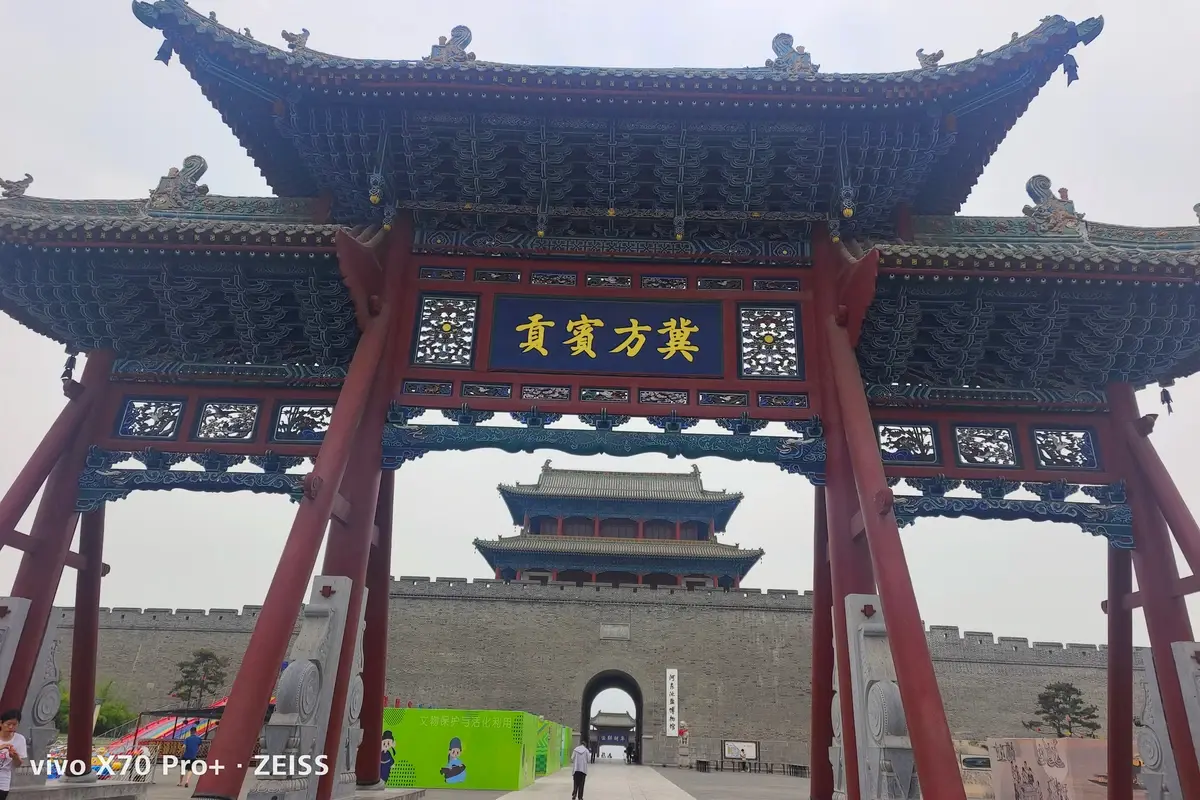
At 11:30 a.m. on May 25, 2024, we left the Yuncheng Museum and took bus No. 14 to Chishen Temple, arriving at 12:05 p.m. After getting off, we first had a bowl of noodles nearby. After the meal, we passed through the city gate tower and entered the Chishen Temple scenic area.
Yuncheng Chishen Temple is located at No. 386 Jiefang South Road, Yanhu District, Yuncheng City, Shanxi Province. It was first built in the 12th year of the Dali reign of the Tang Dynasty (777 AD). Constructed because of the salt pond, it is the only temple in China dedicated to the worship of the 'God of the Salt Pond'. The temple is an important carrier of Hedong salt culture. In May 2013, it was announced by the State Council as part of the seventh batch of National Key Cultural Relics Protection Units. The establishment of Chishen Temple is linked to Emperor Daizong of Tang, Li Yu. He bestowed upon the Yuncheng salt pond the title 'Baoying Lingqing Pond,' and enfeoffed the pond god as 'Duke Lingqing,' including it in the national sacrificial ceremonies. The temple enshrines the Pond God, the Sun God, and the Wind God, reflecting ancient people's awe and worship of nature.
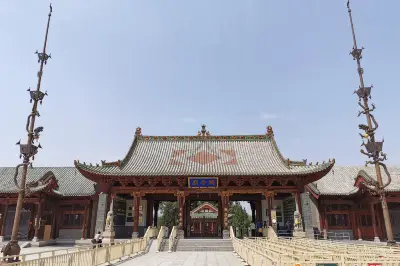
The architectural style and layout of Chishen Temple embody the essence of ancient Chinese architecture. Facing south and built against the mountain and beside the water, it follows a symmetrical central axis layout, creating a unique architectural style. The main buildings within the temple include the Three Grand Halls, the Steles Forest, and Haiguang Tower. Among them, the Three Grand Halls are the most magnificent, with a width of five bays and a double-eaved hip-and-gable roof. They are the places where the three deities closely related to salt production are worshipped.
Apart from its historical and cultural value, Yuncheng Chishen Temple is also a great place for visitors to learn about traditional Chinese religious culture and Daoist beliefs. Inside the temple, there are not only exquisite buildings and sculptures but also rich cultural exhibitions, showcasing ancient China's religious beliefs and philosophical thoughts to visitors. Furthermore, Chishen Temple boasts a superb location, backed by Woyun Hill and facing the salt lake. From here, visitors can overlook the salt pond waters and gaze at the Zhongtiao Mountains in the distance. While enjoying the natural scenery, they can also deeply feel the unique charm of ancient China's salt industry and religious culture.
The main hall complex of the Chishen Temple, the Three Grand Halls, is arranged horizontally, with all three halls placed in equal importance—a rare sight in Chinese temple architecture. Each hall is three bays wide and six rafters deep, surrounded by a veranda. Only the central hall is larger than the side ones, with a double-eaved hip-and-gable roof. The lower eaves have bracket sets of four tiers with a single descending cantilever; the upper eaves have five tiers with double descending cantilevers in the heart-centered style. The column capitals and corner bracket sets are fashioned into mandarin duck interlocking arches. The interior beam framework is neatly crafted, adorned with a caisson ceiling. The roof is covered with cylindrical and flat tiles, edged with yellow, green, and blue tri-colored glazed tiles. Zouyan Tower is one of the few surviving Yuan Dynasty stages in China. It is seven bays wide and four rafters deep, with a four-beam structure and a rear single-step beam under the eaves supported by three columns. The roof is covered with cylindrical and flat tiles, with grayish-green ridge decorations, and features a single-eave overhanging gable with a rolled-shed roof. In the center of the first floor, a north-south arched passage is built. During a major restoration in 2003 when the stage was dismantled, a stone trough was unearthed from the rear eave wall, with an inscription on the bottom reading, 'A stone trough case was installed on the 19th day of the 12th month in the 10th year of the Zhizheng era of the Yuan Dynasty.' This clearly proves the stage was built before the 10th year of Zhizheng (1350 AD), making it an authentic Yuan Dynasty stage. The Chishen Temple is built on the 30-degree slope of Woyun Hill, and its historical overall layout resembles a turtle shape. The now-destroyed Gexun Tower to the south formed the head, as if drinking from the salt lake; the sacred way and steps are the turtle's neck; Haiguang Tower, the Middle Gate (Steles Forest), the stage, and the Three Grand Halls form the turtle's shell; the tail is the Qianmen Gate of Chishen Temple. The entire temple faces the mountain and overlooks the water, presenting a magnificent sight.
Haiguang Tower was built during the Hongwu period of the Ming Dynasty (1368–1398) and served as the mountain gate tower of Chishen Temple. It was destroyed by war in 1947 and was rebuilt on the original site in 2003. It is five bays wide, three bays deep, with two stories and a double-eaved hip-and-gable roof. Visitors climbing the tower can enjoy a panoramic view of the Hedong salt pond. In ancient times, the Hedong salt pond was called the 'Salt Sea,' hence the name 'Haiguang Tower' (Sea Light Tower).
The verse from four millennia ago still echoes across the land of Yuncheng: 'The south wind's gentle caress soothes my people's discontent; the south wind's timely arrival enriches my people's wealth.'
The Salt Pond scenic area is a major attraction in Yuncheng, but unfortunately it is currently closed for construction and not open to the public. However, from Haiguang Tower in Chishen Temple, you can see the salt pond clearly and entirely. The water is not multicolored but turbid and yellowish, with a dull hue—nothing special, so it's fine to skip it.
We entered the scenic area from the south gate and exited from the north gate, which brought us right to the Yuncheng Hedong Salt Pond Museum. Located next to Chishen Temple in Yuncheng, the Hedong Salt Pond Museum officially opened on November 6, 2021, with a total exhibition area of 3,800 square meters. It mainly displays cultural relics and sculptures centered around 'salt culture.'
At 3:15 p.m., as we finished visiting the museum and were about to leave, it suddenly started pouring outside. We had to wait for the rain to ease. After about ten minutes, the rain lightened slightly, and we walked through the water to the bus stop, took a bus back to the hotel to rest. In the evening, we braved the rain to go out near the hotel and had vegetable-stuffed buns—simple, delicious, and filling.