Shanxi Travelogue: Yongle Palace in Ruicheng
On the morning of May 26, 2024, after breakfast at the hotel, we took the 109 intercity bus from Yuncheng Railway Station at 8 am to Yongle Palace in Ruicheng. The fare was 12 yuan per person. We got off at Dongyimao at 9:10, still about 3 kilometers from the Yongle Palace scenic area. Buses were inconvenient, so we planned to take a taxi. Just then, an elderly couple from Shenyang, Liaoning, got off with us—they were also heading to Yongle Palace. We shared a taxi, and the fare of 7 yuan was split among us.
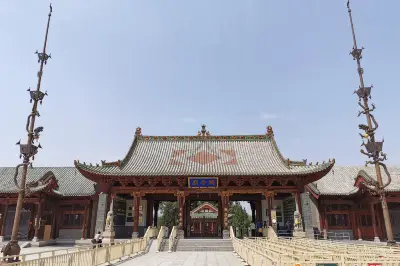
Ruicheng's Yongle Palace, originally called Dachunyang Wanshou Palace, was built to honor Lü Dongbin, one of the Eight Immortals. This Daoist temple complex is located on the east side of Longquan Village, about 3 kilometers north of Ruicheng county seat, Yuncheng, Shanxi Province, on the site of the ancient capital of the state of Wei from Western Zhou. Yongle Palace is the largest and best-preserved Daoist temple complex in China and, together with Beijing's Baiyun Guan and Chongyang Palace in Huyi District, Shaanxi, is one of the three ancestral temples of the Quanzhen (Complete Perfection) Daoist school. Its architectural style is unique, incorporating the Song dynasty's 'Yingzao Fashi' building standards and the Liao-Jin period 'column-reduction technique', creating a distinctive aesthetic. The complex includes four tall Yuan-dynasty halls arranged along a central axis: the Longhu Hall, Sanqing Hall, Chunyang Hall, and Chongyang Hall. Along the east-west axis, ancillary structures like the Lü Ancestral Family Temple, the God of Wealth Temple, and the Xuandi Temple have been preserved.
Yongle Palace is renowned for its architectural and mural artistry, with the murals being particularly celebrated as an 'Eastern Art Gallery'. The murals, found in each hall, showcase a variety of styles including meticulous gongbi figure painting and gongbi landscape narrative scrolls. The highlight is the 'Hundred Immortals Paying Homage to the Primordial' mural in the Sanqing Hall, featuring 290 deities, which, together with groups of immortals from the Longhu Hall, total 360 deities. The figures are over 4 meters tall, making it an outstanding example of Yuan-dynasty mural painting.
The history of Yongle Palace is equally legendary. Construction began in the second year of Guiyou's reign in the Yuan dynasty (1247) and was completed in the 18th year of the Zhizheng reign (1358), spanning 111 years. When the original site was to be submerged by the Sanmenxia Reservoir, then-Premier Zhou Enlai directed a project costing over 2.2 million yuan to relocate the entire complex piece by piece to its current location between 1959 and 1965. This relocation, alongside the moving of Egypt's Abu Simbel temples, is considered one of the two great artificial relocation feats in world cultural heritage history.
Yongle Palace is not only a vital center of Daoist culture but also a treasure of ancient Chinese art and architecture. It was designated a National Key Cultural Relic Protection Unit in 1961, added to the tentative list for World Cultural Heritage in 1998, and rated a national 4A tourist attraction in 2004.
The Sanqing Hall, also known as the Wuji Hall, is the main hall, enshrining the Three Pure Ones—Yuanshi Tianzun (Celestial Worthy of Primordial Beginning), Lingbao Tianzun (Celestial Worthy of Numinous Treasure), and Daode Tianzun (Celestial Worthy of the Way and its Virtue). It is seven bays wide and four bays deep, with eight rafters and a single-eave five-ridged roof. The central five bays of the front eaves and the central bay of the rear have lattice doors, while the rest are walls. In the three central bays to the north, there is an altar with statues of the Three Pure Ones. The hall's four walls are fully covered with murals, each 4.26 meters high, totaling 94.68 meters in length and spanning an area of 403.34 square meters, featuring 286 figures.
The Chongyang Hall is dedicated to Wang Chongyang, the founder of the Quanzhen school, and his seven disciples, the 'Seven True Ones'. The hall's murals depict his life story, from birth to achieving Dao and transmitting it to the seven disciples, in a comic-strip-like narrative.
The Chunyang Hall (also called Huntong Hall or Lüzu Hall) is five bays wide and three bays deep, with eight rafters and a single-beam, nine-ridged glazed-tile roof. The northeastern part has an altar with four pillars, and the front and rear bays have lattice doors, with walls elsewhere. Originally, a statue of Lü Dongbin stood on the altar, now damaged. Behind the screen wall is the mural 'Zhongli Quan Converting Lü Dongbin', 3.7 meters high and covering 16 square meters.
Yongle Palace's murals cover all four great halls, totaling 960 square meters. The 'Chaoyuan Tu' (Chart of Paying Homage to the Primordial) illustrates deities revering Yuanshi Tianzun: led by the Azure Dragon and White Tiger, with the Southern Longevity Star, the Queen Mother of the West, and six other main deities surrounded by Thunder God, Lightning Mother, star gods, dragon, snake, monkey deities, and warriors, guardians, and jade maidens attending. Nearly 300 deities move in one direction, creating a majestic pilgrimage procession.
When we entered Yongle Palace, we happened upon a rehearsal performance inside—many students in costume presenting a grand spectacle. After watching the show, we toured each hall one by one. To preserve the artifacts, photography is restricted inside the halls, but there is a mural wall in the courtyard where visitors can take photos freely, a small consolation.
At 10:30 am, we prepared to return. We bumped into the same two Liaoning tourists again and shared a taxi to the bus stop, then took bus 109 back to Yuncheng city.