Shanxi Travels: Yuncheng Guandi Family Temple
At 10:50 am on May 26, 2024, we took bus 109 from Ruicheng back to Yuncheng city center, and at 11:45 am got off at the Yanhu Scenic Area stop. Here we transferred to bus 21 to go to the Guandi Family Temple. This family temple is not the Xiezhou Guandi Temple; we had visited Xiezhou Guandi Temple before, so this time we had no plans to revisit Xiezhou. However, by chance we saw online that there is another Guandi Family Temple in Yuncheng, separate from the Xiezhou one and in a different location. We found that bus 21 goes to the family temple scenic area, and transferring at Yanhu was the most convenient. So we got off at Yanhu and waited for bus 21 to come from the opposite direction, heading to the Guandi Family Temple.
The Yanhu Scenic Area was not open, and the drop-off point by the lake only had a large rock carved with "Yanhu Scenic Area." Although tourists kept coming and going, they could only stop here and take photos. We also took a little time to wander while waiting for the bus. Soon bus 21 arrived, and we got on, reaching the Guandi Family Temple scenic area at 12:40 pm. Two female tourists from Shanghai got off with their luggage and started walking toward the family temple. After a few steps, we suggested they leave their luggage at the parking lot guardhouse so they wouldn't have to walk several hundred more meters. The guard kindly agreed. We hadn't had lunch yet, and right by the scenic area there was a stall selling Shaanxi cold-skin noodles. We ordered two bowls to fill our stomachs.
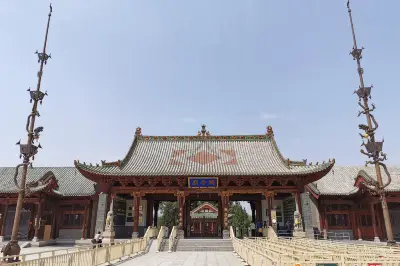
The Yuncheng Guandi Family Temple, also called Changping Guandi Temple, is located in Changping Village, Changping Township, Yanhu District, Yuncheng City, Shanxi Province. It was first built during the Sui dynasty. The Changping Guandi Temple faces south and covers an area of 13,937 square meters. In architectural layout, it follows the traditional "front court, rear residence" arrangement, with the main buildings aligned along the axis. From south to north on the central axis are the mountain gate, ceremonial gate, offering hall, Chongning Hall, Niangniang Hall, and Shengzu Hall. Flanking the east and west sides are the bell tower, drum tower, wooden memorial archways, corridor rooms, administrative halls, treasury, and Taizi Hall. In front of the temple stand two wooden archways inscribed "Ling Zhong Yan Hai" (Numinous Bell over the Salt Sea) and "Xiu Yu Tiao Shan" (Graceful Cultivation of Tiaoshan). The bell and drum towers face each other; the stone-carved archway, positioned between them, bears the inscription "Guanwang's Hometown" on the front – erected in 1524 during the Ming dynasty's Jiajing reign. Passing through this archway you reach the mountain gate, meridian gate, and offering hall. All three structures are three bays wide and four rafters deep, with overhanging gable roofs. The offering hall's front and rear eaves are open and spacious, with simple beams and rafters all painted in colors. Between the mountain gate and meridian gate stands the Ancestral Home Pagoda, an octagonal seven-story solid brick tower with no base. It has seven tiers of overlapping corbelled eaves. Five stone tablets are embedded in the tower body, recording its construction in the Dading Yiyou year of the Jin Dynasty (1165) and renovations during the Jiajing era of the Ming dynasty and the Jiaqing era of the Qing dynasty. Behind the offering hall is Chongning Hall, five bays wide and four bays deep, with a double-eave hip-and-gable roof. Inside, a wooden shrine houses a seated statue of Guan Yu, with four attendants in respectful poses. In a courtyard compound, directly opposite is Niangniang Hall, five bays wide and five bays deep, nearly square in plan. It has a front corridor, double-eave hip-and-gable roof. The statues of Lady Guan and her maidservants inside are considered masterpieces of Qing dynasty sculpture. This hall is also three bays wide and four rafters deep, with an overhanging gable roof.
Among these, the Ancestral Home Pagoda has a story rich in local legend and history. It is said that a well originally stood beneath the pagoda. After Guan Yu, also known as Guan Gong, killed Lü Xiong and fled, his parents, to free him from any worries about them, threw themselves into this well. To commemorate these parents of great righteousness and steadfast courage, later generations built a pagoda over the well, thus the Ancestral Home Pagoda. On May 25, 2006, the Changping Guandi Temple was designated by the State Council of the People's Republic of China as part of the sixth batch of National Key Cultural Relics Protection Units.
During our visit, we happened upon a pilgrimage group from Quanzhou's Five Great Guandi Temples. They were conducting a worship ceremony, laying out the three sacrificial animals in proper ritual fashion, sitting on mats in reverence, and murmuring prayers.
We finished touring the Guandi Family Temple at 2:30 pm, returned to the roadside, and waited for bus 21 to take us back to the city center.