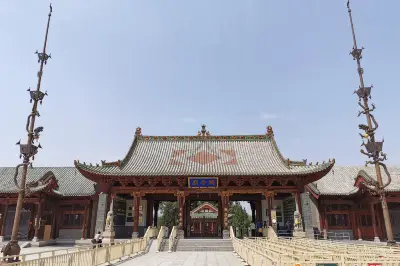
Shanxi Travelogue: Xiezhou Guandi Temple, Yuncheng
At 2:30 p.m. on May 26, 2024, we finished visiting the Guandi Family Temple and walked to the road to take a bus back to the downtown area. Checking the real-time bus info on my phone, I saw that the return bus on Route 21 had not started its trip yet, while a bus coming from the city was about to arrive. We immediately changed our plan and decided to take Route 21 to its terminal, Xiezhou Guandi Temple. From there, many Route 11 buses could take us back to the city center. So we took Route 21 to Xiezhou Guandi Temple. Since we were already there and had time, we thought it wouldn't hurt to visit Xiezhou Guandi Temple again, especially since it was free.
I had been to the Guandi Temple over a decade ago, and I never expected it to be so different now. Back then, the temple was squeezed into a narrow little street, cramped and humble. Today, the square outside the scenic area and its surrounding facilities far exceeded my imagination. Nothing remained of my past impressions, except that the interior of the temple itself hadn’t changed much.
Xiezhou Guandi Temple is located in Xiezhou Village, Xiezhou Town, Yanhu District, Yuncheng City, Shanxi Province. First built in the Sui Dynasty, it has a history of over 1400 years. After a fire destroyed the temple, it took eleven years to rebuild it, completed in the 52nd year of Kangxi’s reign in the Qing Dynasty (1713), with most of its main structures dating to the Qing period. As of 2023, it is the earliest-built, largest-scale, highest-ranking, and best-preserved Guandi Temple. The total area is 220,000 square meters, divided into the main temple and the Oath Garden, with the garden to the south. During the Xuanhe era of Emperor Huizong of the Northern Song Dynasty, Guan Gong became an object of official sacrifice. According to the 'History of Song, Treatise 58, Rituals 8': In the fifth year of Xuanhe (1123), Guan Yu was granted the title 'Yiyong Wu'an Wang' (Brave and Loyal Prince of Martial Peace), after which he was 'worshipped in the Temple of Wucheng Wang.' The stone lions in Xiezhou Guandi Temple stand proud and majestic; the iron figures depict foreigners with high noses and deep-set eyes, representing the non-Han keepers of lions, and are exquisite casts from the Ming Dynasty. They are valuable not only for studying Ming casting techniques but also provide important evidence for research on ancient clothing and accessories. In 1957, the temple was listed among the first batch of key cultural relic protection sites by the Shanxi Provincial People's Government. In 1988, it was designated a national-level key cultural relic protection unit by the State Council. In 2005, it was rated a national AAAA tourist attraction.
The ancestral temple of Xiezhou Guandi Temple faces the majestic and beautiful Tiao Mountain to the south and leans against the vast, sparkling Silver Lake to the north, with temple halls and towers harmoniously reflecting the lake and mountain scenery. It is a well-preserved, grand-scale ancient architectural complex, laid out in the traditional Chinese 'front court, rear residence' style with a symmetrical central axis. Along this axis are arranged the Duan Gate, Zhi Gate, Wu Gate, Imperial Library, Chongning Hall, and Chunqiu Tower, flanked by wooden and stone archways, stele pavilions, bell towers, and long corridors on both sides. The towering buildings, accompanied by towering pines and cypresses, exude a royal grandeur. Hanging in the temple are plaques inscribed by Emperor Kangxi: 'Righteousness Shines Through Heaven and Earth,' by Emperor Qianlong: 'Divine Courage,' by Emperor Xianfeng: 'The Ultimate Model for All Ages,' and by Empress Dowager Cixi: 'Awe-Inspiring Power Protects This Land,' all of which are treasures. The temple's architectural highlight is the Chunqiu Tower, whose second floor features a suspended beam and hanging column structure, a rarity in ancient Chinese architecture. South of the ancestral temple lies the Oath Garden, covering over fifty mu (approx. 8.2 acres), designed to evoke the peach orchard where Liu Bei, Guan Yu, and Zhang Fei swore brotherhood in Zhuo County. It includes the Oath Arch, Junzi Pavilion, and other main structures, surrounded by ancient cypresses touching the sky, lake and mountain views, bamboo groves around the lake, green lotuses brushing willows, small bridges over flowing water, hills covered with peach blossoms, pavilions and towers, and winding paths and corridors—a delightful spot for recreation, leisure, and pilgrimage.
We entered through the main gate and exited via the north gate after our tour. Outside, there were sightseeing cars for 3 yuan per person that would take visitors back to the scenic area exit. A Route 21 bus was parked by the roadside. We boarded and asked the driver when it would depart; he said it would be another 20 minutes or so, and suggested that Route 11 buses were frequent and we could wait on the sidewalk. Sure enough, a Route 11 bus soon arrived. At 4:15 p.m., we boarded and returned to Yuncheng, getting off at the Nio Hotel. By the roadside, there was a Guyang Yuan restaurant, where we had dinner before heading back to the hotel to rest.