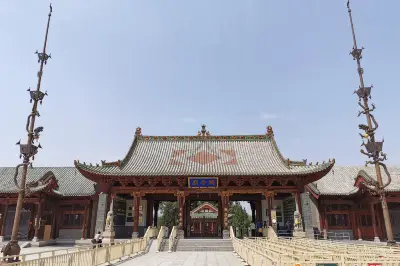
A Second Visit to Shanxi: 2024 Tour of Central and Southern Shanxi – Jinzhong, Yuncheng, Ruicheng, Wanrong, Pingyao
Just ten and a half months later, we set off again for Shanxi.
We had booked a flight at 5:40 pm on July 12, 2024. We had been a little hesitant about changing to an earlier flight, but to our surprise, we were automatically rebooked onto a 3:00 pm plane—what a effortless gain!
Replicating our dining arrangement at Hongqiao Airport from last year's Shanxi trip, we ate at Tsui Wah Restaurant again, ordering the barbecued pork with scrambled egg rice and Hainanese chicken rice—still delicious.
Our first night in Taiyuan, we stayed at the Pullman Taiyuan R&F Hotel again, with a pleasant experience as before.
At 8:10 this morning, we took a taxi to our meeting point, and everything went smoothly. The first stop was Zhenguo Temple.
Zhenguo Temple is one of the few surviving Five Dynasties period temples in China, built in 963 AD during the Later Han of the Five Dynasties. Zhao Kuangyin had already established the Northern Song in 960, so Zhenguo Temple can be considered either a late Five Dynasties temple or an early Northern Song one. Since very few structures from the Five Dynasties remain, experts prefer to classify it as Five Dynasties.
The main hall of Zhenguo Temple resembles Nanchan Temple, with a column-free central space supported by 12 pillars. The central altar is large, and the Buddhas and Bodhisattvas inside have great charm. The statues also show a slight feminine touch, with eyebrow-like painting techniques. The Vajra guardians and warriors are not overly fierce, somewhat akin to Tang dynasty works. As the best-preserved, if not the only surviving, hall and statuary from the Five Dynasties, they are of great historical value.
Shuanglin Temple in the afternoon was a surprise. We knew its painted sculptures were famous and representative of Yuan dynasty work, but the number and exquisite quality far exceeded expectations. Before entering the main hall, at the gate, four guardian Vajras over three meters tall stood outdoors, all with rich facial details and imposing, powerful stances. Some details were remarkable: for instance, every few steps, it felt as if at least one Vajra’s gaze was fixed on you.
Shuanglin Temple also has some exceptionally vibrant painted sculptures, especially the Weituo, hailed as the most artistically valuable and handsomest in the country, often sketched by art school students.
The eighteen arhats in the Arhat Hall were also very interesting. One had such vivid facial expressions that he almost looked like a Mr. Bean character—amusing.
The sheer quantity of painted sculptures at Shuanglin Temple—said to exceed 2,000—was dazzling. So many building and artistic legacies converge here; time seems to condense or compress, leaving a lasting aftertaste.
I won't remember which Bodhisattva is in which hall, but I'll recall the most beautiful and interesting ones, like the small sculpture group where two ghost attendants fight over the Bodhisattva’s holy water, only for a balcony ghost below to snatch it.
It was extremely hot today, around 34–35°C, wilting us by noon. After finishing our visit at 3:30 pm, we drove about two hours to Hongtong County—the very county from the story of Su San's ordeal. Going out for dinner brought two surprises: first, a highly rated restaurant on an app served noodles far below expectations; second, a heavy rainstorm caught us without umbrellas, so we sheltered at a Luckin Coffee and recorded this travel diary.
In the morning, we visited Guangsheng Temple, a national cultural relic protection site. Its glazed pagoda is a masterpiece. The second highlight is the discovery here of a sutra called the Zhaocheng Jinzang, now housed in the National Library of China as one of four treasured collections, alongside the Yongle Encyclopedia and the Complete Library of the Four Treasuries.
The weather remained hot. When we arrived at Guangsheng Temple, even in the morning, the sun beat down. Teacher Wang told us this was a filming location for the 1986 TV series Journey to the West, in the episode 'Sweeping the Pagoda to Clear an Unjust Accusation.'
We took the scenic shuttle to the Upper Temple first, where the Feihong Pagoda stole the show. It is said that half the glazed tiles date from the original construction, with the rest added during later restorations. Feihong Pagoda was less stunning than in photos—perhaps expectations were too high.
Guangsheng Temple is said to date back to the Han dynasty, though it has suffered much from two earthquakes centuries ago. The Zhaocheng Jinzang was found in the Maitreya Hall. The cabinets around the Maitreya statue are said to have once stored the scriptures; they look ordinary, unremarkable.
Beside the Upper Temple, there are also the Lower Temple and the Water God Temple, connected together. We took the shuttle to the Water God Temple, passing a spring. In the mountains of central Shanxi, where rainfall seems scarce, a bubbling spring is a true treasure—fitting for a Water God Temple.
The Yuan dynasty murals in the Water God Temple are a highlight. Though not large, they are vivid and lifelike. One memorable section depicts a theatrical troupe, with roles like sheng, dan, jing, mo, chou, and a child peeking through the curtain—so lively on the wall.
These murals use a predominantly warm, reddish palette, rare in classical art.
The Lower Temple originally had many murals too, but unfortunately they have now ended up in a museum in Canada or the University Museum in Philadelphia. Teacher Wang sent a photo of a mural lost overseas, and its shape matched the empty spaces on the wall.
Interestingly, the abbot of Guangsheng Temple at the time even erected a stele recording the murals' story.
In the afternoon, we went to the Jinguo Museum in Quwo County. Built directly on the tombs of several Jin state rulers, the museum’s entrance features an imposing stone sculpture called 'Soul of Jin.'
The chariot pit in the museum is awe-inspiring, predating the Qin Terracotta Warriors by 600 years.
Other notable relics include a bird-shaped zun (wine vessel). Though excavated locally, the replica here replaces the original, which was severely damaged by tomb robbers—shattered into over a hundred pieces. The restored original is at the Shanxi Museum, not here. Also memorable were bird-shaped bells and the Jin King’s Basin, teeming with tiny lifelike animals.
That night, we stayed in a county-level city called Houma, making sure to soak in the nighttime scene of a northern small town.
The first sight was the Macun Brick Tomb Complex, said to be the tombs of four generations of a doctor surnamed Duan. Of the dozen or so, four are open. Though a national cultural relic site, the brick carvings look relatively new and feel somewhat eerie, not entirely pleasant.
The second site was the ancient Yubi City ruins. It was my first such site visit. During the Eastern Wei and Western Wei period, a great battle took place at Yubi between Gao Huan and Yuwen Tai. The city was built on a plateau with cliffs on three sides and a gentle slope on the fourth. Naturally easy to defend, attackers could only come from the slope. In the battle, the defenders repelled a force ten times their size with just 10,000 troops. Today, the battlefield site is covered in cornfields.
Despite being a national heritage site, it has no walls, only a stele, waiting for later generations to trace its relics. Over 1,400 years later, all we see is a dirt slope and a field of white bones...
At noon we ate at Wanrong Hotel in the county seat of Wanrong. The largest sub-group in our tour group had 13 people, including a young man named Li Ning—a coffee and photography enthusiast, a high-level pour-over brewer who even packed his own drip bags. Having learned from the previous day’s failed hunt for good coffee after lunch, we immediately ordered delivery from Luckin Coffee as soon as we sat down. Even with Yirgacheffe beans, it wasn’t very good.
After lunch, we visited Feiyun Tower, the third stop. Feiyun Tower and the Wooden Pagoda of Yingxian are praised as the 'Southern Tower and Northern Pagoda,' but it pales in comparison to Yingxian’s pagoda.
Feiyun Tower is celebrated for its exquisite craftsmanship—built without a single nail, entirely with mortise and tenon joints. It sits within Dongyue Temple, which also contains some Ming and Qing structures. Some stone carvings were damaged; for instance, in one hall, half of each stone pillar is preserved while the other half is destroyed—reportedly because the intact half was protected by an enclosing wall.
It rained almost all day. Braving the rain, we visited our fourth sight, Jiwang Temple.
As a fifth-batch national protected unit, it is inconspicuous, nestled among residential homes, with no admission fee and few visitors. Its significance lies in being the only discovered ancient building from the Song or Jin dynasty with a wudian (hip) roof.
This alone makes it a pilgrimage site for ancient architecture researchers and enthusiasts. Inside is a large bell, relocated from another Song dynasty temple.
To allow time for Yongle Palace on the final day, we hurried to Ruicheng. Shanxi has an interesting rule: vehicles cannot use the highway when it rains. With still a light drizzle, the driver tried, and luckily we were allowed on. By 5:30 pm we reached Ruicheng and visited our fifth stop, Guangrenwang Temple.
Along with Nanchan Temple and Foguang Temple, Guangrenwang Temple is one of only three extant Tang wooden structures in Shanxi. Although later restorations have obscured much of the Tang flavor—the brackets are no longer robust, the eaves not so grand—its main structural frame is confirmed as Tang. Another commendable aspect is that a well-known real estate company and its designers transformed it into an elegant space blending modernity and antiquity.
While our guide said opinions vary, my wife and I loved this renovation. It’s a great example of ancient architecture preservation in China. Simple yellow walls, white gravel, and tasteful trees enhanced the atmosphere beautifully.
An additional highlight was a timeline on the wall, starting from the Tang dynasty, illustrating Liang Sicheng’s studied ancient buildings all the way to the Temple of Heaven.
There were also physical models explaining the details of dougong (bracket sets) and showcasing outstanding ancient architecture in southern Shanxi. As we left, a young man—perhaps a high school or college student—rushed in with a suitcase by taxi, eager. It was heartening to see more young people interested in ancient architecture and culture.
Checking in that evening proved a bit troublesome. Our first room was very noisy due to a fan opposite the window and a cooling tower on the side. We paid an extra 170 yuan to upgrade to an executive room on the 12th floor, which was quiet and offered a better view. We slept soundly that night.
For dinner, on Teacher Wang’s recommendation, we went to a restaurant next door simply named '熟肉店' (Cooked Meat Shop). We ordered roujiamo, dragon beard noodles, and a vegetable salad. The taste was excellent, good value, and at 42 yuan for two, we couldn’t even finish.
After dinner, we walked to the county’s City God Temple, also a national heritage site, but it was already closed. It would open at 8:00 the next morning, but we had to leave Ruicheng at 8:00, so we just missed this Northern Song relic from the Dazhong Xiangfu era of Emperor Zhenzong—a pity.
On the last day, Yongle Palace was the sole destination.
It poured rain, and we held umbrellas throughout. Yongle Palace’s murals are very famous, so I had high expectations. Unfortunately, the dim light made the 'Chao Yuan Tu' mural hard to see clearly. Compared with the excitement of first seeing Foguang Temple, the impact wasn’t as strong as anticipated.
Beyond its grand scale, the murals’ brilliance lies in many small details: a three-meter-long ribbon, a small drum in the Thunder God’s hand, the fierce eyes and swaying beard of Taiyi Zhenren, and more.
The ancients had a fun practice: when painting a hall, two master painters would lead teams on the left and right sides, separated by a curtain so they couldn’t see each other’s work. Only when finished would the curtain be removed, revealing which side was superior. The Chao Yuan Tu at Yongle Palace confirms this: the figures on the right side are more lifelike, especially in the comparison between the Houtu Goddess and the Queen Mother of the West—the right side clearly has more spirit and finesse.
My wife said Yongle Palace didn’t deliver the same powerful impact as the murals at Yong’an Temple in Hunyuan, as if lacking the same aura. My half-joking theory: Yongle Palace was relocated due to the Sanmenxia Dam, so being off its original site, the aura changed. But even so, the relocation of Yongle Palace, with nearly 100% restoration of murals and halls, earns deep admiration for the skilled craftsmen and artists of 1950s–60s China.
At the Yongle Palace cultural creative shop, I bought a Chao Yuan Tu picture scroll to peruse at leisure. A pity I didn’t buy it before the visit; with the scroll in hand during Teacher Wang’s explanation, I might have absorbed more. (Photography is prohibited inside Yongle Palace.)
Around 2 or 3 pm, we reached downtown Yuncheng and visited Yuncheng Museum, but nothing particularly memorable stood out.
There are two daily flights from Yuncheng to Shanghai, one at 7:30 am, and ours at 9:30 pm. With time to spare but feeling tired, we went to a coffee shop called 'A Cup of Americano' found on an app. The flat white and cinnamon latte were excellent, the shop had a nice ambiance, and the barista was handsome. Unfortunately, they had just run out of pour-over beans, so we didn’t get to try. Yuncheng has good coffee too!
My wife has a friend from Jishan, Shanxi, who, knowing we were visiting southern Shanxi, recommended the Jiangzhou Bronze Hotpot.
Indeed, for 38 yuan, the bronze pot was packed with meatballs, sliced meat, and vegetables, plus a complimentary steamed bun. One pot was more than enough; we ended up paying 50 yuan when leaving.
Yuncheng Airport—originally called Yuncheng Guandi Airport, later renamed, and recently renamed again to Yuncheng Salt Lake Airport—had a delay of over an hour. Our flight changed from 21:25 to 22:20, meaning arrival in Shanghai after midnight. Perfect timing to record this Shanxi travel journal while waiting.
2025, will we see Shanxi again?
Travelogue Contents: 1. Day 1: Zhenguo Temple, Shuanglin Temple; 2. Day 2: Guangsheng Temple and Jinguo Museum; 3. Day 3: Five 'Small' Sights; 4. Day 4: Yongle Palace. Travel Information|Hotel Index|Guide Index|Flight Index|Web Navigation|Travel Index|Cruise Index|Corporate Travel Index|Partnership|Distribution Alliance|Friendship Links|Corporate Gift Card Procurement|Insurance Agency|Hotel Franchise|Destination and Scenic Spot Cooperation|More Partnerships|About Ctrip|About Ctrip|Ctrip Hotspots|Contact Us|Careers|User Agreement|Privacy Policy|Business License|Security Center|Ctrip Content Center|Intellectual Property|Trip.com Group Algorithm Disclosure