Shanxi Travelogue: Longxing Temple in Xinjiang
On the morning of May 30, 2024, after breakfast, we took a taxi to Houma Bus West Station, planning to take Bus 36 to Xinjiang County. While waiting, a woman with a motorized three-wheeler came to solicit passengers, offering to take us to Longxing Temple for 8 yuan per person. A girl happened to agree to share the ride, so we all got on and arrived at Longxing Temple at 9:40 a.m.
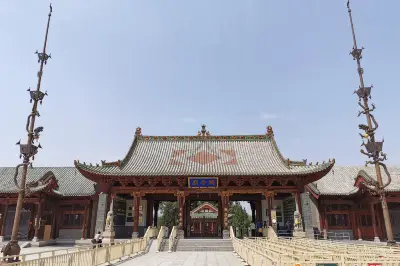
Longxing Temple in Xinjiang is situated on high ground at the north end of Longxing Road, in Sifujie Community, Longxing Town, Xinjiang County. It is a National Key Cultural Relic Protection Unit and a national AA-level tourist attraction. Facing south, it measures 128.6 meters from north to south and 37.4 meters from east to west, covering an area of 4,809.64 square meters. The temple was first built during the Tang Dynasty and was originally called Biluo Temple. Longxing Temple is of great heritage value due to its unique architectural layout, scientific structural design, and the artistic quality of its stelae and statues. In May 2006, it was designated as one of the sixth batch of National Key Cultural Relic Protection Units.
Longxing Temple faces south. In front of the main hall, there are the Guanyu Hall on the left and the Niangniang Hall on the right. On the left side is the main gate, in front of which stand the Weituo Tower and three west wing rooms. Behind the hall rises the thirteen-story Longxing Pagoda. The main hall is five bays wide and three bays deep, with a single-eave overhanging gable roof and bracket sets of five puzuo with double descending cantilevers — a surviving Yuan-dynasty structure. Inside, a Buddhist altar at the rear houses nine painted sculptures of the Buddhas of the Three Times and attendant bodhisattvas. The Longxing Pagoda, located just behind the main hall and facing south, was built in the Tang Dynasty, originally with eight stories. After a collapse in the 49th year of the Qianlong reign (1784), it was rebuilt, clad in grey bricks, and raised to 13 stories, reaching a height of 42.4 meters. It has an octagonal plan, each side measuring 4.3 meters, and is a pavilion-style brick pagoda. The temple also preserves three stone stelae recording renovations in the 47th year of the Kangxi reign (1708) and during the Republican period, as well as one sutra pillar. The temple is laid out on a central axis, with structures from south to north: the mountain gate, 108 steps, the Biluo Stele, the Mahavira Hall, east and west side halls, the Longxing Pagoda, and Song-Jin ancient tombs. The highlights are the Biluo Stele, the Song-Jin painted clay sculptures in the Mahavira Hall, and the mysterious pagoda that repeatedly emits smoke. Inside the Mahavira Hall are seven Yuan-dynasty painted sculptures. The Biluo Stele is a national first-class cultural relic and a calligraphic treasure. Below the steps southeast of the pagoda, two Song-Jin brick-chamber tombs were relocated here in 1995.
The Longxing Pagoda is the landmark of Jiangzhou, located within Longxing Temple in Xinjiang. According to records, the pagoda was built during the Zhenguan reign of the Tang Dynasty, originally with eight stories. In the 42nd year of the Qianlong reign (1777), the outer structure had deteriorated and during renovation it was clad in bricks and raised to 13 stories, with an octagonal shape and a total height of 43.7 meters. As the unique symbol of the ancient city, it is also called the 'Jiangzhou Pagoda.' The pagoda's fame largely stems from the baffling phenomenon of smoke rising from its top. According to the Xinjiang County annals, the Longxing Pagoda emitted smoke six times: in the first year of the Guangxu reign, 1937, 1971, 1976, and 1993. A 1941 stele recording the renovation of Longxing Temple notes that in the first year of Guangxu (1875), 'smoke rose from the pagoda top, a blue cloud straight up, an omen of success in imperial examinations.' On the Mid-Autumn Festival in 1971, every day toward dusk, wisps of blue smoke rose from the top of the pagoda and swirled around it for about half an hour before vanishing. The smoke could be clearly seen from 300 to 400 meters away, and this repeated for over ten days, drawing crowds of no less than a thousand each day. According to the Xinjiang County Museum, from August 21 to 28, 1993, for eight consecutive days the pagoda emitted smoke again at dusk, each time lasting a different duration. The cause remains unexplained.
The mysterious phenomenon draws a constant stream of visitors, but actually seeing it is extremely rare, and we were not so fortunate. At 11 a.m. we finished our visit to Longxing Temple and walked the short distance to the Xinjiang Confucian Temple. The Xinjiang Confucian Temple is on Sifu Street in Xinjiang County and is a key cultural relic protection unit of Shanxi Province. It covers an area of 10,670 square meters. Its founding date is unknown. Based on a stele inside the temple— a Song-dynasty collection of inscriptions from Wang Xizhi, the Right General of the Jin dynasty, recording the renovation of the Temple of the Master— it is inferred that the temple was built no later than the Song Dynasty, with subsequent additions during the Yuan, Ming, and Qing dynasties, forming a distinctive ancient architectural complex. Anyway, Confucian temples everywhere are much the same, all places to honor and revere Confucius. In half an hour we completed our visit, then headed west. There awaited the Christian church, the Sui Dynasty Garden, the Jiangzhou Prefectural Office, and other attractions.