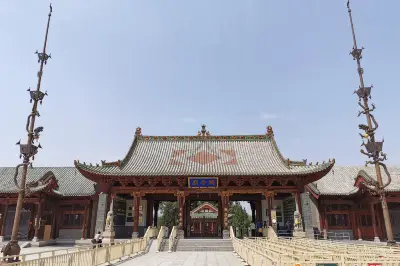
The Thousand-Year-Old Baitai Temple
Xinjiang, known as Jiangzhou in ancient times, is the only National Historical and Cultural City in Southern Shanxi.
Twenty kilometers northwest of Xinjiang county, just over 200 meters southwest of Guangma Village in the Quanzhang Old Town, lies a thousand-year-old Buddhist temple — Baitai Temple.
Baitai Temple, also known as Puhua Temple, got its name from the white lotus pedestal of Sakyamuni Buddha. It was once called Tianning Chan Temple as well, and is a Major Historical and Cultural Site Protected at the National Level.
Baitai Temple is one of the oldest monasteries in Southern Shanxi. According to records in the Qianlong-era "Zhili Jiangzhou Gazetteer," the Wanli-era "Jiangzhou Gazetteer," and temple steles, Baitai Temple was first built in the fourth year of Kaiyuan (716 AD) of the Tang Dynasty, and renovated in the fourteenth year of Kaiyuan (726 AD). Later, it underwent restorations during the Dading and Mingchang periods of the Jin Dynasty, the fifteenth year of Zhizheng (1355) of the Yuan Dynasty, and the sixth year of Zhengde (1511) of the Ming Dynasty. It covers an area of 4,492 square meters.
The temple stands tall on a high platform in the Mabi Gorge stream bank, shaped by rainwater. All around it stretch flat fertile fields, offering a serene and comfortable setting. About three to four kilometers directly south is the Yubi Autumn Wind, one of the eight famous scenic spots of ancient Jiangzhou.
In the past, reeds swayed, creeks babbled, and waterfowls sang here. West of the temple is the Neolithic Guangma Site. The surroundings of the temple are quiet and peaceful, making it a perfect place for rest and reflection.
Today, although the streams, reed marshes, and fragrant rice paddies of old are gone, the wheat fields all around ripple with green waves and billows. The majestic Baitai Temple is like a giant Noah's Ark, floating on the sea of ages.
For a millennium, Baitai Temple has been a flourishing place of worship, drawing monks and pilgrims in droves. According to the extant "Monastery Regulations" stele, at its peak the temple housed up to a thousand monks, both literary and martial, wielding considerable influence in the surrounding counties and prefectures.
Today, according to Master Yiji, the current abbot of the Jade Buddha Courtyard at Baitai Temple in Xinjiang and also abbot of Pan Mountain Xianhua Temple in Tianzhen County, the temple's architectural layout remains largely intact. Along the central axis from south to north, the main extant structures include the Three-Drip Scripture Pavilion, the Mountain Gate Tower, the Eastern Side Hall, the Sakyamuni Hall, and the Western Wing Room of the Rear Hall.
Entering the temple gate, a broad plaza unfolds. Facing you is the magnificent three-tiered Three-Drip Scripture Pavilion and the two-story Mountain Gate Tower, flanked by tall brick courtyard walls and winding forest paths heading north, giving the ancient temple a sense of secluded depth.
Stepping up the stone ramp through the 'cave gate' of the Mountain Gate Tower, your feet tread upon stone paths polished smooth by monks, pilgrims, and time over centuries. Inside the gate stands a large, smiling Maitreya Buddha — cheerful, affable, and welcoming.
This 'cave gate' of the mountain gate was originally built during the Hongzhi period of the Ming Dynasty, over 530 years ago. The screen wall behind Maitreya Buddha dates from the 24th year of Qianlong's reign in the Qing Dynasty.
The Scripture Pavilion was first built during the Jin Dynasty (1115–1234) and repaired in the Yuan Dynasty. It was constructed against the earthen cliff, with three-tiered dripping eaves, three bays wide, two stories high, featuring a suspended hill roof with railings and a flat balcony. Its structure is magnificent and ingenious; from afar, it presents a 'three-drip' roof style. When it rains, water drips from each eave tier by tier, a truly spectacular sight.
Enshrined in the upper level of the Scripture Pavilion are Ksitigarbha (Dizang) and Avalokitesvara (Guanyin) Bodhisattvas, as well as the 'Three Saints of the East' — the Medicine Buddha (Yaoshi Rulai) in the center, flanked by Suryaprabha (Sunlight) and Candraprabha (Moonlight) Bodhisattvas, all Yuan Dynasty clay sculptures. The lower level originally housed a statue of Guanyin with attendants.
According to the stele 'Biography of Master Jinxing of Tianning Wanshou Chan Temple in Jiangzhou,' during the Tianjuan era of the Jin and Yuan dynasties, the temple's abbot, Master Ning Jinxing — a native of Xiaoning Village in Jishan and the Deputy Buddhist Chief of Jiangzhou — oversaw the construction of the Three-Drip Scripture Pavilion, as well as the Guangjiao Temple and its pagoda in Jishan. Master Ning lived to the age of 75 secularly and spent 50 years as a monk.
The Scripture Pavilion connects to the Eastern Side Hall, which enshrines Ksitigarbha Bodhisattva flanked by attendant monks Daoming and Min Gong, with the Ten Kings of Hell on either side. Behind, there is a statue of the Southern Sea Guanyin, sculpted in the sixth year of Zhengde (1511) during the Ming Dynasty.
The Southern Sea Guanyin sits with downcast eyes, a kind expression, poised on a lotus pedestal. Behind her, waves surge, rocky peaks jut out, and auspicious clouds swirl.
The Sakyamuni Hall was rebuilt during the Mingchang period of the Jin Dynasty. It has three bays across, six rafters deep, a single-eave hipped-gable roof, and brick-carved ridge ornaments. Inside, Sakyamuni Buddha sits at the center, flanked by his disciples Ananda and Kasyapa, along with Manjusri and Samantabhadra as attendant bodhisattvas. On each side are three arhats with vivid expressions, plump bodies, lifelike appearances, and distinct personalities. Though reassembled several times, they still retain their Jin Dynasty style.
Behind them stands a standing statue of Skanda (Weituo), the Dharma protector, clad in golden armor with a war robe over it, his hands joined and resting on a vajra pestle, gazing forward with a serene expression. This suggests that Baitai Temple was once a monastery of medium to large scale.
Farther back is the Amitabha Hall, also known as the Rear Hall. It was rebuilt in the fifteenth year of Zhizheng during the Yuan Dynasty (1355). The hall has five bays across, four rafters deep, a single-eave suspended hill roof, and simple bracket sets. It houses the 'Three Saints of the West' — Amitabha Buddha in the center, flanked by Avalokitesvara (Guanyin) and Mahasthamaprapta Bodhisattvas. The two bodhisattvas, with dignified faces, belted robes, and long skirts, stand tall and natural — all are Yuan Dynasty clay sculptures.
In front of the hall is a large moon platform with stone edge slabs. Three octagonal sutra pillars from the Song Dynasty once stood here, but now only their bases remain visible. The Tang Dynasty stupa for relics has vanished, which is a great pity.
On the east and west sides of the platform stand two ancient Tang locust trees, each over a thousand years old and too thick for one person to hug. Though aged and withered, their branches and leaves are still lush and green, full of vitality.
On the 19th day of the sixth lunar month in 1993, under a clear and sunny sky, hundreds of wasps suddenly appeared from nowhere. They set to work inside a hollow of the withered tree trunk on the west side, and using white beeswax, 'crafted' a 22-centimeter-high, 8-centimeter-base-wide white wax 'Guanyin Bodhisattva statue,' vivid and white as jade. It was reported in the Shanxi Daily on October 2, 1993, and some local TV stations also interviewed and captured video footage.
Baitai Temple originally housed nine steles from the Tang, Song, Yuan, and Ming dynasties. There was a Tang Dynasty (518–907 AD) statue column, two six-sided Northern Song Dynasty Dharani sutra pillars, a Song Dynasty iron cloud plaque from the third year of Xuanhe (1121), a Ming Dynasty iron bell, an incense burner, and other artifacts — all of high appreciation and artistic value.
About 200 meters north of Baitai Temple lies the Jade Buddha Courtyard. Its main hall, the 'Jade Buddha Hall,' was begun in 1996 and completed in 1998, primarily enshrining a reclining Sakyamuni Buddha made of jade.
According to records, the reclining jade Buddha was donated in 1997 by Madam Fu Fengying, an American Chinese and the aunt of the famous anti-Japanese general Fu Zuoyi. She was 106 years old when she offered the jade Buddha.
Walking into the Jade Buddha Hall, you see the jade Buddha clad in a yellow robe, lying on a lotus pedestal in the main hall — peaceful and serene. This Sakyamuni jade Buddha measures 7.3 meters in length, 2.63 meters in height, and 1.54 meters in width, weighing 15.3 tons. The body is gilded, exceptionally lifelike. It is the largest jade Buddha in China, a rare treasure in the world.
Notably, since 1999, several faint red lines have appeared on the jade Buddha’s chest, chin, arms, and other parts, resembling the 'blood vessel-like meridians' on a human body, a wonder that amazes visitors.
In front of the Jade Buddha Hall stands a Guanyin statue 5.63 meters tall, weighing 17.7 tons. The graceful jade Guanyin 'rides' a golden dragon, holding a pure vase and a willow branch, draped in a red robe — vivid, tall, and benevolent.
South of the Southern Sea Guanyin is a Maitreya Buddha draped in a yellow robe. At the high platform entrance of the Jade Buddha Courtyard, there is also a tall standing statue of Ksitigarbha Bodhisattva holding a monk's staff — very imposing.
According to local legend, Baitai Temple and the Jade Buddha Courtyard were once connected. Baitai Temple was a large ancient monastery, perhaps separated at some point due to historical changes. As time passed, the northern monastery fell into disrepair, leaving only the surviving Baitai Temple.
With the attention of higher cultural and tourism authorities and the Xinjiang County Party Committee and government, the enshrinement of the giant Sakyamuni jade Buddha in the Jade Buddha Hall has brought new luster to this millennium-old Baitai Temple in the new era.