Revisiting Shanxi (1)
Last Spring Festival I went to Huai’an, but the rain never let up and left me utterly uninspired. It brought back memories of the summer before last in Shanxi – a trip that was truly rewarding, yet still left a few regrets. Then in 2024, the Black Myth: Wukong game took the internet by storm, and those classic ancient buildings captivated the whole country. If we didn’t fill in those gaps soon, we figured we’d end up staring at crowds instead of scenery. So this year, we decided to revisit Shanxi.
Our first stop was still flying into Yuncheng. Stepping off the plane, a gust of cold wind hit us in the face. Under a grey, murky sky, you could barely make out anything more than a hundred metres away. We’d originally planned to head straight to the Yongle Palace in Ruicheng after landing, but with visibility like this, we’d never be able to see the murals inside the halls. Our driver, Xiao Liu, suggested tweaking the itinerary and bringing forward the next day’s skiing. Alright, fine. But in the end, we didn’t ski – every slope we checked was packed with people, and since our interest was only mild, we scrapped the idea.
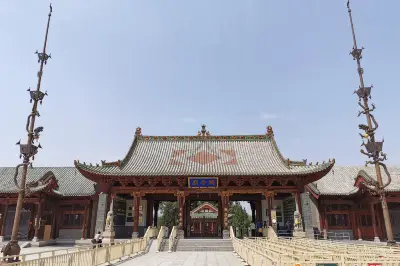
With skiing off the table, we decided to wander around the city instead, picking Guanwang Temple and Chishen Temple.
Guanwang Temple honours Guan Gong; little shrines like this are scattered all over the Yuncheng area. But this one, unassuming as it is, dates back to the Yuan Dynasty. If it were back home, people would rave about it – yet here, hardly anyone bothers to visit.
Across the road from Guanwang Temple, a church caught my eye – Eastern and Western civilisations facing off over a busy street. The murals inside the church were exquisite, though I couldn’t make sense of what they depicted. For me, I only recognised Jesus nailed to the cross. Maybe I just don’t know enough about it.
After sightseeing, the three of us shared a big plate of dapanji. Having tried it on our last Shanxi trip, we were wiser this time: we ordered only a medium portion (and still couldn’t finish it) and asked for no chilli. The dish uses only chicken legs—first stir-fried, then pressure-cooked until incredibly tender, paired with potatoes and Sichuan pepper, all served over hand-pulled noodles. The flavour is genuinely excellent and filling. A sip of the noodle broth and a bite of raw onion instantly cut through any greasiness.
Full and content, we headed to Chishen Temple in the afternoon. Right in front of it sprawls the vast salt lake. Salt was a strategic resource in ancient times (and still is), a monopoly managed by the state with dedicated institutions across dynasties. Maybe it was the overcast sky and the cold, but we rushed through the site and went back to the hotel to catch up on sleep.