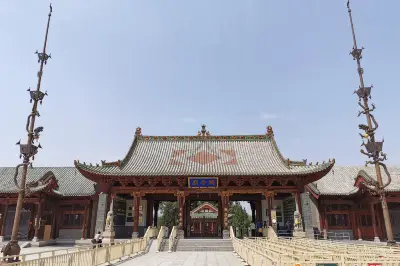
Revisiting Shanxi (2)
In 2003, on my first visit to Yuncheng, I had wanted to admire the 'Chaoyuan Tu' mural at Yongle Palace, but unfortunately heavy rain closed the expressway and I couldn't make it. This time, I finally got my wish.
The next morning (the fifth day of the Lunar New Year), the sky was still overcast. The car drove along Yanhu Avenue, then onto the expressway. The snow on the Zhongtiao Mountains had not yet melted, leaving the world in just black and white. Ink-wash landscapes unfolded before my eyes, evoking an indescribable Chinese painting mood. The car moved through the painting, the painting enveloped the car. As we advanced, the scenery shifted, as if watching a freehand Chinese-style animation!
Speaking of Yongle Palace, there's a little-known story behind it. After the founding of New China, to develop electric power, it was decided to build the Sanmenxia Reservoir. According to calculations by Soviet experts, once the reservoir was completed, Yongle Palace would be entirely submerged within the reservoir area. Premier Zhou Enlai personally instructed: 'Yongle Palace must be protected!' Thus, an unprecedented relocation of cultural relics began in 1956, with the actual move starting in 1957. It took a full ten years to complete. Ironically, the Sanmenxia Reservoir began storing water in 1961, but the original site of Yongle Town was never actually affected. Halfway through the relocation project, it was still decided to finish it. Some say the Soviet experts' calculations were wrong, while others cite additional reasons—the versions vary. Also slated for relocation at the same time was the millennium-old Tongguan, which had withstood countless wars over a thousand years (including the War of Resistance against Japan) and remained standing, only to be wiped out by this project.
Yongle Palace consists of three main halls: Wuji Hall, Chunyang Hall, and Chongyang Hall. The largest is Wuji Hall. The mural inside, 'Chaoyuan Tu,' is rightly hailed as the pinnacle of ancient Chinese painting. (The following text is sourced from the internet.)
'Chaoyuan Tu' is not only a vital part of China's cultural heritage but also embodies the wisdom and creativity of the Chinese nation. Through vivid figures and delicate brushwork, it showcases the exquisite skill and profound heritage of Yuan Dynasty mural art. Each figure in the painting has unique features—from the intricate hairdos to the fine beards, every detail is rendered lifelike and awe-inspiring. 'Chaoyuan Tu' has had a profound influence on the development of later painting. Its distinctive artistic style and superb technique provide invaluable physical resources for studying ancient Chinese religion, culture, and art. The figures and costume details reflect the lifestyle and aesthetic trends of Yuan society, holding significant historical and cultural value.
The photos above are from the reproduction room. Photography is not allowed inside the main hall. During our visit, sunlight happened to stream in through the window lattices, momentarily brightening the dim hall. The murals on the walls became much clearer. The host of celestial beings seemed to part the clouds and appear around us, robes billowing, each with different expressions—solemn or quietly conversing. Some held colorful coral, others cradled eight-petaled lotus flowers, bejeweled and radiant, exuding an air of grace and opulence. Listening closely, one could almost hear ethereal music drifting in and out of hearing. The visitors in the hall held their breath, absorbed in admiration. Even the guide spoke in a hushed tone, perhaps afraid of disturbing the heavenly immortals at that moment! It was then I understood why Driver Xiao Liu had said the day before that an overcast sky wouldn't give a good viewing experience.