Revisiting Shanxi (6)
Leaving Xia County, we headed north. The altitude steadily rose, but we saw few mountains. On both sides stretched vast fields where crops had been harvested; in the shaded areas there was still plenty of leftover snow. Windmills stood here and there in the middle of the fields. Watching them turn proved we were definitely at a high elevation. In my home village, we call fields farmed on mountain slopes 'sky-dependent fields' — meaning they rely solely on rain for irrigation, and harvests depend on the heavens. Who would be so foolish as to carve fields out of mountaintops?
Our driver, Mr. Fan, told us that back in the 1950s and 60s, it was their parents' generation who, with just hoes, slowly leveled the hilltops to create the fields we see now. His words reminded me of a slogan from those years: 'In industry, learn from Daqing; in agriculture, learn from Dazhai.' Dazhai is in Xiyang County, Shanxi, less than 300 kilometers from here.
(Later I looked up some information online.) The village of Dazhai in Xiyang County, Shanxi, under the leadership of Party branch secretary Chen Yonggui, had been undertaking massive farmland infrastructure projects since 1953. By leveling hills, filling ravines, diverting rivers and building embankments, they created man-made plains, expanding arable land and increasing grain yields, which was widely publicized within Shanxi. Then, in the disaster year of 1963, they launched the 'Three No's and Three Not Lesses' campaign, reported by the Shanxi Provincial Party Committee and drawing attention from the central leadership. With the approval and direction of Mao Zedong and Zhou Enlai, a call was issued for the whole nation's agriculture to learn from Dazhai, and the movement quickly spread across the country. Chen Yonggui became a prominent figure of the time, joining the Politburo and serving as Vice Premier of the State Council. After the Cultural Revolution, various irrational practices and extreme leftist trends within the 'Learn from Dazhai in agriculture' campaign were singled out for criticism as having violated natural and economic laws, believed to have caused major production losses and damaged the ecological environment. On November 23, 1980, the Central Committee forwarded Shanxi Province's self-criticism and the central leadership's instructions (Central Document No. 83, 1980). Chen Yonggui had been forced to resign the previous September, and the Dazhai movement came to an end.
Sighing at the ebb and flow of history's tides, I wonder: where are all those once-powerful figures now? I can't help but recall those lines: 'The mighty Yangtze flows eastward, its waves wash away heroes. Right and wrong, success and failure, all turn to emptiness in a blink. The green hills remain as ever, catching the glow of many a sunset.'
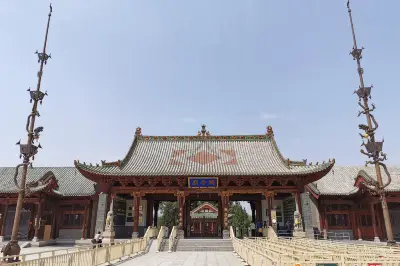
The Jiyi Temple is located in a small village within Yangwang Town. It was the sixth day of the lunar new year, and the stage in front of the temple was draped in golden cloth, with the wall adorned with paper-cuttings of the character '福' (fortune). The festive atmosphere was thick! The small temple looked rather ordinary from the outside, but inside it held a delightful surprise!
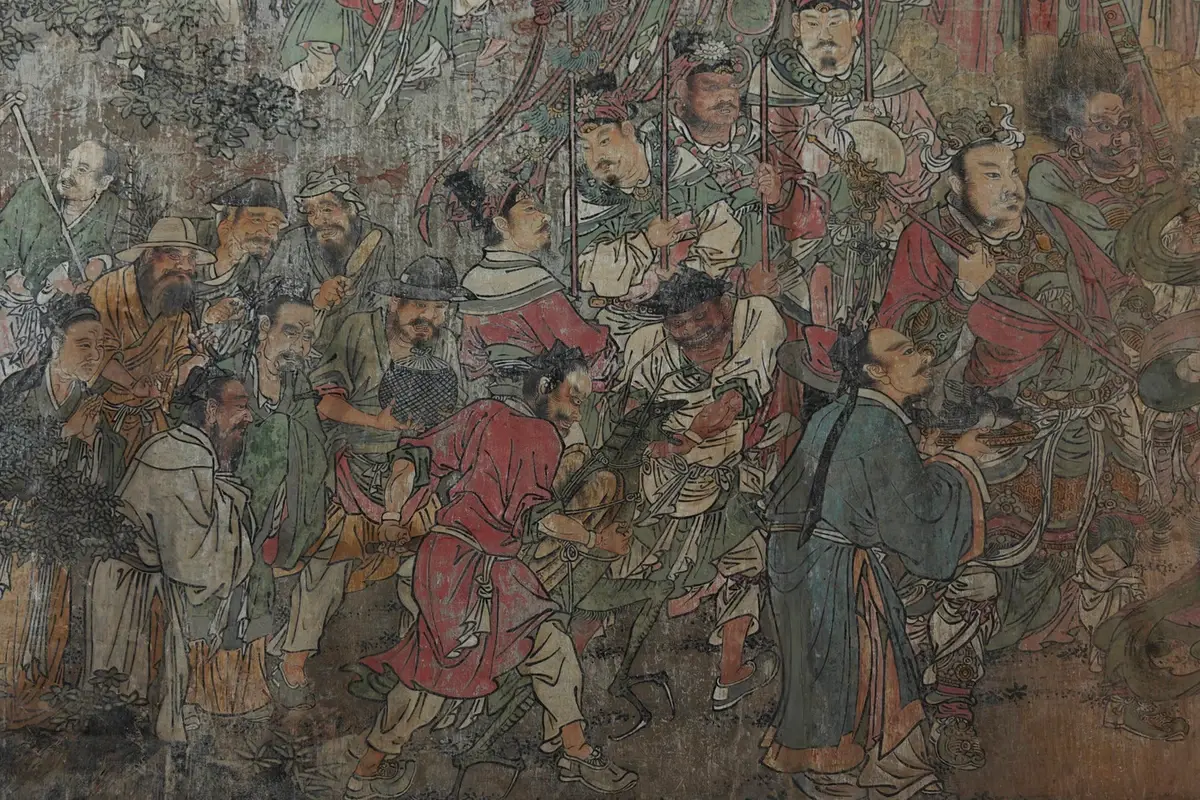
I had done my homework before coming; there's a famous mural here depicting a locust hunt, and that was what I especially wanted to see. The east and west walls of Jiyi Temple are covered with murals. The renowned locust-hunt scene is on the east wall: a brawny farmer in red clings fiercely to a locust spirit as tall as a man, his eyes glaring. The locust spirit, its two claws pushing hard against the ground, jaws open, strains to break free. Beside them, a farmer in white pulls the rope tightening around the locust spirit with all his might. Behind them, a man in a round hat, holding a bamboo cage, watches their struggle nervously, afraid the locust spirit might escape. Several elders stand by, including an old woman pressing her palms together and murmuring prayers, imploring the two farmers to subdue the locust spirit.
In Xinjiang, Wanrong, and Jishan, you often see temples dedicated to 'Ji'. Who is this Ji? Ji is what we commonly call millet. The figure associated with Ji is Hou Ji, whose personal name was Qi, of the Ji clan, born in Jishan, and the ancestor of the Zhou dynasty. Legend has it that Qi was skilled in planting all kinds of grain crops. During the time of Emperor Shun, the people suffered from grain shortages. The emperor ordered Qi to sow a hundred grains. Qi taught the people to farm and is regarded as the first to cultivate millet and wheat. He was given the title Hou Ji and the surname Ji. Hou Ji is the ancestor of the Ji clan, the Zhou people, and the Zhou dynasty, also called Zhou Qi. The Zhou people revered Hou Ji as their ancestral spirit and the God of Millet, worshipping him with suburban rituals. Later generations called Hou Ji the Lord of Agriculture and Millet, King Ji, the Millet God, or the God of Farming and Millet.
Beyond the exquisite murals, the suspended sculptures on the beams of Jiyi Temple are another major highlight. Two gleaming gold five-clawed golden dragons flank the sides; in the middle, several small dragons cavort up and down; the beams also bear gorgeous painted figures, truly breathtaking!
Before leaving Jiyi Temple, a few elderly locals sunning themselves heard we were from Guangdong and chatted with us a bit, suggesting we visit the King Ji Temple in Beichi. Following the 'since we're here, might as well see it' mindset, we drove to Beichi. Upon arrival, we called the site's preservation officer. Entering the temple, we were a bit disappointed — it had just been restored and there was little to see inside. The only things worth viewing were the opera stage opposite the main hall and the wood carvings in the west side hall; the carvings, in particular, were exquisitely beautiful!