Roaming Southwest Shanxi
On June 19, I departed from Shanghai Station on train Z196.
On June 20, I arrived smoothly at Taiyuan Station. The car rental company picked me up at the station, and after completing the formalities, I drove off. First stop: Xiaoxitian in Xixian. Perched on Phoenix Hill in the western outskirts, Xiaoxitian has surged in popularity thanks to the video game Black Myth: Wukong, with a 542% increase in visitors in 2025. Though there are no grand structures, it hides artistic treasures. Climbing the 81 steps (symbolizing the 81 trials of Tang Sanzang and his disciples on their westward journey to obtain scriptures) leads into the temple. Particularly, in the Great Hero Hall's 169-square-meter space, 1,915 hanging sculpted Ming Dynasty Buddha statues are packed, some as small as a fingernail, with vivid colors and varied expressions, leaving visitors in awe.
Second stop: Dongyue Temple in Puxian. Located atop Baishan Hill east of town, the temple is dedicated to Dongyue Dadi (the Great Emperor of the Eastern Peak) Huang Feihu, who in the Daoist system presides over the cycle of life and death and the judgment of the underworld. The layout is based on legends of the netherworld, using images of judges and ghostly guards and mechanisms of karmic retribution to caution people. Especially the Eighteen Hells, which are eerie and frightening, not suitable for children. The Changyang Palace, on the other hand, enshrines three goddesses in charge of childbirth, where people pray for abundant offspring.
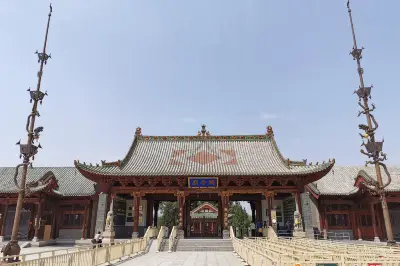
Linfen, named for its location on the banks of the Fen River, is one of the cradles of Chinese civilization. The Fen River runs north-south through Shanxi and is known as the 'Mother River of Sanjin.' The Fen River basin is also the birthplace of Chinese agricultural civilization. Emperor Yao established his capital at Pingyang (modern-day Linfen) and divided the land into nine regions. I arrived in Linfen city proper near evening and first went to pay respects at Yao Temple. The temple was originally built during the Western Jin Dynasty and moved to its current site in the Tang Dynasty. As a national sacrificial site, emperors of successive dynasties visited it personally. The main buildings include the Mountain Gate, Wufeng Tower, Yaojing Pavilion, Guangyun Hall, and the sleeping chambers. Nearby, there's also Huamen, proclaimed as the 'First Gate under Heaven.'
June 21: Shanxi has a wealth of ancient buildings, temples, and monasteries—almost every county has nationally protected cultural relics. Dongyue Temple in Jiedian Town, Wanrong County, has an uncertain founding date but existed by the Tang Zhenguan period, was rebuilt in the Yuan Dynasty, and repaired many times during the Ming and Qing; the current structures preserve elements from all three periods. Facing south, the central axis includes the Mountain Gate, Feiyun Tower, Wumen Gate, Xian Hall, Incense Pavilion, the Main Hall (Dongyue Dadi Hall), and Yama Hall. The centerpiece, Feiyun Tower, is hailed as the 'First Tower of China,' with a history of 1,400 years, and together with the Yingxian Wooden Pagoda forms the duo 'Southern Tower, Northern Pagoda.' The tower is 23.19 meters high, appears to have three floors but actually has five. Not a single nail is used in its entire structure; it's all mortise-and-tenon joinery. Four colossal pillars rise straight to the roof, with 345 bracket sets, four-tier eaves, and 32 roof corners with both large and small upturned eaves, creating a sense of being surrounded by clouds and blooming flowers.
The Yellow River Great Ladder Cliff lies by the Yellow River in Hejin City, with Shimen to the north, Longmen to the south, the Yellow River to the west, and the Lüliang Mountains to the east. The centerpiece, the Ladder Cliff, dates back to the Northern Wei period. A zigzag plank road was manually carved into the cliff face—365 steps, a vertical drop of 100 meters, and a gradient of about 80 degrees. The terrain is precipitous yet ingeniously crafted, serving both military defense and transportation. Now developed for tourism, facilities such as an elevator and a glass walkway have been added. Looking north to Shimen, the Yellow River flows between hundred-meter vertical cliff walls, seemingly hewn by axes, with the narrowest point only 38 meters wide. The downstream Longmen scenic area features the Yuwang Temple, a monument to anti-Japanese war martyrs, and the spectacular sight of five bridges—road and rail—spanning the river together. Nearby, there are also Peach Blossom Valley and Yiti City to explore.
The Yellow River No. 1 Tourist Highway starts at Laoniu Village, Pianguan, Xinzhou in the north and ends at the border between Yuncheng and Jincheng. Driving south along it, I turned off at Miaoqian Village, Ronghe Town, Wanrong County. Houtu Temple stands right by the Yellow River and the Fen River, nestled between mountains and water on open ground. It is the oldest extant temple dedicated to Nuwa. The core building, Qiufeng Tower, takes its name from the stone tablet inscribed with Emperor Wu of Han's 'Ode to the Autumn Wind' kept there. The tower is a three-storey brick-and-wood structure 32.6 meters high, with tall staircases at the base that pass through east-west—historically known as Zhang Yi's Route. This originated with the Warring States strategist Zhang Yi, who took this route from his hometown (present-day Zhangyi Village, Wanrong County) to the state of Qin. Wang Zhaojun passed through here on her journey to marry beyond the frontier, and the Eighth Route Army marched eastward along this path to fight the Japanese. Houtu Shrine has been an imperial sacrificial site for a millennium; since Emperor Wu of Han, nine emperors performed ceremonies here 24 times. Apart from the complete sacrificial space from the Mountain Gate, Xian Hall, to the Main Hall, there is also the Pinzi-shaped opera stage and the east and west Five Tigers side halls (the east enshrines the Five Sacred Mountain Emperors, the west the Five Tiger Generals of Shu Han).
Continuing south along the tourist road, I reached Xixiang Village in Puzhou Town. Here, Pujiu Temple, first built in the Sui and Tang dynasties as Xiyongqing Temple and renamed Pujiu in the Five Dynasties, became a symbol of love thanks to Wang Shifu's Yuan Dynasty play The Story of the Western Wing. The temple's only historical relic is the nearly 600-year-old stupa, called 'Yingying Pagoda'. All other buildings are recent reconstructions based on the plot of The Story of the Western Wing. Pujiu Temple has thus turned into a sanctuary for seeking love and marriage, imbued with romance. East of the Great Hero Hall, the Lihua Courtyard has the main room serving as the Old Lady's bedroom and Buddhist shrine, the west wing as the boudoir of Cui Yingying and her maid Hongniang, and the east wing occupied by Yingying's brother. Outside the courtyard wall, there is the apricot tree over which Scholar Zhang jumped for their rendezvous.
Three kilometers west, by the ancient Yellow River course, stand four large iron oxen from the 13th year of the Tang Kaiyuan era, originally cast to stabilize the pontoon bridge at Pujin Ferry and maintain transportation between Qin and Jin. The bridge was destroyed in the Yuan Dynasty, fell out of use, and after the Yellow River changed course, they were gradually buried in silt.
A hundred meters further west is Guanque Tower. Thanks to Wang Zhihuan's immortal poem 'On the Stork Tower,' it is one of China's Four Great Towers. First built in the Northern Zhou, destroyed in the early Yuan, and reconstructed in 1997, it appears three-storeyed from outside but has six levels inside. An elevator takes you straight to the top, where you can gaze far at the Yellow River's surging waves and the majesty of the Zhongtiao Mountains, while close up, vast fertile fields stretch as wheat rolls like waves.
June 22: Setting out from Yongji City southward, I crossed Fenglingdu Bridge to Tongguan, Shaanxi. Tongguan stands where the Yellow River is to the north and the Qinling Mountains to the south, at the junction of Shaanxi, Shanxi, and Henan—a strategic point always contested. Today, most structures are imitations of ancient styles, leaving only history and topography to contemplate. The best view is from the pass tower, overlooking the confluence of the Wei, Fen, and Yellow Rivers, with the Longhai Railway and Lianhuo Expressway bustling with traffic. Shuipoxiang, an old alley in Tongguan, still preserves northern Ming-Qing-style residences, now inhabited only by the elderly.
I crossed Fenglingdu Bridge back to Ruicheng County in Shanxi. In the north of the town, Yongle Palace, built in 1247 to honor the Eight Immortals' Lü Dongbin, has all buildings from the Yuan Dynasty except the Mountain Gate. Besides the distinctive Yuan Dynasty architecture, the murals inside the four main halls are extraordinarily exquisite. Especially, the 'Chaoyuan Tu' in the Sanqing Hall is a masterpiece of ancient painting—highly skilled, large in scale, and well-preserved. To protect the murals, doors and windows are curtained, visitors wear shoe covers, and photography and flashlights are strictly prohibited.
Passing the Lingbao Yellow River Bridge and switching to the Lianhuo Expressway, I got off at Lingbao City. Hangu Pass got its name because the pass lies in a gorge, deep and perilous like a case. It was first built in the Western Zhou and was an important pass for Qin to defend against eastern states during the Warring States period. In the Spring and Autumn period, Laozi passed through here and wrote the Tao Te Ching. Now, there are sites like the Taiwei Sacred Palace and Zhanzi Tower, honored as the 'Source of Daoism.' Crossing the suspension bridge before the pass, you can visit the ancient Hangu road, where thoughts of ancient battles stir the imagination.
About a 40-minute drive east, I arrived at Shanzhou District, Sanmenxia City, to see the Dikengyuan (sunken courtyard). Across different regions, folk dwellings have their own features; the Dikengyuan of Shanzhou presents a curious sight: 'Entering the village, you see no houses; hearing voices, you see no people.' These are cave dwellings dug into the ground according to the terrain and soil conditions. They are warm in winter and cool in summer, and come complete with storage rooms and wells. Now developed for tourism, the villagers have relocated. Inside, there are exhibits on local customs, Shanzhou drum storytelling, and sales of local specialties.
Taking the Sanmenxia Yellow River Bridge and then the Houping Expressway through the Zhongtiao Mountains, I reached Yuncheng. On the way, I passed Yuncheng's Seven-Color Salt Lake, an open scenic spot accessible directly by car. It has various amusement and dining facilities, popular with locals. Coinciding with the weekend, it was crowded with families, so I just circled around and left.
June 23: Guan Yu was from Changping Village, Haizhou Town, Yuncheng. Today, the Haizhou Guandi Temple forms the core of the Guan Gong Hometown Cultural Tourism Area. Aiming for a 5A rating, a huge new parking lot has been built, with shuttle electric carts to the temple. The temple was rebuilt in the Qing Dynasty, covering 220,000 square meters, and is the largest and highest-ranking ancestral Guandi temple. Entering the area, you see the Oath of Brotherhood Pavilion, Gentlemen's Pavilion, and a screen wall (behind it, a large stone reputed to match Guan Yu's height). After passing through a memorial arch, you enter the temple, with the central axis featuring Duan Gate, Wumen Gate, Imperial Book Tower, Chongning Hall, and Spring and Autumn Tower. Flanking it are wooden and stone arches, stele pavilions, bell pavilions, and long corridors. Chongning Hall is the main hall, with 26 dragon-carved stone pillars and a solemn statue of Guan Gong. Emperor Kangxi, Xianfeng, and Qianlong all left imperial inscriptions. Exiting through Houzai Gate leads to the Imperial Garden, a newly built park.
From Haizhou, I took the Houping Expressway, then switched to the Jingkun Expressway to get off at Hongdong. First stop: the Ming Dynasty Prison, a small attraction based on the famous Ming-era story of 'Su San's Escort' and its wrongful conviction. Just inside on the right is an introduction to the prison. Through the exhibition hall is a small prison god temple, and around it various old cells. The death row cell has a wall 18 feet high (one zhang eight) filled with quicksand to prevent escapes, known as the 'zhangba wall.' In the center is a statue of Su San, and behind it the main room provides an account of her story.
Second stop: the Hongdong Great Pagoda Tree Ancestral Memorial Garden. It commemorates the largest and longest official migration in Chinese history, from the third year of Hongwu to the fifteenth year of Yongle in the Ming Dynasty, to restore economic and demographic balance in the Central Plains after wars and disasters. Past the root-carved gate stands a screen wall with the character 'root' (gen). Turn right to the migration relic area. Groups of stone statues recount the origins of the migration. Beyond a memorial arch, you reach the ancient Great Pagoda Tree stele pavilion. The first-generation tree is dead; in the 2nd year of the Republic of China, Hongdong native Jing Daqi built the pavilion and a teahouse here. In the 1980s, it was expanded into the Great Pagoda Tree Ancestral Memorial Garden, listed as a national intangible cultural heritage in 2008, and promoted to a 5A scenic area in 2018. The garden has second- and third-generation pagoda trees, and a replica of the first-generation tree was built in front of Guangji Temple. There's a live performance reenacting the migration, depicting the forced exodus by officials and the sorrowful departure of ancestors. The scenic area now has expanded to include a ceremonial area for ancestor worship, a folk cultural zone, and a Fen River ecological area.
Third stop: Guangsheng Temple. Located on the southern slope of Huo Mountain in the outskirts of Hongdong, it was first built in the first year of the Jianhe era of the Eastern Han, rebuilt in the fourth year of the Dali era of the Tang, and renamed Guangsheng Temple. It suffered damage many times from wars in the Song-Jin period and earthquakes in the Yuan-Ming period and was rebuilt; most existing structures date from the ninth year of the Dade era of the Yuan, combining Tang-Song legacies with Jin-Yuan features. Guangsheng Temple's 'Three Wonders' are the Flying Rainbow Pagoda, the Zhaocheng Jin Tripitaka, and Yuan Dynasty murals. Its 'One Oddity' is a pair of ancient cypresses that twist in opposite directions from the Tang Dynasty. The Flying Rainbow Pagoda in the upper temple stands 47.31 meters tall with 13 storeys, adorned with yellow, green, and blue glazed tiles, as well as Buddha, bodhisattva, and coiling dragon ornaments; despite centuries, colors remain vivid. The Zhaocheng Jin Tripitaka is a Yuan-era printed Buddhist canon, now a treasured possession of the National Library. In the lower temple, the Water God Temple contains Yuan murals covering 190 square meters of high artistic value. In the upper temple, before the Great Hero Hall, two 1,300-year-old cypresses have bark twisting one left, one right—a mystery still unsolved.
June 24: The highway was closed, so I took a national road, oversaturated with trucks—a tiring drive. I headed to Mianshan Scenic Area (5A) in Lingshi City, the birthplace of China's Qingming (Cold Food) Festival, with a long history. The shuttle bus's last stop is Shuitao Gully, a roughly 2-kilometer-long mountain ravine with babbling streams and lush greenery. Outside the gully, a cable car goes up to Jiegong Ridge, where there are statues of Jie Zitui and his mother, his tomb, and a memorial temple, before descending via Qixian Valley. Qixian Valley's cliff plank road is treacherous, a challenge for the young. Zhengguo Temple houses the encased mummies of eight eminent monks and four Daoist priests. Yunfeng Temple is the highlight: getting off the bus, you immediately see the zigzag cliff plank road leading to Zhengguo Temple. Yunfeng Temple's main buildings are embedded in a cave, and the cliff is covered with wind chimes hung by those who made vows, tinkling gently in the breeze. On the way to Longtou Temple, there are Zhujiaao, Yidou Spring, Sky Bridge, Daluo Palace, and Beecell Spring. The last stop, Longtou Temple, has a cable car to Longji Ridge, with Tang Palace, Li Gu's Rock, and a health garden. Longtou Temple has Yude Hall, Zhenwu Temple, Guandi Temple, and Southern Heavenly Gate, plus a newer underground court with Yama Hall the Eighteen Hells. Mianshan is not only beautiful but also rich in historical stories, worth exploring at leisure.
The Wang Family Courtyard in Lingshi City epitomizes the huge compounds of wealthy Shanxi merchants. It has both high-walled deep courtyards and escape tunnels. The countless rooms are adorned with masterpieces of wood, stone, and brick carving. It is not just a dwelling but a piece of solidified art.
June 25: Zhangbi Ancient Castle is about 20 kilometers from Jiexiu City; the tourist road winds around mountains but is smooth. Truly a defensive fortress, with high walls, narrow gates, crisscrossing streets and lanes, and even more astonishingly, a vast underground tunnel network extending ten thousand meters. There are multiple levels and interlaced passages, like a labyrinth. Inside the tunnels are hidden forts, command rooms, prisoner camps, armories, wells, and water cellars. It allowed both the shifting of troops and staunch defense. The above-ground dwellings are well preserved, with large homes and small courtyards, ancient temples and old alleys. In front of the Guandi Temple, there is a drill ground, showing how the ancients always prepared for danger and resisted intruders.
Jiexiu is near Pingyao Ancient City. I had been to the ancient city before, but the Shuanglin Temple outside the city is listed with the Pingyao city wall on the World Heritage List. Its founding date is unknown; existing buildings are from the Ming and Qing. The temple houses over two thousand painted clay sculptures from the Song, Yuan, Ming, and Qing dynasties, highly realistic and each a rare treasure.
I took the highway back to Taiyuan, my third visit to Shanxi beginning and ending in Taiyuan. There was still time, so I visited the Jinshang Museum in the city center. The site was originally the Shanxi Governor's Office during the warlord era, and after liberation, the provincial government's seat. In 2017, after the government offices moved, it was converted into the Jinshang Museum. It has three parts: the front section features exhibitions on 'Shanxi in the War of Resistance' and 'Liberation of Taiyuan'; beyond the Yuanyi Hall on the central axis, there are displays on Jinshang (Shanxi merchant) culture, plus a west garden and a mix of Chinese and Western-style buildings. In front of the buildings, plaques explain their uses before and after liberation, preserving a slice of history and memory here.
Taiyuan was anciently called Jinyang. In 2021, the ancient county of Taiyuan was restored and opened, once a filming location for the movie 'Full River Red' and briefly popular; now entry is free. A man-made ancient town, it's spacious but with few visitors. The car return point wasn't far from the ancient town. After returning it, the driver took me to Taiyuan Station, where I caught the Z198 back to Shanghai.
On June 25, I arrived back at Shanghai Station smoothly. My roaming through southwest Shanxi came to a successful end.