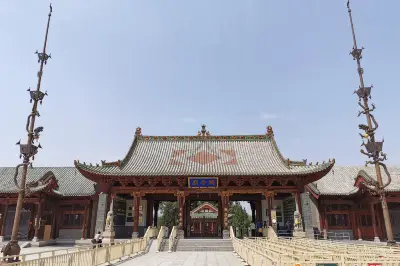
Roaming Southeast Shanxi
Last year I explored northern Shanxi. Shanxi definitely has a way of lingering in your heart—there’s always more to see, always a desire to return. A trip originally scheduled for late September finally happened a month later.
Day 1: Hangzhou ✈ Yuncheng. They say the best way to know a city is to start at its museum—in Yuncheng, that saying truly comes to life. Yuncheng Museum: I thought it would only be a chance to see the replicated Yongle Palace murals, but I underestimated how much the museum holds. If you look closely, you could easily spend most of the day. On the way to Guandi Temple, we checked out the Salt Lake’s Instagram-famous road and lamp post No. 006.
→🚗 Guandi Temple: The Haizhou Guandi Temple was first built in the Sui Dynasty, with a history of over 1,400 years. It is the earliest, largest, and best-preserved ancestral temple of Guan Yu, honored as ‘the progenitor of Guan temples’ and ‘the crown of martial temples’.
→🚗 Guangrenwang Temple: Very small, with only one unassuming hall, but it is a genuine Tang Dynasty structure, one of only three surviving Tang-era wooden buildings in China. The whole scenic area is strongly design-oriented, said to have been planned by a Tsinghua University professor.
→🚗 Yongle Palace: The highlight of the Yuncheng trip. Yongle Palace is a Taoist temple built in honor of Lü Dongbin. Its 1,000 square meters of Yuan Dynasty murals inside the halls are one of the world’s surviving treasure troves of ancient mural art.
Day 2: Three wonders of Linfen in one day
Hukou Waterfall → Xiaoxitian → Guangsheng Temple
→🚗 Hukou Waterfall: An immersive experience of the ‘Yellow River roaring’; the spectacle is beyond words, perfectly embodying the line ‘the Yellow River waters seem to come from the sky’. On the drive from Hukou Waterfall to Xiaoxitian, there are many coal-carrying trucks, so self-drivers, be very careful.
→🚗 Xiaoxitian (also called Qianfo An, Thousand Buddha Monastery), perched on the Phoenix Mountain west of Xixian County in Shanxi, is hailed as the ‘Museum of Chinese Suspended Sculpture Art’. It shot to fame thanks to the ‘myriad gods and Buddhas’ scene in the game Black Myth: Wukong, and even CCTV calls it the ‘unparalleled masterpiece of Chinese suspended sculpture’. Four centuries later, the painted sculptures are still as vivid as ever. Even on a weekday, Xiaoxitian’s popularity hasn’t waned; the Mahavira Hall was packed with visitors admiring the hanging sculptures. I’d seen many photos and videos beforehand, but seeing it in person still overwhelmed me. Behind the 1,900-plus Buddha figures lies unimaginable craftsmanship. Truly, ‘before Xiaoxitian there was no hall full of suspended sculpture; after Xiaoxitian, there is no hall of suspended sculpture like it.’
→🚗 Guangsheng Temple: Compared to the Yungang Grottoes and the Yingxian Wooden Pagoda, this thousand-year-old temple is more low-key and receives far fewer visitors. Yet it houses one of China’s four famous ancient pagodas—the world’s best-preserved glazed-tile pagoda, stunningly beautiful and exquisitely crafted. The ‘Sweeping the Pagoda to Uncover a Mystery’ episode in the 1986 CCTV production Journey to the West was filmed here, with Tang Monk sweeping the pagoda.
Guangsheng Temple is divided into upper and lower monasteries. The Feihong Pagoda (Rainbow Pagoda) is in the upper monastery—I recommend taking a sightseeing car up first, then visiting the lower monastery on the way down. To save energy, take the car both ways.
Lower Monastery: Mainly the Water God Temple, with Yuan Dynasty murals, but if the lighting is poor they’re hard to see clearly, and preservation isn’t complete—many have been stolen 😂
Day 3: Linfen → 🚄 Pingyao Ancient City,
→🚗 Zhenguo Temple: The Ten Thousand Buddha Hall of Zhenguo Temple houses 11 painted sculptures from the Five Dynasties period, including a Buddha, two disciples, four attendant bodhisattvas, and heavenly kings. Aside from the Mogao Caves in Dunhuang, this is the only surviving group of Five Dynasties temple sculptures in China.
→🚗 Shuanglin Temple: The Four Heavenly Kings with their glazed-glass pupils that pierce your soul; the ‘World’s Finest Skanda’ with armor that seems about to burst from dynamic tension; and the Eighteen Arhats, Song-style ‘divine masterworks’ that are a must-study for art academy students. When we were there, students from the Sculpture Department of Xi’an Academy of Fine Arts had moved their class to Shuanglin Temple, intently sculpting away.
→🚗 Pingyao Ancient City: Before coming, I’d heard there were plenty of tourist traps in Pingyao, and I still stepped into one despite my guard. Absolutely do not take the sightseeing car! The so-called ‘150 yuan all-inclusive package with guide and transfer’ just dumped us at the city wall and the county yamen, then provided only phone guidance for the rest, with no prior warning that vehicles aren’t allowed inside the old city. We had to do all the walking ourselves—a complete rip-off. I promptly filed a complaint with the local market supervision bureau.
🚄 Taiyuan South → Changzhi East Station
→🚗 Chongqing Temple: The 18 Arhats here are hailed as exemplary models of Song Dynasty sculpture.
→🚗 Faxing Temple: Fresh from the vividly expressive 18 arhats at Chongqing Temple, we now encountered the graceful and approachable Twelve Enlightened Bodhisattvas, once again feeling how Song Dynasty Buddhist figurative art merges deity and human with a secular, realistic touch. Faxing Temple holds three national-treasure relics: a Tang stone stupa, a Tang lighthouse, and the Song sculpture of the Twelve Enlightened Ones.
→🚗 Guanyin Hall: I suggest arriving before 2 p.m. The hall has no artificial light, relying solely on natural light. Tucked deep in the old town, this Ming Dynasty suspended sculpture gem packs over 500 painted sculptures into less than 40 square meters, creating an otherworldly Buddhist realm where Confucianism, Buddhism, and Daoism coexist. The cultural relic guardian told us that every day when the doors open, a faint fragrance wafts through the main hall—and we did indeed smell it there.
Day 5: While planning, I’d heard that some nationally protected sites in southern Shanxi might close temporarily due to weather or other reasons. This time, Tiefo Temple and Kaihua Temple in Jincheng drew the short straw—during our trip, a public account notified us both had temporarily closed, so we had to regretfully adjust our plans.
→🚗 Huangcheng Xiangfu (Imperial Chancellor’s Mansion): The former residence of Chen Tingjing, teacher of Emperor Kangxi and chief editor of the Kangxi Dictionary. It’s not just an official residence but a complete military fortress.
→🚗 Yuhuang Temple: Founded during the Northern Song Dynasty, this was once a large and influential Taoist temple in ancient Zezhou. To get the ‘travel permit’ (passport stamp), we rushed in as soon as the doors opened and successfully obtained it. The 28 Lunar Mansions inside Yuhuang Temple were created by Yuan Dynasty sculptor Liu Luan over 700 years ago.
Day 6: Jincheng is right next to Zhengzhou. I planned to transfer to a high-speed train back to Hangzhou from Zhengzhou. I’d been to Zhengzhou seven years ago, but back then I only had time to visit the Henan Museum and Erqi Square while rushing to catch a connection to Luoyang. This time, a Zhengzhou city walk is a must.