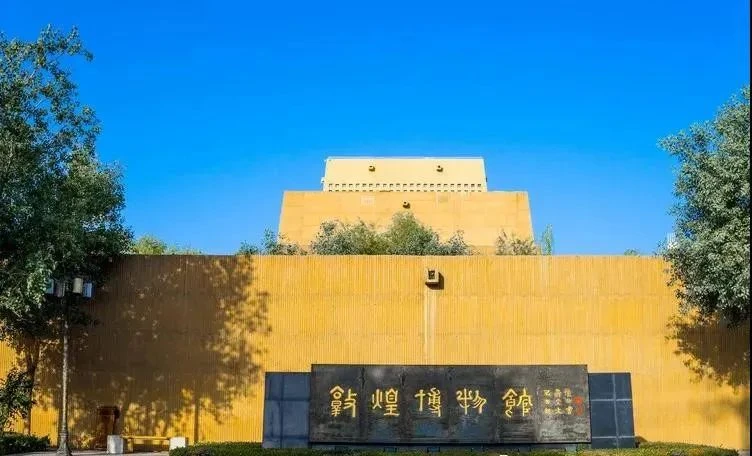
Dunhuang Museum Reopens from March 26 – Come and Hear the Stories Behind the Artifacts!
Dunhuang Museum will reopen from Thursday, March 26.
I. Opening Hours
Tuesdays to Sundays
09:00 – 18:00 (last entry at 17:30)
II. Daily Visitor Capacity
No more than 400 visitors in the morning and no more than 400 in the afternoon, with a daily total of no more than 800.
III. Entry Procedures
1. Visitors must wear masks inside the museum. Those without masks will be advised not to enter. A health QR code must be obtained and presented. After temperature check at the front desk and security inspection, visitors may enter.
2. Please maintain a distance of at least 1.5 meters when queuing and visiting to avoid gathering.
3. Group visitors will enter at staggered times and intervals; groups must not exceed 30 people. Advance reservation is required for group visits.
4. The number of visitors in each exhibition hall at the same time must not exceed 15. Hall staff will guide and manage crowd flow.
5. The museum shop may accommodate no more than 17 people (including staff) at any one time.
Dunhuang – a brilliant pearl on the Silk Road. Dunhuang culture is a culture created by multiple ethnic groups. The Dunhuang Museum is a microcosm of Dunhuang’s history and culture, and a window for the public to understand Dunhuang. The museum houses over 14,000 artifacts, each seemingly dreamlike, with a story behind every treasure.
The museum’s layout divides exhibition halls by historical periods. Besides artifacts from various eras, there are many models reconstructing ancient architecture, presenting the prosperous Dunhuang of the Silk Road’s heyday. The museum is fully equipped with comprehensive facilities, serving as an important window to promote Dunhuang culture and display its ancient civilization, as well as a key research base for Dunhuang studies.
Among the artifacts on display, there are production and daily life tools such as sand-tempered clay pots, stone axes, stone sickles, and stone grindstones from the Bronze Age (3,000–4,000 years ago), proving that Dunhuang’s ancestors lived and thrived in this “desert oasis” very early on.
Since the discovery of Dunhuang bamboo slips in the 20th century, six batches have been unearthed, totaling over 20,000 slips. Correspondence was frequent at this frontier outpost, and these slips faithfully record various aspects of the commanderies, garrisons, and beacon towers. Their content is rich, including imperial edicts, legal codes, beacon regulations specifying duties, inventories of defensive equipment and weapons, records of property, prices, loans, private letters, and writing tablets.
In this photo, we see a Sogdian figure. The Sogdians were one of the most active and mysterious ancient peoples in Central Asia, with a high level of economic and cultural development. They were skilled in agriculture and crafts and had a unique script – Sogdian – to record their language. From the Wei and Jin dynasties onward, the Western Region merchants who came to Dunhuang were mainly Sogdians living in the Zeravshan River valley in Central Asia, centered around Samarkand (Kangju). The Sogdians were adept at commerce, well-traveled, and multilingual. While trading goods, they also served as messengers of Eastern and Western cultures and civilizations. By the 4th century, Dunhuang had become an important transit point for Sogdians on the Silk Road.
Dunhuang painted bricks are widely distributed, mainly from the Mogao Caves, ancient tombs, and temples. They vividly reflect the carving art and brick-making techniques of Dunhuang’s history, and the development of their themes and craftsmanship mirrors Dunhuang society, providing concrete evidence of the economic and cultural life of the ancient Hexi Corridor.
Among the Tang-dynasty decorative bricks unearthed, the most famous are a set of four bricks from the Tang tombs at Foye Temple in Dunhuang: “Riders on a Journey” and “A Hu (Central Asian) Leading a Camel.” These bricks and their patterns are grayish-green, rectangular, and of identical size. The patterns are in relief, with smooth and skilled lines, rounded and thick images, giving a strong sense of motion. The proportions of humans and animals are harmonious, the composition is meticulous, the patterns are dense yet well-arranged, and the design is clever. The figures’ characteristics are accurate and vivid. Just four simple images vividly depict merchants and riders traveling on the Silk Road, enduring long journeys and dusty trails to exchange goods and culture.
Dunhuang was the first place in China to open to the West and is a historical witness to ancient Sino-Western exchanges. In 2008, Dunhuang Museum was listed among the first free-admission museums in Gansu Province. After nearly twenty years of development, the museum has taken shape as a venue with distinct Dunhuang regional and cultural characteristics. Welcome!


