Zhang Qian: The First Influencer of the Silk Road
"A steadfast, upright, and extraordinary man, the first figure to open the world history"—Liang Qichao's comment on Zhang Qian
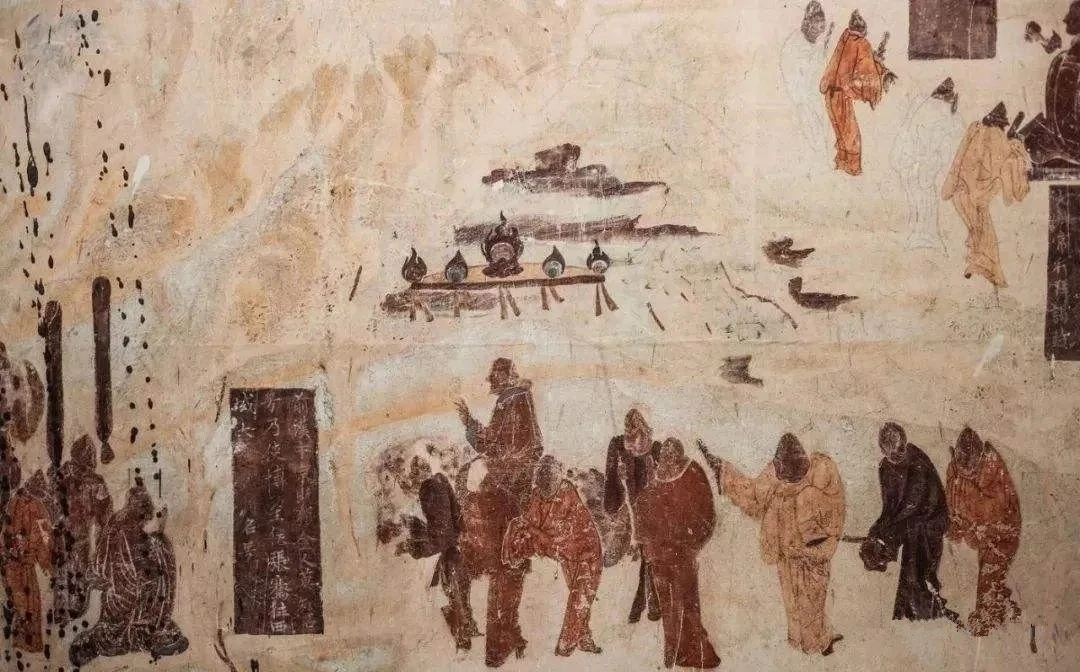
(Mogao Cave 323, Dunhuang, mural of Zhang Qian's mission to the Western Regions)
**'Influencer' Zhang Qian**
(Comparison of Zhang Qian's journey to the Western Regions and the Silk Road. Source: *Atlas of Chinese Historical Manuscripts*)
Besides the Han dynasty, which was founded on agriculture, a powerful nomadic tribe—the Xiongnu—had risen in northwestern China. The Xiongnu's strength not only threatened the Han's northwestern border but also became an obstacle to the dynasty's communication with the outside world.
(Portrait sketch of Zhang Qian, Qing dynasty *Wushuang Pu*)
(Wax figure of Zhang Qian at the Shaanxi History Museum, photo by Ding Tinghui)
As an attendant official who often stood and walked in the palace, appearance was particularly important. From this, we can infer that Zhang Qian must have had a good physique and handsome features—these were important criteria for selecting court officials at the time. Zhang Qian, who made significant contributions to the country's foreign exchanges and territorial expansion, was not given a dedicated biography at the time. Instead, he appears in the *Records of the Grand Historian: The Account of Dayuan*, where he is passively mentioned for describing the geography of the Western Regions. It is not difficult to see that before his mission, Zhang Qian held an unremarkable position in the Western Han civil service. However, we can infer that he likely came from a lower-class background. Another famous diplomat, Su Wu, was different; historical records clearly state that "when young, due to his father's influence, he and his brothers became court officials, and he was soon promoted to supervisor of the stables at Yizhong."
(Part of the *Shanglin Painting*, depicting Emperor Wu of Han hunting, attributed to Ming painter Qiu Ying)
(Mogao Cave 323, Dunhuang: Emperor Wu of Han receiving two golden figures)
(Part of the *Eighteen Songs of a Nomad Flute*, Ming dynasty painting)
Adventurers always start from humble and grassroots origins, whether in the East or the West.
**'Columbus on Land'** Comparing Zhang Qian to 'Columbus on Land' is not entirely appropriate, because the Chinese explorer came first. However, to help people recognize his achievements, we sometimes have to use this analogy.
The starting point of the mission was not Chang'an, but the Ganquan Palace in present-day Chunhua County. There, Zhang Qian received from the head of state a seven-foot-long, red-lacquered bamboo envoy staff, each joint hanging with long yak tail hairs. He and his deputy, the Xiongnu Tangyifu, mounted their horses and turned westward. No one expected that this turn would last 13 years. Emperor Wu of Han watched from afar, while Zhang Qian turned and traveled far. This scene reminds me of the Spanish king and the explorer Columbus about to set sail during the Age of Discovery in the 15th century.
(Oil painting of Zhang Qian's mission to the Western Regions, by Zhang Kewei)
Similar circumstances, different eras: In the Old World era, the Xiongnu blocked the Hexi Corridor, and the Easterner Zhang Qian rode west to find allies and open a channel for East-West exchange. In the New World era, the Ottoman Turks cut off the maritime Silk Road, and the Westerner Columbus sailed west to find new lands and open a new route between Europe and the East. Of course, these two expeditions were different in nature. Sponsored by Queen Isabella I and King Ferdinand II of Spain, Columbus crossed the Atlantic four times and reached the Americas, beginning the Spanish colonization of the Americas. Columbus became the pioneer of European colonization of the 'New World.' The background of the Age of Discovery or the opening of new sea routes was that Western imperialists wanted to find new trade routes to expand colonies and increase wealth. The Spanish king was both a political leader and a spokesperson for capitalist financiers.
(Columbus's Return, 19th-century oil painting by Eugène Delacroix)
In Zhang Qian's time, the Han Empire's purpose in connecting with the Western Regions was to eliminate the Xiongnu threat to its borders, and then establish mutual exchange and peaceful friendly relations with the vast Western Regions. Although their aims were not exactly the same, it is certain that both Zhang Qian and Columbus came from humble origins, were brave enough to become explorers, and wanted to seize the opportunities of their times. Once successful, their lowly fates would surely change. Their birth years are unknown. Zhang Qian's resume before his mission is almost blank. Columbus's father was a weaver who ran a cheese stall, and Columbus often watched over it as a child.
In the 2nd century BCE, Zhang Qian made two missions to the Western Regions, reaching places like Jushi, Kucha, Shule, Dayuan, Kangju, Daxia, Shache, Yutian, and Loulan, learning about their geography and customs. Through these places, he obtained information about West Asia and Europe—things previously unheard of by people in the Central Plains.
(Base map: *Map of Chinese Civilization* edited by Hua Linfu et al., China Map Publishing House)
(2017 special stamp: Zhang Qian)
(Series of oil paintings of Zhang Qian, by Fang Hengbo)
In 126 BCE, after many life-and-death experiences, Zhang Qian returned to Chang'an. On this trip, he did not achieve Emperor Wu's original goal, nor did he bring back any gifts. But the richest harvest remained in Zhang Qian's mind. He recounted in detail to the emperor and court officials the previously unknown Western Regions—their mountains, rivers, products, customs... all appeared on maps and were revealed to everyone.
(Zhang Qian's Return, oil painting by Zhang Hongnian)
In 119 BCE, Zhang Qian set out again for the Western Regions. This time, the mission numbered over 300 people, carrying many gifts. By then, the Hexi Corridor was under Han control and had been established as prefectures and counties. Zhang Qian and his group passed through smoothly, reaching the Wusun Kingdom in the area of present-day Yili Basin to Lake Balkhash via the northern foothills of the Tianshan Mountains. During his stay, he sent deputies to Yutian, Dayuan, Kangju, Dayuezhi, Daxia, Anxi (present-day Iran), and Shendu (present-day Pakistan and India).
(Zhang Qian's Mission, oil painting by Zhang Guoqiang)
This means that from then on, the northwestern states began to interact with the Han dynasty. The transportation passage was opened by Zhang Qian, so people often mentioned the title of Bowang Hou (Zhang Qian's marquisate) in their interactions, thus gaining mutual trust. In this way, Zhang Qian became the first internet celebrity on the Han dynasty Silk Road.
**'Zhang Qian Exchange'** After the mission and the army, more footprints came from merchant caravans. Han products continuously flowed into the Western Regions and were transshipped farther to South Asia, West Asia, and Europe. Exotic goods from foreign lands also poured into Chang'an and entered the vast interior.
(Photo of Dunhuang dance drama *Silk Road, Flower Rain*)
Grapes from the Mediterranean and pomegranates from West Asia began to be transplanted in the Han imperial gardens; Emperor Wu's Shanglin Park had exotic birds and animals such as peacocks and elephants from Shendu, lions and ostriches from Anxi, and most importantly, the 'heavenly horses' from Dayuan, said to be the descendants of the blood-sweating horses. On the streets of Chang'an, large numbers of foreign merchants with high noses and blue eyes began to appear; the orchestra of the Weiyang Palace introduced foreign instruments such as the hujia (nomad flute), pipa, and konghou.
(2017 Zhang Qian stamp)
For food lovers, you must know that these familiar fruits and vegetables today began to be introduced from Zhang Qian's time: pomegranates, grapes, alfalfa, sesame, walnuts, figs, fava beans, mung beans, cucumbers, garlic, scallions, pepper, fennel... Their original names indicate their imported status, such as fava beans originally called 'hu dou' (foreign beans), scallions originally called 'hu cong' (foreign scallions), garlic originally called 'hu suan' (foreign garlic), walnuts originally called 'hu tao' (foreign peaches), and pomegranates originally called 'fan shiliu' (foreign pomegranates).
*Zhang Qian's Mission to the Western Regions* sculpture by Zhang Wei
Because of his achievements in opening up the Western Regions, Zhang Qian's life fate changed. He eventually became the Minister of Heraldry (Da Xing Ling), one of the 'Nine Ministers,' responsible for diplomatic ceremonies. Unfortunately, this explorer and diplomat did not live long; he passed away at about the age of 50. Long after Zhang Qian's death, his good name continued to be praised along the Silk Road. Whether envoys from various countries visiting each other or merchants trading, they often used 'Bowang Hou' as a credit identifier. It is no exaggeration to call him the first influencer of the Silk Road.
Source: 'Great Geography Hall'


