Gansu Travel: From Mingsha Mountain to Mogao Caves in Dunhuang (Photos)
Dunhuang in Gansu has always been a mysterious and wonderful place in our reporter's mind. Many years ago, a large-scale ethnic dance drama 'The Silk Road', created by the Gansu Provincial Song and Dance Troupe based on the world-famous Dunhuang murals, further ignited the reporter's fascination with Dunhuang. The most unforgettable was the Mogao Caves, one of China's four major grottoes.
Dunhuang Railway Station (Photo by Feng Ganyong)
Speaking of China's four major grottoes, one cannot help but feel proud of Gansu Province, which houses two of them. Among the four, Yungang Grottoes in Datong, Shanxi, and Longmen Grottoes in Luoyang, Henan, each account for one, while the remaining two, Maijishan and Dunhuang Mogao Caves, are both within Gansu Province. The reporter's 2011 northwestern journey began with a stop in Dunhuang. On the evening of July 25, 2011, the reporter took a train from Lanzhou and after an overnight trip arrived smoothly at Dunhuang Railway Station the next morning.
Mingsha Mountain Scenic Area Entrance (Photo by Feng Ganyong)
Stepping out of Dunhuang Railway Station, whose architecture blends the 'simple and robust' style of the Han Dynasty with the 'graceful and bright' style of the Tang Dynasty, the group first took a tourist bus to the Dunhuang Mingsha Mountain and Crescent Moon Spring Scenic Area. Located 5 kilometers south of Dunhuang city, Mingsha Mountain and Crescent Moon Spring have been like twin sisters in the vast Gobi Desert since ancient times: 'The mountain sings because of its spirit, and the water shines with its charm.' Visitors here, whether looking down from the mountain top or strolling by the spring, feel enchanted and lost in thought, truly experiencing 'Mingsha Mountain soothes the soul, Crescent Moon Spring cleanses the heart.'
Mingsha Mountain Memorial Stone (Photo by Feng Ganyong)
This area is renowned worldwide for its unique landscape where 'mountain and spring coexist, sand and water live in harmony,' often hailed as 'one of the wonders beyond the Great Wall.' Particularly, the integration of Mingsha Mountain, Crescent Moon Spring, and the artistic landscape of Mogao Caves forms the 'two wonders' connected in the south of Dunhuang, making it a coveted tourist destination for both Chinese and international visitors.
Sea of Desert (Photo by Feng Ganyong)
In 1994, it was designated as a National Key Scenic Spot. Our guide Peng Yu, a warm and cheerful young woman from Gansu Silk Road Travel Agency, offered vivid and engaging introductions throughout the journey from the station to the scenic area, whetting everyone's appetite. After about half an hour by bus, we arrived at the entrance of the scenic area.
Reporter at Crescent Moon Spring (Photo by Zhuo Yue)
Upon entering the scenic area, a vast sea of desert greeted our eyes. A large stone with three red characters 'Mingsha Mountain' stood in front of the sand sea. Little Peng said there were two routes to explore the area: one could ride a camel up the sand mountain and then descend to Crescent Moon Spring; the other could take a sightseeing bus directly to Crescent Moon Spring. Everyone chose their preferred route.
Camel Caravan at Mingsha Mountain (Photo by Zhuo Yue)
Mingsha Mountain in Dunhuang features undulating sand peaks that 'curl like a dragon,' glittering golden like a mountain of gold. The entire mountain is formed by fine yellow sand that accumulates. When strong winds blow, the mountain emits loud sounds; when gentle breezes pass, it sounds like string and wind instruments, hence the name 'Mingsha' (Singing Sand) Mountain.
Camel Caravan in the Distance (Photo by Feng Ganyong)
Mingsha Mountain has two peculiarities: when people slide down from the top, the sand under their feet rumbles; footprints left by climbers during the day completely disappear by the next day.
Camel Caravan in Fisheye Lens (Photo by Feng Ganyong)
Historically known as 'Sand Horn Mountain' or 'Divine Sand Mountain,' the mountain is accumulated by shifting sand. It stretches about 40 kilometers east-west and 20 kilometers north-south, with the highest peak at 1,715 meters. The sand ridges interlock, peaks like blades, and viewed from afar, they ripple like ocean waves, a magnificent sight. The sand comes in five colors—pink, yellow, green, white, and black—glittering and clean. Standing at the foot of the sand mountain, watching the long camel caravan slowly moving across the sand sea presents a beautiful and spectacular scene.
Crescent Moon Spring in the Sand Sea (Photo by Feng Ganyong)
The reporter took a sightseeing bus to near Crescent Moon Spring. After getting off, we had to walk a stretch across the sand sea. First climbing a sand dune, we looked ahead and saw the full view of Crescent Moon Spring nestled within Mingsha Mountain. Descending the sand dune and passing by the spring, a large stone with three red characters 'First Spring' stood prominently in the sand.
First Spring Memorial Stone (Photo by Feng Ganyong)
Viewed from above, Crescent Moon Spring is clearly shaped like a crescent moon, from which it gets its name. Covering 0.88 hectares with an average depth of about 3 meters, the spring has cool, clear water. Historically called 'Sand Well' or 'Medicine Spring,' it was once mistakenly referred to as 'Wowachi Pool' before being officially named 'Crescent Moon Spring' in the Qing Dynasty. For thousands of years, surrounded by sand mountains, it has never been buried; located in an arid desert, its water remains clear and never dries up—a rare phenomenon. Approaching the spring, we saw star grass and iron fish in the water, and the reflection of the mountain created a picturesque scene.
Desert Oasis (Photo by Feng Ganyong)
Crescent Moon Spring is over 300 meters long and about 50 meters wide, completely surrounded by Mingsha Mountain. White poplars stand gracefully by the spring, fish swim leisurely in the clear, shallow blue water, which tastes sweet. Crescent Moon Spring, dreamlike and enchanting, has never been buried by shifting sand nor dried up despite drought for millennia. It is truly the 'First Spring in the Desert,' an astonishing marvel.
Close-up of Crescent Moon Spring (Photo by Feng Ganyong)
According to records, there was originally a group of ancient, elegant, and well-arranged buildings on the south bank of Crescent Moon Spring, including over a hundred rooms like the Empress Hall, Dragon King Palace, Bodhisattva Hall, Medicine King Cave, and Thunder God Platform from east to west. The main halls contained over a hundred colored sculptures and hundreds of murals. Important halls were adorned with plaques and stone inscriptions such as 'First Spring,' 'Unique World,' 'Half Circle Spring,' 'Connecting with Kunlun,' 'Mastering the Universe,' with elegant calligraphy considered top-notch. At that time, pavilions and towers stood magnificently by the water, with lush trees and a serene atmosphere, complemented by ancient temples and constant incense.
Yuequan Pavilion (Photo by Feng Ganyong)
Today, this building complex by the spring may not be as grand as before, but the lush green oasis in front delights visitors. Passing through the path between the lawns, we entered the courtyard through a gate with a plaque reading 'Morning Sunlight.' The towering, pagoda-like Yuequan Pavilion stood prominently, surrounded by a group of elegant pavilions and terraces such as Mo Chi Yun, Cheng Han, Ting Lei Xuan, and Yue Dao Feng Lai.
Yuequan Pavilion Courtyard (Photo by Feng Ganyong)
On the walls leading up the stairs of Yuequan Pavilion, there were calligraphy rubbings of 'Sand Mountain Cloud Sea' and 'Sand Spring Wonder.' Unfortunately, upon entering the pavilion, we found the stairs blocked artificially, preventing visitors from ascending to enjoy the view. The reporter thought how wonderful it would be if visitors could climb Yuequan Pavilion to overlook Crescent Moon Spring from above.
Ancient Desert Willow (Photo by Feng Ganyong)
It is said that many literati throughout history have visited Crescent Moon Spring, composing poems and leaving their marks. Historical records indicate that in 113 BC, Emperor Wu of Han obtained a heavenly horse from Wowachi Pool; later generations suspected Crescent Moon Spring was that pool and erected a stone tablet reading 'Han Wowachi Pool.' 'Wild horses gallop in the sand from all sides, and the shadow of a pool transforms into a roaming dragon.' This added endless legendary charm to the unique Crescent Moon Spring.
Reporter at Mogao Caves (Photo by Wang Hong)
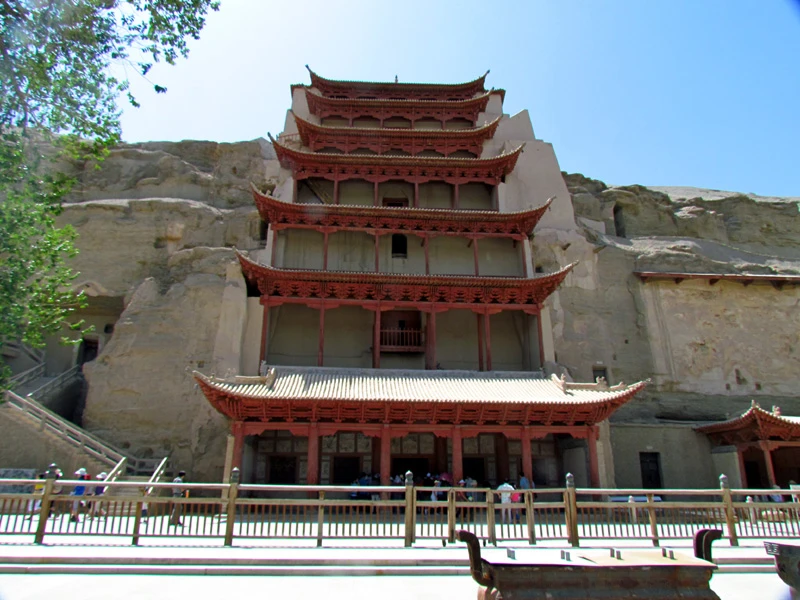
Leaving Mingsha Mountain and Crescent Moon Spring, we drove to the long-anticipated Mogao Caves. As they say, the best is saved for last. In the reporter's view, visiting the cultural landscape of the Mogao Caves was the grand finale of the Dunhuang trip. Mogao Caves are located 25 kilometers southeast of Dunhuang, carved into the cliffs on the eastern foothills of Mingsha Mountain. Stretching over 1,600 meters north-south, arranged in five layers with varying heights and an orderly disorder, they resemble beehives and pigeon lofts—a spectacular sight. It is the largest, best-preserved, and richest classical cultural and artistic treasure house in China, as well as a world-famous Buddhist art center.
Mogao Caves Crowded with Visitors (Photo by Feng Ganyong)
Although photography and filming were prohibited inside the site, this did not diminish the reporter's keen interest in the statues and murals. After all, visiting the Mogao Caves had been a long-cherished wish. Previously, the reporter had only seen glimpses through films, books, and newspapers; today, finally seeing them in person brought an indescribable excitement.
Dunhuang Mogao Caves (Photo by Feng Ganyong)
Despite the scorching heat, the reporter visited caves 94, 148, 130, 96, 71, 329, 332, and 16–17. The reclining Buddha of 14.7 meters in Cave 148 and the 35.5-meter Maitreya Buddha in Cave 96 left a deep impression. Particularly, looking up at the towering seated Buddha in Cave 96 reminded the reporter of the Leshan Giant Buddha in Sichuan. Although this Buddha is not as large as Leshan's, being inside a cave made it appear even more majestic and spectacular.
Mogao Cave Grottoes (Photo by Feng Ganyong)
After touring the Mogao Caves, the reporter marveled that this is indeed an artistic palace combining ancient architecture, sculpture, and murals. The rich and varied murals are world-renowned. No religious grotto, temple, or palace in the world can compare to the Mogao Caves in the volume and richness of their murals.
Souvenir Photo at Mogao Caves (Photo by Wang Hong)
Looking around the caves, ceilings and walls are covered with images of Buddhas, apsaras, musicians, and fairies. There are paintings of Buddhist stories, sutra illustrations, historical Buddhist sites, mythical figures, donor portraits, and various exquisite decorative patterns—all lifelike and vibrant. After viewing them, one feels reluctant to leave. The trip to Dunhuang was truly worth it. (Text & Photos: Feng Ganyong)


