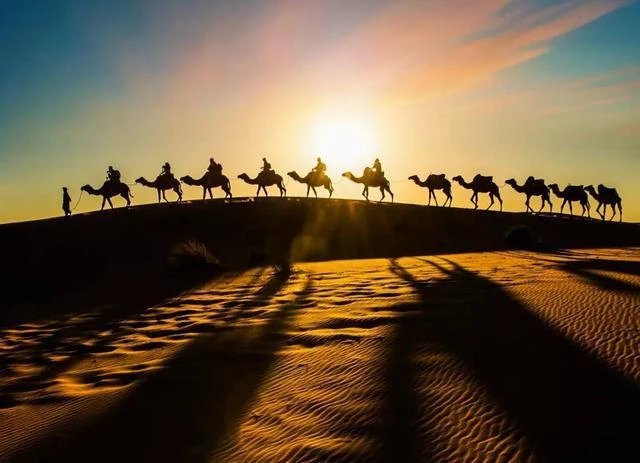
Dunhuang: Why Is This Small Oasis Surrounded by Desert and Gobi Praised as the Confluence Center of World Civilizations?
As the towering Qilian Mountains gradually fade into the wilderness, the Hexi Corridor quickly loses its vitality and color, and the increasingly expansive views only make people more weary.
Suddenly, a stretch of golden sand dunes picks up from the black mountains and extends into the distance, with greenery faintly emerging beneath the dunes. We know—Dunhuang has arrived.
Dunhuang, known in ancient times as Shazhou (Sand Prefecture), is aptly named. It is indeed like a small boat stranded in a vast sea of sand, waiting to be discovered, to be recorded, and to embark on an extraordinary voyage.
In 121 BC, this long wait finally received a response. That spring, the Xiongnu, defeated in the Hexi Corridor, hastily retreated westward. The spirited Huo Qubing pursued them all the way to Dunhuang before reining in his horse.
This marked the Han Dynasty's all-out counterattack against the Xiongnu, as well as the beginning of the legendary voyage of this sand-sea oasis. Ten years later, it was given a meaningful name—Grand and Glorious, which is Dunhuang.
After expelling the Xiongnu, Emperor Wu of Han quickly rebuilt the order of the Hexi Corridor, constructing the Great Wall, setting up passes, deploying troops, and relocating people for farming... When the flames of war subsided and the people's hearts were somewhat settled, Zhang Qian and his envoy team set out from Chang'an in great force.
This was Zhang Qian's second journey to the Western Regions as an envoy. This time, he brought the majesty of the Great Han Dynasty and conveyed the intention of peaceful trade with generous gifts.
A trade route connecting the Western Regions and the Central Plains through the Hexi Corridor began to take shape. Dunhuang, as both a branching point and a meeting point, became lively from then on.
Traveling merchants and envoys from the Western Regions brought fine horses, jade, and spices through Dunhuang into the Hexi Corridor. On their return, they loaded silk, tea, and ceramics and set out from Dunhuang into the desert.
The thriving and ceaseless trade made Dunhuang famous far and wide. By the Eastern Han period, it had become a bustling metropolis where "Chinese and foreigners interacted."
Traveling merchants in Dunhuang murals (Mogao Cave 296) ▼
Among all goods sent to the Western Regions, silk was the hottest commodity. When this lustrous, smooth, and soft fabric crossed the Pamir Plateau to West Asia and even the Mediterranean coast, it caused excitement all along the way.
One day in 47 BC, Caesar, the dictator for life of the Roman Republic, appeared in a newly built theater draped in a gorgeous robe. Instantly, everyone's attention was drawn by Caesar's dazzling attire. An experienced elder told everyone, "This is silk, from the distant East."
Silk became the new favorite of Roman aristocrats overnight, even seen as a symbol of wealth and status. According to Roman lore, silk was a material that grew on trees, and this magical tree existed only in an Eastern country called "Seres" (meaning the land of silk).
The aristocrats' frenzy drove silk prices soaring. In Rome at the time, one had to spend 12 taels of gold to buy 1 pound of silk (1 pound ≈ 9 taels). The huge profits prompted wave after wave of caravans to embark on journeys to the East. They came from different corners of the world and eventually all converged in Dunhuang.
China's silk-making techniques only gradually spread to Western countries around the mid-6th century AD. Before that, the Western world's desire and demand for silk could only be satisfied in China.
Besides silk, Chinese tea and porcelain also became highly sought-after "hard currencies" worldwide. Profit-driven merchants flocked to China, crossing snowy mountains, traversing deserts, spanning grasslands, and sailing across seas; no difficulty or danger could stop them. Thus, routes connecting China to the world were trampled out by generations of merchants, collectively called the Silk Road.
In ancient times, whether heading east or west, setting off for Dunhuang was a very cautious decision. Those traveling westward would leave the shelter and nourishment of the Qilian Mountains, while those heading east would bid farewell to the chain of oases beneath the Tianshan and Kunlun Mountains.
So when people arrived in Dunhuang after great hardship, they inevitably had to stop for several days to replenish water and supplies and prepare sufficiently for the journey ahead.
As more and more merchants and goods accumulated in Dunhuang, some simply stopped moving forward and started doing business in the local market. As the transportation hub of the Silk Road, Dunhuang further took on the role of a major trading center.
Along with trade came not only various goods but also different religions, languages, music, dance, painting, sculpture, and production techniques. Dunhuang became a land of bliss where Eastern and Western civilizations collided, merged, and coexisted harmoniously.
Skilled painters depicted scenes of daily life from that era in the form of Buddhist stories on the walls of Dunhuang's caves. Today, through the colorful murals, we can still feel the prosperity of that distant time.
Huxuan dance (Mogao Cave 220) ▼
In March 1986, the master of Chinese studies, Ji Xianlin, published a paper on "Dunhuang-Turfan Studies" in the journal Red Flag. He wrote: "There are only four cultural systems in the world that have a long history, vast territory, self-contained system, and far-reaching influence: China, India, Greece, and Islam, and no fifth. And there is only one place where these four cultural systems converge: China's Dunhuang and Xinjiang region, and no second."
Mr. Ji's conclusion later became a frequently quoted saying when people talk about Dunhuang, and Dunhuang's historical status as the convergence center of four civilizations has been widely accepted. However, only by coming here in person can one truly understand how tenacious and yet how fragile this cultural center is.
Although Dunhuang has been famous since ancient times, it is essentially just a small oasis surrounded by desert and Gobi, with no room for outward expansion.
The annual precipitation here is less than 50 millimeters, but the evaporation exceeds 2,500 millimeters, making it one of the driest regions in China.
It is precisely in such a place that Dunhuang, relying on the Dang River with a relatively small flow, has endured for thousands of years with an unbroken flame.
The Dang River, originating from the Qilian Mountains, was originally the largest tributary of the Shule River. The place where the two rivers met was once the Hala Nur Lake, covering an area of over 70 square kilometers.
However, from the mid-to-late Qing Dynasty, people began large-scale reclamation of wetlands and diversion of water for irrigation, drastically reducing the flow of the Dang River. By the 1970s, dams were built on the west side of Mingsha Mountain to store water, causing the lower reaches of the Dang River to essentially dry up. The Shule River faced a similar fate, leading directly to the complete desiccation of Hala Nur Lake...
In ancient times, after filling Hala Nur Lake, the Dang and Shule Rivers would overflow westward, eventually flowing into Lop Nur.
The vast, sea-like Lop Nur, when full of water, gave rise to the mysterious Loulan Kingdom. But its drying up must have been rapid, which is why Loulan disappeared so thoroughly and silently.
As we drove through Dunhuang's Gobi, roadside signs often showed names like "Nanhu" (South Lake) and "Xihu" (West Lake). One can imagine that this parched land must have once been covered with lakes and marshes, with rippling water.
I widened my eyes, expecting a lake to appear at any moment. But after waiting a long time, what came was a row of huge slogans: "Don't let Dunhuang become the second Loulan!"
On Mingshan Road in Dunhuang, looking up, you see huge sand dunes lying horizontally at the end of the road, as smooth and hard as porcelain, staring menacingly at the oasis below.
Strong westerly winds carry yellow sand from the Kumtag Desert eastward until they encounter the Sanwei Mountain and Heishi Peak, where the sand grains settle one by one. Over time, they accumulate into mountains—this is Dunhuang's landmark, Mingsha Mountain.
When you come to Dunhuang, you will surely marvel at how close the city is to the desert, and how calm the people living beneath the sand mountains are.
The nearly 800-square-kilometer Mingsha Mountain is regarded as nothing more than a large amusement park. Here, the desert is not frightening; you can put aside all worries and jump into the gentle sea of sand, indulging in wild joy.
In fact, Mingsha Mountain has not always been stationary; it just moves so slowly that it's hard to notice.
Geological workers, after subsurface exploration, have inferred that the expansion of Mingsha Mountain once forced the Dang River to shift northward. Strangely, when the sand mountain swallowed the old course of the Dang River, it deliberately left a small section—this small section is today's Crescent Moon Spring.
Although Crescent Moon Spring is now isolated from the Dang River, the two are still closely connected through the groundwater system. Therefore, the decline in the Dang River's water level has also led to a significant shrinkage of the Crescent Moon Spring's surface. To prevent it from drying up completely, people now spend huge sums every year to replenish it through various means.
Many people like to sit on the eastern ridge of Mingsha Mountain, quietly waiting for the sun to set, witnessing the moment when the sun and moon shine together. Year after year, the sun arrives on time every day. But if one day the crescent moon on the ground suddenly disappears, how sad that scene would be...
If the golden desert is approachable, then what truly chills people is the black Gobi.
Leaving Dunhuang city and driving about 100 kilometers northwest, you'll find the ground gradually covered by black sand and gravel. Deeper in, there is a mysterious "ancient city" stretching for over ten kilometers, with castles standing in order and streets in neat rows, but utterly lifeless. Whenever the wind blows, sand and stones fly, and sounds like wolves howling and tigers roaring make one's heart pound with fear.
The "Devil City" on the Black Gobi ▼
This geological landscape, known as "Devil City," is actually a type of yardang landform. The neatly arranged castles are sedimentary layers from ancient lake basins or riverbeds.
Crustal movements exposed these poorly consolidated rock layers to the surface. Strong, persistent directional winds continuously eroded along the rock fractures, eventually forming these parallel ridge-like remnant hills aligned with the wind direction.
The Black Gobi and the Devil City—what a cold combination! They resolutely reject all signs of life and do their utmost to intimidate passersby.
Yet this area was the must-pass route for the Silk Road west of the Yumen Pass heading to Turpan. How much courage did ancient merchants need to resist this boundless desolation?
Returning from Devil City and passing by Yumen Pass again, I truly felt what "Spring breeze never reaches Yumen Pass" means.
This pass, established during the reign of Emperor Wu of Han, has long disappeared. However, archaeologists have managed to find some related remains near Xiaofangpan City by the Xihu Wetland, based on clues from Han Dynasty bamboo slips.
Yumen Pass Xiaofangpan City ▼
On the Gobi desert, holding onto water sources means holding onto the lifeline. So, whether Yang Pass or Yumen Pass, both guarded the most important water supply points west of Dunhuang.
Merchants, couriers, and envoys entering and leaving Dunhuang, whether traveling along the northern foothills of the Kunlun Mountains or the southern foothills of the Tianshan Mountains, had to pass through these two passes. They not only protected the safety of the western gate of the Hexi Corridor but were also responsible for issuing "passports" to those coming and going. During the Han and Tang Dynasties, these two majestic passes standing opposite each other in the wilderness bustled with activity for several centuries.
However, all the prosperity came to an abrupt halt in the mid-8th century AD.
The Tang Dynasty experienced the An Lushan Rebellion. The emperor summoned border garrison troops back to the Central Plains to suppress the rebellion, leaving the entire northwest region defenseless. The Tubo (Tibetan) forces seized the opportunity, and thus the Hexi Corridor slipped from Tang control. Yang Pass and Yumen Pass began a long wait. They didn't know why, from one day onward, the letters they sent out never received replies, caravans and people no longer appeared on the distant horizon, and the singing and dancing women, jingling jade, and fragrant grape wine all vanished...
Meanwhile, soldiers stationed far beyond the passes, cut off from the Central Plains due to the loss of the Hexi Corridor, waited in vain for aid as they were isolated in the Western Regions. Only Yang Pass and Yumen Pass stood silently at the edge of the yellow Kumtag Desert, gazing at them from afar—the last echo, but also the deepest despair.
In AD 766, Tubo successively captured Liangzhou, Ganzhou, and Suzhou (i.e., Wuwei, Zhangye, and Jiuquan), turning Dunhuang (Shazhou) into an isolated city. After holding out for 20 years with no outside rescue and depleted supplies and weapons, the defending soldiers and civilians negotiated a surrender.
In 786, all prefectures and counties in the Hexi and Longyou areas had been occupied by Tubo. The Tubo commander forcibly implemented "Tibetanization" in the occupied areas, requiring Han people to speak Tibetan, adopt Tibetan customs, "wear clothes with left-sided lapels, and wear braids with tattoos."
However, the oppressive policy could not subdue the people's hearts. After Dunhuang fell, although the locals "wore barbarian clothes and served as subjects," every time they worshipped their ancestors, they would "wear Chinese-style clothes," bow eastward, wail loudly, and then take off the Han clothes and hide them secretly.
"Does the court still think of us? When will the troops come?" The people in the Tubo-occupied areas longed for liberation every day. This wait lasted more than half a century.
The boundless longing eventually stirred up huge waves in Dunhuang. In AD 848, a rebel army led by Zhang Yichao raised the banner of "Return to the Great Tang," taking advantage of Tubo's internal strife to recapture Dunhuang. Then, using Dunhuang as their base, they gradually recovered the Hexi Corridor.
They called themselves the "Return-to-Righteousness Army" (Guiyijun), restoring order and comforting the people with the principle of "people and culture, the same as the interior." They sent ten teams of messengers to inform the Tang court of the joyful news of Dunhuang's recovery.
Zhang Yichao leading the army, mural (Mogao Cave 156) ▼
In 851, Zhang Yichao sent his elder brother to Chang'an to present the map of the eleven prefectures of He and Long to Emperor Xuanzong of Tang, re-establishing the subordinate relationship with the Tang Dynasty.
However, the Tang Dynasty, having fallen from its peak, could no longer restore its former glory. Although the Hexi Corridor nominally returned to Tang control, the Central Plains emperor could no longer provide substantial support for its management. The Guiyijun had to struggle to survive on their own in a predicament surrounded by powerful enemies.
From driving out the Tubo in 848 to being conquered by the Western Xia in 1036, the Guiyijun of Dunhuang never gave up efforts to maintain contact with the Central Plains.
Cao Yijin, a later leader of the Guiyijun wearing Central Plains official attire (Yulin Cave 16) ▼
As a node city on the ancient Silk Road, Dunhuang's fate seems inescapable: when the road is open, it thrives; when the road is blocked, it declines.
Mentioning Dunhuang, many people immediately think of the Mogao Caves. And mentioning the Mogao Caves inevitably brings up that painful history.
From 366 AD, when the monk Le Zun dug the first shovel of earth, to 1897, when the Daoist Wang Yuanlu took charge of the Mogao Caves, the rise and fall of the Mogao Caves over 1,600 years have always been in sync with Dunhuang.
The turning point came on June 22, 1900 (the 26th day of the fifth month of the 26th year of Guangxu). That evening, while clearing sand, Wang Yuanlu accidentally opened a secret cave filled with scripture scrolls through a crack in the cave wall.
Scriptures in the Library Cave ▼
Wang Yuanlu, with little education, might not have known the value of these cultural relics and ancient books sealed for nearly 900 years, but he still felt this was a major issue he couldn't handle alone. So he first invited local gentry for advice, then walked to Dunhuang county office to report to the magistrate, and finally traveled over 800 li by donkey to Suzhou to visit the Daotai (a high official). But all his efforts only resulted in an order from the Gansu provincial government: "Check the scriptures and protect them on site."
Frustrated by repeated setbacks, Wang Yuanlu even dared to write a memorial to Empress Dowager Cixi in faraway Beijing, holding onto his last hope and waiting bitterly.
The controversial Daoist Wang Yuanlu ▼
Little did he know that at the moment he pushed open the secret door of the Library Cave, the Eight-Nation Alliance was gathering in Tianjin, preparing to attack Beijing. Two months later, the Empress Dowager would flee to Shanxi disguised as a peasant woman. One year later, Li Hongzhang would sign the Treaty of Xinchou. And the powerful Empress Dowager, in her edict of self-blame, would exclaim: "Measure China's resources to win the favor of the foreign powers"...
For seven whole years, no one heeded the secret Wang Yuanlu had submitted. Confronted with the cultural treasures in the Library Cave, the isolated and unsupported Wang Yuanlu must have felt an indescribable heaviness and confusion.
But he had already done everything an ordinary person could do. Facing the stupas of past abbots at the foot of Sanwei Mountain, he could feel some peace of mind.
The news that ancient scriptures had appeared in Dunhuang spread, and the few scrolls that Wang Yuanlu had given away or sold cheaply to raise funds began to circulate among the populace.
In 1907, the British explorer Aurel Stein came to the Mogao Caves following the clues. The following year, the Frenchman Paul Pelliot entered the Library Cave. One after another, large quantities of scriptures and cultural relics from the Mogao Caves were coaxed or tricked away at extremely low prices. In addition, expeditions from the United States, Japan, and Russia also came upon hearing the news...
Paul Pelliot inspecting scriptures in the Library Cave ▼
More than 40,000 manuscripts from the Library Cave, numerous exquisite statues, and even the murals on the walls were cut down, packed in boxes, and hauled away on carts by these so-called explorers.
For the Mogao Caves, this was undoubtedly a gruesome plunder. But for the whole of China at the time, it was just one of countless plunders—one of the most tranquil and least noticed.
Tang Dynasty statue stolen by American Langdon Warner ▼
Because the cultural relics were lost through Wang Yuanlu's hands, he naturally bore the blame. But in an era when even the country's supreme ruler had to grovel before Westerners, what right did we have to pour our anger on him?
We can only hate that era of poverty and weakness, and turn that hatred into inner strength to strive for progress, so that our country and nation will never suffer such humiliation again.
Since the Han Dynasty, Dunhuang has been a frontier where multiple ethnicities and cultures coexisted and thrived. The Dunhuang caves, first carved during the Wei and Jin Dynasties, carried forward this spirit of openness and inclusiveness.
From nobles to commoners, regardless of ethnicity or social status, anyone could become a cave carver or donor. Therefore, the content displayed in the caves encompasses a wide range of subjects.
Nirvana statue of Shakyamuni (Mogao Cave 158) ▼
Beyond their aesthetic and religious value, the cave statues and murals also include historical events and life scenes from different periods, such as politics, military affairs, diplomacy, song and dance, acrobatics, farming, hunting, business, and travel. The vast collection of Dunhuang manuscripts covers an even broader scope with more detailed content.
These precious historical legacies are the most valuable and reliable primary sources for studying the history of medieval China and even the entire Eurasian continent in fields such as history, religion, anthropology, sociology, linguistics, literary history, art history, history of science and technology, and ethnic history.
Music and dance: playing the pipa behind the back (Mogao Cave 112) ▼
In fact, Dunhuang is not only about the Mogao Caves; there are also the Western Thousand Buddha Caves, Eastern Thousand Buddha Caves, Yulin Caves, and the Five Temples Caves. Most of them are located in remote areas, difficult to reach. So from the late Ming Dynasty onward, they were largely neglected and left to their own devices.
It was only after the Dunhuang manuscripts from the Library Cave caused a sensation in the West that scholars in Beijing belatedly turned their attention to this long-forgotten land.
In 1944, the National Government, responding to calls from various sectors of society, established the Dunhuang Art Research Institute, placing the Dunhuang cave complex under national protection for the first time. By then, tens of thousands of Dunhuang manuscripts had been abroad for over 30 years, and scholars around the world had already begun research and exploration of Dunhuang culture.
Admittedly, the theft of cultural heritage is heartbreaking, but perhaps it is precisely this that made the rise and development of Dunhuang studies so vigorous and powerful.
Many talented young people traveled thousands of miles to Dunhuang. Faced with the dilapidated caves, they did not wallow in sorrow and stop; instead, with great enthusiasm and a pressing sense of mission, they labored hard on the loess cliffs.
They knew that instead of hating, it was better to strive not to fall behind; instead of fighting, it was better to let that treasure radiate even more splendid brilliance.
The Governor's Family Paying Homage to the Buddha (Copy by Duan Wenjie) (Mogao Cave 130) ▼
As for the lost artifacts, we are relieved that they have at least received careful preservation. Foreign scholars and institutions are also working hard to interpret the information they contain from different perspectives, and through sharing, they have opened up a global situation for the study of Dunhuang.
Once, Dunhuang embraced all rivers and became the confluence of four major ancient civilizations. So today, Dunhuang studies even more requires people from all over the world to participate in discussion.
As Mr. Ji Xianlin said: "Dunhuang is in China, but Dunhuang studies belong to the world."


