A Trip to Dunhuang: Lose Yourself in the Great Northwest
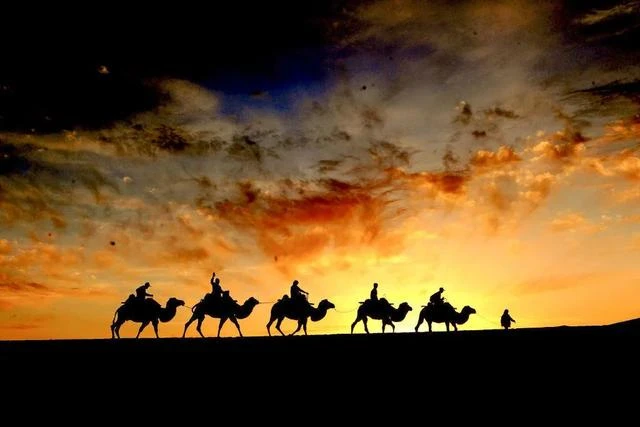
How beautiful is Dunhuang? Mingsha Mountain and Crescent Moon Spring—the sand does not encroach upon the spring, and they have coexisted in close embrace for thousands of years. Ride a camel through the desolate and vast scenery. Under the azure sky, there is nothing but golden sand—yellow upon yellow. A gentle breeze comes, the sand rises softly, smoothing over the shallow footprints.
People say, "Mingsha Mountain pleases the soul, Crescent Moon Spring cleanses the heart," offering a unique experience. Perhaps it is the tender care of Mingsha Mountain and the gentle companionship of Crescent Moon Spring that create such moving charm and elegance.
How beautiful is Dunhuang? At Yadan Devil City, you can appreciate the uncanny workmanship of nature. This was a necessary pass on the ancient Silk Road as it exited Dunhuang into the Northern and Middle routes of the Western Regions, a place full of magical charm. It is said that fierce winds are like knives and fine rain like swords; long-term weathering and erosion have given it a hellish landscape.
Walking into Yadan is like stepping into a medieval castle. Inside the castle, walls, streets, buildings, plazas, and sculptures are all present, as if meticulously arranged by an ingenious designer. Yet there is not a single blade of grass or tree. Amidst the gravel and sand sea, clay sculptures of various heights are arranged in a scattered yet orderly manner, each with a unique form. When the wind rises at night, eerie and desolate sounds emanate from within, like the wailing of ghosts and howling of wolves in myths, hence the name "Devil City."
How beautiful is Dunhuang? Yumen Pass—the majestic frontier pass where spring wind never reaches. In ancient times, going beyond Yumen Pass meant truly leaving the Central Plains. Tea and silk from the Central Plains entered the Western Regions here, while jade from the Western Regions was brought into the Central Plains. Yumen Pass became the gateway to the various kingdoms of the Western Regions.
In those days, the camel bells at Yumen Pass chimed leisurely, people shouted and horses neighed, caravans were continuous, and envoys came and went—a scene of bustling prosperity. Now, climbing the ancient pass and looking into the distance, one sees swamps and ravines everywhere, the Great Wall winding, beacon towers standing upright, red tamarisk flowers blooming, reeds swaying, all reflecting the majesty of the ancient pass—a moment of mixed emotions.
How beautiful is Dunhuang? Mogao Caves—the art gallery in the desert, a place people say "you must visit once in a lifetime."
Entering Dunhuang, the most immediate feeling is desolation and mystery. The passage of time and the wind-blown sand of millennia have left many marks on this land: culture, history, vicissitudes, art. And Mogao Caves are the most powerful testament to this vastness.
They are not a fleeting mirage, nor a fantastical tale, but rather "celestial beings from beyond the sky" deep in the desert.
735 caves, 492 painted sculptures, 3,990 colored figurines, over ten wooden structures from various dynasties, spanning 1,653 years of history, gathering the wisdom of craftsmen from ten dynasties. Over the passage of time, it has inscribed the depth of history. Though the colors have faded, it still emanates an indescribable mystery and splendor. The cave statues of Dunhuang Mogao Caves are mainly made of clay and painted, hence called painted sculptures. The pigments are derived from natural minerals, brilliant in color and long-lasting. The painted sculptures are the main focus of the caves, usually placed in the center of the main hall, primarily depicting Buddhas or Bodhisattvas. Murals adorn the surrounding walls and ceilings. In early caves, murals were only decorative and subordinate.
Dunhuang Mogao Caves are a treasure house of ancient Chinese art, not only for painted sculptures but also for frescoes. Dunhuang murals are also a treasury of Chinese art, whose cultural and historical value has shone like a brilliant pearl for a thousand years.
1. Cave 45, Mogao Caves: Bodhisattva Mahasthamaprapta
In Cave 45, the Bodhisattva Mahasthamaprapta wears a jeweled crown and a high bun, his upper body half-naked, skin smooth and radiant, adorned with a cape, necklace, armlets, bracelets, and other ornaments, handsome yet with feminine charm. His eyes are downcast, expression focused, as if listening attentively to the prayers of worshippers. He is the embodiment of compassion and kindness, a perfect crystallization of ideal and artistic creation.
2. Cave 57, Mogao Caves: The Beauty Bodhisattva
In Cave 57, the Avalokitesvara Bodhisattva is considered one of the finest among Tang dynasty Bodhisattva images, praised as the "Beauty Bodhisattva," and the cave is thus called the "Beauty Cave." The Bodhisattva has a graceful posture, smooth and delicate skin, long eyes, slender eyebrows, red lips, straight nose, refined and elegant, beautiful and charming. Her gilded and embossed jeweled crown and ornaments, along with her lightly blushed skin, make her appear extraordinary, magnificent, and opulent.
3. Cave 158, Mogao Caves: Bodhisattva to the Left of the Sutra of the Questions of Brahma
In Cave 158, the Bodhisattva to the left of the Sutra of the Questions of Brahma sits on a lotus throne, with a halo and a serrated backlight. The left Bodhisattva holds a ruyi scepter with both hands. Above are pavilions and winding corridors, surrounded by many Bodhisattvas and offering Bodhisattvas, each holding flowers with palms joined, listening to the sermon.
4. Cave 158, Mogao Caves: Flying Apsaras (1)
In Cave 158, there are three Flying Apsaras located on the south, middle, and north sides above the row of Bodhisattvas between the sal trees on the west wall. The Flying Apsaras either play a transverse flute, hold a flower tray, or hold a necklace. Their scarves drift with auspicious clouds, giving a strong sense of motion. To the right of each Flying Apsara, there are large geese carrying flowers.
5. Cave 14, Mogao Caves: The Principal Bodhisattva (1)
In Cave 14, the Principal Bodhisattva, either sitting or kneeling, holding an object or forming a mudra, has a jade-white full body, simple clothing and adornment, slender eyebrows, small mouth, phoenix eyes, straight nose, compassionate and gentle, serene and joyful, deeply meditative.
How beautiful is Dunhuang? Through millennia, there is only one Dunhuang. "Dun" means great; "Huang" means flourishing. Dunhuang's name means great splendor, and this name recorded in the Records of the Grand Historian reveals its essence at once.
From the murals and stone carvings of Mogao Caves to the myth of the Nine-Colored Deer; from the rolling dunes of Mingsha Mountain to the clear and inexhaustible Crescent Moon Spring; from the uncanny workmanship of the Yadan landforms to the historical tales of the Yumen Pass... each stirs the profound strength of traditional Chinese culture, shining brightly in the river of history.
Ancient and modern, this small town, with its innate character, always touches the heart just right. Whether it is the wind and moon at the end of the desert or a glance across a thousand years on the Silk Road, it possesses an irresistible beauty and undeniable power—the boundless land beneath you and the myriad stars above that you can almost touch.
One grain of sand, a world; one speck of dust, a Buddha land. A thousand years in a moment, a moment in a thousand years. Even if a great dream lasts a thousand years, it may be buried by the yellow sands of history. Yet, "when you bend down and scoop up a handful of sand, a story will appear in your palm."
Some say, "As a Chinese, you must visit Dunhuang once in your lifetime." Because the scenery is beautiful, and also because Dunhuang carries a brilliant culture. It has endured millennia, experienced prosperity and decline in the vast desert, yet has remained immortal, writing the art of Huaxia.
I want to ride a camel at Mingsha Mountain, to see the Crescent Moon Spring among the dunes; to go to Yumen Pass and Yang Pass to experience the heroic grandeur of "a lonely city amid a thousand peaks"; and even more, to visit Mogao Caves to appreciate the ancient traditional art of China...


