In the Film City Amidst the Gobi Desert, You Are the Director and the Star—Shoot a Blockbuster, It's All Up to You!
Dunhuang, an oasis in the heart of the desert; an ancient and time-honored historic city; once a vital hub of East-West transportation and a key choke point along the Silk Road! Although the remnants of the ancient city of Dunhuang are now mere broken walls and ruins, you can still find some traces of the old city on the riverbed of the west bank of the Dang River, which the people of Dunhuang call the mother river...
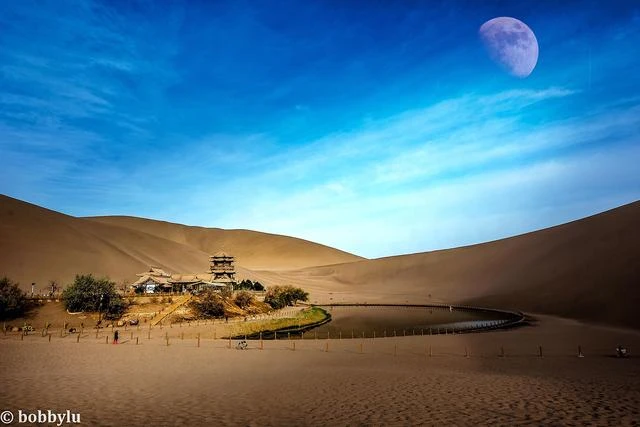
Historically, the ancient city of Dunhuang was bordered by the Sanwei Mountains to the east, the Mingsha Mountains (Singing Sand Dunes) to the south, the boundless desert to the west, and the uninhabited Gobi to the north! In terms of history and culture alone, Dunhuang has long left a brilliant and indelible mark on the grand scroll of Chinese history and culture. In terms of modern tourism resources, Dunhuang also holds a distinct advantage, earning international fame as a renowned tourist city in western China.
Moreover, influenced by Dunhuang's long history and the brilliant culture of the Silk Road, in 1988, China and Japan co-produced the large-scale historical feature film "Dunhuang." Before filming, a meticulously designed ancient Chinese architectural style—financed by the Japanese side—resulted in the construction of a 10,000-square-meter Dunhuang Ancient City (a Song Dynasty-style Shazhou City replica).
From that time onward, and continuing to this day, an ever-increasing number of film and television production teams have come here year-round to shoot and complete one masterpiece after another. Well-known films and series include the 1990 mythological costume drama "The Legend of the Condor Heroes" (note: actually "Fengshen Bang"?), the 1992 martial arts film "New Dragon Gate Inn," and the third and fourth installments of "Detective Dee" ("Young Sherlock Holmes"?), all of which were filmed here. To date, over a hundred films and TV shows have been shot at this location.
As for this miniature version of Dunhuang Ancient City (Dunhuang Film City), it can be described by the saying: "Small as a sparrow, but with all the vital organs." From outside the film city, the towering city walls and gate towers are majestic. The entire film city has three gates: east, west, and south. The layout of the inner city was designed and built entirely referencing the murals of the Mogao Caves.
Inside, several imitation ancient bustling streets have been carefully created, featuring buildings with strong Western Regions (Xiyu) charm, as well as ethnic-minority-style adobe houses. Of course, the re-creation of Ganzhou City (Zhangye) streets, Xingqing Street (Yinchuan), and so on, have all been built and displayed here. Different areas showcase different regional landscapes and architectural styles, with inns, shops, taverns, temples, and shrines—everything you need.
Of course, since this is called a film city, aside from the fixed buildings and sets that cannot be altered, it naturally includes plenty of props, costumes, filming equipment, and even professional actors. For example, there is a stable here, and you can even rent a real "sweating blood horse" (Akhal-Teke). If you don't know how to ride or need stunts, there are professional stunt riders to perform the equestrian moves for you.
If you and your companions want to spend a day here creating a "blockbuster" that you direct, shoot, and star in yourself, I can responsibly tell you that this idea is absolutely feasible! There are several costume and prop rooms to choose from, with categories ranging from ancient costumes to modern war military uniforms, and even contemporary outfits and props, including swords, spears, and halberds. You can rent them for a day at a reasonable price, and staff will help you dress and apply makeup...
And not surprisingly, in this film city, you often meet young dreamers who share the same passion for filmmaking, directing, or starring. Look! A young lady, after finishing her makeup, is gradually immersing herself into her role. Judging by her attire and styling, she is clearly playing a noble lady, performing a scene of offering prayers and fulfilling a vow...
The yamen (government office) gates are wide open, ready for the classic scene of beating the drum to appeal for justice. Whether a constable rushes in with an urgent dispatch, or a bully is brought in and waits for trial at the yamen entrance—how these scenes are performed, how many lines are spoken, whether you enter running or crawling—it's all up to you, because here, you can be the director!
You see, while describing the scene, I have already turned the script I just narrated into a "work" and added many more twists along the way. I only captured a few frames from the video (converted from a mobile screenshot, so not very clear), but after watching the full video, the effect and the pride are definitely worth bragging about!
Of course, the general environment here is excellent for shooting martial arts themes. But that doesn't mean romance, spy thrillers, comedies, or contemporary fashion blockbusters can't be filmed here. As for the theme, story content, character styling, etc.—again, everything here is up to you. As long as you like it, at least for today, you call the shots!
So, while traveling to Dunhuang in Gansu, why not come here and get a taste of being a "director"? In my opinion, acting is the most satisfying, but being both the director and the lead is truly the ultimate thrill. Look, this young hero is still immersed in the scene he just acted, known as "not having come out of character yet." That's okay—here, as long as you have time, whether to cut the scene or not, and when to cut it, is—again—all up to you!


