Eyes in Heaven: A Painstaking 10,000-Word Guide to the Northwest Grand Loop (with Charter Itinerary and Price List) – Ladies, Please Look Here
The Northwest has always been synonymous with holiness, mystery, and hardship in my heart. Deciding to make the trip in the scorching summer takes great courage. As the title says, throughout the entire journey, our eyes were in heaven—ordinary mortals living on earth, if we have the chance to see such beauty in a lifetime, what more could we ask for?
But don't forget the second half of the saying "Eyes in Heaven" is... "Body in Hell"!
So, ladies, I beg you to take a good look at this guide. I don't want to waste words; I just want to give you the hard-earned lessons I learned from blood and tears. I hope that besides taking beautiful photos during the trip, you won't need to rebuild your skin and figure after returning.
The Northwest Grand Loop refers to a circuit starting from Xining, the capital of Qinghai Province, passing by the south, west, and north of Qinghai Lake, and returning to Xining. The total distance is over 2,800 kilometers. Tourists can depart from Xining and leave from Xining at the end.
The specific attractions are determined by the number of days. Our group of four girls chose a 7-day charter, which was worry-free, labor-saving, cost-effective, and relatively safe. According to our preliminary research, the price ranged from 4,500 to 6,500 yuan. The main factors determining the price should be shopping and service. Our charter price was 5,200 yuan for 7 days for 4 people (including airport transfer), no shopping. The car was a Toyota Corolla, and splitting it per person, 1,400 yuan was quite a bargain.
Since we didn't want to leave on the same day we arrived, we arrived a day early and left a day later. The entire trip was a full 9 days. For the 7-day itinerary described below, just look at Day 2 to Day 8.
The specific route is as follows:
Day 1: Arrive in Xining - Overnight in Xining
Day 2: Xining - Tar Temple - Laji Mountain - Qinghai Lake - Overnight in Chaka Town
Day 3: Chaka Salt Lake - Qaidam Basin - Emerald Lake - Overnight in Dachaidan
Day 4: Dachaidan - Highway 315 (Most Beautiful Highway) - Water Yadan - Dongtai Jinerhu Lake - Overnight in Dachaidan
Day 5: Dachaidan - Yadan Ghost Town - Dangjin Mountain Most Beautiful Highway - Aksai Oil Town - Dunhuang Ancient City - Dunhuang Wild Camping (optional) - Overnight in Dunhuang
Day 6: Dunhuang Mogao Caves - Dunhuang Museum (optional) - Singing Sand Mountain & Crescent Moon Spring - Dunhuang Night Market (optional) - Overnight in Dunhuang
Day 7: Dunhuang - Guazhou - Jiayuguan - Zhangye Rainbow Mountains - Overnight in Zhangye
Day 8: Zhangye - Biandukou - Qilian Grassland - Ebo Silk Ancient Road - Gangshka Snow Peak (distant view) - Menyuan - Xining
Day 9: Leave Xining
This route is the most classic. Although a bit rushed, it includes all the highlights: mountains, lakes, grasslands, deserts, starry skies, and flower seas. I recommend extending it, not shortening it.
Different group sizes mean different car models, but no matter the model, please learn a bit about the car. Comfort is crucial for seven days. Each day’s itinerary covers at least 400 kilometers, meaning you'll be in the car for over five hours. If you choose the wrong car, the entire trip will be very painful.
For example, some sedans have a hump in the middle of the rear seat, known as rear-wheel drive. If you choose a rear-wheel drive car, the person sitting in the middle will suffer—crouching every day for such a long time is terrible. So, smart you will make the wisest choice, right?
Our driver goes by the name "Wuxin" (Heartless). To be honest, we initially wanted to replace him. He never spoke more than five words: "Jump again," "Not pretty," "Get down," "Hurry up," "So long"... He was nothing like the talkative tour guide driver I expected. He didn't introduce any attractions or local customs, just drove silently and urged us constantly. We wanted to kill him.
But later we found out he was a man of few words but deep down was a tsundere straight guy: always had plenty of bottled water and motion sickness patches in the trunk; when he saw me pulling up my scarf, he would silently turn down the air conditioning; if a friend coughed a couple of times, he would quietly close the window to avoid dust; he took over 70 photos and sent them via AirDrop while driving, startling us; knowing we were picky about accommodation, he let us check the rooms before settling; and when I was deeply asleep, he poked me and said, "Look, you like canola flowers"...
Although he was fierce when taking photos, constantly urging and complaining, his photos made us shut up immediately. Maybe because he has led many tours in the Northwest, he was familiar with taking photos there. His motion shots, group photos, panoramas, and videos were at the level of a professional photographer. On the road, he even taught me how to use time-lapse photography while driving, again nagging that I wasn't doing it right, not low enough, not long enough. But when I followed his instructions, the result actually looked good.
Later, making this tsundere guy laugh became our entertainment in the car. When Liu Liu imitated a horse's neigh, he couldn't help laughing. We were happy for a long time—studying his expression of wanting to laugh but holding back was a perverse hobby. Anyway, choosing the right driver is very, very important. You'll be together day and night for seven days. Of course, I wish he were omnipotent, but everyone has different strengths. I suggest you add several drivers, check their photo quality on Moments, and chat to see if you get along. One big reason we chose this driver was that he was very diligent in helping us pick hotels, and he got us prices lower than any website. His taste was indeed good. Even a picky person like me had nothing to complain about the hotels he recommended. Hope all the girls who set out can find a compatible driver, making these seven days a happy journey!
We are just a group of beauty-loving silly girls, not photography enthusiasts. So we only had three iPhones and one Huawei phone between us. I personally don't like to edit photos much, so most of the photos you'll see later are the real Northwest. Of course, we had a designated P-image guy supporting us from behind, but post-editing is only for a few classic shots. The key is the framing, angle, and clothing. I'll talk more about our painful experiences posing for photos and highlight key points later.
This is the most important thing: Before departure, ask the driver how many and what size suitcases can fit in the trunk. Girls always have a lot of stuff, and the Grand Loop requires changing accommodation almost every day. I completely understand wanting to bring your entire home. But normally, a sedan trunk can hold two 24-inch and two 21-inch suitcases. So one suitcase plus one large backpack per person is standard. If you bring more, you'll have to add burden to the cabin, making it uncomfortable. Next, I'll tell you what you absolutely must bring; if not necessary, leave it at home!
Sunscreen and sunscreen spray: This should go without saying. Bring one lotion and one spray. Apply everywhere from head to toe half an hour before going out daily. Don't miss the neck and chest. Also, avoid using spray on your face after makeup, or it will remove your makeup instantly (contains oil), leaving black tears. The best way is to use sunscreen as a base or a foundation with SPF. But if you've had makeup on for more than four hours and the sunscreen has worn off, preserving fair skin is more important than preserving makeup.
Shampoo and conditioner: As much as I hate it, you basically need to wash your hair every day. Your hair will be filled with salt and sand. The only good thing is it won't look greasy? Hotel toiletries, as everyone knows, can turn normal hair into a rope, especially when mixed with sand and salt. If the hotel is not great, you might also need to bring a hairdryer (check the hotel facilities on the booking site). The basic requirement for the Northwest Grand Loop is to wake up earlier than the rooster and sleep later than the dog. You arrive at the hotel around 10 PM every night. After dropping your luggage, you basically just wash up and sleep. Not drying your hair after washing can have terrible chain effects. Of course, I luckily found hairdressers in Xining and Dachaidan, so I could be lazy a couple times.
Skincare: I know it's summer, but bring the most moisturizing products you use in winter! Or even products like Dabao, Snow Flower Cream, Vaseline, Horse Oil, Essential Oil, Bio-Oil! Listen to me: throw the lotions and cream masks out of your suitcase. They're useless. If you gave me a bottle of oil in Shenzhen in summer, I'd curse. But in the Northwest, if you share a bottle of oil with me, we're friends! Hand cream, lip balm, sheet masks (enough for one per day) must be prepared. If you don't believe me, I'll show you photos of how terrifyingly dry it is here!
Cosmetics: Try not to bring liquid eyeliner; bring eyeliner pencils. If you must know why, because the air pressure here makes liquid eyeliner gush out like oil when opened—imagine that scene. For foundation, even La Mer isn't moisturizing enough, so just go with whatever. Don't bring loose powder; it's so dry you don't need to set makeup. Avoid cream lipstick, blush, and contour unless you want them to sacrifice themselves in the desert.
Clothing: Many guides mention wearing bright colors. I add: try different styles—tough, soft, Hanfu, or ethnic costumes if you have them. Be the most flamboyant girl in the Northwest. Only one goal: take the best photos. Women can't lose! Bring all the clothes you dare not wear at home; no one knows you there, right? Later in the travelogue, I'll detail what color and style to wear each day. For packing, roll your clothes to save space. A 21-inch suitcase can easily fit ten sets.
Disposable items: Since you change hotels almost daily and leave early and return late, there's little chance to do laundry. For underwear, either bring ones you're about to throw away or disposable ones. Hotel conditions in the Northwest are average; if you're uncomfortable, bring your own toothbrush, water bottle, and disposable travel towels. Actually, it's satisfying to see things in your suitcase diminish.
Medicine: I rarely bring medicine on trips. But my travel companions aren't very healthy. They took Rhodiola rosea a week before and also brought motion sickness pills, Banlangen, painkillers, etc. Decide based on your situation.
Flip-flops: Useful for lakes where you might want to wade or take photos. Hotel slippers are super ugly, so bring your own.
Long pants and sun-protection jacket: Even though you'll wear all kinds of bright clothes, long pants and a sun jacket are what you use most.
Umbrella and sunglasses: You probably bring an umbrella anyway, but sunglasses are a must in the Northwest; otherwise, you can't open your eyes in some places.
Jacket and shawl: This trip includes high altitudes and huge temperature differences between day and night, so a jacket is necessary. Shawls are available everywhere; just buy one.
Plastic bags, wet wipes, hand sanitizer: See next section for reasons.
I have to talk about this separately! I fear nothing, but I fear the bathrooms in the Northwest's no-man's-land!!! No signal is fine, but no water in the bathroom?! At first, our civilized dignity made us reluctant, but later we found that bottom lines are fragile—what is face? Not important...
So, if you didn't bring wet wipes or hand sanitizer, prepare an empty plastic bottle every day and fill it with tap water. You'll thank me when you can't wash your hands. As for garbage bags, girls inevitably produce some trash in the bathroom; you can't just leave it in the wild. A plastic bag helps; throw it away when you see a trash can.
Anyway, this is an unavoidable challenge. May you let go of your burdens and embrace nature...
Okay, enough rambling. Now let's formally introduce our entire journey—I'll write down what I saw, heard, and found. I used to not want to spoil it for you, but later I realized if I don't write these things down like taking notes, I'll forget them in a month or two! So treat this as a preview of key points, saving you the trouble of searching for info, hehe~
We took an early flight from Shenzhen on July 3rd and arrived in Xining just at noon. I have to say, there's no need to buy delay insurance for Xining flights. Our 9:25 flight had us in the air at 9:28, incredibly punctual. Before coming to the Northwest, we knew there was a big temperature difference between day and night, but we thought it would be hot during the day since there's a desert nearby... However, as soon as we stepped out of the airport, we were blown away by the wind. Checking the weather, it was only 17°C at noon—kind of scary. The airport transfer driver took us smoothly to the Vienna Hotel on Delingha Road. This hotel had just opened a year ago, very new with a good location. The online price was 338 yuan, but the driver booked it for 228 yuan per night. It was said that during peak season in July and August last year, prices were at least double. Happy!
As soon as we dropped our luggage and put on makeup, we rushed to fill our stomachs—our first meal in Xining was at 'Qingzhen Yiranxuan Qinghai Specialties', just a 10-minute walk from our hotel. The high ratings of this restaurant were evident the moment we walked in: the front desk lady was so beautiful! So Dilraba was telling the truth; her looks are actually common in the Northwest. Gorgeous girls are everywhere here. The restaurant environment was great, each table in a separate private room, and the service was attentive—pouring tea, helping with photos. Most importantly, the food was delicious, affordable, and generous in portion. You deserve it!!!!! Must order the signature braised beef bone; the meat easily falls off the bone, soft and flavorful. The Qinghai clay pot hotpot uses a copper pot; it's called "earthy" because the ingredients are everyday items. The food is already cooked when served. It's like a stewed version of hotpot with soup. The meat and veggies taste good with or without dipping sauce, and the broth is light and delicious, drinkable. 'Goujiao Niao' (dog urination) is a local flatbread, a sweet golden thin pancake. The name comes from the action of repeatedly drizzling oil while baking, resembling a dog urinating. The beef bone and hotpot were small portions, plus the flatbread and eight-treasure tea, total 257 yuan. Four of us were stuffed to the brim. Great value! Highly recommended!
There aren't many attractions in Xining city; mostly mosques. After eating, we headed to Dongguan Mosque. It's one of the four great mosques in Northwest China and can accommodate the largest number of Muslims for prayer in the country. Currently, due to special circumstances, it's closed, but you can feel its grandeur from the outside. The architecture combines Han, Tibetan, and Islamic styles, rare in China. The Tibetan gilded vase on the roof is said to be unique nationwide. Worth seeing! Mosques are clustered in this area. A 10-minute walk takes you to Nanguan Mosque and Yudaiqiao Mosque, both closed but each unique. Along the way, there are many local shops worth exploring.
After visiting the mosque, we found that the driver recommended Xin Qian International Plaza nearby, so we walked over. The plaza adjoins Wangfujing Department Store. As a mall, it even has a mosque in its center—very local! The reason the driver recommended it is the night market with various snacks, a new bustling area. We had walked over 10,000 steps and were tired, but it was still bright at 8 PM, which was frustrating. We chose the busiest restaurant, 'Bao Hulú', a local chain dessert shop. We tried local specialties like sweet fermented barley (tianpei), fermented rice (laozao), yogurt, and cold noodle (liangpi), all for 10-15 yuan. We ordered milky tea with tianpei, yogurt, egg and milk fermented rice, and potato slices. Each was a small portion, total 52 yuan. Strongly recommend the potato slices (yangyu pian)—addictive! Northwest potatoes are especially delicious. Cheap and tasty, ten thumbs up!
Next, we went to a very disappointing place—Mojiā Street. Actually, the driver had told us not to go, but we had to see for ourselves. Mojiā Street is famous as one of Xining's oldest streets with over 600 years of history. But it's a total tourist trap, especially the 'Ma Zhong Food House', which became the shadow of our entire trip. Whenever we encountered bad food afterward, we used 'Ma Zhong' as a substitute sentence: What the heck is this? So Ma Zhong!
Because Northwest restaurant names are often hard to remember (mostly starting with 'Yi'), even good ones require looking at photos to recall. But this Ma Zhong, where only the fruit was good, had a name that was easy to remember. Don't step on this landmine! (Later we found its online rating is only 3.2; I believe you won't go either!)
Our relaxing first day ended happily. The next day, the 7-day Grand Loop officially started!
The next morning at 7:30, we crawled downstairs for breakfast under the driver's cold urging. Key point: Wear bright colors today, ethnic accessories (e.g., shawl, bracelet) are a plus! No shorts or mini skirts. Sunglasses and hats can be carried, but you must remove them when entering a temple. In the Northwest, a religious holy land, respecting faith is respecting yourself.
I especially like to have breakfast at a roadside shop. Our hotel had a beef noodle shop downstairs. They only served two or three basic items; we ordered one of each, three bowls for 27 yuan, super full. Let's go!
The first stop of the Grand Loop was Tar Temple (Ta'er Temple). At the entrance, there were shops offering hair braiding (10 yuan for three braids) and selling various shawls at reasonable prices. Since we were going to Laji Mountain at over 4,000 meters, I bought a thick wool shawl (from 150 to 100 yuan). It was very useful throughout the trip.
Tar Temple ticket: 70 yuan per person. There are professional guides at the entrance, 160 yuan for groups under 5. We hired one. The earlier you arrive, the better, especially for praying and photos. A guided tour of the entire temple takes about two hours. Crowds increase at noon. We arrived around 9 AM, so we could still stand in front of the Buddha for prayer. But many places in the temple don't allow photos, so by the time we listened to the guide's stories and wanted to take pictures, tour groups had filled every corner, making it hard to photograph.
The first thing you see upon entering is the Eight Pagodas of如意 (Ruyi), the most iconic landmark of Tar Temple. They commemorate the eight great deeds of Buddha Shakyamuni from birth to nirvana. As a tourist, Tar Temple is the center of Tibetan Buddhism in Northwest China. Devotees can be seen prostrating themselves in three steps and nine bows, some even carrying bags to stay and practice. Their faces are full of piety and peace, inspiring respect. The Eight Pagodas are the classic photo spot. With the blue sky, they look sacred and majestic. They look great from any angle. Don't miss them!
All four of us believe in Buddhism, but Tibetan Buddhism is much more profound than what we know. Even with the guide, I couldn't fully understand the historical origins and relationships of Tibetan Buddhism, confusing Dalai, Panchen, Lama—which is normal; otherwise, what's the point of masters studying Buddhism all their lives? But I remembered key knowledge: The name 'Tar Temple' comes from the story "first the pagoda, then the temple." The main buildings are built on a mountain shaped like a blooming lotus, with Tar Temple at the center—a feng shui treasure. The pagoda contains a bodhi tree and gold. According to legend, Tsongkhapa, founder of the Gelug sect of Tibetan Buddhism, left home to study Buddhism in Tibet. His mother missed him and sent a lock of her white hair, hoping he would return. But Tsongkhapa was determined to devote himself to Buddhism, so he told his mother to build a pagoda at his birthplace using 100,000 lion's roar Buddha statues and a bodhi tree as the relic. See the pagoda as seeing him. The temple beside it was built 200 years later.
Religious culture is profound and sometimes obscure, but art is universal. I don't consider myself artistic, but I was shocked when I saw the three art treasures of Tar Temple: appliqué thangka (duixiu), frescoes, and butter sculpture (suhua). Since almost all indoor places forbid photography, be sure to appreciate them.
The most impressive was the butter sculpture. When I saw these colorful, intricate sculptures, I didn't feel anything special, nor did I realize they were made of butter. The guide said, "Do you think this display case is glass? Actually, it's a large freezer. Only by maintaining low temperature can these sculptures be so perfectly presented." After hearing this, I got goosebumps. This is indeed a cruel yet transcendent art—
All the butter sculptures we saw were made by monk artists in the temple. Everyone knows that oil solidifies when cold and melts when hot. To prevent the butter from melting due to hand temperature during sculpting, the monk artists work in studios with temperatures controlled to zero degrees Celsius, with a basin of ice water nearby. They have to dip their hands in ice water frequently to keep them cold. As a result, most of them have frostbite on their hands. This devotion to Buddhism and pursuit of artistic perfection transcends physical pain. In their cold hands, gorgeous butter sculptures come to life. The whole process is unimaginably hard, truly moving...
The guide lectured for about 90 minutes, then we had free time. We finally took out our phones for photos!
We spent 2.5 hours at Tar Temple. Afterward, it was lunchtime. We ate at a restaurant near the entrance. Reminder: For the following days, dinner is usually around 8 PM, so lunch must be full and good.
About an hour later, we arrived at Laji Mountain. It belongs to the Riyue Mountain range, with an altitude of over 4,000 meters—the highest on this trip. The temperature dropped to about 13-14°C. Liu Liu and Coco had taken Rhodiola a week earlier and seemed fine, but Lily, with weak constitution, was struggling. She had to move slowly to survive. If you're sensitive to altitude and cold, be well-prepared.
We directly went to the highest point, Zongka Laze, at 4,180 meters above sea level. This is the largest Laze in the world and holds a Guinness record.
Inside, a guide offered us hada (ceremonial scarves) and explained some Tibetan Buddhist sacrificial customs. There was a master chanting sutras. He randomly selected some of us to give words of advice. Three out of four of us were chosen—and it was incredibly accurate, hitting the mark. We met the master for the first time, but his words were not generic; they were specific advice and blessings for each individual. Some of us almost cried. We grew up believing in Buddhism, so we made offerings (voluntary, ranging from hundreds to thousands of yuan). This place truly gave me peace. Was it the master's power to purify the soul?
After leaving Zongka Laze, the next stop was Qinghai Lake, about a two to three-hour drive. If you charter a car, the driver can bypass the official entrance and save the ticket. Note: After leaving Tar Temple, there are no decent bathrooms along the way, including at Zongka Laze. There are paid toilets, but they are horrific—no water! Friends who went in first almost wanted to poke out my eyes and turned me back. Recalling our expressions, it was both pitiful and funny... Later, we even went into a roadside restaurant and asked, "We'll pay you. Can we wash our hands?" So before leaving Tar Temple, make good use of the last luxurious facilities. Wish you a pleasant life.
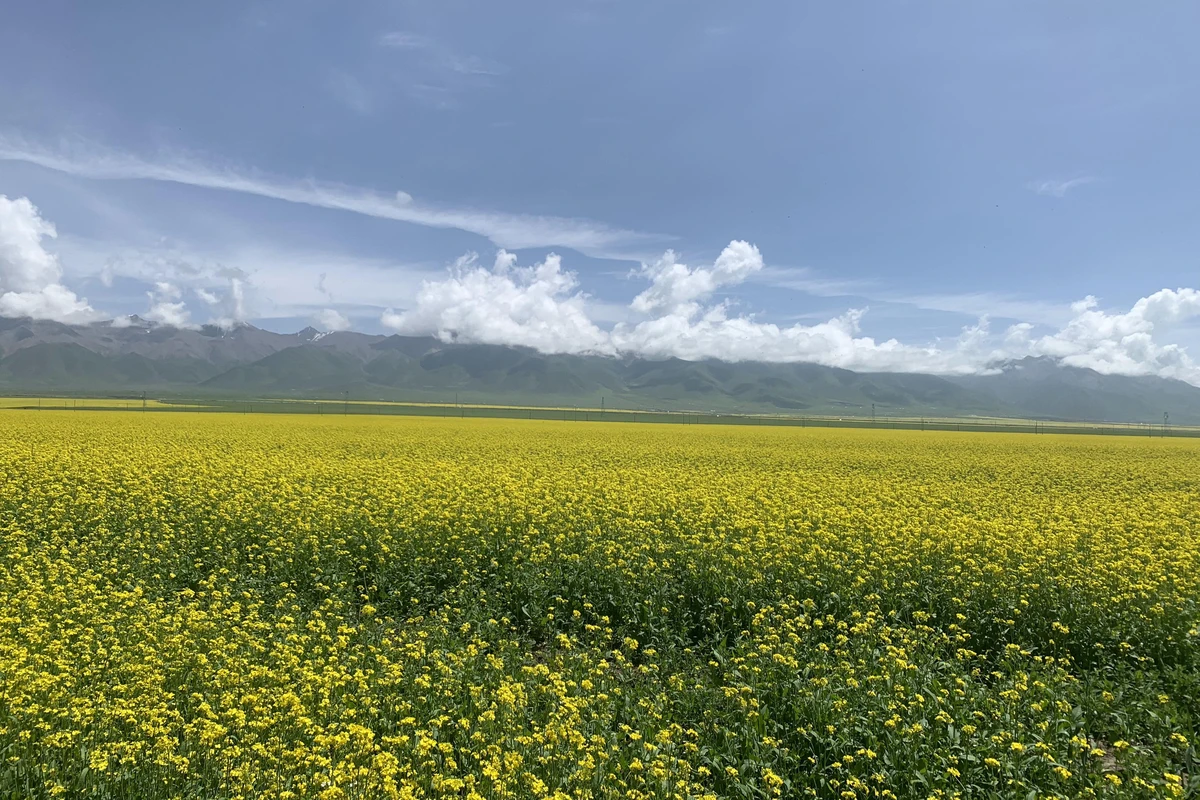
Before reaching Qinghai Lake, I sincerely admired the roadside scenery: large fields of golden canola flowers, matching the sky and lake—stunning! These flower fields charge 60 yuan per person. Since we were there, we went for it! The fields had different varieties: canola, lavender, each forming a sea of flowers. I love golden canola flowers. Even the scorching sun at 5 PM could make you two shades darker, I couldn't bear to leave. Just standing there made for a great photo.
Next to the flower field is Qinghai Lake. Although sunny, the temperature at the west side was quite comfortable, not hot. The sun was boiling us like a frog in warm water, slowly tanning us. The lake water was very cold, around 10°C. If you want to go in, wear flip-flops. There are yaks for photo ops: 10 yuan on land, 20 yuan in water. Try to pick a female yak; herders even give them smoky eye makeup, making them look hilarious. Two of my friends are afraid of animals; they screamed at the sight of a dog and almost fainted at the yak. But I was excited. I convinced Lily to ride one after negotiating with the yak baby. Fun!
Near Qinghai Lake, there are hot air balloons overlooking the lake and flower fields. If interested, try it. We didn't go and regretted it later, as the balloons need windless conditions. Seize the chance. We spent about two hours at Qinghai Lake and canola fields, then headed to Chaka Town for the night. Although it was evening, the Northwest doesn't get dark until 9 PM, which messed up our time perception. Afternoon meant 1 PM to 9 PM... We arrived in Chaka around 8 PM. According to online recommendations, the top-ranked restaurants were Yi Feng Yuan and Xi Yu Ah La Ba La Restaurant (search address in Chaka: Wulan County, Haixi). We scheduled them for dinner tonight and lunch tomorrow, respectively. This place is interesting—only restaurants and hotels, nothing else. The entire industry seems driven by Chaka Salt Lake!
At Yi Feng Yuan, we ordered lamb pot (kang guo yang rou), yogurt, egg soup, and stir-fried cabbage. Two dishes were enough for four girls. The lamb pot was huge and delicious—Northwest people know how to cook lamb! Spices perfectly complemented the meat. The potatoes underneath were the best. We cleaned the plate. Total: 193 yuan, 50 per person. Great value. But this area might be salt-producing, so sweets are rare. We ran to a milk tea shop across the street for 66 yuan for four cups, average taste.
We stayed at Hengfeng Hotel, opened in June 2020. Online price over 400, driver got 260 per night. The only plus for me was it was new; there was still a faint smell of decoration, which will improve. The hotel was thoughtful: baseboard heating, plants, humidifier. Clean enough. But I noticed that except for city hotels, bathrooms in Northwest have no separation between wet and dry. After showering, the whole bathroom becomes a sea. Be careful. We got back after 10 PM, washed hair, took photos, posted on social media, and it was past midnight. The thought of waking up earlier than a rooster was despairing.
Since we stayed in Chaka Town, it was a short drive to the scenic area the next morning. Breakfast at a roadside shop: fried dough sticks and beef noodles, cheap and filling. The weather was cool but UV was strong, so we all dressed like Arab women, fully covered. Tickets for Chaka Salt Lake come in single or combo; we bought combo (including observation tower, small train, and electric cart) for 150 yuan per person. Strongly recommend the small train ticket. The entrance is 5 km from the salt lake; walking would kill your legs. On the train, you feel like you're in a fairyland. I could sit and stare all day.
Key point: Sun protection is a must. Don't take off clothes unless taking photos. Sunglasses are necessary; this is the "Mirror of the Sky," and the reflection can blind you. Wear the brightest clothes possible. Photos are the priority; no one knows you here. Bring flip-flops if you plan to wade. The scenic area offers shoe covers (very ugly), but wearing them protects your feet. Those who dare to walk barefoot in Chaka Salt Lake are heroes...
We couldn't stand the shoe covers (later we realized tight jeans plus shoe covers look cool, like boots; with a bright shawl, it's pretty). So we made a bold decision: go barefoot and wade to a remote area for photos!
Oh my god! The water was freezing, about 5-6°C, biting cold. The water wasn't deep, but the lakebed was rough salt crystals. Even with flip-flops, salt bits squeezed between foot and shoe, causing pain like walking on knife edges. After half an hour of suffering, we crawled to the center where few people were. Then a photographer asked if we wanted photos. We almost refused without thinking. Later, we found that phone photos couldn't achieve the effects in travel blogs. Worst of all, the photographer disappeared into the lake in no time...
After struggling to take photos for each other, we realized we were too overconfident. So that day, we shouted across the lake: "Best photographer, where are you? We apologize!" As luck would have it, he reappeared!
We suppressed excitement and asked the price. He offered 688 yuan for at least 50 shots. We tried to negotiate to 300. He turned to leave without saying goodbye. We couldn't let him escape. We chased him, made peace, and finally he agreed to 300 for over 30 shots. Professional work done by professionals. We didn't save money!
After the photo session, we had no feeling in our feet. We trudged back to shore. On the return train, we got off at each stop because the shore views of the salt lake were also beautiful. It was near noon; the sun could blind us, but I couldn't bear to wear sunglasses and miss the colors. This place is so beautiful—how lucky to be able to see this fallen mirror of the sky!
Going into the water was fun, but washing feet was hell. The salt dried on our skin, stinging when peeled. And why was the tap water at noon as cold as ice water? Anyway, three hours at Chaka Salt Lake were memorable—you have to endure pain to get the best. Looking back, all the hardship was worth it.
Before leaving for the next stop, we returned to Chaka Town for lunch. Some restaurants offer small discounts if diners post good reviews online. But I think travelers are honest; the highly-rated restaurants we visited were genuinely good. At the Ala Bala restaurant, we ordered big plate chicken, stir-fried yak meat, and lettuce. The big plate chicken was delicious, and the noodles added were a bonus. Potatoes underneath were again the highlight—Coco's eyes lit up as she grabbed potatoes, ignoring meat. We ate more potatoes than meat on this trip! But the stir-fried yak meat was tough. It's not the restaurant's fault; yak meat is naturally tough. Buy dried yak jerky instead. This dish cost 98 yuan and we barely touched it. Total lunch: 270 yuan. Even without the yak meat, it would be under 200. Four girls can order one meat and one veggie (our big plate chicken was a small portion).
Next stop: Emerald Lake. On the way to Dachaidan, we passed through the Qaidam Basin. On this trip, I developed a habit I never had: napping. The scenery was beautiful, but between 1 PM and 4 PM, I naturally got drowsy. Tough! Note: There's a highlight on this route—a national second-class standard restroom with automatic flushing and music! Incredible! We almost cried with joy! No dignity checking!
After two hours of bumpy ride, we seemed close. The muddy roads and gray dust were disappointing, but then my pupils dilated—I shouted "Damn!" ten times. Emerald Lake appeared suddenly, a green jade in the barren land. I couldn't imagine such pure green amidst the gray. Nature's work is amazing.
We practically screamed as we jumped out, but don't get too excited. Emerald Lake is also a salt lake, the salt underneath is white and fine, but it's much more dangerous than Chaka. The water is deep; you'd never get out if you fell in. The area isn't fully developed, with poor safety measures. Be careful when taking photos. For drone enthusiasts, this is a treasure. Although no camera can capture its real color, you can enjoy it with your eyes for two hours, especially with the sunset. Worth it!
Our salt lake games ended beautifully. We reached Dachaidan hotel around 9 PM, starving. Below the hotel was a restaurant called 'Yi Xin Yuan Special Cuisine'. No online reviews, but crowded. We went in. We ordered grilled lamb ribs, four grilled lamb legs, and hand-torn cabbage. This was the worst restaurant on the trip. The lamb ribs were not even the right cut. Total 197 yuan. Not recommended. Better to rely on online rankings. If you're in the middle of nowhere with no choice, at least in Dachaidan, you can search on apps with location set to Haixi.
Dachaidan allowed us to stay two nights, a rare opportunity to do laundry. The dry climate means any clothes dry overnight. We stayed at Haixi Dachaidan Yijing Hotel, 380 yuan/night with breakfast (weird breakfast dishes like hand-torn cabbage, tomato-scrambled eggs, cucumber). Dachaidan hotels are relatively expensive on this route. Average quality, still no separation in bathroom. Just bear with it.
Next day, first stop was Highway 315, the famous "Most Beautiful Highway." To match the vibe, wear cool clothes: black-and-white workwear or denim, plus boots and sunglasses. You'll be at the finish line while others are still at "on your marks"! But we visited different spots that day: some tough yellow sand, some gentle blue water. If possible, bring a change (since we stayed in Dachaidan two nights, luggage wasn't in the car but in the hotel).
On Highway 315, you're taking photos with your life—it's an active highway! We walked to the middle of the road, sat down, posed, and had to jump up within five seconds to avoid speeding cars. Every shot required the photographer to seize the moment. Grateful for our driver's photography skills; he took all the photos in one go and we got back in the car.
Speaking of bathrooms, the highway is in no-man's-land. There are toilets by the road, but more like crude huts. We'd rather embrace nature. At our wits' end, what's bottom line? What's dignity? All unimportant! Although no one knew us, using the bathroom was still terrifying. The lookouts wished they had ten eyes and eight ears. If someone approached, they'd stutter and explain. A huge meltdown. Please, country, build some decent flush toilets in no-man's-land! I can accept no signal, no asphalt road, but not a waterless bathroom! Remember what I said: bring a plastic bottle of tap water to wash hands. At least you'll feel better.
Next stop was Water Yadan. But when we arrived, a strange wind blew. The ticket hall announced that visitors could only tour via electric cart due to weather. The water wasn't beautiful that day due to sandstorm, so we skipped it. This was the only attraction affected by weather. Still, we were relatively lucky—the weather gods gave us natural lessons: in this trip we saw tornado, rainbow, sandstorm. A diligent teacher! Except for this time, it didn't affect our sightseeing. Grateful. Although we didn't enter, it was lunchtime. The second floor had a buffet for 58 yuan/person, average food but filling. Some ate instant noodles and hot dogs. Your choice. By the way, the second floor has a flush toilet, a world away from the frightening ones outside. Visit before leaving!
Before coming to the Northwest, we had mental images of most spots, but Dongtai Jinerhu Lake was completely unknown. It's undeveloped, so few online guides mention it. To enter, you pay 10 yuan (for the whole car) in cash only—no signal for phones. Compared to Emerald Lake's surprise, I can say Dongtai Jinerhu Lake is even better.
The beauty of this lake is not modest. The water glows fluorescent blue. I can't find fancy words; just look at the photos!
The salt in Dongtai Jinerhu is industrial salt, which gives it the bright blue color. The water can irritate skin, so not recommended for barefoot soaking. The reflection is more intense than Chaka, like thousands of diamonds blinding you. Sunglasses are a must, but the lake appears in two different colors with and without sunglasses—both beautiful. Try a few seconds. After seeing these lakes, I thought: people say "after Jiuzhai, no need to see water," but the Northwest's water is still worth seeing after Jiuzhaigou.
Since we skipped Water Yadan, the driver moved Yadan Ghost Town (scheduled for tomorrow) to today, which fit perfectly. Our next day became less rushed. I recommend this arrangement. From here, our itinerary left the gentle lakes for a different style.
Yadan Ghost Town is barren, with yellow sand and hard rocks, wind howling. It gives you a chill. I thought it would be hot, but the temperature was pleasant, just the wind strong enough to twist your mouth. Tourists usually climb to the hilltop, where the wind is stronger. Hair management is tough. Every photo has hair fighting for C position. Facing the wind, your bangs disappear, forehead exposed. Torture.
After a packed day, we returned to Dachaidan like refugees. At least we had fruit to stave off hunger. We obediently opened the app to find the top-ranked restaurant: Yibula Te Se Kang Guo. Even hungry, we didn't want to risk bad taste. The driver took us there.
Wow, this place was packed! A true internet-famous restaurant! We arrived around 8 PM, peak dinner time. All thirty-plus tables full. We finally found a seat, but ordering took forever. We had to grab a server by hand speed. Food came after half an hour, but all was forgiven when we tasted the lamb pot (kang guo yang pai). This is real lamb ribs! Each bone clearly separated, perfect fat-to-meat ratio, fragrant without gamey taste. We ate so clean we almost swallowed the plate. Also ordered lamb skewers, baked bread, veggie, and wheat porridge. All good. The wheat porridge surprised us; in Guangdong it's sweet, but here it's savory. Total: 164 yuan. Classic.
We walked back to the hotel, passing restaurants, hair salons, cosmetics shops. This area is quite lively. But most importantly, rest well, because tomorrow we head to my most anticipated stop: Dunhuang! I was too excited to sleep. Dunhuang, wait for me!
Since we'd already visited Yadan Ghost Town the day before, we naively slept in and left at 9:30 AM. We regretted it—the day's schedule was very full. Strongly recommend racing the rooster and leaving early.
Here are key lessons from my blood and tears: If it's a sunny day, WEAR PANTS—long pants, cool pants, and sneakers! Because Lily said "just wear anything" the night before, I wore a dress and flip-flops. Luckily I packed a sun jacket, otherwise I'd be peeled.
First stop: Aksai Oil Town. I thought it was just some alien houses, a film base with low expectations. But we went in, ticket 30 yuan per person (including electric cart).
Midway through the loop, the weather is no longer mild. Noon is hot. Any money spent to save energy is worth it. Although the scenic area is small, a combo ticket is sensible. The electric cart driver gave some commentary.
The electric cart played upbeat electronic music, making us sway involuntarily. But the visible Aksai town could only be described as "devastated." I was shocked—whatever happened here, its past prosperity is still evident under the ruins. I searched online for info, but 90% is clickbait with no content. The only confirmed fact is that in 1983, an event caused this town to fall from extreme prosperity to thirty years of desolation... Perhaps in the county party office, the secretary and party members once seriously discussed development. Maybe in the schools, children's reading and laughter once rang out. Maybe in the collapsed factory, workers chatted while working on assembly lines. This is a microcosm of that generation's life, now disfigured by time. It made me feel indescribably sad.
Fear of hunger on this trip taught us to eat whenever food is available, or we'd wait until 8 PM for dinner. Aksai town is a mature tourist area with good bathrooms, services, and a food street. We bought 2 red willow lamb skewers, 2 chicken-in-rice, 2 lemonades, and 2 apricot-juice drinks. The shop owner even helped us creatively bend the straws. Total: 90 yuan. Satisfied.
After eating, we started the two-hour photo session that tortured me to doubt life. Now we were in the sand-themed area. The site had abandoned jeeps, motorcycles, tanks, and buses, perfect for tough, heroic poses, especially men. But here I was in an incompatible dress and flip-flops, watching others climb effortlessly, crying inside.
Most women choose to pose by cars, but since we're here, I couldn't lose! I took a deep breath, hiked up my dress, and climbed everywhere in full view—car roof, tank interior. It was incredibly hard. Every inch of metal was scorching hot, like being punished. I danced on the tank roof, very embarrassing. But since no one knows you while traveling, so be it! So I beg you: wear long pants, no flip-flops, apply sunscreen when not taking photos.
We split into two groups. While Coco and I struggled to the top of a tank, Lily and Liu Liu said they were making a "cooling blockbuster" in the school. We went in, only to find them filming a horror movie and forcing us to watch. Why do I have such friends...
Back in the car, the driver grumbled we wasted too much time at Aksai. We wouldn't be able to visit Dunhuang Museum and Ancient City. After our coaxing, he allowed us one hour at the ancient city, since it's on the way. Around 4 PM, we finally reached Dunhuang Ancient City. To save time, we rented a four-person bike and cycled in frantically. Ticket: 33 yuan per person; bike 40 yuan.
The city isn't big. We came to rent costumes for photos. In Chinese historical scenic spots, Han costume photos are standard, but this is the Western Regions frontier, so styles differ: swordsmen of the frontier, princesses of the Western Regions, grassland girls, concubines of the Hu states. Costume plus makeup and styling: 60 yuan per person. The shop owner also provided props like flutes, swords, fans. If we hadn't only had half an hour, it would have been a great deal.
After changing, we turned into drama queens. The scenes here are perfect for acting, which explains why this is a famous film base.
Time was tight; next was desert camping. We left at 6:30 PM.
Soon, we stepped into Dunhuang, an ancient city full of vicissitudes. It's so attractive; its name hasn't changed for thousands of years (compared to other cities like Luzhou to Hefei, Lanling to Zaozhuang, etc.). I fell in love at first sight, already sad about leaving the next day.
We stayed at the best hotel of the trip: Xihu Gongguan, 160 yuan/night, incredible value. After dropping luggage, we changed into comfortable long pants for desert activities.
After settling in, a driver took us to the desert camping site. Our driver got us tickets for 100 yuan per person, including buffet dinner and one desert motorcycle ride. I'd been curious about this site; its rating was higher than any scenic spot. I was puzzled.
Soon, we found out why: it's so much fun! Desert motorcycles, off-road vehicles, camel rides, sand sledding—every activity exhilarating. A handsome, funny guy welcomed us, then acted as a motorcycle rider, accelerating to the top of the dunes. Awesome. Of course, some people (like Liu Liu) got off trembling. Then sand sledding—fun but climbing the dune is ten times harder than climbing a mountain. Even using the sled as support, we collapsed halfway, calling for help. I wanted to ride a camel, but all camels were booked (camel riding here costs half of Singing Sand Mountain's price: 50 yuan per ride). I went up and down three times, then collapsed like a starfish. Couldn't move even if buried in sand. For the less daring, there are smaller, family-friendly activities.
Even though the sun didn't set until 9 PM, we felt we hadn't played enough. That's why I advise arriving early. If you arrive at 6:30 PM, you can play for two hours (no earlier, too hot).
Then the host gathered everyone for dinner: hotpot buffet (some groups say it's BBQ, depends on the camp). 10 per table, unlimited drinks and ingredients. Travelers from across China started socializing, drinking and singing, feeling like life is good. After dinner, a bonfire party. New friends held hands, shoulders together, running and shouting under the stars. Even I, the introvert, eventually danced wildly under the DJ's lead. Unforgettable night.
We stayed until midnight; those not camping took a bus back to the hotel. Campers stayed in the desert. Many netizens camp for the starry sky. But we couldn't stand the sand on our bodies without washing, so we chose the hotel. Your loss if you don't try camping, but I hope you will.
The camp experience was perfect, but returning to the hotel was a mess—sand everywhere, even in bras. Our delicate skin had become rough desert skin. Crazy fun has its price, but I don't care. Next year, I'll be fresh and tender again!
Although the next day's schedule featured the highlight Mogao Caves, we had booked entrance at 10 AM, and Dunhuang city is small with concentrated attractions, so we could leave at 9:30. Warm reminder: Tickets for Mogao Caves must be booked at least half a month in advance (reportedly a month in peak season). As a national key cultural relic, only 6,000 tourists are allowed per day. Tickets are Type A (8 caves) and Type B (4 caves). Type B is a compromise when crowds are huge. Try to get Type A, 238 yuan per ticket.
I was determined to see Mogao Caves in my lifetime. This is the world's largest treasure of Buddhist art. Despite decades of protection by Dunhuang Academy experts, its condition is worrying: since the discovery of the Library Cave, it drew global attention and even Western greed. In recent years, with more tourists, the number of daily visitors exceeds 7,000, far above the capacity of 2,000. Repeated exposure to air and carbon dioxide has caused more than half of the murals to suffer from "saline disease," a cancer for murals. Colors are fading.
That is, in the future, people might only see digital images of the murals. But only standing before the originals can we feel the shock of this millennia-old treasure.
Every cave is locked; only the guide's key can open them. This minimizes exposure to pollution. No photography allowed inside. Each group of 10-20 people relies on the dim light at the entrance and the guide's penlight to appreciate these masterpieces. With utmost respect, we clung to the guide, afraid to slight. Every breath we take harms the caves.
Our guide was excellent, like a living encyclopedia, revealing every secret. Under her explanation, each mural and statue came alive. Caves from different dynasties have different structures and styles. Some older caves were "restored" in later dynasties, losing original artistic value. So what we see now are authentic. The colors survived over a thousand years because the pigments were ground from precious gems. The gemstones were priceless, and the transport and labor involved unimaginable.
Mogao Caves are the peak of ancient Chinese architecture and aesthetics.
Architecturally, each cave supports seemingly impossible weight—a mountain above, yet not collapsed for millennia, thanks to ingenious structures. For example, the common inverted bucket ceiling centers concave and surrounds convex, effectively distributing pressure. And the central pillar structure integrates the statue with the mountain. What you see as a statue is actually part of the mountain. It's like the greatest renovation project: the mountain faces east, and artisans calculated the angle of sunlight into the caves, even the curve of the statue's smile.
Aesthetically, the murals are handmade wallpapers, each stroke meaningful. With the guide's explanation, we got goosebumps understanding their secrets.
The essence of each cave is often on the ceiling. As tourists, we craned our necks for ten minutes and felt pain, but the ancient artisans, with little light, looked up and painted stroke by stroke for hours. Just imagining this moved us.
Here, I felt that although humans are small in the universe, our power is infinite. Miracle after miracle created by humans. We are lucky to witness these surviving civilizations. But behind every glory, there are infinite sacrifices. Faith is priceless; a certain conviction drives humanity forward.
After visiting seven caves, we came to the iconic Nine-Story Building (Cave 96). It's likely the last stop for every visitor. Located at the center of Mogao, it's a pagoda built against the mountain, exquisite but seemingly ordinary. Unprepared, we followed the guide inside.
Instinctively, I looked up. My mouth dropped open, uttering only "Wow." I can't describe the impact—goosebumps all over. If you haven't seen any materials, I hope you also enter with surprise and expectation. May everyone say sincerely: Mogao Caves, worth it!
Reluctantly parting with the guide, we visited a few history exhibitions and the cultural creative shop. The souvenirs are exquisite and unique. My respect for Dunhuang Academy is now as high as for the Palace Museum. Thank you to these guardians of cultural relics for preserving the treasures. I hope the fading of Mogao murals can slow down, just a little.
Midday in Dunhuang is deadly. We ordered takeout to the hotel from a century-old local favorite: 'Shunzhang Yellow Noodle House'. Donkey meat with yellow noodles is Dunhuang's specialty. Actually two dishes: donkey meat + yellow noodles, a great combo. Large portion, two bowls enough for four. The braised donkey meat is also top-notch. I can't tell it from beef, but it's delicious. So far we've had beef, lamb, donkey—how nutritious!
After lunch and rest, we walked to the Dunhuang Museum opposite. Free with ID. Guided tours last about an hour, but we only had half an hour, so we rushed through. The highlight is a 1:1 replica of Cave 45 of Mogao, with vivid clay sculptures and clear sutra transformation pictures. We had seen the original in Mogao, so it was a good review.
In Dunhuang, Singing Sand Mountain and Crescent Moon Spring are must-visits. Usually tourists go early morning or evening because it's extremely hot.
I know all that, but I was determined to watch the "See Dunhuang Again" performance at 7 PM, so I bravely entered Singing Sand Mountain at 5 PM. Liu Liu and Coco refused, resting at a tea stall in Moon Spring Town. Lily and I bought desert shoe covers, masks, sun jackets, and tickets.
Ticket: 110 yuan per person, plus off-road vehicle and camel ride packages. I really wanted to ride a camel, but it requires crossing a mountain, minimum 50 minutes. We only had 1.5 hours, so we had to give up. We took an electric cart to the core area.
At Singing Sand Mountain, all the poems about desert came alive. Caravans on the Hexi Corridor once endured hardships here.
Hot, really hot: over 40°C. Phone overheated and shut down. Lily and I nearly died. Now I know how a desert feels when it meets water—after crawling step by step, nearly collapsing, seeing the crescent spring and oasis is so joyful you think it's a hallucination.
There were photographers in the sand, 66 yuan for 10 photos. It was too hot to bargain; we just wanted to finish and leave. The sand here was as hot as the Aksai jeep hood. I advise visiting before 6 AM or after 6 PM. At the oasis, there's a pagoda. Climbing up, the view was stunning. We had experienced the desert oasis.
1.5 hours passed in a flash. We rushed back to the car and headed to the theater for "See Dunhuang Again."
Dunhuang has three major shows: "See Dunhuang Again," "Dunhuang Grand Ceremony," and "Silk Route, Flower Rain." Prices around 200-300 yuan. I wanted to watch all three, but only had time for one. Among reviews, "Silk Route, Flower Rain" scores highest as a complete indoor musical, but it's not open during the special period. "Dunhuang Grand Ceremony" is a live show; it requires sunset for proper lighting, so only after 9 PM—too late for our plan to visit the night market. So we chose "See Dunhuang Again," which is about Mogao's history and its protection. Our driver got us tickets at 218 yuan each. No reserved seats.
The show lasts about 80 minutes. The audience stands and moves to different stages. A novel format. It sells emotion: Mogao endured foreign covetousness and fading threats, saved by first dean Chang Shuhong, researchers, and Dunhuang people. I was moved to tears. Behind glory, someone carries the burden. Thank these historical guardians!
However, I love the flying Apsaras dance and Dunhuang dance, but they weren't in this show. That was a big regret. Dunhuang deserves at least two days on the loop, but it could be a standalone destination for 3-5 days. I will come again!
After the show, it was 8:30 PM but still light. We headed to Dunhuang Night Market in the city center. There's a famous statue of a dancer playing the pipa behind her back. Our target was the nearby popular restaurant 'Jingyuan Ga Liu Mei Wei Gao Yang Rou'. Following the navigation, we waited in line for half an hour at 9 PM. It lived up to its reputation. We ordered hand-grabbed lamb (shou zhua bai tiao), Hu sheep stewed pancake (hu yang men bing), scrambled eggs with sand onion (sha cong), and lamb offal soup. Every dish was excellent. In terms of environment, price, and food quality, I only have two words: highly recommend! Four people, 214 yuan, stuffed. Northwest is a great place for meat. Burp!
After dinner, strolling the night market is best. There are many restaurants with names starting with 'Ma', reminding us of the nightmare Ma Zhong. We instinctively detoured. Why so many Mas in the Northwest? The market has many interesting crafts, worth browsing. Dunhuang is great!
I really didn't want to leave Dunhuang. I even thought of skipping the last two days of the loop, staying in Dunhuang and flying back to Shenzhen. The driver gave me a cold glare and I swallowed my words. Fine. I packed obediently and headed to Zhangye.
The day to Zhangye had the longest drive: about 600 km, with only one stop—Jiayuguan.
Oh, do you remember the stop called 'Guazhou'? Coco joked it's all melons. I laughed all day. I had thought it was a melon field tour. Turned out it's just a rest stop with dozens of specialty shops lining the road, luring customers with free melons and bathrooms. Well, I didn't care about the melon, but a bathroom with water I must use! The shop owners skillfully cut melons like cucumbers, and cut beef jerky, enthusiastically feeding us. They're not afraid you won't buy, only that you won't try. The melons were sweet, the jerky fragrant, the bathroom clean, the service good. I spent 600 yuan there, having them pack jerky and fruit to Shenzhen.
We arrived at Jiayuguan at noon. The heat was visible: waves shimmered over the road. Without sunglasses, eyes couldn't open. We had lunch at a restaurant opposite the scenic area, hoping it would cool down. But the sun got even more enthusiastic. My friends convinced me to skip entering the area. Still, Coco and I ran to the city wall to feel the grandeur of the First Pass Under Heaven. It counted as visiting.
We arrived at Zhangye Rainbow Mountains scenic area around 5 PM. To my surprise, this small city's scenic area is very mature, comparable to Mogao—a top 5A.
Ticket: 74 yuan per person, including shuttle bus. Some travelers buy a photography package; we didn't. At Viewing Platform 3, staff take photos for you to collect later.
The scenic area has four viewing platforms, with frequent and clear shuttle buses. Easy to follow. For sunrise, go to Platform 4. I'm at a loss for words about natural beauty. The vibrant colors light up the Hexi Corridor. Perhaps God knocked over a palette, creating this stunning scene. The gentle touch of yellow sand won the cool breeze. I, who can't resist toughness with tenderness, felt the most romantic beauty on the yellow slopes, with wind and sunset viewing the "rainbow".
This world-renowned natural wonder attracts many photographers. We were lucky to be chosen as models by a photographer who also gave us a tip: "Keep your head in the sky." We applied this to all subsequent photos. But honestly, except for backlit shots, even a phone can capture great photos. Still, photos can't show even one-tenth of the visual beauty. You must see it with your own eyes.
At Platform 4, there are hot air balloons and gliders. We ran to queue for the balloon: 200 yuan per person for 6-8 minutes. Just to see the grand view from above would be unforgettable. But halfway through, they announced the balloon couldn't fly due to strong wind. So disappointed! My first time, ruined.
After the scenic area, we checked into a hotel near Zhangye. There are many good hotels in the city, but our activities were around the scenic area. The driver, knowing my pickiness, let us check the room first. We stayed in the newest building of Duocai Hotel, which was clean and new. Still no separation in bathroom, alas. But only 120 yuan per night. I don't know what relationship the driver had with the owner.
In Zhangye, we had our only non-Northwest meal: boiled beef in chili (shui zhu niu rou) with sunset view. A strange but enjoyable experience. Despite eating Sichuan food, we still ordered scrambled eggs with sand onion, which we can't get in Shenzhen. Tastes like juicy chives, very good. Three dishes and a soup, 240 yuan. Love the soups here, all generously peppered, warming the stomach.
The other three refused to wake up for sunrise, so I gave up on a second visit to the scenic area. But the sunset was satisfying. The red glow dyed the sky. Words can't describe it.
On the last day of the loop, we headed from the desert to the grassland. I was excited to ride a horse. The driver sarcastically said, "Didn't you want to fly back from Dunhuang?" I was speechless.
From Gansu back to Qinghai Haibei, the altitude and climate changed noticeably. We brought out the thick shawls and jackets again. The Qilian Grassland with its tents and horse farms excited me. Nothing could stop me from horse riding! 100 yuan per ride. My weak friends screamed, but I was thrilled and went twice. My horse was a mother, followed by her two foals, like a little team. The herder told me these horses live happily, with 1-2 hours of free time after work. I'd love that too. For riding, you can choose walking or galloping. But let me tell you: galloping on horseback is freaking awesome! Friends, be brave and run!
After riding, we were tired and slept in the car. When shaking my head, the driver poked me, "Look, you like canola flowers." I opened my eyes—a huge golden canola field outside, even larger than the one by Qinghai Lake, stretching endlessly. The scenery that day was fantastic: snow peaks, grassland, flower fields, roads, and occasionally cattle stopping to say hello. Nature is kind to humans. May this harmony last.
Lunch at a roadside restaurant was okay. The mu xu rou (stir-fry with egg and meat) was made with lamb, not bad. A yellow mushroom dish, local specialty, was good. For pepper chicken and lamb skewers, only one suggestion: eat them in Xining. Three dishes plus 10 skewers: 218 yuan. The highlight was a clean bathroom. Good review.
Around 4 PM, we completed the entire loop and returned to Xining.
I don't understand why these young girls are more health-conscious than me, an older lady. They insisted on buying saffron and black goji berries. As a foodie, I wanted to bring meat. The shop assistant was enthusiastic, offering free samples. After bargaining, we got beef tendons 75 yuan/jin, saffron 45 yuan/gram, black goji 100 yuan/6 jars, dried fruits 100 yuan/6 bags, air-dried yak meat 45 yuan/jin, beef jerky 80 yuan/jin. We spent over an hour there, each getting what we wanted.
Half-full from samples, we still had a proper dinner at a local famous restaurant 'Yi Zhi Rong Cha Yan Lou'. This tea restaurant is like a Cantonese morning tea spot for families, with diverse dishes, mostly Northwest. But we were 80% full, so only ordered signature sour-spicy pork fillet, potato slices, and noodles. With environment and service, 135 yuan was a bit embarassing.
On our last day, I insisted on visiting the museum and eating pepper chicken. The main events can be late but not absent.
Without breakfast, we headed straight to the top-rated 'Mu Sa Dong Xiang Shou Zhua Mian Pian'. We ordered pepper chicken, liangpi, old yogurt, eight-treasure tea, and heyuan mian pian (noodle slices). Please try their pepper chicken! It's really good! As a Cantonese professional chicken eater, I like this dish—a northern take on southern cuisine. The name sounds strong, but the numbing is gentle, salty and flavorful. The heyuan mian pian was possibly the meatiest noodle dish I've seen. It's like a plate of stir-fried meat poured over noodle soup. If the meat is good, the dish succeeds. The bowl looked small but had a lot of food. Northwest people are strong for a reason. This restaurant's online rating is 4.92; nothing is a miss. Go!
After lunch, we took a taxi to the Qinghai Tibetan Culture Museum. It's far from the center, about 30 minutes. All museums in Xining are clustered together: provincial museum, Tibetan culture museum, natural museum—confusing. We almost entered the wrong one. Time was running out. We finally found the right place and rushed upstairs to see Thangka (Buddhist scroll painting).
The top floor houses the museum's treasure: the kilometer-long Thangka 'Colorful Grand View'. It winds along the wall, covering half the floor—magnificent.
Tibetan culture is distant and mysterious to us. This ancient minority has its own religion, language, art. Its culture is rich, but exploring it is thrilling. Tibetans give me a thick, intense feeling: persistent, very persistent. They seem born with a mission for their faith, simple as strong liquor, devoting their lives to one thing. For example, the creator of this Thangka, Mr. Zongzhe Lajie, spent 40 years gathering over 400 artisans to create this masterpiece, for the pursuit of excellence and spiritual fulfillment.
The difficulty of collecting stories and drafting the composition is easy to imagine. But the secret to its fading-proof colors: the pigments are natural, not modern, requiring complex processes. For green, they grind azurite and malachite (two minerals stuck together), add vegetable oil, and boil to separate layers. Each layer becomes a different shade of green, a natural color palette.
This Guinness-record Thangka not only shows rich Tibetan culture and great artistic value but also inspires us with the power of perseverance. The highest level of persistence is when it becomes a habit. Habits eventually accumulate into miracles. Admirable.
After viewing the Thangka, we visited other exhibition halls. I especially loved how all halls were pitch black before we entered, then motion-sensor lights turned on, revealing treasures. Amazing!
Tibetan costume hall (like a fashion show), lifelike wax figures of Tibetan customs, solemn hall of a thousand Buddhas, architectural models, carpet hall like a treasure shop—all dazzling. We could have spent an afternoon. Although most museums are free, the 30 yuan ticket here is worth it.
With a bit of regret, mindful of Xining's punctual flights, we obediently returned to the hotel, grabbed luggage, and headed to the airport.
Nine days passed in a flash, like both heaven and hell. It felt unreal.
But seeing the three giggling girls—the same silly bunch who screamed when riding animals, needed medicine and oil on rides, dared each other to use bathrooms, and became drama queens for photos—memories came back, warm and funny.
Returning from the dry Northwest to humid Shenzhen brought happiness but also some loneliness. Anyway, we unlocked a new map and completed this real adventure. No matter how much the body suffered, having a colorful pure land in our minds is the most fortunate thing.
Only eight provinces left to visit in China: Xinjiang, Tibet, Inner Mongolia. It's time to plan a trip there, right?
Due to the special period, flight and hotel prices may not be a standard reference. Our round-trip flights cost 1,440 yuan per person. The driver said that in peak seasons past, even through him, hotel prices were at least double this year's. We were extremely lucky this year: fewer people, lower prices. Each of us gave 5,000 yuan to Liu Liu as group fund, and we didn't need to add any more. So grateful!
Although prices for tickets and hotels fluctuate, food and ticket prices are roughly stable. So you can refer to the price list provided by Liu Liu. I sincerely hope that everyone heading to the Northwest in the future can create wonderful memories!
Travel Notes Table of Contents
1. About the Route
2. About the Vehicle
3. About the Driver
4. About Photography
5. About Luggage
6. About Bathrooms
7. The Travelogue Begins
8. About Costs
Travel Info
Hotel Index
Guide Index
Ticket Index
Website Navigation
Travel Index
Cruise Index
Corporate Travel Index
Franchise Cooperation
Distribution Alliance
Friendship Links
Corporate Gift Card Purchasing
Insurance Agency
Cooperative Agency
Hotel Franchise
Destination & Scenic Spot Cooperation
More Franchise Cooperation
About Ctrip
About Ctrip
Ctrip Hot Topics
Contact Us
Careers
User Agreement
Privacy Policy
Business License
Safety Center
Ctrip Content Center
Intellectual Property
Trip.com Group Algorithm Disclosure


