A Splendid Encounter in the Great Northwest (Lanzhou - Qinghai - Dunhuang - Zhangye - Mount Zhuor)
I've finally made it to the Great Northwest that I've been longing for.
Why is it called a 'splendid encounter'? Here, I saw not the monotony I had imagined, but the vivid colors of a bowl of beef noodles — clear broth, white radish, red chili oil, green herbs, and yellow noodles; moreover, under the blue sky and white clouds, there were sandy soil, deserts, oases, flowers, and even spiritual yaks.
It is a desert that has stayed in my middle school memories — the Mingsha Mountain that echoes the Sahara in Sanmao's writings; the historical stage of Zhang Qian, Huo Qubing, and the Xiongnu in history textbooks; the secret place of the Hexi Corridor in documentaries; a Buddhist sacred site of high status... You say it is desolate and lonely, but it has the tenderness of Qinghai Lake, the artistry of Chaka Salt Lake, and the company of patches of rapeseed flowers and lavender.
The Hexi Corridor is about 1,200 kilometers long. On this corridor, almost all the landforms on this planet except the ocean are presented. The phrase 'Great Northwest' summarizes such a vast territory, so many historical sites, and such a long history. Some say that traveling the Great Northwest once is like touching half of China; walking through the Great Northwest, you experience emotional ups and downs.
From sunrise to sunset, from barren silence to blooming flowers, following the Gobi, gazing at snowy mountains, wading through the mirror of the sky, crossing the desert isles. Embracing the sun, moon, and stars with nature, marveling at the uncanny workmanship of Danxia; conversing with vast history and ancient sites, feeling the clashing of iron horses and golden spears in the Western Regions.
The main attractions visited this time were:
Lanzhou - Kumbum Monastery (Tar Temple) - Qinghai Lake - Chaka Salt Lake - Delingha - Emerald Lake - Mogao Caves in Dunhuang City - Yadan Ghost City - Yumen Pass - Jiayuguan - Zhangye Danxia Landform - Mount Zhuor - Biandukou - Huahai Yuanyang - Menyuan - Lanzhou
Lanzhou City - Kumbum Monastery: 246 km
Kumbum Monastery - Qinghai Lake: 145 km
On the first day, from home to Lanzhou, the flight stopped over in Yinchuan before arriving in Lanzhou. Unfortunately, it rained in Lanzhou. The hot northwest with blue skies and white sun in my mind was extinguished by the drizzle. I had planned to visit Gansu Museum in the afternoon, and then eat and have fun at Zhengning Road Night Market and Zhongshan Bridge in the evening, but the drizzle killed my mood, so I just went to the hotel to rest.
Lanzhou Zhongchuan Airport is about 70 kilometers from the city center. The airport bus costs 30 yuan, or the intercity train costs 20 yuan. I think both are good choices. Taking a taxi costs about 200 yuan, and you can carpool.
So, after the grand loop trip at the end, I stayed in Lanzhou for two more days to make up for the regret of the first day.
We took a chartered car from Lanzhou. About a dozen kilometers before reaching Kumbum Monastery, we switched to a Qinghai bus. I don't know why; I still haven't figured it out.
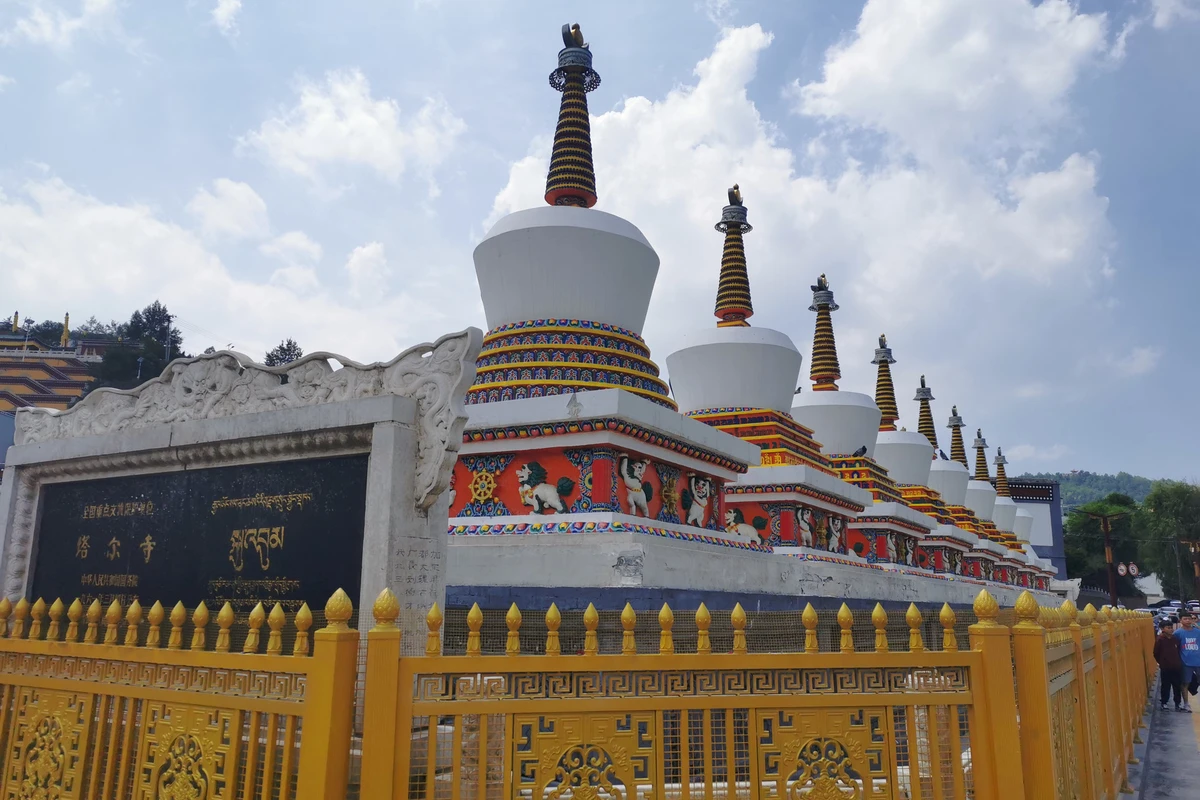
Due to the epidemic this year, the scenic shuttle bus at Kumbum Monastery hadn't started operating until mid-July. At first, we thought it wasn't far, and since we were just starting our trip with high energy, we walked. Actually, the main entrance is about 4 kilometers from the monastery. You can use Didi taxi; we found it a bit novel. Along the road, there were a nationalities school and the Eight-Petal Lotus Intangible Cultural Heritage Inheritance and Experience Center.
More surprisingly, the scenery on the left side of the road was amazingly beautiful. On the way back, we deliberately went down to explore. That's the Lianhua Lake scenic area — an unexpected gain!
Qinghai Lake - Chaka Salt Lake: 132 km
Chaka Salt Lake - Delingha: 216 km
Delingha - Emerald Lake: 218 km
It took three days to visit these three lakes. Since they are all lakes, I'll group them together. At Qinghai Lake, we watched the sunset the day before, and after watching the sunrise the next day, we went to Chaka Salt Lake. But the weather didn't cooperate; the salt lake that needs clear skies was overcast. Alas! We stayed in Delingha that night, and reached Emerald Lake on the third day.
Emerald Lake and Chaka Salt Lake are somewhat similar in that both can produce mirror-like reflections, but they are not the same. Both scenic spots are worth recommending.
Emerald Lake is green, consisting of many small salt ponds. If you use a drone, you can capture the emerald effect.
During these days, there were no proper dining places at the scenic spots; at most there were some snacks to fill the stomach, so it's better to bring your own. When exiting Chaka Salt Lake, there is a commercial street with snacks like Chinese hamburger (roujiamo) and instant noodles. Emerald Lake, being newly developed, has no commercial facilities yet.
The journey from Emerald Lake to Dunhuang City was exactly the representative picture of the Great Northwest that we, who grew up by the seaside, had imagined — all the way through Gobi and desert. The drive took a full 6 hours, and for three of those hours, there was no mobile signal. We passed through the Qaidam Basin and the most beautiful highway, seeing barren land where nothing grew.
Along the way, there were various speed limits, mountain roads, and roads that were not highways. Driving was quite tiring.
Dachaidan Emerald Lake - Dunhuang City: 348 km
The actual itinerary was: arriving in Dunhuang the day before and checking in directly. The next day, we first went to Yadan Ghost City and Yumen Pass. In the afternoon, we returned to the hotel to rest until 5 PM, then left for Mingsha Mountain. We wanted to watch the sunset, and also because the evening was less hot than daytime and the light was better.
For the Mogao Caves, tickets need to be booked a month in advance, and daily visitor numbers are restricted.
The ticket includes two digital films to give visitors a general understanding before a close-up tour. This facilitates rapid visitor flow and gives an initial understanding of the caves' past and present. Photography is prohibited during the digital films, and also inside the Mogao Caves. So I basically just took photos of the Nine-Story Pagoda. Everything had to be felt with the heart.
After visiting the caves, there is a museum outside, where several fully restored replica caves can be visited. The following few copied images are from the museum, where you can freely take photos.
Dunhuang City - Yumen Pass: 83 km
Yumen Pass - Ghost City: 82 km
Mogao Caves - Jiayuguan: 370 km
The Hexi Corridor, full of stories all the way. The vast open view is like a movie that draws back the curtain of history, behind which flows a river.
Niuxin Mountain, called 'Ami Dongsuo' in Tibetan, meaning 'God of Mountains' or 'Mountain that Guards the Mountains'. It faces Mount Zhuor from afar. Barley fields wave like ocean, and rapeseed flowers are fragrant. Smoke from chimneys curls up, presenting a peaceful farm scene. It is known as a 'fine pasture at the foot of the Qilian Mountains'.
Travelogue Directory: 1. Secrets of the Hexi Corridor 2. Guardianship of Kumbum Monastery 3. Regret of Chasing the Three Lakes 4. Pearl of the Desert 5. Ancient Frontier with Clashing Swords 6. Danxia Landforms, Again Flower Sea, Little Switzerland of the East 7. Written at the End Lanzhou Travel Information Hotel Index Strategy Index Airfare Index Website Navigation Travel Index Cruise Index Corporate Travel Index Join Cooperation Distribution Alliance Friendship Links Corporate Gift Card Purchase Insurance Agency Agency Cooperation Hotel Join Destination and Scenic Area Cooperation More Join Cooperation About Ctrip About Ctrip Ctrip Hotspots Contact Us Careers User Agreement Privacy Policy Business License Security Center Ctrip Content Center Intellectual Property Trip.com Group Algorithm Publicity


