Travelogue of Dunhuang
In June this year, I used my saved vacation days for a spontaneous trip to Northwest China, with Dunhuang as the first stop. Dunhuang is an ancient and mysterious city, boasting a long history and miraculous natural landscapes. The most famous attractions include the Mogao Caves, Mingsha Mountain and Crescent Moon Spring, Yangguan Pass, and Yadan landforms.
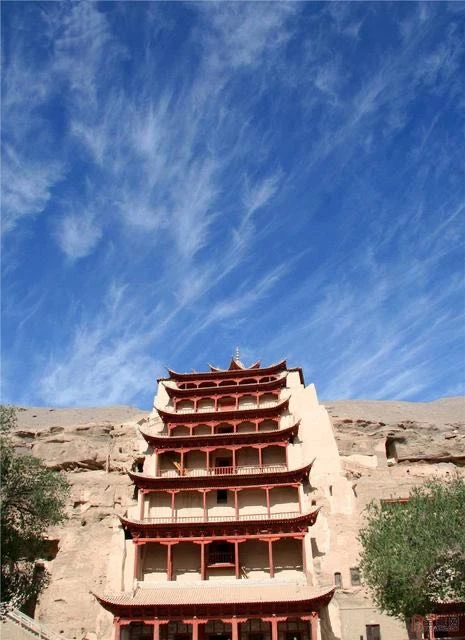
The Mogao Caves, also known as the 'Caves of a Thousand Buddhas,' are located on the cliffs of Mingsha Mountain, 25 kilometers southeast of Dunhuang city. The Mogao Caves are grand in scale, rich in content, and steeped in history. Together with the Yungang Grottoes in Shanxi Province and the Longmen Grottoes in Henan Province, they are known as the 'Three Great Buddhist Art Treasures of China.' The construction began during the Former Qin period of the Sixteen Kingdoms and continued through the Sixteen Kingdoms, Northern Dynasties, Sui, Tang, Five Dynasties, and later dynasties, forming a massive complex. Currently, there are 492 existing caves, over 45,000 square meters of murals, and 2,415 painted clay sculptures, making it the largest and richest Buddhist art site in the world. In 1987, the Mogao Caves were listed as a UNESCO World Heritage Site. In 1900, the 'Library Cave' was discovered here by chance, containing 50,000 to 60,000 cultural relics from the 4th to the 14th centuries. This was a major archaeological discovery in early 20th-century China that shocked the world.
When visiting Dunhuang, one must not miss the Mingsha Mountain and Crescent Moon Spring scenic area. The drifting sand produces sounds, and nestled within Mingsha Mountain is the never-drying Crescent Moon Spring. Here, you can witness the rare sight of a desert coexisting with a clear spring. In this endless sea of sand, there is a distinctive landmark: a crescent-shaped spring beside a grove of tall trees, with a small pavilion built among them, adding a unique charm. The formation of Crescent Moon Spring arouses visitors' curiosity. On Mingsha Mountain, you often see convoys of camels wandering about, with bells around their necks jingling clearly as they move, adding a touch of liveliness to the picturesque scenery. Riding a camel in the desert is an essential experience. 'A single plume of smoke straight in the vast desert, a setting sun round over the long river.' The sunset at Mingsha Mountain is beautiful. Climb to the top, and you'll see sand dunes glowing gold under sunlight, looking like towering pyramids standing on the vast land of Dunhuang.
In Dunhuang, you must watch a performance called 'Dunhuang Grand Ceremony.' It features a 360-degree rotating auditorium, artificial small sand dunes of Mingsha Mountain and Crescent Moon Spring, and enveloping cave settings. The show takes a legendary love story as its main thread, using stage design and wall projections to reveal the historical culture and humanistic features of Dunhuang, an important town on the ancient Silk Road. It allows you to experience the cultural atmosphere of Dunhuang from over two thousand years ago. The entire performance is magnificent, with fantastical scenes, gripping plot, and dazzling visuals—a visual feast not to be missed.
Yangguan Pass was a vital land route gateway in ancient China, a necessary pass on the southern route of the Silk Road. It is located near the ancient Antique Beach (Gudong Tan) southwest of Dunhuang City in Gansu Province. The pass was established in the Western Han Dynasty and named Yangguan because it lies south of Yumen Pass. Together with Yumen Pass, it served as a gateway to the Western Regions. Once you passed Yangguan, you entered the Western Regions. After the Song Dynasty, as land routes with the West gradually declined, the pass fell into disrepair. Near Yangguan, the Antique Beach area has revealed a large number of Han Dynasty artifacts, such as bronze arrowheads, ancient coins, stone mills, and pottery cups, indicating that Yangguan was once a busy and bustling stop for merchants.
The Dunhuang Yadan landforms are part of the ancient Lop Nur region. On this magical land of Dunhuang, nature has created many wonders. The Dunhuang Yadan is located at the junction of Xinjiang and Gansu, more than 80 kilometers northwest of Yumen Pass. There is a typical Yadan landform cluster, orderly arranged and uniquely shaped, forming a rare natural sculpture museum. It is another wonder of Dunhuang, a masterpiece of nature's uncanny craftsmanship and infinite wonder.
The Dunhuang Yadan landforms are part of the ancient Lop Nur region. On this magical land of Dunhuang, nature has created many wonders. The Dunhuang Yadan is located at the junction of Xinjiang and Gansu, more than 80 kilometers northwest of Yumen Pass. There is a typical Yadan landform cluster, orderly arranged and uniquely shaped, forming a rare natural sculpture museum. It is another wonder of Dunhuang, a masterpiece of nature's uncanny craftsmanship and infinite wonder. Each Yadan landform has its own distinct shape—odd and varied, vivid and lifelike. Some resemble pagodas, palaces, haystacks, a golden peacock standing tall and gazing into the distance, an eagle about to take flight, a fleet of ships sailing through the sea, or a graceful beauty... Here, the myriad strange Yadan landforms can make you feel relaxed and happy, free your thoughts, and let your imagination run wild. Here you can unleash your creativity and appreciate the magical beauty of nature's perfect creations.
You only need three days in Dunhuang to experience historical and cultural relics and the uncanny workmanship of nature. It's a journey well worth taking.


