Dunhuang
As a native of Gansu, I finally visited Dunhuang. I spent three days thoroughly exploring this small city nestled in the desert beyond the Great Wall, from its urban landscape to the hearts of its people—a clarity that penetrates everything.
The train from Lanzhou to Dunhuang pulled into the station right on time before dawn. After a night of travel, we witnessed the sunrise in the wind beyond the Great Wall—a small patch of pomegranate-juice-like purple-red that intoxicated the senses, clinging to the black night sky in an inseparable embrace. This was the earliest sunrise I had ever seen; it could barely be called a sunrise—there was no sun, just that patch of purple gradually melting the blackness, stirring the soul.
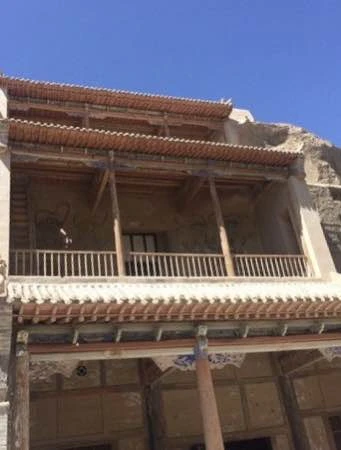
On the first day, we went to the Mogao Caves. A taxi from the city to the caves cost only 30 yuan. Inside the exhibition hall at Mogao, there is a stele inscribed with the words: "Dunhuang is the伤心史 (heartbreaking history) of Chinese academia." This quote by Mr. Chen Yinke, though a quick search on Baidu revealed that Mr. Chen might not have fully endorsed this phrasing, sometimes a taken-out-of-context interpretation can stir deeper emotions. The Mogao Caves bear witness to past glory and the traces of past decline. Time always quietly carries away the sweet, sour, bitter, and spicy—the achievements and fame of the cave builders, the rights and wrongs of Abbot Wang—all but wind-scattered dust in the vast Gobi.
Besides the Mogao Caves, Dunhuang also has the Crescent Moon Spring and the Singing Sand Dunes. At this scenic spot, I saw the Crescent Spring enclosed by railings, with reeds growing aimlessly. The wild spring water, left unattended, seemed unconcerned about drying up because its growth and disappearance were utterly carefree. We felt as if we had discovered a free soul, filled with delight.
Back in the city, we wandered the Dunhuang night market street. There were so many dried fruits and trinkets that it was dazzling. However, these items seemed more attractive to visiting tourists—they make nice souvenirs too.
After visiting these sites, we booked tickets online for a local special performance—the "Dunhuang Grand Ceremony." According to online reviews, the show was spectacular. It started at 9:30 PM every night, with ticket entry at 9:00. We bought A-zone tickets online and consulted the hotline; the staff said the middle seats offered the best visual experience. So we chose the central A-zone for a better viewing effect. Arriving at the theater on time, we took our seats and waited for the show to begin.
The performance started promptly at 9:30. It was a bit slow at the beginning, but when the seats started rotating as a whole, it captured all my attention. The graceful and exquisite stage design, along with the iron flower shower (Da Tie Hua)—which, according to the introduction, is an intangible cultural heritage—was something I had witnessed for the first time. Then came an impressive 3D wall projection, very realistic, and the storyline had a good narrative arc.
When the rotating chairs moved into the cave setting, the plot's depiction of Moding's reluctance to part with the princess stirred all my emotions, and I couldn’t help but shed tears. That scene was truly touching—Moding's unwillingness and the princess's helplessness were portrayed to perfection. After calming down from the tears, the descending celestial maiden from above was so beautiful it brought fresh tears. I watched the entire performance following every scene; it was truly worth watching. Here are a few stills from the show to feast your eyes on.
This photo of the iron flower shower under lights also felt like a uniquely local touch—beautiful and amazing.
The reflected image of the Buddha cave was truly magnificent.
It was really lifelike.
In fact, travel is about going from a place you're tired of living in to a place where others are tired of living. Every tiny detail of a place where others are weary deserves our attention, because surprises might be hidden there. That's it. Too long.


