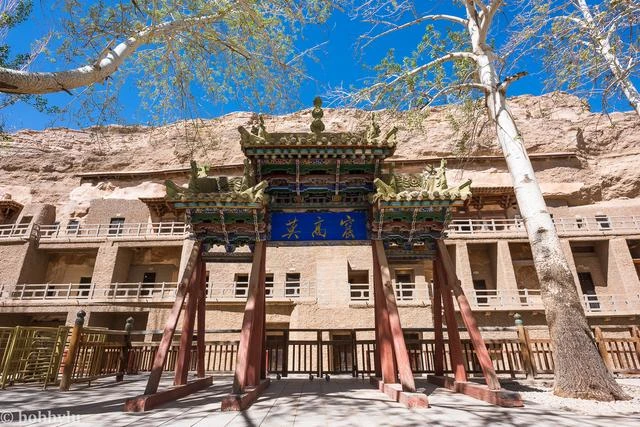
A world-renowned cultural heritage site, also a scenic area with visitor limits and photography bans - the mysterious Mogao Caves
Taking photos while traveling is a perfectly normal behavior! But in some scenic areas in China, it is absolutely prohibited! Actually, this absoluteness is relative, for example, at the Mogao Caves in Dunhuang. The prohibition is fully communicated and measures are taken before the tour. Specifically: before entering the indoor spaces, that is, the caves, you must temporarily store your photographic equipment...
The Mogao Caves in Dunhuang, located at the western end of the Hexi Corridor, are the largest and most richly contented Buddhist art site in the world today. Moreover, in 1987, they were inscribed on the World Heritage List as a cultural heritage site, so it's no wonder they are world-renowned! It is precisely because of people's admiration for the various artistic, historical, and cultural values of the Mogao Caves that people from all over the world have increasingly flocked to this place since its opening, with no sign of abating.
But the fact that photography is allowed outside the Mogao Caves area brings some comfort to many tourists. After all, whether for commemorative photos or artistic creation, recording and preserving images is one of the best ways for travelers or tourists to look back and savor memories when they see the photos later. As for the precious image materials inside the caves, they can probably only be browsed online or in books and magazines. Not only that, but spending the full admission fee only to see part of the cave contents is hard for many to understand! This also makes many people feel a sense of regret and a perceived unfairness.
However, in this era of universal photography, the high普及 of mobile phones and the convenience of phone photography have made many people feel like they have found a panacea, eager to sneak a taste of the 'forbidden fruit' inside the caves! But the dim lighting conditions inside the caves and the ban on photography, coupled with being in the public eye, make such attempts furtive and nervous. I ask, why bother?! Even if you manage to take a picture, it's bound to be crooked or too dark to make out the content, and if you get called out, it would be awkward!
Some may ask, why is photography explicitly banned inside the caves, and why, after paying the full ticket price, can we only visit a few caves each time? Indeed, the scale of the Mogao Caves is enormous, with a total of 735 caves, and the murals inside are so rich that they cover 45,000 square meters! The number of clay-colored sculptures and other statues reaches 2,415! The artistic value of these sculptures, murals, and even the architectural structure and historical value are rare and precious in today's world.
It is precisely because of the extreme rarity and immense value of these murals and sculptures that the scenic area, and even the country, has invested so much manpower, resources, and effort to protect and preserve them! It is also for this reason that many people have misinterpreted the rules limiting access to caves and prohibiting photography inside, with some even believing that these measures are purely for profit, to prevent the cave contents from being publicly shared so that people won't visit after seeing pictures. Others have resorted to superstitious explanations for these policies. All of the above are not sufficiently scientific or rigorous...
In fact, for those who have visited the Mogao Caves or other cave sites, while the tour guides explain the historical and cultural significance, they also explain why restrictive measures such as limited access and photography bans are implemented. The root cause is entirely about protecting the sculptures and murals inside the caves. Why? Imagine if all caves were fully open and tourists could enter freely; it would inevitably disrupt the original internal environment of the caves.
That is: the carbon dioxide produced by prolonged stays and breathing of tourists, along with changes in temperature and humidity, would cause oxidation and corrosion of the murals, sculptures, and even the exterior walls of the caves, accelerating deterioration. These subtle changes accumulate over time. A single visit may not show visible effects, but in the long run, it is absolutely detrimental to the preservation and transmission of cultural relics! Peeling paint and disintegration of wall particles will ultimately cause irreversible damage to sculptures and murals, leading to color fading and even wall detachment, which is evident in many caves!
As for the ban on photography inside the caves, it is not due to the previously mentioned notion of Buddhist sacredness where photography is disrespectful, and certainly not because of fear of pictures being leaked. There has long been a rumor that the flash from cameras causes chemical reactions with the murals, accelerating oxidation, leading to fading and damage. This claim is basically a legend. Ultimately, the real reason is that stopping to take photos causes congestion, and concentrating on photography may obstruct the view of others behind, potentially leading to crowding or disorder. Moreover, when a large number of tourists gather in one cave, the aforementioned imbalance in temperature and humidity and increase in carbon dioxide occur. These are the hidden drawbacks that ultimately cause damage!
Some may ask, then how do you have so many photos of the cave interiors? Actually, on one side of the Mogao Caves scenic area, there is a constructed venue that replicates several caves at a 1:1 scale, including the size, murals, sculpture content, color reproduction, and even lighting, faithfully reproducing all elements of the original caves. But even then, even for replicas, photography is only allowed with permission from the venue! Therefore, the scenic area's actions are entirely focused on the protection, preservation, and development of cultural relics. The aim is to better promote the civilization and historical heritage of the Hexi Corridor!
So, let the long-standing bans on photography and visitor limits continue. At least, I support and will continue to comply with such measures. Of course, visiting only a few caves at a time does leave regrets, but it also signifies and looks forward to another trip to Gansu and the Dunhuang Mogao Caves, even if only to review the old and learn new things... I believe that now, in the best season for visiting, friends who are planning to go there will certainly support and cooperate!


