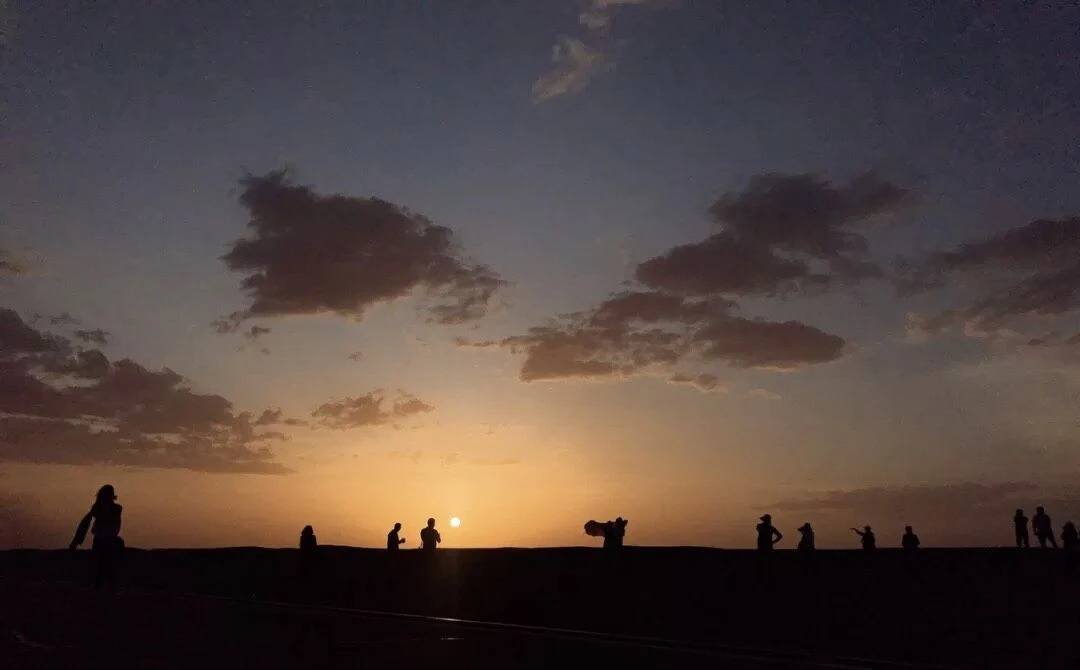
Origins in the Desert: A Dream of Dunhuang
I grew up in the water towns of Jiangnan, yet I've always felt an inexplicable longing for the deserts of the Northwest. People are never content—having gained Long, they yearn for Shu. Perhaps it's because we often lose interest in what we already possess. During my college years, I secretly set a goal: to go to the Northwest at least once, to witness a desert landscape unlike anything in Jiangnan.
When it came to choosing a destination, I agonized for a long time before finally settling on the city of Dunhuang. I dislike loop tours that allocate one or two hours per attraction and rush through several sites in a single day. So I chose just one city, allowing myself several days to fully immerse in its culture and essence. Why Dunhuang? It was quite serendipitous. While researching online like any other traveler, I found that Dunhuang was highly recommended and very famous. To the point that one night, I dreamt of boarding a plane to Dunhuang. Being an impulsive and sentimental girl, I booked my ticket the very next day.
I've always associated Dunhuang with mystery. Whether it's the sublime Buddhist culture of the Mogao Caves or the miraculous coexistence of sand and water at Singing Sand Mountain and Crescent Moon Spring, I held high expectations for this city. Because of its mystery, my anticipation and curiosity piled higher and higher. But now, sitting calmly at home in front of my computer writing this travelogue, I can say that this trip to Dunhuang was truly worthwhile. I gained a lot and learned a lot, living up to my expectations and longing for this city.
I don't want to describe each attraction in lengthy detail. I only want to share the most delightful surprises and the unexpected tenderness I encountered on this trip.
The iconic Mogao Caves and Singing Sand Mountain and Crescent Moon Spring did not disappoint. They are indeed the "hallmarks" of Dunhuang and well worth visiting. But what truly struck me was the story behind the Mogao Caves—the tale of "cultural plunder." The Library Cave in the Mogao Caves was discovered by a man named Wang Yuanlu, a Daoist priest. Some call him a traitor and a destroyer of Dunhuang art. When Wang Yuanlu opened the Library Cave and saw it piled high with sutras, he was astonished. He walked 50 miles to the county seat to report to Dunhuang County Magistrate Yan Ze, presenting him with two scrolls from the cave. Wang's intention was clear: to attract the official's attention. Unfortunately, Magistrate Yan was an unlearned man who regarded the scrolls as nothing more than yellowed wastepaper. In 1902, a new magistrate, Wang Zonghan, arrived in Dunhuang. Magistrate Wang was a jinshi (a scholar who passed the highest imperial examination) and had studied epigraphy. Wang Yuanlu reported the Library Cave to him. Magistrate Wang immediately brought a group of people to the Mogao Caves, inspected the site, and casually took a few scrolls away, leaving behind an instruction for Wang Yuanlu to keep the cave safe. But they gave him not a single coin.
When Stein arrived, he spent a long time persuading Wang Yuanlu and offered him a sum of money. Wang sold a portion of the sutras. Later, he sold more to Pelliot, Yoshikawa Koichiro, and others. The loss of so many scrolls pained Wang Yuanlu deeply. After all, he had discovered the cave and, during his years of custodianship, never lost a large number of scrolls without cause. The official plunder and greed filled him with great indignation. So when Stein returned to the Mogao Caves in 1914, Wang Yuanlu told him something thought-provoking. As recorded in Stein's "Ancient Khotan," Wang said: "When the officials moved the Chinese scrolls he treasured and damaged them, he regretted not having had the courage and boldness to follow the advice of Secretary Jiang and accept my large sum of money to let me have the entire collection. After this ordeal with the officials, he was terrified. So he hid what he considered the most valuable Chinese manuscripts in a safe place." From then on, the Mogao Caves' sutras were scattered overseas. The Qing government later took notice. But unlike Stein and Pelliot, who packed the scrolls in wooden boxes, the Qing government sent a few donkeys covered with straw mats and left. Precious sutras were scattered on the ground, blown away by the wind. The building in front of me was paid for by Wang Yuanlu. But not a single coin he received was spent on himself.
Yu Qiuyu, in his book "A Cultural Journey," considers Wang Yuanlu's destruction of Dunhuang's cultural relics to be devastating and grieves for it. But after learning this story, my view of Wang Yuanlu was overturned. I ask: If the scrolls had been handed over to the Qing government back then, how many would we still be able to see today? After Stein and Pelliot took them away, they preserved them in museums in their own countries, safe and sound. Pelliot, as one of the first Dunhuang scholars, brought this history to the world's attention. Naturally, they were at fault—this was plunder and deception. But can Wang Yuanlu's actions be considered excusable? The eternal matter of Dunhuang—who truly knows its joys and sorrows?
During these days in Dunhuang, I didn't rush from one attraction to another. I set aside time to watch the performance "Dunhuang Grand Ceremony." Initially, I wasn't interested in this stage show, but a friend I met at the same inn wanted to go, so I joined them. To my surprise, the performance left me utterly amazed—yet another gift from the city of Dunhuang.
Prologue: "Soul of the Desert"—a secret vow of eternal love; "Meditation: Singing Sand Mountain"—an artisan's search for love; "Departure: Dunhuang City"—a clever escape; "Heartfelt: Mogao Caves"—a tearful farewell; "Moon: Crescent Moon Spring"—the blend of dream and reality; Epilogue: "Dream of Dunhuang"—moonlight spilling over the desert, bonfires illuminating the ancient city's dim lights, people from different lands dancing together in a fantastical Dunhuang. It was an unparalleled visual feast, as if I had traveled through a thousand-year-old path, experiencing love story that transcended millennia.
This city always makes it hard to tell whether you are in the glorious Tang Dynasty of a thousand years ago or in present-day Dunhuang. I saw so much in this city. I visited the Mogao Caves and witnessed the devotion of artisans from centuries past. I saw Yumen Pass and beheld the spring that never crosses it, stopping on the Gobi Desert and turning into a flowing streak of green. I saw Yangguan and gazed upon the road westward, still covered in sand and wind, with no hope of an old friend's return. Walking along these paths, the cries of vendors selling dried apricots echo through the ages in your ears; walking along these paths, you carry the sand of the Gobi and the clear water of the oasis; walking along these paths, you can almost see the dancer playing the pipa behind her back—an eternal symbol of the Tang Dynasty. This city—from prosperity to decline, then to revival—is a trace of history. If possible, let me see this city once more. I want to hear the cries of vendors again, the flowing water of the Dang River, the solemn yet awe-inspiring Buddha statues. I thank my dreams for forging this inexplicable bond with the ancient city. If you have the chance, come here with your pure soul. Dunhuang will fulfill your grand and splendid dream of the desert.


