Following Go Fighting to Dunhuang
After watching episodes 7 and 8 of season 6 of Go Fighting, where Yue Yunpeng and the others went to Dunhuang, climbed Mingsha Mountain, visited Yang Pass, and explored the night market... they toured Dunhuang. I felt an urge to go to Dunhuang myself. So I set off on a spontaneous trip and put Dunhuang on my itinerary.
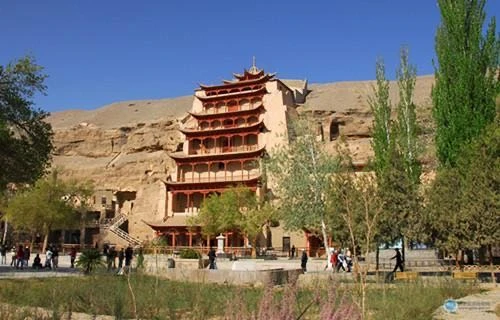
We arrived in Dunhuang on July 10. Since we had booked tickets for the Mogao Caves online in advance, we dropped off our luggage and headed straight there. There weren't many people. First we watched a movie at the digital center, then took a shuttle bus to visit the caves. To protect the murals, photography was not allowed inside the caves. Listening to the guide's explanations while gazing at the murals stirred a unique mix of emotions. Especially when we reached the Library Cave, I felt anger, regret, pity, and gratitude—a hundred feelings intertwined. I hope our country grows stronger and stronger, so that we can reclaim the scriptures and murals scattered abroad, making the Mogao Caves more complete, with fewer regrets.
After returning from the Mogao Caves, we had dinner and rested a while before heading to the long-awaited Mingsha Mountain and Crescent Moon Spring. As far as the eye could see, there were rolling sand dunes. Deep in the desert, we could see Crescent Moon Spring—mountains and water depending on each other. For thousands of years, the desert has not buried the spring, and the water has neither dried up nor become foul, still taking the shape of a crescent moon. In this dry, rain-scarce region, it's nothing short of a miracle. I suggest arriving at the Crescent Moon Spring scenic area around 6 p.m., as it's too hot earlier. At that time, you can also catch the sunset over the desert. The sky doesn't get dark here until after 9 p.m., so you'll have plenty of time to explore.
The next day we went to Yang Pass, a once-glorious strategic pass. In the past, the taverns there were bustling with activity; merchants and envoys came and went in an endless stream. They traded goods and established diplomatic relations, and scholars left behind immortal literary works. The phrase "west of Yang Pass, no old friends" refers to this place. Beyond Yang Pass lies the ancient Western Regions, with a completely different culture and customs. Thus, Yang Pass was once an important gateway on the ancient Silk Road.
Continuing west from Yang Pass, we reached the Yardang Devil City. The wind there was incredibly strong, and the ground was completely barren. When the wind was strong, it blew sand and pebbles against our legs, bodies, and faces. If the wind is strong when you come, it's advisable to wear long pants, long sleeves, and bring a hat and mask. It is this wind, blowing for thousands of years, that has shaped these various strange and unique Yardang landforms—some resembling peacocks, some pyramids, some Roman columns, some beautiful women, some turtles... As long as you let your imagination run wild, you can appreciate the wonders of nature.
Returning from the western route around 6 p.m., we had dinner and thought about watching a performance with Dunhuang characteristics. There were two shows: "Dunhuang Grand Ceremony" and "Seeing Dunhuang Again." We were actually quite tired after a day of sightseeing. Since "Seeing Dunhuang Again" required walking around while watching, we felt too exhausted to walk, so we decided to watch the live performance "Dunhuang Grand Ceremony," which had a rotating audience seat. It had good reviews online.
"Dunhuang Grand Ceremony" had several acts, and the audience seats rotated with the performance. In the second act, there was even a dazzling display of iron fireworks, which looked spectacular. There were also realistic desert and cave sets, depicting the prosperity and bustle of Dunhuang thousands of years ago. The gradual excavation of the Mogao Caves and the meticulous painting of the murals showcased the wisdom and ingenuity of the ancient working people. The show was absolutely fantastic. I highly recommend that everyone visiting Dunhuang must see "Dunhuang Grand Ceremony."
On the third day, we slept in and then went to eat the local specialties: braised lamb with flatbread and donkey meat with yellow noodles. We strolled along Dunhuang's streets, eating and walking as we went. In the evening, we visited the night market, bought some small handicrafts for family and friends, and also enjoyed red willow kebabs, beef pies with scallions, and liangpi (cold noodles)... We also tried the local apricot peel water—delicious! I recommend buying it. There were plenty of food and drinks at the night market; just buy whatever you like.
Although it was only a short three-day trip, it gave me a glimpse of the wisdom of the ancient working people, the uncanny workmanship of nature, and its wonders... If time allows, I suggest spending more days there.


