Travel Notes from Dunhuang
In May, I joined a few friends on a trip to Dunhuang. After leaving the train station, I felt a gentle breeze on my face. The yellow sand mountains in the distance were layered and undulating, under the hazy morning light, they appeared tender and shy, like a girl with no makeup, rubbing her sleepy eyes. Following the continuous mountain range with my gaze, I unexpectedly saw a vast expanse of green shade—'Suoyang City'—and Dunhuang lay right in this desert oasis.
Outside the city, the fields were planted with sprawling grape trellises. The driver glanced at the grapevines outside the window and said, 'If you had come a few months later, you could have gone into the orchards to pick grapes.' Staring at the vineyard outside, I was immersed in the fantasy of 'Wine in a glowing jade cup,' and was about to lament our bad timing when the driver smiled warmly and patted my shoulder: 'Just being able to come to Dunhuang is a blessing! In a few months, President Xi will also come to our Dunhuang, along with many foreign heads of state!' Sitting next to him, I could almost feel the pride and happiness overflowing from his words and expression. Chatting and laughing along the way, we soon entered the city. Dunhuang is not large, but it doesn't feel cramped at all. The buildings in the small city are meticulously arranged, with no abrupt skyscrapers; the gently retro architectural complex gives a strong sense of familiarity. You might easily mistake it for the small town Teresa Teng sang about.
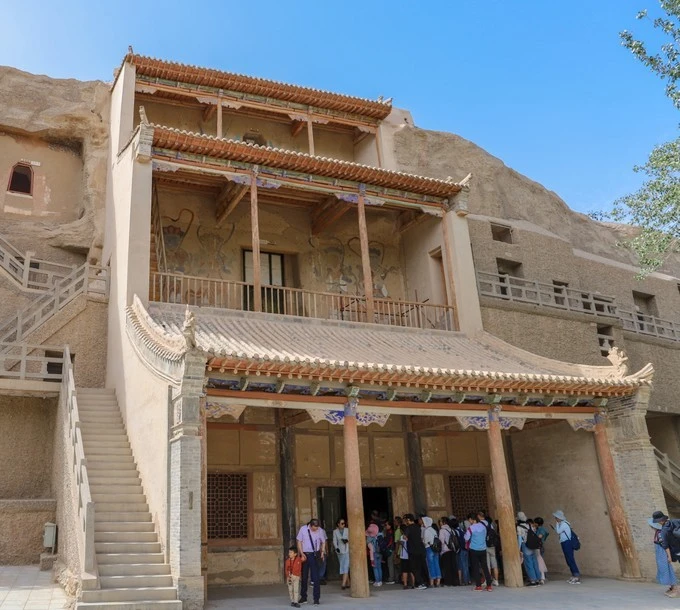
After lunch, we took a bus from the Digital Center to the Mogao Caves. On the boundless wilderness, the only asphalt road seemed very out of place. Inside the bus, everyone stared intently at the desert and mountains outside, afraid of missing the first sight of the Mogao Caves. Someone said, 'Aren't those the caves?' Immediately, everyone turned their gaze to the right-side window. Dilapidated living caves were scattered in an orderly manner on the cliff face, silently telling the stories of history. Generations of craftsmen and artists humbled themselves in these simple caves, completing the exquisite murals and statues under the inspiration of devout faith.
The periphery of the Mogao Caves had been fully renovated, and all the caves were installed with security doors. Towering ancient trees nodded in the breeze, sheltering the caves from the strong, damaging sunlight. Entering a cave, following the guide's flashlight, vivid murals came into view. The long-dreamed-of 'Apsaras' finally appeared before my eyes. On the caisson ceiling of the cave, the Apsaras had flowing robes and fluttering ribbons, their body curves smooth as flowing clouds and water, seemingly flying toward the sky, or singing and dancing to Buddhist music. The guide joked, 'The Apsaras are like today's cheerleaders, adding a bit of joy to the ascetic life.' I really liked the guide's metaphor. Cultivation is for inner truth; sometimes, exhausting the body and starving the skin, falling into the mire of asceticism, does not lead to the true essence. On the contrary, understanding the joy of life allows one to encounter the Buddha's light in the smallest details. My friend traveling with me stood still, staring unblinkingly, forgetting to move. We entered another cave; everyone was engrossed in the magnificent murals on the walls, not noticing a Buddha statue in the corner. When the guide's light shone from the statue's chin, we saw it slightly baring two teeth, a gentle smile, and eyebrows evenly level. When the light shone from its forehead, the Buddha's appearance was peaceful and natural. Looking from the left, the left eyebrow was higher than the right; from the right, the opposite. We marveled at the artisan's superb skill, calling it the 'Mona Lisa of the East.' The Buddha spoke no words; his words were in the eyes of the faithful from all directions. Perhaps, by changing perspective and posture, the truth of things is not just black and white. After the tour, my friend and I stood for a long time in front of the Mogao Caves, calming our minds, feeling much lighter.
We drove to Crescent Moon Spring. At the entrance, it was hard to see the spring; the yellow sand covering the mountains blocked our view. Climbing to the top of the hill, we looked down and saw a crescent of clear water and green willow trees. We slid down the sand and sat leisurely by the spring, watching the sun slowly sink into the desert. Gradually, we lost track of time... The sunset at Mingsha Mountain was as beautiful as a painting treasured for a thousand years. Reminded by a travel companion, I also took many photos, trying to capture the beauty before me.
After dinner, we went to the foot of Mingsha Mountain to watch the large-scale desert live performance 'Dunhuang Grand Ceremony,' with the starry sky as the curtain and the sand mountain as the backdrop. The experience felt like traveling through time. Along with the stage performance, we were transported to the vast Mingsha Mountain, nestled beside the crystal-clear Crescent Moon Spring, listening to the painter Mo Ding tell beautiful and touching stories, and savoring the human culture and gentle emotions behind the solemn Mogao Caves murals. With exquisite stage lighting and professional dancers, against the beautiful scenery of Dunhuang's Mingsha Mountain and Crescent Moon Spring, 'Dunhuang Grand Ceremony' truly created a magnificent dream across a thousand years for every audience. Even the last itinerary was so satisfying; this trip to Dunhuang was truly worthwhile.
After a busy day, we returned to the hotel tired and fell asleep, the world becoming silent. I will always remember that night. Goodnight, Dunhuang, holding the Crescent Moon Spring to wish you a peaceful sleep.


