Over the vast desert, the wind and sand slowly drift, the divine light appears and disappears
Day 1: Singing Sand Mountain and Crescent Moon Spring — Mogao Caves — Dunhuang Museum — Dunhuang Grand Ceremony
Singing Sand Mountain and Crescent Moon Spring
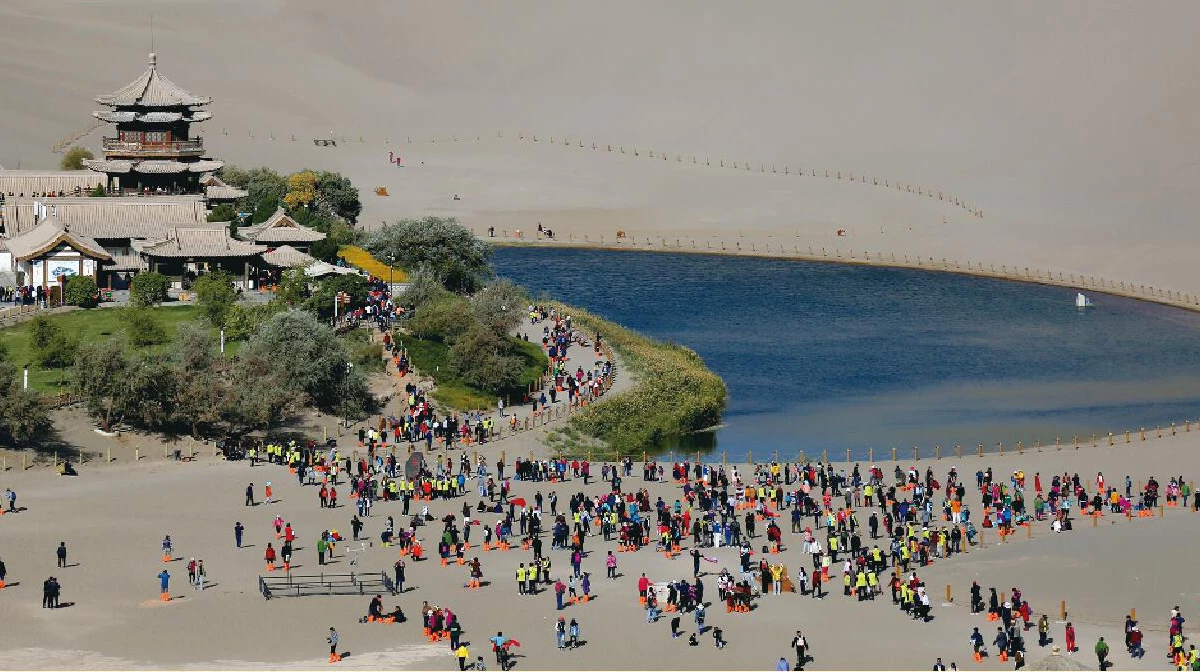
Singing Sand Mountain and Crescent Moon Spring is located in the south of Dunhuang City. It is renowned worldwide because the sand makes a singing sound and the mysterious Crescent Moon Spring in the desert. Today, I came to the world-famous Singing Sand Mountain and Crescent Moon Spring. The endless desert, with golden sand dunes shining like silk, soft as satin and as serene as a maiden. What touched me the most was the most magical and charming Crescent Moon Spring. Crescent Moon Spring is like a mysterious woman veiled in gauze, appearing grayish from afar; as I slowly approached, it gradually turned blue and green. Facing it, a coolness swept over me. The spring water was so clear that I could see my reflection at the bottom, making me stand there unwilling to leave for a long time. Yet when I turned around, there were towering, endless yellow sand dunes. Crescent Moon Spring lies quietly in the embrace of the sand dunes. Such a contrast made my heart pound! In amazement, I had to marvel at and admire the magical wonders of nature!
Among the dazzling and diverse historical creations of mankind, four cultures have the widest scope, form their own systems, and shine with radiance: Greek culture, Islamic culture, Indian culture, and Chinese culture. These four cultures met in a fascinating place and were most splendidly expressed—that place is Dunhuang, a cultural holy site of China. Today, we came together to the Mogao Caves in Dunhuang and personally experienced the infinite magic and charm of the Mogao Caves.
Following the guide's footsteps, we arrived at Cave 96. This giant Buddha is 35.5 meters tall! It is the largest Buddha in the Mogao Caves. It is as high as a dozen stories. Standing at its feet and looking up, we felt like tiny ants. Such a colossal statue, yet ancient artists sculpted it with smooth lines and lifelike features. Next, we came to Cave 130. This Buddha is about 26 meters tall, the second largest cave in Mogao. The ancient craftsmen made the Buddha's head relatively large, up to 7 meters, exceeding the normal proportion of the human body. The craftsmen cleverly used the shadows cast by the light from the front window of the cave on these surfaces, so that when we look up, the Buddha's facial features appear distinct, majestic, solemn, and sacred. Due to long-term burial under shifting sand and erosion by moisture, this painting has been severely damaged. Later, we arrived at Cave 148, which features a nirvana statue of Shakyamuni. The Buddha's body is 14.7 meters long. Because the nirvana statue is in a reclining posture, it is commonly called the "Reclining Buddha" or "Sleeping Buddha." Although the statue has been restored by later generations, its lines remain smooth. Just as Confucius had 72 disciples, there are also 72 disciples beside the reclining Buddha, each with a different posture, all standing behind the reclining Buddha. Since this Buddha has entered nirvana, the cave is shaped like a coffin, and the walls and ceiling are completely covered with thousands of Buddha statues in various lifelike poses. Leaving the Mogao Caves, I was extremely reluctant. In my heart, I silently wished: Oh, Mogao Caves with infinite charm and vividness, may you forever leave a brilliant and splendid page in the long river of human history...
Dunhuang, located at the westernmost end of the Hexi Corridor, brings together Chinese and Western cultures, achieving the prosperity and sharing of Eastern and Western trade and culture. Here, the history of the ancient Silk Road and the flourishing of China during the Han and Tang dynasties is condensed. A visit to Dunhuang must include the museum. The Dunhuang Museum is built in the shape of a beacon tower, and its interior is designed to resemble the caves. The museum exhibits some cultural relics that are not usually seen, as well as replicas of murals and statues from caves that are not open to the public. Coming here allows you to understand the overall development process of Dunhuang, and then when you enter the caves, your understanding will be more thorough. The museum can be reached by bus from the city center, getting off two stops before Crescent Moon Spring. It is only about 10 kilometers from the city. You can exchange your ticket at the entrance with your ID card, and admission is free. The basic exhibition layout of the Dunhuang Museum consists of a preface hall and five exhibition halls. The first hall covers the great development of Dunhuang in the Han Dynasty; the second hall covers the continued development during the Wei, Jin, Southern and Northern Dynasties; the third hall covers the prosperity of Dunhuang in the Sui and Tang Dynasties; the fourth hall covers the period of Tubo, the Five Dynasties, Song, Yuan, and Ming Dynasties; the fifth hall covers the development of Dunhuang in the Qing Dynasty. It mainly introduces the history and culture of Dunhuang. I recommend visiting it.
The Dunhuang Grand Ceremony: the music is soul-stirring, the dance is exquisite and unrestrained, and the lighting is colorful. The thousand-year history and culture contained in Dunhuang are interpreted here bit by bit. The theater style is very good, with Han and Tang dynasty architecture, which fits the historical and cultural features of Dunhuang. The performance showcases Dunhuang's history and culture with great skill and charm. I personally liked it very much. The audience seats can rotate 360 degrees, and actors appear among the audience to advance the story. The actors are professional, and the lighting is colorful.


