Under the Desert Sunset, Who Plays the Pipa Backwards?
Day 1: Ancient City — Yumen Pass — Yadan Landform
Day 2: Mogao Caves — Shazhou Night Market — Dunhuang Grand Ceremony
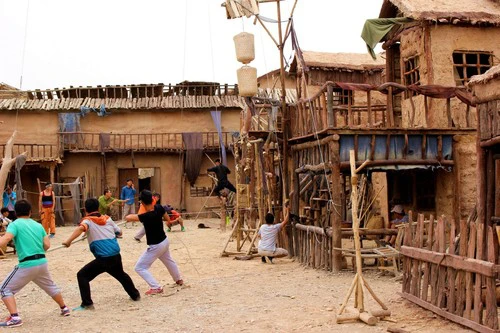
This small city has been the filming location for over forty films and TV series. Looking at the signboard of productions, familiar titles like "New Dragon Gate Inn" and "Detective Di Renjie" were shot here. Passing by "Ganzhou Street" and declining the commercialized "Buddha worship" ceremony, we climbed the city wall to view the ancient city one last time. The old streets, the old houses—everything is wrapped in antiquity. Compared to the vast desert in the distance, the ancient city appears so tiny. We then visited a stone calligraphy and painting exhibition hall and saw a musical stone. When I struck it, the stone emitted a beautiful "ding-ding" sound. There was also a stone that looked like ice—white and transparent, very beautiful. Dunhuang Ancient City is a filming location with picturesque scenery.
The Yellow River reaches far into the white clouds, / A lonely city stands amid thousand-foot mountains. / Why need the Qiang flute complain of the willow trees? / The spring breeze never crosses Yumen Pass." The desolate and poignant emotion in this poem sparked our longing for this ancient pass. Yumen Pass, also known as Xiaofangpan City, was built around 111 BC. It was a strategic throat on the Silk Road leading to the northern route of the Western Regions, located in the Gobi Desert 90 kilometers northwest of Dunhuang City. The pass city is square, with walls made of rammed earth standing 10 meters high, 3 meters wide at the top, and 5 meters wide at the bottom—well preserved. It measures 24 meters from east to west and 26.4 meters from north to south, covering an area of 633 square meters, with one gate on the northwest and one on the southwest respectively. At that time, Yumen Pass bustled with camel bells, people shouting, horses neighing, caravans in an endless stream, and envoys coming and going—a scene of prosperity. The Han Dynasty Yumen Pass relics of 2013 is a small square fortress standing on a sandy gravel ridge in the narrow strip of Gobi stretching east-west. Ascending the ancient pass and looking far into the distance, you see marshes everywhere, crisscrossing gullies, winding Great Wall, solitary beacon towers, upright poplars, and clear spring water. Red willow flowers bloom and reeds sway, complementing the majestic posture of the ancient pass, stirring your heart and evoking a sense of nostalgia.
The Yadan Landform looks like a stretch of rolling earthen mountains. I was surprised by how high it rises in the desert. Approaching, I could clearly see its mysterious patterns—deep and shallow gullies like wrinkled folds covering its steady earthy yellow body. It resembles a serene old man, sleeping quietly deep in the desert, standing silently, piled with earth and carved by time, standing here for millions of years! The landform is so vast, each formation so exquisitely original, as if I could hear the sound of its heart beating—deep and ancient yet vibrant. This miracle, shaped by tens of thousands of years of wind, rain, and seawater erosion, finally appears before people in this form, deeply shaking my heart! No matter how long passes, the magnificent and grandiose scenery of Dunhuang Yadan will be etched in my memory; no matter how long passes, the weathered and noble soul of Dunhuang Yadan will remain in my heart!
What attracts me most at the Mogao Caves is the flying apsaras scattered across the murals—the city sculpture of Dunhuang is also a flying apsaras playing the pipa backwards. Apsaras are deities serving the Buddha and Indra, skilled in singing and dancing. On the walls, apsaras dance in the boundless universe—some holding lotus buds and soaring into the sky, others diving downward like shooting stars. The painters used unique winding long lines and a sense of elongation and harmony to present people with a beautiful and ethereal imaginary world. The vivid colors and flowing lines reveal the northern painters' passionate and emotional depiction of the ideal heavenly kingdom. It seems we can feel their unrestrained passion for galloping across the vast desert wilderness. Perhaps it is this passion that gives birth to such bold imagination in the murals!
Shazhou Night Market is a street of snacks and handicrafts. The crafts here are not clichéd, mostly retaining local characteristics, and some are intangible cultural heritage. Fridge magnets with Dunhuang mural themes are very popular because photography of the beautiful murals in Mogao Caves is prohibited, so only this method can preserve the memory of the original paintings in mind. Wood carving represents original handicrafts. The dense fine-textured sand willows in the desert are the best raw material for wood carving, and Dunhuang has never lacked skilled painters. Their knife techniques are sharp and calm, outlining a world in a small space, and in no time they carve out your imagination. There are a variety of snacks, surely one will suit your taste.
The overall impression of Dunhuang Grand Ceremony is good. The performance is realistic, the actors vivid, and there are rotating seats that enhance the visual impact, giving a sense of time travel and making you feel immersed. The simulated cave reproduces the scenes from Mogao Caves murals of falling into the mortal world, crossing time and space—"Buddha comes alive," "Bodhisattva comes alive," "Apsaras fly in the sky"—highlighting the features of Mogao Caves.


