We Will Always Chase Faith and Stars - The Most Complete Self-Drive Tour of the Northwest Loop
In 2020, due to the pandemic, people's hearts are covered with some dust. In the first half of the year, the whole country was fighting the epidemic, and in the second half, the south was dealing with floods. This year, traveling to the Northwest has naturally become a more yearning destination for people.
A week-long journey, spontaneous and free, unhurried and calm, taking things as they come.
DAY1: Lanzhou - First Bridge of the Yellow River, Baitashan Park
DAY2: Tar Temple - 150km - Qinghai Lake - 80km - Haiyan County
DAY3: Qinghai Lake - 150km - Chaka Salt Lake - 200km - Delingha
DAY4: Yangguan - 60km - Dunhuang
DAY5: Mingsha Mountain Crescent Spring - 30km - Mogao Caves - 120km - Guazhou
DAY6: Jiayuguan - 210km - Zhangye Rainbow Danxia - 300km - Wuwei
DAY7: Lanzhou Airport
In "Big Fish & Begonia," it says: Life is a journey. How many cycles have we waited to enjoy this one journey? In this short life, we will eventually lose everything. So we might as well be bold: love someone, climb a mountain, chase a dream...
Also, visit a city, fall in love with a local thing — that part I added.
Time takes away youthful arrogance, and the years gradually settle into maturity, but we have never restrained our passion!
No itinerary, no hotel bookings, 2,500 kilometers, set out at sunrise, rest at sunset — an impromptu Northwest Loop departure.
Our Northwest Loop starts from Lanzhou, which naturally becomes our place to rest and prepare "supplies" for the journey. After all, it is our "first expedition" to the Northwest, filled with curiosity and excitement, urging us to quickly explore those mysteries.
Departing from Lanzhou, the first stop along the way is the Tar Temple in Xining. In Tibetan, Tar Temple means "Gumbum," which means ten thousand Buddha statues. During the Tang Dynasty, this was the first city entering Tubo from the Tang Empire — Xining Tar Temple.
We arrived at Tar Temple near noon. The temple is built upward along the slope. Here, you can see devout believers and people seeking faith everywhere. Since we are here, whether or not we have Buddha in our hearts, we might as well buy some highland barley to throw into the incense burner and let it burn, or light a butter lamp and watch its flickering flame, or put our palms together and tell Buddha what our hearts desire. Or we could close our eyes in the temple, turn the prayer wheels of three lifetimes, forget the hustle and bustle as dust, and find something to calm our minds. Although the world belongs only to you and has nothing to do with others, who can resist the desire to pray for themselves, their families, or even the world?
Ticket: Can be purchased on phone or at the venue. Phone tickets need to be exchanged for paper tickets at the ticket office to enter.
Guide: You can hire a guide to explain the statues and handicrafts inside (bodhi tree, gold Buddha statue, applique embroidery).
Visit time: About 3 hours.
Faith, snow, plateau, Buddhism, desolation — these form the unique scenery of the Northwest in people's impressions.
In a lifetime, whether it's meeting or passing by, the flying dust is a long-awaited release. Facing the clear lake water, this is the yearning we came for.
Leaving Tar Temple, heading west toward the next longed-for place: the high mountain lake, Qinghai Lake. Also known as "Kokonor," meaning "blue sea" in Mongolian.
Without the urging of a guide or the nagging of a driver, stopping here and there is exactly what people call a spontaneous trip. After a 150-kilometer drive, we suddenly hear, "Look, what scenic spot is that? Qinghai Lake entrance!" A thrill rushes through our hearts — this is the lake that lies at the highest point of our longing. We find a place to park, get out, and the vast, boundless Qinghai Lake appears before us, like a sea. The water is so clear and blue, like a mirror embedded in the grassland. White clouds float on the lake surface in the distance, and looking further, it seems as if the mountains connect the sky and the lake. Compared to the sea, it lacks natural surging waves but has more sacred tranquility. Crouching there quietly, watching the rippling water, my heart suddenly calms down — less restless, more peaceful. I just close my eyes and stay still, using my heart to "see" the stillness within. Or perhaps, in an unexpected moment, I shout loudly to empty myself and release.
Suddenly, a few raindrops fall on my face, and I realize that night is approaching. Haiyan County, also known as Atomic City, the closest place to Qinghai Lake, becomes our lodging choice for tonight. Atomic City is the first nuclear weapons research base built in China. Here, the older generation of scientists successfully developed China's first atomic bomb and first hydrogen bomb. Atomic City was built in 1958, and both China's first atomic bomb and first hydrogen bomb were born here, hence the name "Atomic City." "Atomic City" is the former location of "Qinghai Factory 221." Salute to the builders of Base 221 and the developers of the two bombs and one satellite! Salute to that glorious and brilliant era! Salute to the spirit of independence, self-reliance, self-improvement, and selfless dedication! Salute to the patriotic spirit of defying power, hard work, striving, unity, and defending the country!
The temperature difference on the plateau gradually makes people feel a hint of coolness in summer. While chasing time on the highway, we noticed the tire pressure was unstable. Although I have changed tires many times and am good at it, the sudden drop in tire pressure still caused some anxiety. After all, it was dark, windy, and drizzling. The raindrops, though small, stung under the wind's force. Moreover, we were in a remote plateau area with no villages ahead or inns behind. We found a parking area for a thorough check. Based on my experience — I can drive but not repair cars — we could continue at a slower speed. When the navigation showed about 10 kilometers to a city, we saw the city's searchlights shooting into the sky. Our anxiety was thrown away again — we had arrived at a "big city." Fix the tire, eat, rest.
Morning: Some people feel it's wonderful to wake up and see a loved one lying beside them. Some feel it's wonderful to wake up and see the sun shining in. I feel: Why does the sun always rise so early?
The 7 a.m. alarm may or may not have rung, but the 9 a.m. sun is indeed very high. The longing for Qinghai Lake can no longer be contained. Locals affectionately call it the "Eye of the Plateau" and "Blue Gem of the Plateau." On the map, Qinghai looks like a cute rabbit, and Qinghai Lake is the rabbit's eye. Cycling around the lake becomes a paradise for every summer cyclist. The azure Qinghai Lake meets golden rapeseed flowers. Whether driving or cycling, the blue lake water, wind-blown prayer flags, and vast rapeseed fields, with the distant plateau snow mountains — all these we have seen in dreams or on TV and photos. Stopping to take in the beauty, we marvel at nature's magic and enjoy this moment!
Ticket: Can be purchased online or at the venue. Other rapeseed fields are privately owned and charge 20 yuan for photo entry.
Visit time: Around the lake.
Note: Non-official scenic areas, do not approach or enter the lake for swimming, deep water hazard.
Bidding farewell to the azure Qinghai Lake, we head southwest to Chaka Salt Lake, China's "Mirror of the Sky." The entire salt lake is brilliantly white, and even the air carries a faint salt smell. The distant sky is high and clear, the clouds are pure white like cotton, and the lake surface reflects the cotton-like clouds. The shore is lined with white salt crystals, and in the distance, the towering Qilian Snow Mountains are clearly reflected on the shimmering water. The water and sky merge, making it hard to tell which is sky and which is water.
Deep into the salt lake center, it is also the famous filming spot for the "Mirror of the Sky." You can buy tickets and small train tickets. Of course, there are also people like us who insist on walking in to save 50 yuan for a one-way ticket. Entering the scenic area, a large observation deck and salt sculptures attract most tourists. A small train track extends into the lake center, very conspicuous. The vast salt lake unfolds before us, experiencing the true beauty of Chaka Salt Lake as the "Mirror of the Sky." Roll up your pants, go barefoot, and have a skin-to-skin contact with the sacred salt lake. Walk in quietly, don't wake it from its slumber. You are beautiful, and your heart is bright...
Of course, there are many people like us who think the train ticket is expensive, don't buy it, and simply walk back and forth. Enjoyment and price are equal.
Ticket: Can be purchased online or at the venue; it is recommended to buy a one-way small train ticket.
Visit time: 2-3 hours.
Note: If entering the water, remember to buy shoe covers in advance or prepare towels and tissues to wipe feet.
Leaving Chaka Salt Lake, we chase the sun and head northwest toward Yangguan. The Third Northwest Traffic Commission reminds you: the journey is long, please fasten your seatbelt. With frequent stops, we decide to find a big city to rest overnight — Delingha. Just before entering Delingha, we look toward the horizon and see phoenix clouds — a pleasant surprise of unexpected beauty.
Delingha is located between Chaka Salt Lake and Yangguan, and it is one of China's four major basins, a must-pass on the way through the Qaidam Basin. Delingha means "vast wilderness" in Mongolian. In the 13th century, the Mongols rose, destroyed the Jin and Song dynasties, established the Yuan Empire, and Delingha came under Yuan rule. Today, Delingha is the capital of Haixi Prefecture. Perhaps Delingha is more widely known thanks to Haizi's "Diary." The loneliness and helplessness in the poem make people feel the sad desolation of the Northwest even more.
Sister, tonight I am in Delingha, covered by night
Sister, tonight I have only the Gobi
At the end of the grassland, my hands are empty
In sorrow, I cannot hold a single tear
Sister, tonight I am in Delingha
This is a desolate town in the rain
Except for those passing by and those living here
Delingha ┄┄ tonight
This is the only, the last, lyric.
This is the only, the last, prairie.
I return stones to stones
Tonight, highland barley belongs only to herself
Everything is growing
Tonight, I have only the beautiful empty Gobi
Sister, tonight I care not about humanity, I only miss you
— Haizi, "Diary"
About 50 kilometers from Delingha, there is an alien ruin. Friends who have been there say it's the best place to photograph stars at night, but 10,000 mosquitoes will make you feel their enthusiasm. The aliens chose this landing point — maybe it's the best choice, after all, big cities have too many onlookers, and it avoids being reported by the "concerned citizens."
People who have driven on the highway from Golmud to Delingha and Yangguan probably remember: there are almost no cars on the road, so much so that people stop and stand in the middle of the road to take photos. Because the road is sparse and rarely traveled, a novice driver in our car, who had a license but never drove, got itchy hands. He started his first real road practice. From then on, I, the old driver, could no longer restrain him. Although he nearly crashed later, it did not diminish his excitement for driving...
Besides few people and few cars, this area is also heaven for various wild animals. If you're lucky, you'll see herds of Tibetan wild donkeys, wild yaks, and Tibetan gazelles roaming freely. And you can see marmots as soon as you get out of the car.
Yangguan: a strategic pass on the Great Wall defense line along the northwestern frontier of the Han Dynasty. It was one of the western gateways from China to the Western Regions and Central Asia, and also a place Zhang Qian passed through on his mission to the Western Regions, which opened the Silk Road from Xi'an to Central Asia.
"Yangguan is a thousand miles away, no one returns,"
"Spring clouds never change Yangguan's snow, mulberry leaves know the autumn of the barbarian land first."
Many literati and travelers sighed with emotion at Yangguan. But the Tang Dynasty poet Wang Wei's "Weicheng Song" — "I urge you to drink another cup of wine, west of Yangguan there are no old friends" — made people yearn for the eternal Yangguan, even though Wang Wei never actually visited Yangguan.
Today, the former prosperity is long gone. The once majestic gates and towering city walls are nowhere to be found. What appears before you now is only the distant mountains and a remaining beacon tower site. Perhaps in many years, under wind and sun, even this sole physical witness will collapse and disappear from people's sight.
Ticket: Can be purchased online or at the venue. Buy a bus ticket to the beacon tower site.
Visit time: 2-3 hours. There is a unified free guided commentary.
Note: Dry weather, sun protection, drink plenty of water. Outside, a watermelon costs 10 yuan and is quite sweet.
West of Yangguan, there are no old friends. Although now the scenery west of Yangguan is even more beautiful, the Northwest Loop has reached its westernmost point. Lhasa, Tibet — we'll come again next year.
Dunhuang has its own unique charm. A major town on the ancient Silk Road, like Yangguan, it has long lost its past glory, but the desert sunset remains the same. In Dunhuang, talk with history with your soul. Located 5 kilometers south of Dunhuang city in Gansu Province, at the northern foot of Mingsha Mountain, the landscape has been known throughout the ages for the wonder of "mountain and spring coexisting, sand and water living together." Mingsha Mountain Crescent Spring: perhaps like me, you first learned about Crescent Spring from elementary school textbooks, or from others' photos, or from Yu Qiuyu's "Hidden Spring in the Sand Dunes" in scholarly books, which gives you more insight. The mountain is called Mingsha Mountain; the spring is called Crescent Spring.
As Yu Qiuyu said, there are roads in the desert, but not here. From afar, a few crooked footprints are visible. Follow them? No, the places stepped on by others are looser and harder to walk on. You have to use your own feet to make a new path. Looking back, you feel happy for your long line of footprints. How long will this line of footprints last?
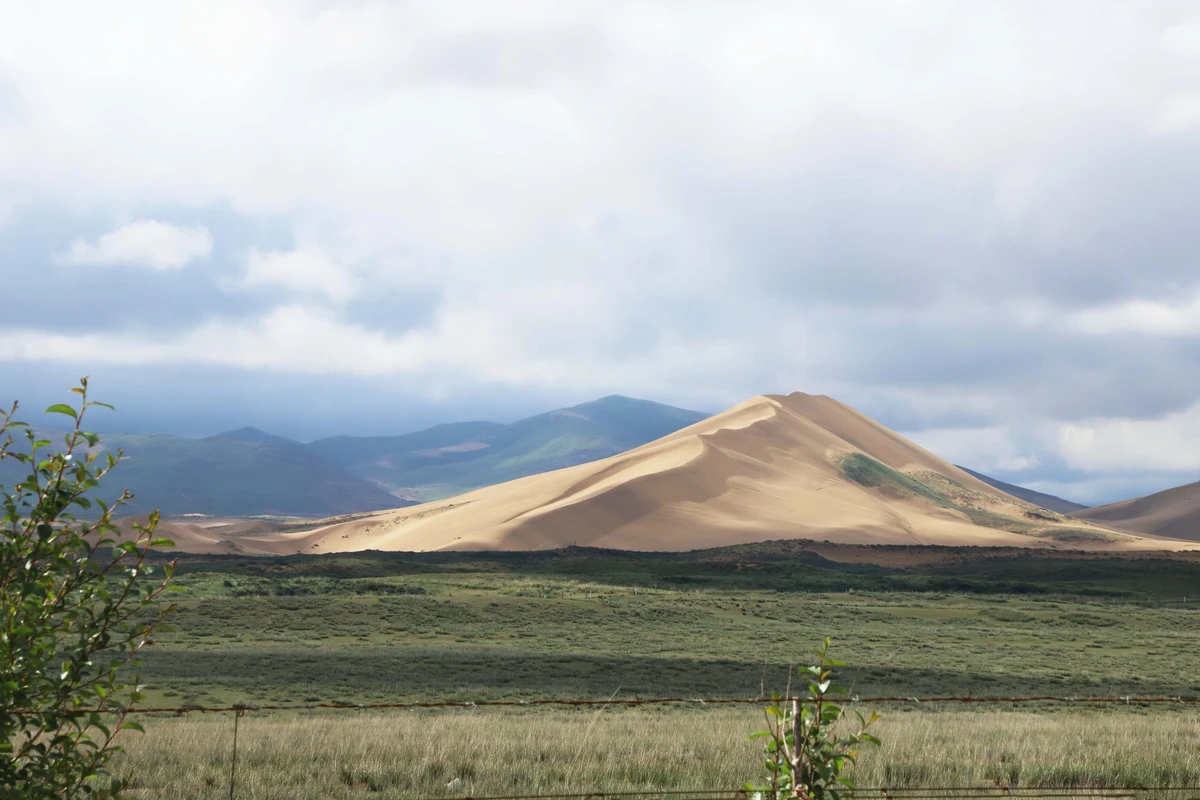
Climbing the sand mountain is an extremely laborious task. Just step down, and with a little force, the sand slides underfoot. The harder you push, the deeper you sink, and the more you slide. After a few steps, you're already out of breath and annoyed. Here you can't be like a child happily climbing a mountain. Tired, with brute force, you could sprint to the peak. But here, brute force won't work. The soft fine sand doesn't hurt your feet, doesn't let you bump into anything; it merely gently saps all your strength. The more you rage, the gentler it becomes — a maddening gentleness. Helpless, you have to suppress your anger, lighten your steps, and rub along with it.
If you want to quickly stomp up the mountain, don't come here. There are plank roads, stone steps — millions have walked them, and millions will. But those don't leave you footprints — your own footprints. If you come, accept it: for the rules of desert travelers, for these beautiful footprints.
With a calm mind, climb slowly. The top of the sand mountain appears higher and higher; the more you climb, the higher it gets, like chasing the moon as a child.
Reaching the top, looking down at Crescent Spring, you can see its full view. It is shaped like a crescent moon, hence the name. In ancient times, it was called "Sand Well" and also "Medicine Spring." Crescent Spring is surrounded on all sides by Mingsha Mountain, yet it is never buried by shifting sand. It remains clear, with blue ripples, not overflowing in prolonged rain, nor drying up in prolonged drought — a relationship of mutual respect.
Ticket: Can be purchased online or at the venue.
Visit time: 2-3 hours; if time permits, wait for sunset.
Note: Dry weather, sun protection, drink plenty of water. Remember to buy shoe covers outside the scenic area.
Besides Mingsha Mountain Crescent Spring, Dunhuang has another must-visit: the Mogao Caves, known as the "Oriental Louvre." As Fan Jinshi said in her autobiography, "My Heart Returns to Dunhuang." An impromptu trip is good, but traveling without a guide has its downsides. Here we encountered a historic problem: no tickets. Due to daily ticket management, Mogao Caves sells 3,000 Class A tickets per day and 6,000 Class B tickets per day. This year, due to the halt of international travel and the popularity of Northwest travel, we were unable to purchase tickets for the day. Again, we remind you: buy tickets in advance. Because of our itinerary and time constraints, we couldn't visit the Mogao Caves. How did we console ourselves? "A life without regret does not exist. But if this Northwest trip truly has regrets, not buying Mogao Caves tickets is the biggest and only regret... Even so, it can still be said: This was not a complete Northwest trip, but it was definitely a perfect one. I believe most people, from departure to arrival in the Northwest, share this sentiment." (The above is the reason my fellow traveler used to convince himself — the strongest excuse ever.) Convincing ourselves: amidst the desolation of the Northwest, there must always be something unattainable, leaving it for next time.
Ticket: Buy tickets in advance, in advance, in advance.
Visit time: I don't know because I didn't go in...
Note: Buy tickets in advance, in advance, in advance.
On the desolate Gobi of the thousand-mile western deserts, by the ancient ferry of the Three Gorges of the Yellow River, we trace the history of venturing west.
Ancient people were probably more resilient and bold. Merchants, craftsmen, troupes — when they decided one day to set off, they would join caravan teams, roam the Silk Road, cross grasslands and deserts, ride horses for months, walk for months, even years, to earn a lifetime of glory to return home.
Jiayuguan: a strategic pass on the ancient Silk Road. It is the western section of the Ming Great Wall and an important town on the ancient Silk Road. Due to its strategic location and magnificent architecture, it is known as "the First Grand Pass under Heaven" and "the Key to the Border Fortress." The pass consists of inner and outer cities, with three main towers, and additional arrow towers, watchtowers, corner towers, pavilions, and sluice towers on the city walls. Climbing the city wall and looking into the distance, you see the Qilian Snow Mountains stretching in the distance and the Gobi desert at your feet.
Zhang Qian once walked from here to present-day Uzbekistan.
The land behind him was later called the Hexi Corridor.
In the following years, Huo Qubing swept away the Xiongnu, Faxian and Xuanzang went west to India, Central Plains culture took refuge westward, Emperor Yang of Sui inspected Yanzhi Mountain, Zuo Zongtang carried his coffin into battle, vowing to recover Xinjiang... The heavy strokes of history repeatedly overlapped on this narrow strip of land, evoking a sense of historical tragedy.
Besides feeling the vicissitudes history brings, we might also seek out another architectural story of Jiayuguan: the legend of a single brick on the city wall.
Ticket: Can be purchased online or at the venue.
Visit time: 2-3 hours.
Note: Dry weather, sun protection, drink plenty of water.
Heading south along the Hexi Corridor, following the Qilian Mountains, on the way to Yulin Caves or Guazhou, on the red hill Gobi lies a sculpture of a sleeping child, "Son of the Earth," lying prone, peacefully asleep, as if not wanting to be disturbed.
The sleeping baby lies on the earth, affectionate and peaceful. We don't know what wonderful dream appeared in the child's dream, making the corners of the mouth upturned with sweetness. Was it eating candy, having many toys, or acting spoiled in mother's arms? After all, we are all children of the earth!
Postscript: Not far from the sculpture's parking lot, there is a building that looks very much like a scenic spot structure. It blends harmoniously with the sculpture and the surroundings. Looking from afar, we guessed it might be related to the sculpture or to the land itself. With the attitude "since we're here, let's take a look," we approached and then went closer — together we went to the restroom, to avoid having to solve the problem on the roadside if there were no rest areas...
I don't remember where I saw this: When a child asks his mother what lies beyond the mountains, the answer is still mountains. In those times, some set out for the Western Regions to conquer territory, some to conquer the Xiongnu, but I wonder if anyone followed the Qilian Mountains into the Central Plains seeking a life called "abundant harvests."
Driving from an altitude of 3,800 meters down to 1,500 meters at the end of the Qilian Mountains, there is a palette knocked over by God — the Rainbow Danxia. This might also be the most serious part of the last trip.
People always attach their own concepts to landscapes. Some say it's a rainbow directly falling to earth; I think that's not accurate enough. If the palette spilled, wouldn't a few drops of water make it even more dazzling? After a rain, the colors are more vivid and distinct after being soaked by rainwater. We traveled thousands of miles to chase these colors, enjoying this heavenly rainbow falling to earth, or if God really knocked over a palette, beauty is enough.
The scenic area bus will take you to the viewing platforms. Entering the area, you cannot help but marvel at the magic of nature — uncanny workmanship, wonderful workmanship surpassing nature. Red, yellow, orange, brown — different colors mix yet remain so clear and distinct.
Ticket: Can be purchased online or at the venue.
Visit time: 2-3 hours.
Note: Dry weather, sun protection, drink plenty of water. Remember which gate you entered from.
Moving forward, all is beautiful, as we often say: reading ten thousand books and traveling ten thousand miles. Because on the road, you'll encounter unexpected luck. A rainbow — right before our eyes, rising from the ground.
Look, that city with lights on.
Wuwei: the largest plain on the Hexi Corridor. The oldest nomadic tribes of China — the Qiang, Quanrong, Wusun, Yuezhi — once dominated here. It also has a more widely known name: Liangzhou. "In Liangzhou, seven miles and a hundred thousand homes, half of the Hu people can play the pipa." For a long time, it was the military, political, economic, and cultural center of the Northwest, a "big city" pursued by many literati.
The Bronze Galloping Horse Treading on a Flying Swallow — the artifact we learned about in elementary school — originates from Wuwei.
The Yellow River flows far into the white clouds, an isolated city amidst a thousand mountains.
Crossing the Yellow River, crossing the Loess Plateau,
The once distant Western Regions began here from Wuwei.
That city with lights on at the foot of the Qilian Mountains is where we rest tonight.
From Wuwei to Yangguan.
This is a journey of searching.
This was the most devout hope of the Han Empire.
From Yangguan back to Wuwei,
This is a return journey of glorious achievement.
This is the hope of the Hexi Corridor's prosperity.
The names of these cities along the Hexi Corridor and the scenery all the way constantly remind us: the beauty of today is the wealth left to us by our ancestors. Let us chase faith and the stars with awe!
Travel notes directory:
1. This world belongs to you, and has nothing to do with others.
2. We will always chase faith and the stars.
3. West of Yangguan, no old friends.
4. Amidst the desolation of the Northwest, there is a touch of the unattainable.
5. Desolation, beauty, and luck travel together.
6. God's palette in the beautiful mountains.
Travel information, hotel index, guide index, flight index, website navigation, travel index, cruise index, corporate travel index, join cooperation, distribution alliance, friendship links, corporate gift card procurement, insurance agent, agent cooperation, hotel joining, destination and scenic area cooperation, more join cooperation, about Ctrip, about Ctrip, Ctrip hotspots, contact us, career opportunities, user agreement, privacy policy, business license, security center, Ctrip content center, intellectual property, Trip.com Group algorithm disclosure.


