2018 National Day Holiday: Beijing-Dunhuang-Jiayuguan 6-Day Trip
During the 2018 National Day holiday, I was a bit busy with work and didn't have the energy for a long road trip. I also didn't want to rent a car and drive—I was feeling lazy. This time, I decided to experience hiring a private car to enjoy the desert, Gobi, and poplar forests.
October 1: Beijing → Dunhuang
[Transport] Fly from Beijing to Lanzhou (CA1239), then from Lanzhou to Dunhuang (QW6007)
[Sightseeing] "See Dunhuang Again" immersive performance, Shazhou Market
The "See Dunhuang Again" performance follows six key characters and spans a thousand years through five typical scenes, recreating Dunhuang's history. Entering the theater, the audience moves through different "caves" in sequence. With the help of rare super-large linked stage machinery, 3D imaging devices, and moving giant screens, the audience can "converse" with historical figures from the Mogao Caves murals and experience the changes of history.
[Food] Lunch: Airport simple meal + airline meal; Dinner: Astin Hotel Restaurant
[Accommodation] Astin Hotel (Dunhuang) Dingdong Robot Standard Room, RMB 2591/3 nights (rates vary per night)
[Review] Astin Hotel (Dunhuang) offers airport pickup. The guide was very enthusiastic. The private car company booked through Ctrip and several hotels in Dunhuang belong to the same group. If there were any issues during these days, I could contact her. The guide promoted the "See Dunhuang Again" immersive performance for the evening, and we booked it in the car. Of course, it was part of our planned itinerary. The performance was quite stunning—grand scenes, touching stories, allowing people to step into history and return to the past. I didn't spend time wandering around Shazhou Market; I only glanced from outside. The small stalls looked a bit messy, and I doubt locals would spend money there.
October 2: Dunhuang
[Transport] Luxury mini-private car day trip to Mingsha Mountain Crescent Spring + Mogao Caves
[Sightseeing] Mingsha Mountain Crescent Spring, Mogao Caves
Mingsha Mountain Crescent Spring is located south of Dunhuang city. Here, sand mountains and springs coexist, known as a "desert wonder" and one of Dunhuang's icons. You can climb Mingsha Mountain to overlook Crescent Spring, enjoy the desert sunset from the summit, and feel the vastness and desolation of the northwest desert. Although fire and water are usually incompatible, Crescent Spring sits peacefully among the sand mountains. Crescent Spring is at the foot of Mingsha Mountain, surrounded by sand dunes. Due to the terrain, wind blows sand upward rather than downhill, so Crescent Spring is never buried by sand and is known as the "Eye of the Desert."
Mogao Caves, also known as the Thousand Buddha Grottoes, is located southeast of Dunhuang city. The caves were first built during the Sixteen Kingdoms period of the Eastern Jin Dynasty and continued for over a thousand years until the Yuan Dynasty. They feature a vast number of murals, caves, and artifacts, making them a world-renowned Buddhist art site. Here you can admire large-scale, content-rich cave and mural art, and learn about the thousand-year history of Buddhism in Dunhuang through explanations and film screenings. It's a must-visit for tourists in Dunhuang.
[Food] Breakfast: Astin Hotel (Dunhuang); Lunch: Roadside shop near Mogao Caves ticket pickup point; Dinner: Astin Hotel Restaurant
[Accommodation] Astin Hotel (Dunhuang) Dingdong Robot Standard Room, RMB 2591/3 nights (rates vary per night)
[Review] The private car driver found it incredible that there were so few tourists in Dunhuang this National Day. There weren't many cars in the parking lot, and there were hardly any visitors when we entered the scenic area. We had a great time at Mingsha Mountain—we tried camel riding, desert jeeps, helicopters, and sand sliding. To attract customers, the helicopter service not only discounted tickets for both adults but also waived the fee for our son, with an electric cart taking us to the helipad. The helicopter flew in a circle, offering a bird's-eye view of Crescent Spring in the desert, lasting only about 5–6 minutes. For Mogao Caves, tickets must be booked online in advance. Fortunately, I had prepared, so we could visit more caves. At Mogao Caves, it's essential to listen to the guide; otherwise, you won't know the legends behind the dim murals.
October 3: Dunhuang
[Transport] Day trip private car to Yangguan, Yumen Pass, Yardang landforms, and Han Great Wall
[Sightseeing] Dunhuang Ancient City, Western Thousand Buddha Caves, Yangguan, Yumen Pass, Yardang Geological Park
Dunhuang Ancient City, also known as "Dunhuang Film City" or "Imitation Song Dynasty Shazhou Ancient City," is located on the Gobi Desert south of the road from Dunhuang to Yangguan, 20 km from Dunhuang city. It was built in July 1987 for the Sino-Japanese co-production of the historical epic film "Dunhuang" by the August First Film Studio. Famous production designer Kou Honglie referred to ancient city materials of Shazhou, Ganzhou, and Bianliang, using the Song Dynasty painting "Along the River During the Qingming Festival" as a blueprint to carefully design and construct this set.
Western Thousand Buddha Caves are part of Dunhuang's Buddhist art system. There are 16 caves from the Northern Wei to the Song Dynasty. Among them, caves 1–3 are Tang Dynasty, caves 4–8 are Wei Dynasty, and cave 16 is late Tang. These 9 caves are well-preserved, while others are blurred due to weathering and hard to date. The cave shapes and mural art styles are similar to contemporaneous works in Mogao Caves, and they were built at least in the same period.
Yangguan (Sun Pass) ruins, also called Yangguan Museum, is a scenic area built on the site of the ancient Yangguan. The site includes imitation Han-style towers, multiple exhibition halls displaying many artifacts from the ancient Silk Road. First, you enter the Yangguan Museum, a group of imitation Han buildings, which includes exhibition halls on the Han dynasty border passes and the Silk Road, the Yangguan Research Institute, Han-style archways, imitation ancient barracks, the Yangguan Commandant's Office, imitation Han Yangguan gate, an imitation Han residential street, and a tourist souvenir center. After visiting, you go to the Yangguan beacon tower at the end of the area, the actual site of the ancient pass. You can take photos, and the millennium-old ruins on the Gobi Desert are magnificent.
Yumen Pass (Jade Gate Pass) was built in the Eastern Han Dynasty, also known as Xiaofangpan Fortress. It flourished with the Silk Road and was once a必经之地 for traders from the Western Regions and central China. Because Hetian jade was imported into central China through this pass, it was called Yumen Pass. It went through several rises and falls along with the Silk Road's three periods of openness and closure, eventually becoming ruins. Now Yumen Pass looks like a rammed earth mound, square-shaped, about 10 meters high and over 20 meters long and wide, with four earth walls and two gates on the northwest sides.
Dunhuang Yardang Geological Park, also known as Dunhuang Ghost City, features a large area of unique yardang landforms, spectacular and surreal on the Gobi. At dusk, the setting sun makes it a perfect spot for photography. The park is vast, with various wind-eroded landform landscapes. There are two routes: the north route and the south route. Visitors can take a shuttle bus to visit the north route, which takes about 1.5–2 hours. Alternatively, after the north route, you can take an off-road vehicle to visit the south route, making a loop that takes 3–4 hours. The shuttle bus has a guide. You enter the park and take the shuttle, which stops at four spots on the north route: Golden Lion Welcoming Guests, Pyramid, Peacock, and West Sea Fleet. Each stop lasts about 10–30 minutes. Golden Lion, Pyramid, and Peacock are individual wind-eroded rock formations, shaped like their names. West Sea Fleet is a group of landforms, the most spectacular of the four—rows of ship-shaped earth mounds parallel on the Gobi, truly resembling a fleet. Also, along the route between stops, there are many unique wind-eroded rock formations, so don't miss them while riding.
[Food] Breakfast: Astin Hotel (Dunhuang); Lunch: Small roadside restaurant near Yangguan; Dinner: Astin Hotel Restaurant
[Accommodation] Astin Hotel (Dunhuang) Dingdong Robot Standard Room, RMB 2591/3 nights (rates vary per night)
[Review] Dunhuang Ancient City is similar to the Western Film Base in Yinchuan, but smaller. We gave it a quick look. There were also few visitors at Western Thousand Buddha Caves. A group was formed and a guide led us to tour the cave murals. I felt the artistic value is not inferior to Mogao Caves. At Yangguan and Yumen Pass, if you expect to see the grandeur and prosperity of ancient passes, you'll likely be disappointed. After thousands of years of erosion, the passes have lost their original appearance, leaving only outlines for tourists. The museums at both passes have exhibits that children liked, especially the sand table models of beacon towers, armor, and weapons. Yardang Geological Park was the highlight of the day—nature's extraordinary craftsmanship is fascinating. Unfortunately, the tour bus only stops at designated areas, and visitors are prohibited from approaching the wind-eroded rocks, so we couldn't observe each site up close.
October 4: Dunhuang → Jiayuguan
[Transport] Dunhuang → Jiayuguan by K369 hard sleeper train
[Sightseeing] Green train
[Food] Breakfast: Astin Hotel (Dunhuang); Lunch: Roadside restaurant near Guangchang Holiday Inn; Dinner: Cake shop opposite the square
[Accommodation] Jiayuguan Guangchang Holiday Inn Standard Room, RMB 899/night
[Review] Our son was very excited when he first boarded the train—he had never been on one before. Everything was new. Whenever wind turbines or substations appeared on the vast Gobi outside the window, he would stare for a long time. But after an hour or so, the fatigue of the past two days caught up, and he dozed off. By the time we settled into the hotel in Jiayuguan, it was already past lunchtime. We finally found a restaurant open on the roadside around 3:30 PM. Jiayuguan city felt very deserted to me—there were hardly any people on the streets.
October 5: Jiayuguan → Jinta → Jiayuguan
[Transport] Jinta day trip private car
[Sightseeing] Jinta Desert Poplar Forest Scenic Area
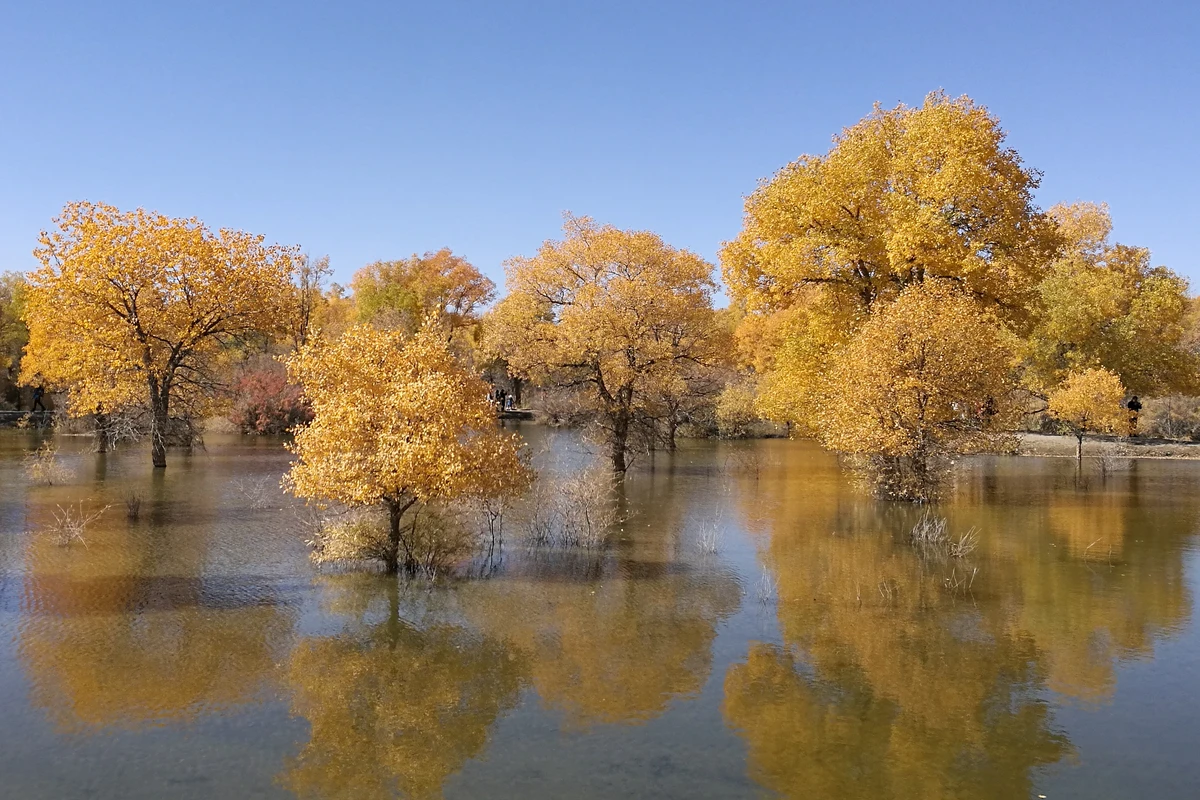
Jinta Desert Poplar Forest Scenic Area is located on the north side of the middle section of the ancient Silk Road, 8 km northwest of Jinta County, Gansu. It consists of five zones: the Poplar Forest-Jinbo Lake core area, the Russian Olive Forest viewing area, the vast Hongliu (Tamarix) forest conservation area, the desert entertainment experience area, and the desert reed maze area, covering over 80,000 mu. The scenic area contains the largest "fossil-grade plant" poplar forest in Northwest China, covering tens of thousands of mu, with great ornamental value. Visiting here allows you to fully experience the desert landscape, appreciate poplar culture, explore hidden forest paths, and enjoy the wild fun of the desert. It is a tourism destination combining ecological afforestation, windbreak and sand fixation, dining and entertainment, leisure vacation, photography, and sightseeing. It has been rated as the most beautiful autumn scenery in Gansu Province.
[Food] Breakfast: Jiayuguan Guangchang Holiday Inn; Lunch: Simple meal inside Jinta Desert Poplar Forest Scenic Area; Dinner: Jiayuguan Guangchang Holiday Inn
[Accommodation] Jiayuguan Guangchang Holiday Inn Standard Room, RMB 899/night
[Review] The desert, poplar forests, beacon towers, and lakes—the poplar forest scenic area was absolutely beautiful. Many tourists bought red scarves at the entrance, adding bright red dots to a sea of gold. It was a feast for the eyes.
October 6: Jiayuguan → Beijing
[Transport] Fly from Jiayuguan to Beijing (MU2417)
Jiayuguan day trip private car
[Sightseeing] First Pier of the Great Wall, Suspended Great Wall, Jiayuguan Pass
First Pier of the Great Wall scenic area has magnificent natural scenery. To the east lies Jiuquan, west the desert, north Jiayu, south Qilian. The Taolai River flows eastward. Looking south, the mountain peaks are white all year round, contrasting with the blue sky, fresh and picturesque. As the saying goes, "The distant peaks are wet with clouds, the sparse forest sways in the breeze." The scenic area covers about 3.58 square kilometers, including the First Pier, comprehensive service area, Taolai River zip line, Taolai Inn, sky-suspension bridge, "Drunk in the Desert" sculpture group, and "Chinese Dragon Forest."
Suspended Great Wall is located on the north slope of Black Mountain at the north side of Shiguan Gorge, 8 km north of Jiayuguan Pass. Because the wall cascades down from the mountain, hanging in the air like an inverted Great Wall on the ridge, sealing the Shiguan Gorge, it is commonly called "Suspended Great Wall."
Jiayuguan Pass is located 6 km southwest of Jiayuguan city, in the narrowest part of the valley, on the highest point of Jiayu Mountain. The walls on both sides of the pass cross the desert Gobi, connecting to the Black Mountain Suspended Great Wall 8 km north, and to the First Pier 7 km south. It was the western stronghold of the Ming Dynasty Great Wall and has been the first strategic pass in Hexi since ancient times. The pass was first built in the fifth year of Hongwu (1372) and took 168 years (1372–1539) to become a complete fortress. It is the most dangerous and majestic among over a thousand passes under the nine garrisons along the Ming Great Wall.
[Food] Breakfast: Jiayuguan Guangchang Holiday Inn; Lunch: Airport simple meal
[Review] Since we had to catch the afternoon flight, we agreed with the private car driver to skip the Wei-Jin mural tombs on the itinerary and go directly to the airport after visiting the pass. The suspension bridge and camp at the First Pier attracted the children the most. Crossing the suspension bridge over the Taolai River required some courage. Compared to that, the Suspended Great Wall wasn't very appealing. The ticket wasn't expensive, we went in, took a few photos, and left. The Jiayuguan Pass was worth visiting. We got a travel permit for our son, and after exiting the pass, we rode camels in a circle, which was a perfect conclusion to this northwest trip.
This trip during the National Day holiday lasted 6 days. All local sightseeing was done by hired private cars booked through Ctrip's day trips—the most hassle-free trip in recent years. We visited Mingsha Mountain, Crescent Spring, Mogao Caves, Dunhuang Ancient City, Western Thousand Buddha Caves, Yangguan, Yumen Pass, Yardang Geological Park, Jinta Desert Poplar Forest Scenic Area, First Pier of the Great Wall, Suspended Great Wall, and Jiayuguan Pass, experiencing the magnificent scenery of western China. The only regret is not having time to arrange a visit to Zhangye Danxia landforms, but that gives us a reason to come again.


