Traveling with Full Joy (Age 5) — Walking on the Silk Road
Do I live in your dream, or do you live in my memory?
The Silk Road will always be a path that the Chinese nation cannot bypass.
I never knew why there was such a famous road until I watched 'The Hexi Corridor' and understood its significance.
Yes, it is that important: to the north are the high mountains where the Xiongnu lived, to the south the high mountains where the Tibetans lived. A narrow canyon corridor nurtured an irreplaceable place. Emperor Wu of Han spent the country's resources to make it prosperous, but it stopped at the Yellow River. However, he left behind four prefectures: Wuwei (martial might), Zhangye (outstretched arm of the nation), Jiuquan (spring as sweet as wine), and Dunhuang (grand and magnificent). He also set up two passes: Yumen Pass and Yang Pass.
History is like this: such a famous place was plagued by war and chaos for a long time. The only emperor in Chinese history to visit was Emperor Yang of Sui (Yang Guang), but he did not take the route of the four prefectures; instead, he went from Chang'an through Xining, crossed the Qilian Mountains, and reached Zhangye.
This time, we followed his path and walked on the Silk Road.
Our 9-day vacation was compressed to 7 days due to very important matters.
I liked the direct flight from Yunlong Airport. In the hottest summer of Luzhou, we hurried to Xining.
We rented a car on Ctrip for the first time. The pick-up point was at the airport. Originally planned to depart at 2 p.m. and arrive in Zhangye by 8 p.m., but the car's brake pads had a problem and had to be repaired, delaying us until after 5 p.m. This also caused our first long-distance, high-altitude drive. It was past midnight when we finally crossed the Qilian Mountains at an elevation of over 3,700 meters. Anger, tension, surprise, novelty—all kinds of feelings mixed together. It was a driving level upgrade.
The exit from the Qilian Mountains onto the Hexi Corridor is called Biandukou. It is said that Huo Qubing fought a great battle against the Xiongnu here, and Emperor Yang of Sui also escaped a cold disaster here.
This time we were just passing through Zhangye, and we happened to encounter the most beautiful meteor shower in the sky. The next day, we got up early, ate our first delicious bowl of Lanzhou pulled noodles at a street-side shop, and then hurried on our journey, driving 600 kilometers along the Hexi Corridor from end to end to Dunhuang.
For no other reason than to feel the vastness of the northwest, the desolation of the Gobi, and the majesty of the snow mountains!
A long drive just to catch a glimpse of its beauty. Today we drove for another full seven hours, still full of passion, and arrived at the Mogao Caves in Dunhuang around 4 p.m. when there were fewer people. Visiting the Mogao Caves requires either an A ticket or a B ticket. Due to the special period, only 3,000 A tickets are available each day, and they are almost snatched up as soon as they are released. We went through several intermediaries, including a friend from the Lanzhou Party School, but in the end we could only get B tickets. The difference is that A tickets allow entry to 8 caves, while B tickets allow entry to 4 caves, and they are all different.
By the time it was almost over, we learned that there were also special exhibition caves that cost extra. It is said that seeing all of them costs 5,200 yuan (10 caves). However, in the exhibition hall outside the main gate, you can take a closer look at 10 fully simulated replica caves, with everything just 20 centimeters away from you.
In the evening, we didn't get to see 'See You Again, Dunhuang,' which everyone recommended. We had bought tickets for the show, but Manman was frightened by the loud noise, so we had to turn back with her and let her mother Minmin go alone.
The surprise that awaited us finally arrived: we stayed at the Dunhuang Shanzhuang hotel, which had been canceled three times. Over the years, we have traveled north and south, east and west, and during this special period, third-party travel agencies could list rooms at nearly three times the front desk price. There was probably only this one hotel like that. If there were no rooms, what could you do? Extreme disclosure: the front desk price plus 200 yuan. Guess the specifics yourself.
In my eyes, this is not a hotel at all, but an artwork disguised as a hotel!
We hadn't eaten well for two consecutive days, so tonight we finally let loose and enjoyed the food. Wonderful!
When I opened my eyes in the morning, it was another sunny day. Today's itinerary was to continue westward, bringing our spring breeze to the place it never reaches. Actually, after driving from Guazhou to the Dunhuang loop, the number of surrounding vehicles dropped by more than 90%. Today's drive felt especially desolate. On a straight road with no end in sight, we were the only car moving forward alone.
The vast Gobi is like a vast ocean!
Two hours later, we finally arrived at the equally lonely Yumen Pass. Thinking back to those times when iron horses galloped and swallowed thousands of miles like a tiger, now only broken walls remain. In a daze, I thought of the merchants coming and going with a dazzling array of goods, once standing where we stood. Yumen Pass, the Han Great Wall, and Hecang City form a closed loop, perfectly showcasing the city gates, defense lines, and supply facilities from a thousand years ago.
After experiencing culture, we experienced nature again.
We continued driving to the Yardang Geopark. In essence, this is where we truly stepped into the ancient Western Regions. Along the way, both sides of the road were the Przewalski's horse nature reserve.
After driving for almost an hour, we finally saw a few small mounds on the flat Gobi. At last, we arrived.
Yardang is actually the result of ancient oceans, ancient rivers, ancient climate, and collapse working together to form various shaped small mounds. According to the development history of Yardang, in the distant future, it will cease to exist, just like the surrounding Gobi!
Think of the time when Monk Lizun traveled eastward.
A friendly reminder to friends who have never been to the northwest: be sure to reserve 2-3 hours for each scenic spot. After coming out of here, we calculated that the time later might be tight, so Minmin and I agreed to give up Yang Pass. 'Imperfection' is also our tacit understanding after years of traveling.
After finishing the tour of Yardang Geopark, we headed to the place Manman most looked forward to. We reserved the time after 4 p.m. for Mingsha Mountain and Crescent Spring (no reason why; during the day it's too hot to set foot on the sand, and you'd die of dehydration and heatstroke). Mom and Manman were too tired and rested in the back. Manman's dad drove nearly 200 kilometers with only three brake presses. First, the road was too flat, too good, and empty of cars. Second, we hadn't refueled since last night, and today we missed the gas station again. The remaining mileage shown on the car's dashboard was almost the same as the distance on Baidu Maps. I was afraid that the onboard computer might have a calculation error. In this vast Gobi, I dared not consider the consequences. I kept thinking we needed to get closer to a city. For the first time, I looked at the dashboard with sweaty hands until everything was resolved when the remaining range showed 30 kilometers!
At 5 p.m., Mingsha Mountain and Crescent Spring were not that cool either. Most people started coming at this time. There was a long line of people waiting to ride camels. Everyone wanted to experience this unusual feeling. Each riding ticket corresponds to a specific camel. Standing up and kneeling down were somewhat strenuous for the camels, so they seemed reluctant to do these two movements. After the large group stood completely straight, the handler led them leisurely walking through the sand dunes. One camel behind seemed to like a certain smell in my bag and lightly touched me many times with its nose. Its long eyelashes and big eyes were quite beautiful.
The camel caravan, accompanied by the sound of camel bells, slowly moved forward along the edge of the dunes, stretching out far from head to tail.
The water in Crescent Spring seemed a bit high this year, spilling out beyond the fence line. Manman and a few newly met children were building sandcastles by the spring, forbidding adults from passing above. After sitting and waiting for a while, Manman's mom and I decided to climb Mingsha Mountain behind us with Manman, and even challenge climbing straight up the middle.
The result of the race: Manman first, Mom Minmin second, Dad last. Sitting on the top of the mountain looking down at Mingsha Mountain and Crescent Spring, accompanied by a touch of red on the horizon at sunset, the scenery before us has endured for thousands of years! Many years later, people will still sit here and watch the sunset!
At 9 p.m., the sky gradually darkened. Reluctantly, we left and took a taxi to the Dunhuang Night Market. Following the locals' advice, we didn't eat in the night market, but turned into an alley on the right side of the market, enjoying food patronized by locals. Manman's dad and Mom Minmin ordered a pitcher of beer, Manman had a bottle of soda, and we gnawed on hand-grabbed lamb.
Time in Dunhuang seemed very tight. We set off on the return journey again.
We drove all the way back along the Lianhuo Expressway. There were noticeably more cars on the return trip. We figured it was because cars from the Haixi Grand Loop had converged here. After four hours of driving, we arrived at Jiayuguan, feeling the majesty of this first great pass at the western end of the Great Wall. The spirit of those times still remained, but things had changed.
From here, the Central Plains and the territory beyond the passes were separated: one on this side, the other on that side. Many years later, after Lin Zexu's Humen Opium Destruction incident, he was demoted and stood on this city wall, gazing at the Western Regions and contemplating national policy. On his way home in retirement, he entrusted all his life's work to the commoner Zuo Zongtang, who later became a famous minister. Although he did not appear on the sea front where the foreign powers attacked, he firmly held China's Western Regions.
History, like the opium destroyed at Humen, turned into a wisp of smoke and disappeared into the past.
The Hexi Corridor also has a wide variety of geological conditions. The Zhangye Danxia landform is one of its dazzling pearls. I wanted to see the 'touch of red' at sunset in Zhangye, but the weather did not cooperate. A mass of dark clouds arrived. We entered the scenic area at the last moment, looking at the alternating ravines and colorful colors, truly like the earth's 'palette.'
Leaving with some more regrets, we stayed for the first time in a yurt near the scenic area tonight.
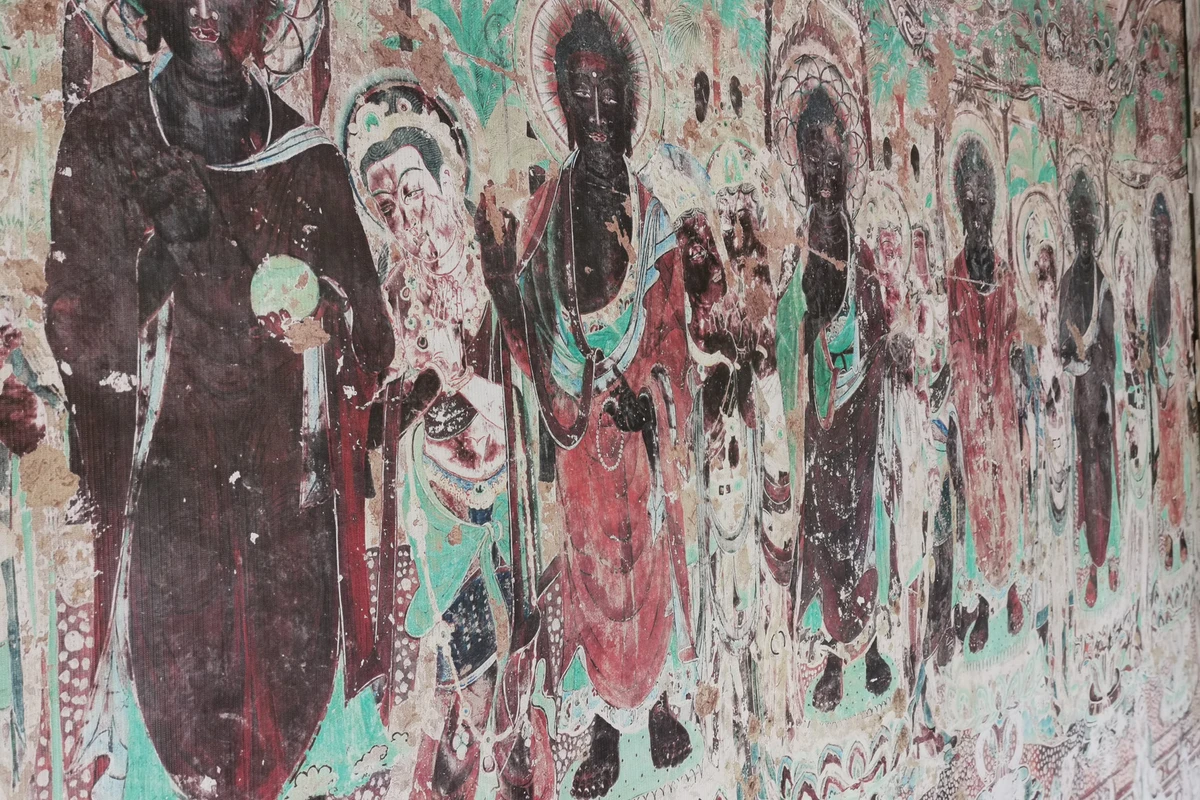
The itinerary for the new day was originally to pass through the Qilian Grassland, turn to the Arou Temple, and then return to Xining. However, the navigation took us onto a county road, gradually deviating from the expressway, and we drove straight towards the snow mountains. Looking around, we noticed we were approaching 'Horse's Hoof Temple,' so we once again tacitly adjusted our itinerary and came to this cave museum, as famous as the Mogao Caves and Yulin Caves, stepping on the same ground where Tang Xuanzang once traveled westward.
Only here did we truly understand that human worship creates miracles!
After Manman performed a Tibetan costume dance with song, we lingered in the Qilian Mountains and came to another major arrangement for Manman's trip: horseback riding on the Qilian Grassland. Stepping onto the horse's back for the first time, Manman showed no fear. Led by the groom, she changed to a white horse and then a black horse before finally lying back contentedly in the back seat of the car.
Detouring to Menyuan, we found the top-ranked noodle shop on Dianping and ate a local specialty tribute 'yellow mushroom.' Then we continued crossing Daban Mountain!
Once again, we luckily stayed in a hotel full of retail shops and had a good sleep.
Xining seems a bit far from the title of a tourist city. Many places were still closed, some due to the epidemic, some due to maintenance. Today, the car got some rest. In the morning, we only went to the Qinghai-Tibet Plateau Wild Animal Zoo in the city center to see the characteristic animals of the plateau. Our unanimous opinion was that this zoo is well-run. The animals are all chubby and cute, clearly well-fed.
Manman also clamored to see the aquarium and panda pavilion. Was that necessary? The ocean is almost farthest from here, and we've seen so many famous aquariums. Pandas? Haha, where we live, pandas are seen in groups; every family gets one for the New Year...
Eating is always our family's unchanging favorite theme. We went to the number one ranked northwestern cuisine restaurant on Dianping in Xining, 'Halal? Yiranxuan Qinghai Specialties.' After twisting and turning through alleys and taking two big loops, we finally found a parking spot. At the reception, before 1 p.m., we were told the lunch session was already full. The numbers held by people sitting around were all in the hundreds. The dinner session started at 4 p.m., and we could get number 2... Dizzy... Dinner session it is. The young man felt sorry and gave us two cups of yogurt.
With perfect timing, after yogurt solved Manman's hunger, we took a taxi to Dongguan Grand Mosque. We walked around it completely but didn't see the entrance. Regrettably, it was closed due to the epidemic.
After Manman learned about the minaret and moon decorations, we walked back along this road to the restaurant. The timing was right, and the door was open.
We had to catch up on the disrupted rhythm. After just having lunch at 4 p.m., we drove back to the hotel and then walked out to head to Mojia Street for dinner...
You don't understand the feeling of wanting to eat but being unable to swallow. In the end, we packed 6 portions of yogurt and two grilled naan breads back to the hotel.
On the last day of this trip, our return flight at 3 p.m. left us with a free morning. I heard that the Qinghai Provincial Museum has been closed for nearly two years due to renovation, so we went to the Qinghai-Tibet Plateau Natural History Museum instead. Manman followed a summer camp tour guide for children and listened all the way, gaining a lot.
Farewell! Returning home.


