Heart Tied to Qinghai Lake, Dream Fulfilled at Mogao Caves
Heart Tied to Qinghai Lake, Dream Fulfilled at Mogao Caves
-----A Brief Account of a Journey Through Qinghai and Gansu
Due to the pandemic, I had been canceling all non-essential trips this year except for work. But in late August, I suddenly felt like going out for a trip, so I chose Qinghai and Gansu as my destinations, fulfilling a long-held dream. I never expected the Qinghai-Gansu route to be so unexpectedly popular this year. Having no concept of the routes and distances, I crammed for two days by reading various travel notes and guides for the region, initially settled on a few spots, contacted several car-hire drivers through others' travelogues, and finally settled on one. After booking round-trip flights, I rushed to finish my work overtime to ensure a smooth departure.
Our trip was from September 14 to September 23, with the Qinghai-Gansu Grand Loop covering seven days, which was the highlight of the journey. Since we had hired a car and it was just the two of us, my husband and I, we thought arrangements would be easy along the way. But we overlooked the unprecedented popularity of the Qinghai-Gansu route this year, which had not cooled even by mid-September. Before departure, I was busy with work and hadn't made detailed plans or booked accommodation, only reserving a room for the day we arrived in Xining. This led to an uneven distribution of activities during the trip and rushed accommodation. Fortunately, with favorable timing, location, and people, everything worked out more or less smoothly—we were quite lucky. Before the trip, I read many people's travel notes and guides, and I wanted to record my own feelings and experiences to share. Since all photos were taken with a phone and I hadn't exported or organized them, I thought of skipping them out of laziness (but in the end, I couldn't resist and included some photos, hehe).
Day 1: Direct flight from Hangzhou to Xining. Arrived at noon. After checking in and settling down, I went out to wander around and look for food.
Although Xining is the capital of Qinghai Province, it still lags far behind cities in Jiangsu, Zhejiang, and Shanghai, feeling more like a small county town. However, the streets were clean, vehicles were neatly parked, and there were no disorderly bicycles or e-bikes blocking the road, which made the place very comfortable. We stayed on Dongguan Street, which was quite central, convenient for travel and dining, and close to Moji Street. We found a noodle shop at an intersection on Nanxiao Street and ate "Chao Pao Zhang" (a type of noodle dish where the noodles look like firecrackers, hence the name). It was quite good. Noodles in the northwest are all handmade, very chewy, and suited my taste.
After the meal, we visited the Dongguan Street Grand Mosque. Due to the pandemic, it wasn't open to visitors, so we could only see it from the outside. The Dongguan Street Grand Mosque is Xining's largest mosque, a combination of Arabic and Tibetan architectural styles, with a slightly gray color scheme. Many Hui people were sitting in the sun in front of the mosque, looking very relaxed, and there weren't many tourists. The Nanguan Mosque was also not far away; we passed it after finishing the loop and saw it. It's a purely Arabic-style mosque, smaller in scale than Dongguan Street, but I preferred its pure white tones. I'm not religious, but I quite like the architecture of mosques; it always feels so pure. Xining has a large Hui population, so there are many mosques.
Moji Street was also not far away. To be honest, it was quite ordinary, similar to the snack streets in many cities. It wasn't worth more than a glance; we decided to find food elsewhere. We only bought yogurt from Delu. Xining's yogurt is really good, with many famous brands. It's available in restaurants and supermarkets, usually 6 yuan per box or bowl, cheap and tasty. It was a bit sweet for me, but you could try the unsweetened version. We had dinner at the popular "Yixin Hand-Grasped Lamb Restaurant" (Yixin Zhuashou Yangrou Guan), which was surprisingly close to our hotel. It was good; hand-grasped lamb is their specialty. If you order lamb, don't order too many other dishes—the portions in northern cuisine are large, and you really can't finish them.
Day 2: From Dangar Ancient City to Qinghai Lake, then to Sky No.1, with beautiful scenery all the way.
The driver picked us up early. We originally wanted to go to Kumbum Monastery (Ta'er Temple), but this year, due to some indescribable reasons between the temple and local authorities, it was said that commercial vehicles were being strictly checked, so drivers were reluctant to go for fear of fines. We didn't want to force the issue and planned to go on our own after the loop. Not wanting to waste the morning, we chose Dangar Ancient City, which we decided on after reading reviews on Ctrip. This turned out to be a very wrong choice. Dangar Ancient City is located in Huangyuan County, a suburb of Xining. It's essentially a film set, abandoned after a movie was shot. It's completely negligible—desolate and all man-made, hardly an ancient city at all. It was a real waste of time. The driver was also dumbfounded by our choice; he said he had never been there himself. We could only laugh at ourselves.
After Dangar Ancient City, we headed straight for Qinghai Lake. Along the way, there was grassland as far as the eye could see. For someone who grew up in the Jiangnan region, this was an eye-opener. I barely blinked, staring out the window, finding every spot beautiful. There were very few people on the grassland. The driver told us that wherever there were prayer flags or white stupas, there must be people, but these people are not permanent residents—they are just herders. So prayer flags usually indicate sheep or cattle first. Each family has its own pasture, and their livestock graze and run leisurely. Since the weather gets cold quickly after October, the animals have to return to their pens. We passed by Sun and Moon Mountain and Daotang River but didn't get off, just glanced from a distance. Some scenery is better viewed from afar.
Around 12:30, we arrived at Erlangjian Scenic Area. Erlangjian is a paid entry area for Qinghai Lake, but many people enter the lake area from other entrances without buying tickets. The driver took us to a spot near Erlangjian where we could walk to the shore of Qinghai Lake. It was free and quite crowded, but Qinghai Lake is so vast that people were well spread out. There is a large stone tablet reading "Qinghai Lake" by the shore, naturally attracting throngs of people taking photos—so typical of Chinese habits. We only had our phones and weren't particularly keen on taking pictures; we preferred capturing empty scenes. We had no interest in riding yaks, so we walked directly inland from the shore. There was a small path along the lake, with a small ditch on the grass side. Standing on the path, one's reflection could be seen in the ditch, which was very beautiful. However, many parts of the path were prone to sinking, so it was important to walk in the middle. While walking along the lake, I stepped too close to the edge due to the crowd, and my foot sank. Luckily, I reacted quickly and pulled it out, but my shoes were covered in black sand and completely soaked. I quickly moved to a safe area, took off my shoes and socks, rinsed them in the water, then found a big rock on the grass to sit and dry them—quite a sight. The sun was strong by the lake, but the wind was also strong, so it didn't feel hot. Sitting on the rock, I watched a group of middle-aged women waving bright scarves, shouting slogans in unison, and striking various poses for photos—it was also a nice scene. The wind and sun dried my shoes quickly; I put them on again and continued walking by the lake. Qinghai Lake is very pleasant, perfect for bringing snacks and sitting on the grass to sunbathe and daydream. The crowds don't concern you, but the scenery does.
It gets dark very late in Qinghai, usually after 8:30 PM. So when we left Qinghai Lake, it was still early. The driver suggested we go to Chaka Sky No.1. Sky No.1 is a new scenic area near Chaka, about 20 kilometers from Chaka Salt Lake. It's similar to Chaka Salt Lake but hasn't been fully developed yet. During peak season, Chaka Salt Lake is overcrowded, and some tourists choose Sky No.1. The area is small but very pristine. You can take a small train from the entrance or walk; it takes only a few minutes. When we arrived, the water train wasn't running, sitting quietly on the lake, which was very beautiful. There are newly built hotels at the entrance of Sky No.1, but they are expensive, and dining options are limited. If you don't mind the cost, staying overnight at Sky No.1 is a good choice, as it's convenient for watching sunset and sunrise. Since we had already booked a hotel in Chaka town, we went there to stay. There were many hotels in the town, with decent conditions, but dining was expensive.
Day 3: From Chaka Salt Lake to Delingha, then to Emerald Lake, stunningly beautiful.
Chaka Salt Lake is best visited early in the morning or late in the evening, otherwise the sun is too harsh. We set off from the hotel early and went to Chaka Salt Lake. The scenic area is large and well-developed. We walked and looked along the way; there weren't too many people. The further in we went, the more beautiful it became. When we reached the central lake area, we realized that the outer viewing points had too many railings, so there was no need to stop. I recommend taking the small train from the entrance directly to the central area, then renting shoe covers to walk into the lake—there will be all kinds of surprises. Whether at Sky No.1 or Chaka Salt Lake, it's better to wear bright colors for photos, but too many people choose bright red dresses and scarves—just hehe. The shoe covers are red, so a touch of red or other bright colors on your outfit is also very beautiful and won't look tacky. So you can rent the shoe covers at the spot where you want to enter the lake; otherwise, carrying them around is a hassle. When wearing the shoe covers, you have to take off your shoes, so it's best to bring disposable shoe covers to put on first, then put on the rented ones for a cleaner feel.
The scenic area management was very good, with shoe cover rental points everywhere, each with attendants. Working under such strong sunlight must be very hard. I hope every tourist consciously follows the rules, doesn't litter, takes photos in safe areas, and doesn't cause trouble for others.
Around noon, we left Chaka Salt Lake and drove to Delingha, the seat of the Haixi Prefecture government. Delingha is a very quiet city, famous because of the poet Haizi's poem "Sister, Tonight I Am in Delingha." There is a Haizi Poetry Exhibition Hall, but few tourists visit. Personally, if time permits, Delingha is worth stopping in. We originally wanted to stay a night in Delingha, but the next day's itinerary was too packed, so we gave up. Many places in Delingha were built by people from Zhejiang, so you can clearly feel a touch of Zhejiang there.
Leaving Delingha, the driver deliberately took a detour to a road with signposts marked "520" and "1431" for us to take photos. I was completely in the dark, but I appreciated the driver's thoughtfulness. Emerald Lake was quite far from Delingha. Along the way, there was still grassland, but it looked more desolate than the day before, with more Gobi desert—still stunning. When we arrived at Emerald Lake, it was already 6 PM. The sun was still in the sky, and there were many people. In the distance, we could faintly see snow on the mountaintops. Emerald Lake is also a salt lake, with a greenish hue like jade, pure and beautiful. Actually, there are more than a dozen salt lakes of various sizes in the area, separated by sand dunes of different shapes. Fewer people go further in. Standing on a sand dune and looking at the lake was breathtakingly beautiful. The wind by the lake was strong; even wearing a down jacket, I felt cold. If it weren't getting dark, even in the cold, I would have walked around the many lakes.
The nearest town to Emerald Lake is Da Qaidam. Accommodation there is very tight, with poor conditions and exorbitant prices. The government has been making efforts to improve the situation, and large hotels may open next year, so it should get better. So if you decide on the route, you should book rooms in advance, otherwise you might have nowhere to stay. Dining in the town was okay. The driver took us to a restaurant called Yibula; the food was tasty and reasonably priced, and it was very busy.
Day 4: Sunrise and sunset, nearly a thousand miles traveled, from Qinghai to Gansu, tiring but worth it.
Because the accommodation in Da Qaidam was so poor and we couldn't get a room, we decided we had to make it to Dunhuang that night no matter what, which meant covering a thousand miles in one day.
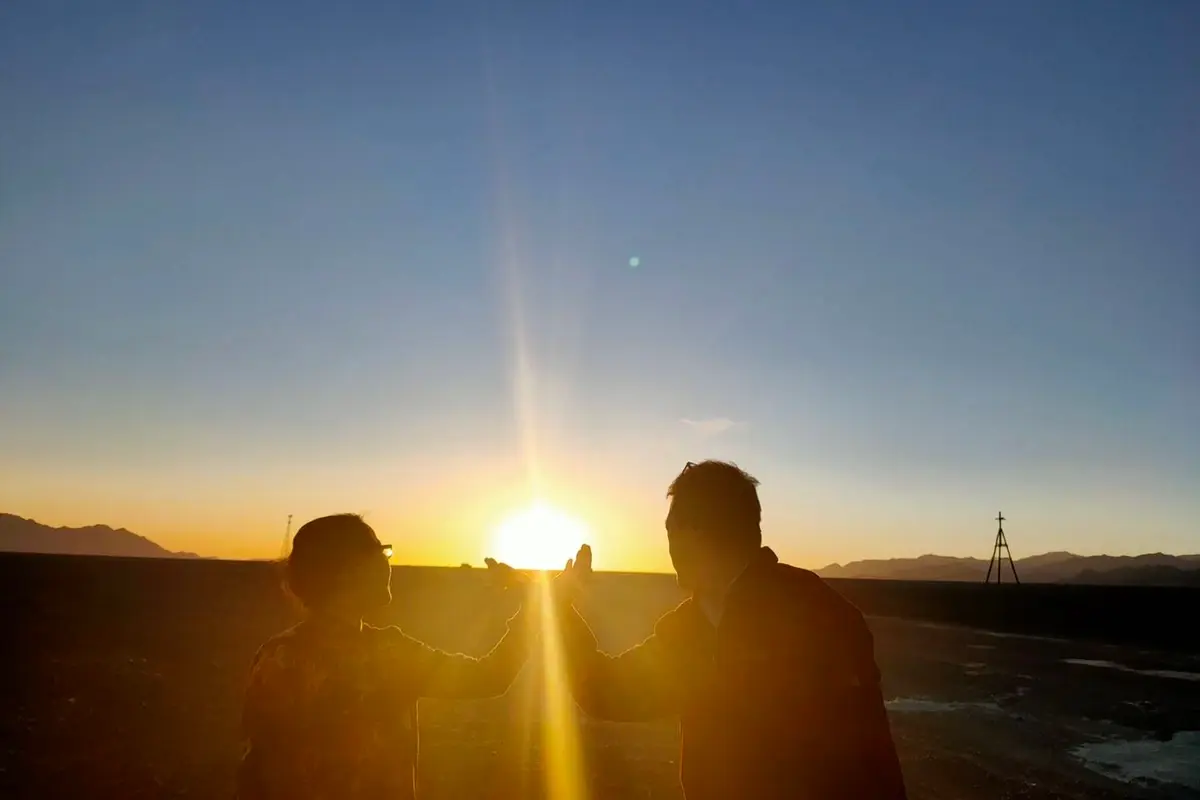
We set off early from the hotel, passing through vast, desolate Gobi with no human presence, yet the scenery was unique. That day, we drove along unmanned highways, watched the sunrise and sunset, saw bar-headed geese flying freely by West Taijinar Lake; entered Water Yadan to admire its unique landforms; strolled along East Taijinar Lake, witnessing the charm of China's Maldives; and descended from the Dangjin Mountains at an altitude of 3,800 meters down to Aksai at 1,500 meters, finally arriving safely in Dunhuang, ending the day's journey. The driver worked very hard, was considerate, and drove with experience. Along the way, he not only let us enjoy the breathtaking scenery but also took many photos for us. The weather was also good; we saw the sunrise and sunset, really lucky and blessed. We also passed a goji berry farm and bought some fresh goji berries, which were very tasty. We also learned why black goji berries are so expensive—not because of nutritional value, but because the cost of manual picking is over 10 times that of red goji berries, naturally driving up the price.
Day 5: Climbing Mingsha Mountain, overlooking Crescent Moon Spring.
We finally slept in. After lunch, we went to the Dunhuang Museum. Usually, I visit museums in every city; understanding history should start with a museum, especially since Dunhuang's history is so alluring. After the museum, it was still early, so we searched nearby and found the White Horse Pagoda, so we went there. This might be the most disappointing attraction I've ever visited. The ticket was 15 yuan, and there was just a small white pagoda with nothing else, and the environment was terrible. But the city of Dunhuang was very clean, with clear street markings, making it very pleasant. I must come again if I have the chance!
It was still hot during the day in Dunhuang, so we set out for Mingsha Mountain around 5 PM. There were naturally many people, and many were riding camels. We rented shoe covers at the entrance and followed the crowd to climb Mingsha Mountain. It was indeed climbing, but thanks to the crowd, it wasn't tiring, though frequent stops wasted time. By the time we reached the top, Crescent Moon Spring looked quite dim. We sat on the sand mountain to watch the instant sunset—it was spectacular. It gets dark around 9 PM, so we could sit on the mountain for a long time, looking at the illuminated Crescent Moon Spring. If the weather was good, we could also see the stars.
The sand at Mingsha Mountain is very fine and doesn't stick to shoes. You could also choose not to rent shoe covers and wear sandals or slippers, walking barefoot in the sand—it's quite comfortable. But be sure to protect yourself from the sun; the UV rays are very strong. Going downhill is much easier than going up; just lift your heel slightly and you can move down quickly, taking less than 10 minutes.
Day 6: Mogao Caves, here I come.
The Mogao Caves were an indispensable part of my entire itinerary, and today I finally fulfilled my dream. The ticket was for the 8:45 session. I entered early, following all the procedures to see eight caves, then I sneaked into three more. Finally, I couldn't help but find the pagoda of Wang Yuanlu (the Daoist priest) to vent my anger.
After leaving the Mogao Caves, I had a bowl of noodles and returned to the room to rest. In the evening, I went to the Dunhuang Night Market (Shazhou Night Market). The night market was large and really worth visiting. It was very well managed; everything had clear price tags, and the same items had uniform prices, which were reasonable. After leaving Dunhuang, the driver told me that Dunhuang's dried fruit is good. At the time, I thought it was too much trouble and assumed I could buy some in Qinghai. If I had known, I would have bought some raisins or something to bring back.
Day 7: Eating melons in Guazhou, overlooking the First Great Pass under Heaven at Jiayuguan, and viewing the Rainbow Danxia in Zhangye.
This day was another challenging one, covering more than 700 kilometers. Around noon, we arrived at Guazhou and ate some melons at the service area; they were indeed very sweet. The local specialties were expensive and not worth buying. After leaving, we drove to Jiayuguan. There were few historical relics left; we just walked around and went into the Great Wall Museum before leaving. The weather was not very good that day. By the time we arrived at the Rainbow Danxia, it was overcast—the only overcast day of the trip. There were huge crowds at the Rainbow Danxia; every viewing platform was almost packed. Because it was overcast, the colors weren't as bright, but still very unique. Many travel notes say that Platform No.4 is the most beautiful, but that's not true. Each platform has its own characteristics and is worth stopping to see. Platform No.1 is the smallest but has distinctive color bands; Platforms No.2 and No.3 are larger, offering a grand view and a sense of scale; Platform No.4 is the prettiest but also the most crowded.
There is accommodation in Qicai Town (Rainbow Town), but it didn't look great. Since the driver was from Zhangye, we drove to Zhangye city center to stay. We had dinner at Luo Pangzi Noodle Shop; the noodles in Zhangye are very tasty and cheap.
Day 8: The weather didn't cooperate; we reluctantly left Zhangye.
The original plan was for the seven-day Qinghai-Gansu Grand Loop, with Day 8 returning from Zhangye to Xining. Since the driver was from Zhangye and didn't have any business taking us back to Xining, and there were also few scenic spots worth stopping at along the route from Zhangye to Xining this season, he suggested that we take the bullet train back to Xining on our own, and we wouldn't be charged for the last day. We agreed. The driver also recommended that if our friends don't choose to travel in summer, they could end the loop at Zhangye and leave from there, instead of necessarily returning to Xining.
We had planned to look around Zhangye city center. The Zhangye National Wetland Park was near our hotel, but unfortunately it was raining, so we gave up and didn't go anywhere, which was a pity. We planned to have lunch at the hotel restaurant and then take the bullet train back to Xining. The restaurant had Zhangye "cuo yu mian" (搓鱼面, noodle fish), which looked nice and tasted good, so worth trying. Looking at the noodles, I guessed they were called that because the noodles looked like little fish? A quick Baidu search confirmed it.
Day 9: First there was a pagoda, then there was a temple; the history of Kumbum Monastery (Ta'er Temple) actually comes from inner devotion.
When we returned to Xining, the sky cleared up. We took a bus to Kumbum Monastery. The monastery does indeed require a guide or audio explanation for a proper visit, but it's quite expensive. We tagged along with a tour group from Jinan, Shandong. As a daughter-in-law of a Shandong man, that shouldn't be too bad, right? But I still felt a bit guilty, hehe. Even though we eavesdropped on the guide, I still want to complain—the guide's standard was really not great, and he was perfunctory. So it turned out to be wise to just tag along, haha.
Kumbum Monastery has three treasures: pile embroidery, butter sculptures, and murals. They are indeed beautiful, but you need to walk slowly and look carefully to really appreciate them. I couldn't take good photos of the monastery, so I really won't post any, hehe.
Originally, we planned to visit the Qinghai Provincial Museum as well, but unfortunately it was closed for renovations, so we couldn't go—another regret. Finally, we went to a specialty shop next to the hotel and bought some local products to ship back, saving the trouble.
For our last dinner in Xining, we went to a nearby restaurant called Yajun, but the food wasn't good.
Day 10: Heading home, flying back to Hangzhou.
Before going to the airport, I didn't forget breakfast in Xining. I queued to buy "gou jiao niao" (dog urine pancake) and yogurt. Gou jiao niao is actually a highland barley flatbread, very fragrant and tasty. You can add eggs, bean sprouts, etc., but I think it's better plain.
Ten days of travel ended quickly. Travel is not just about relaxing the mind, but also a form of spiritual practice, a purification of the soul. Along the way, I had many feelings. The continuous beautiful scenery was overwhelming; no camera or technique could capture it, so I chose to let my heart hold it. Qinghai and Gansu are vast and sparsely populated. The continuous improvement of infrastructure is truly remarkable, showing the state and government's efforts in developing the west. The improvement of living conditions for ethnic minorities has indeed been hard-won, and you can genuinely feel their gratitude toward the Party and government. I hope all friends traveling to these areas will follow the rules, leave no litter, and reduce pollution.
Finally, let me share some travel tips that might help you.
1. **Travel Time**: Many say the best time to visit Qinghai is from mid-June to mid-August, when the grass is greenest and flowers are in bloom, and you can go to Menyuan to see rapeseed flowers.
2. **Itinerary Planning**: Arrange according to your time. First determine the spots you want to visit, then plan the route. Personally, I think Kumbum Monastery, Qinghai Lake, Sky No.1, Chaka Salt Lake, Emerald Lake, East Taijinar Lake, West Taijinar Lake, Water Yadan, Dunhuang, and Rainbow Danxia are all worth visiting; choose based on your time.
3. **Clothing, Food, Accommodation, and Transport**: The temperature difference between day and night in Qinghai is large, so bring plenty of clothes. The diet mainly consists of beef, lamb, and noodles. On the road, bring some dry food and water, as you'll rely on them in sparsely populated areas. Accommodation conditions are poor in many places, very tight during peak season, and unreasonably expensive. But the government is making improvements, and there are already many results, and construction is getting better. Based on this experience, book cancellable rooms in advance and have backup plans to avoid having nowhere to stay. Hiring a car is a good choice; ensure the seats are not cramped—too many people in the car will be tiring. Choosing the driver is very important. Our driver this time was really good: thoughtful, not a swindler, experienced, and he recommended rooms cheaper than what we found online, and the restaurants he found were also reasonably priced.
4. **Sun Protection and Moisture**: The sun in Qinghai and Gansu is strong, with very high UV rays that can easily cause sunburn, so be sure to protect yourself. It's also very dry, so bring moisturizing skincare products, especially hand cream. I felt my hands were terribly dry every day and regretted not bringing Vaseline jelly.
5. **Altitude Sickness**: Usually, you might have some reactions in the first two to three days, but not severe—mostly a mild headache. I brought various medicines but only took two doses of Saridon for headache; the rest were unused. However, after returning to Hangzhou, I felt dizzy every day, like being drunk, for about a week. I checked online; it's normal, possibly due to oxygen intoxication (or altitude de-adaptation). Be careful not to catch a cold; keep warm.
I originally planned to write a simple summary, but it turned into a long-winded account. Bear with me.


