The Bleak Beauty: 2020 Western Trip (III) — Chaka and Dunhuang
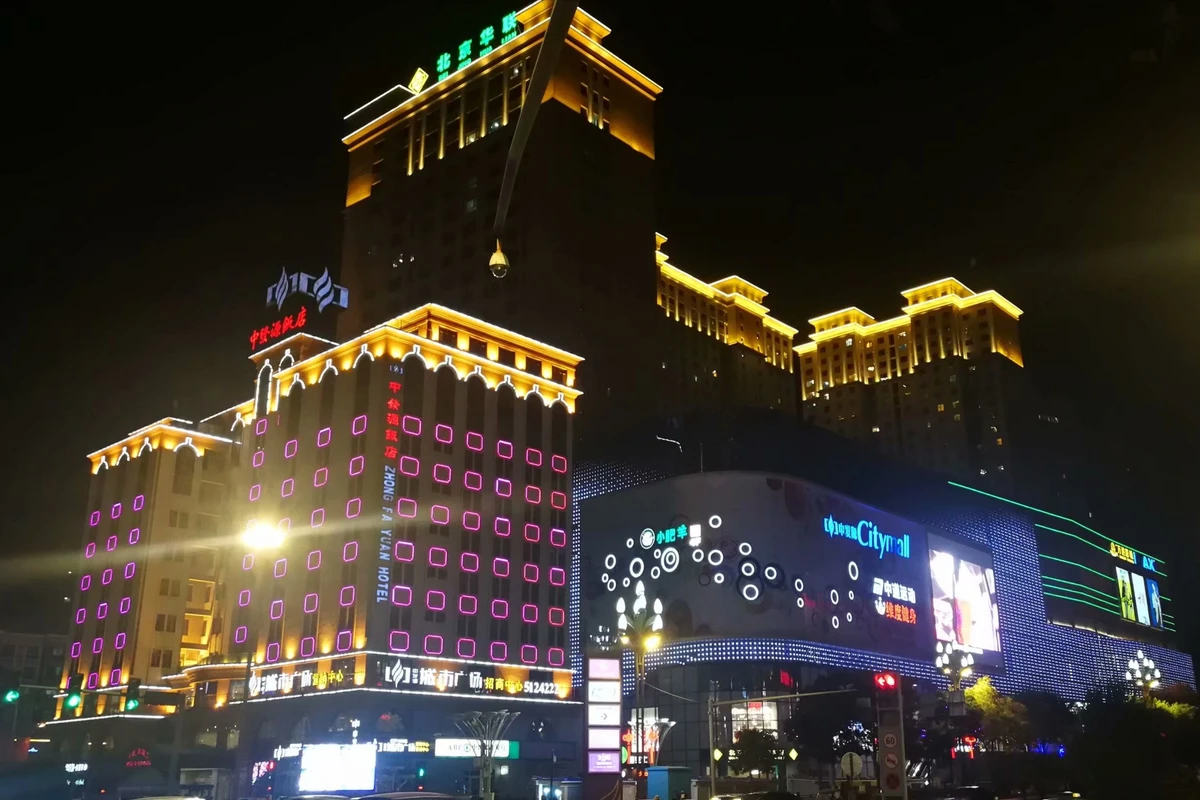
Arrived in Xining in the evening of October 26, 2020. Sure enough, I felt the difference as soon as I landed: the chest tightness was gone, oxygen was sufficient! Breathing was much smoother, and I felt relaxed. After checking in, the city lights had just come on—the night view of Xining city.
October 27, 2020. Since I had been to Xining in 2009, this time my only goal was the famous internet-famous scenic spot: Chaka Salt Lake.
The weather was not cooperative. Before departure, large snowflakes were already falling from the sky. The driver was worried about whether we could smoothly cross the mountain. Fortunately, after departure, the snow gradually lightened and turned into sleet. First we passed by the Sun and Moon Mountain and the Daotang River. Sun and Moon Mountain belongs to the Qilian Mountains, with an average altitude of about 4,000 meters and a highest point of 4,877 meters. Sun and Moon Mountain is not majestic; its importance lies in that it was once the boundary mountain between the Tang Dynasty and Tubo (ancient name Chiling), as well as the dividing line between the Loess Plateau and the Qinghai-Tibet Plateau. Since ancient times, it has been an important passage on the historical routes of the "Qiangzhong Road," "Southern Silk Road," and "Tang-Tubo Ancient Road." It is also where Princess Wencheng stayed on her way to marry Songtsen Gampo. The Daotang River originates from the western foothills of Sun and Moon Mountain and flows from east to west into Qinghai Lake, contrary to most rivers that flow from west to east, hence the name Daotang (meaning "flowing backwards"). When we passed, it was not yet dawn, so we could only glimpse the outline of the mountains and rivers in the dim light, passing quickly.
When we arrived at Chaka Salt Lake, the snow had stopped, but it was still overcast. It is said that only on sunny days can you achieve the mirror effect, so today's scenery would be compromised.
Salt lakes are formed by crustal plate movements: the originally seawater-covered boundary zone gradually rose to form a plateau, and during this process, part of the seawater became trapped in low-lying areas. Chaka Salt Lake is a natural crystalline salt lake. It is one of the four major salt lakes in the Qaidam Basin. The lake surface is at an altitude of 3,100 meters, with a total area of 105 square kilometers. It is a renewable salt lake with a salt storage capacity of 40,000 tons. It is also a brine lake with coexisting solid and liquid phases. The bottom rock salt deposit has a sedimentary salt layer thickness of 4 to 8 meters, which enables the mirror effect, earning it the name "Mirror of the Sky."
Upon entering the scenic area, the first things you see are the railway and the internet-famous small train. The weather was bad, so there were few people. I chose to walk and enjoy the view.
Although I had mentally prepared myself not to see the perfect mirror of the sky, the full view of the salt lake still shocked me with its magnificence. The white, flat lake surface stretched endlessly, and the boundary between sky and water was vast and boundless. It is indeed a must-visit place in one's life.
Tip: The scenic area is quite long; walking round trip takes about two hours. During peak season, it is recommended to take the scenic train for at least one way. Additionally, adjacent to Chaka Salt Lake is a place called "Sky No. 1," which is easily confused with the Mirror of the Sky, but it is much smaller in scale. The driver said it was built purely to divert tourists from Chaka.
On the way back to Xining, we first passed Qinghai Lake and then had to cross Xiangpi Mountain (Rubber Mountain). Xiangpi Mountain is 4,451 meters above sea level, with steep winding roads, high altitude, and low temperatures. It was snowing heavily again. Fortunately, the driver was familiar with the road, and after some nervous moments, we returned safely.
October 28, 2020. After having hot beef and radish buns and spicy soup for breakfast, I took the bullet train to Dunhuang.
After checking in, it was already past 6 p.m., but it gets dark late here. I first strolled around the city center. Dunhuang is not big, with a population of less than 200,000. I stayed near the Hui ethnic district, where there is a mosque. Nearby is the night market.
The climate and landscape here are very similar to Xinjiang. Many restaurants serve pepper and Sichuan pepper chicken, big plate chicken, kebabs, and naan bread. For dinner, I ordered stir-fried chicken, expecting it to come with green peppers, potatoes, and other side dishes, but it was just seasonings and chicken pieces—quite similar to what I had in Xinjiang. According to the driver the next day, the specialty foods of Dunhuang are actually Hu Yang Stewed Flatbread, donkey meat yellow noodles, and apricot peel water. I first bought apricot peel water to try. It tastes sweet and sour, somewhat like sour plum soup, but with the fragrance of apricots—very nice. The next day I had Hu Yang Stewed Flatbread, which was delicious and the lamb was generous. However, it was more like lamb stew with sliced noodles. The driver said that restaurants use sliced noodles for faster preparation, while homemade flatbread at home is thicker and more flavorful.
October 29, 2020. The first stop today was, of course, the Mogao Caves, which was the highlight of this trip and a place I had longed to see for many years.
The Mogao Caves, commonly known as the Thousand Buddha Grottoes, were first built during the Former Qin period of the Sixteen Kingdoms, spanning nearly a thousand years. They were constructed over successive dynasties including the Northern Dynasties, Sui, Tang, Five Dynasties, Western Xia, and Yuan, forming a huge scale with 735 caves and 45,000 square meters of murals. They are the world's largest and richest Buddhist art site. Along with the Longmen Grottoes in Luoyang, Henan; the Yungang Grottoes in Datong, Shanxi; and the Maijishan Grottoes, they are known as the Four Great Grottoes of China.
They are carved into the cliffs on the eastern slope of Mingsha Mountain, southeast of Dunhuang, facing the Dang River to the front and the Sanwei Mountains, a branch of the Qilian Mountains, to the east. The entire site stretches 1,680 meters from north to south, distributed on a fault cliff 15 to 30 meters high, arranged in 1 to 4 tiers. The architectural forms of the caves include central pillar caves (stupa caves), hall caves (central Buddha altar caves), inverted-dome caves, giant Buddha caves, nirvana caves, and some pagodas. There are 492 painted sculptures, mostly with wooden armatures and clay, including Buddha images, bodhisattvas, disciples, heavenly kings, vajra warriors, and deities. Over 500 caves contain paintings. The murals are rich and colorful, featuring various Buddhist sutra stories, landscapes, pavilions, architectural paintings, landscape paintings, floral patterns, and flying apsaras. The painters of different periods, based on Han culture, absorbed elements from ancient Iranian, Indian, Greek, and other arts, creating a unique style and distinctive artistic features where Eastern and Western cultures converged miraculously.
Visits require reservations, and the open caves vary daily. Our tour route that day included: Cave 328 (Tang Dynasty), Cave 335 (early Tang, Amitabha Sutra), Cave 17 (Library Cave, originally containing 50,000 artifacts), Cave 292 (Sui Dynasty), Cave 259 (Northern Wei), Cave 249 (Western Wei, murals used much precious lapis lazuli), Cave 237 (mid-Tang, Tubo period), and Cave 96 (early Tang, with a 35.5-meter Maitreya Buddha, the largest Buddha in Mogao).
The murals in each cave are rich in content, magnificent, and beautiful. After a cursory tour, I understood why so many professors and artists are willing to stay in this barren place for a lifetime—each cave is a perfect artistic treasure. However, due to cultural relic protection, photography is not allowed inside the caves.
Tip: Make sure to note that after purchasing tickets online, you must go to the Digital Exhibition Center, which is not located at the scenic area but 15 kilometers away. You need to pick up tickets at the Digital Center, watch related documentaries, and then take a bus to the site. (Fortunately, I called in advance to inquire; I almost took a taxi directly to the scenic area.)
In the afternoon, I went to Dunhuang's second most famous attraction: Mingsha Mountain and Crescent Moon Spring. Crescent Moon Spring is surrounded by Mingsha Mountain, shaped like a crescent moon, hence its name. Mingsha Mountain is said to make sounds when sand moves, but I didn't hear it.
There is a viewing pavilion by the spring.
In the scenic area, you can ride camels. The camel bells seem to come from ancient times.
Reeds at the foot of the mountain.
You can climb the nearby sand mountain to overlook Crescent Moon Spring. The sand mountain is very steep, and climbing was really strenuous. I stopped many times and took a long time to reach the top. But the view from the top was beautiful, making the hard climb worthwhile.
October 30, 2020. Today was a one-day tour of the western route of Dunhuang. First, we went to the Dunhuang Ancient City (actually a film studio, all newly built). I didn't enter; just took photos outside.
Next, the Western Thousand Buddha Caves. These caves are earlier than the Mogao Caves, so they are more damaged. That day we visited Cave 0405 (Sui-Tang period), Cave 15 (mid-Tang), and Cave 18 (Northern Zhou).
Next stop: Yangguan Pass. Yangguan was a necessary pass on the ancient Silk Road. Since only a beacon tower remains, the guide suggested we go to Yumen Pass instead, so I didn't enter—just took photos outside.
Fourth stop: Yumen Pass. Yumen Pass got its name because Emperor Wu of Han opened up the Western Regions and imported jade. At that time, both Yangguan and Yumen were garrison towns; all traffic between the Central Plains and the Western Regions had to pass through these two passes. They were important military passes and Silk Road thoroughfares during the Han Dynasty. The scenic area now has three sites. First is Dafangpan City, the ruins of the Han Dynasty 'Chang'an Granary,' over 2,000 years old. It was a grain storage depot, built with rammed earth in a rectangular shape, 132 meters long from east to west, 17 meters wide from north to south, with the highest remaining wall 6.7 meters.
The second site within the scenic area is the Han Dynasty Great Wall ruins. The Han Great Wall was built during Emperor Wu's conquest of the Western Regions, stretching about 136 kilometers from Guazhou along the southern bank of the Shule River into Dunhuang. This section has weathered thousands of years of wind and rain, losing its original majesty, but its outline is still faintly discernible. The highest part is 2.95 meters, with a top width of 0.65 meters. It was built with layers of reeds, sand, red willows, and loess, each layer about 0.2 meters thick.
In the distance, immortal poplar trees (diversiform-leaved poplar).
The third site is the actual Yumen Pass ruins, also called Xiaofangpan City. It was built around 111 BC. The pass is square, built of rammed loess about 10 meters high, with walls 3 meters wide at the top and 5 meters at the bottom. It measures 24 meters from east to west and 26.4 meters from north to south, covering an area of over 600 square meters, with gates on the west and north sides.
Imagining the camel bells, caravans, bustling markets, clashing weapons, and heavily guarded passes of ancient times. Now only a loess fort remains, isolated in the Gobi, with crisscrossing gullies, standing ruins, ancient poplars, and swaying reeds—a place that stirs mixed emotions and a sense of nostalgia. The sky and earth are vast; one can't help but sigh.
After leaving Yumen Pass, we headed to the Yardang Geological Park, which is also the highlight of the western route. On the way to Yardang, we entered a no-man's land. On both sides of the road are test fields of the Jiuquan Satellite Launch Center, only 120 kilometers from the famous Lop Nur center.
"Yardang" is a term for a type of landform. In the late 19th and early 20th centuries, the Swedish explorer Sven Hedin and the British explorer Aurel Stein went to Lop Nur for surveys. Local guides used the Uyghur word to describe "steep small mounds," and thus "Yardang" became a common term in geography and archaeology, referring to raised mounds, specifically a landform in dry areas.
Two important factors form Yardang landforms: first, lake sedimentary strata; second, external forces—strong directional winds and water erosion in deserts. Due to long-term strong wind erosion, soft sand and soil are blown away, forming gullies, while hard soil layers become mounds of varying heights. The strong wind carves these mounds into various strange shapes—"stone lions," "stone Buddhas," "stone mushrooms," "peacocks," "pagodas"—with countless forms, vivid and lifelike. After nightfall, the strong wind makes terrifying howls, like thousands of beasts roaring, making it eerie and earning the name "Devil City."
This is "Golden Lion Welcoming Guests."
This is "South China Sea Fleet," but the aerial view is better.
As time passed, night fell quietly. Watching the sunset at Devil City was beautiful, but also brought a unique melancholy.
On the way back to the city, the driver also took us to see the stars. Although the moon was very bright that night, we still saw many stars.
We arrived back in Dunhuang at around 10 p.m. I thought nightlife in the north ended early, but the Shazhou Night Market was lively and bustling.
In just two days, Dunhuang left me with wonderful memories. It is a simple, low-key, quiet, and peaceful northern town.
Farewell, Dunhuang. Farewell, Mogao Caves. Farewell, a thousand years of history.


