Autumn Journey to Gansu and Inner Mongolia
Series travel notes one 'Journey to Longshang' Joy [Golden Autumn Populus euphratica and the Thousand-Year Silk Road Dream Journey] I walked across the ridge, the ridge was covered in autumn colors. The leaves on the branches were golden, the wind came with a rustling sound, as if singing for the season... The blue sky is vast, dotted with a few white clouds; the green mountains are not lonely, with a small brook flowing by... In the Year of the Goat (乙未), golden autumn season, the weather was clear and crisp, sweet osmanthus fragrant. On the afternoon of September 25 (Sunday), a group of friends, with the thought 'Autumn has come, where to find golden autumn scenery? Step onto Longxi and you will know, the scenery here is uniquely beautiful,' took a flight from Nanjing Lukou International Airport, transited through Xi'an Xianyang Airport, flying for four hours, arriving at Lanzhou Zhongchuan Airport in Gansu at 8:30 PM. A local car took over an hour to get from the airport to Lanzhou city center, the major city in Northwest China.
Lanzhou, abbreviated as Lan, also known as Jincheng (Golden City), is the capital of Gansu Province, located in the upper reaches of the Yellow River. It is the geometric center of China's land territory, reputed as the 'Capital of the Yellow River in the West, Famous City of Silk Road Landscape.' It now governs 5 districts and 3 counties, with a total area of 13,100 square kilometers, of which the urban area is 1,631.6 square kilometers. The permanent population is over 3.6 million. It is a city with a long history and culture.
On the morning of September 26, our journey to Gansu and Inner Mongolia began with the first bowl of Lanzhou beef noodles... Lanzhou beef noodles: 'Clear soup (一清), white radish (二白), green cilantro and garlic sprouts (三绿), red chili oil (四红), yellow bright noodles (五黄).'
[Night view of the Yellow River banks in Lanzhou illuminated (Zhongshan Bridge)]
After eating the delicious noodles, we took the high-speed train from Lanzhou West Station, passing through Xining in Qinghai Plateau, and arrived at Zhangye City at noon after more than two hours.
In the afternoon, we began our visit. Zhangye, a prefecture-level city in Gansu Province, got its name from 'Zhang Guo Bi Yi, Yi Tong Xi Yu' (spreading the arm of Zhangye to reach the Western Regions). It is located in the northwest of Gansu Province, in the middle of the Hexi Corridor. Known as 'Ganzhou' in ancient times, it is the origin of the character 'Gan' in Gansu Province.
[Zhangye Giant Buddha Temple Scenic Area] is located in the southwest corner of Zhangye city.
Zhangye has many historical sites, rich tourism resources, and unique cultural landscapes. The ancient buildings of various shapes are exquisitely constructed and colorful. In ancient times, there was a beautiful scenery of 'a lake of mountain light, half a city of pagoda shadows, reeds and streams connected, and ancient temples everywhere.'
[Zhangye Giant Buddha Temple Scenic Area] is a landmark building of the historical and cultural city of Golden Zhangye. The temple houses the world's largest indoor reclining Buddha, which is the Nirvana image of Sakyamuni. He lies on a Buddha altar 1.2 meters high in the center of the hall. The Buddha is 34.5 meters long, 7.5 meters wide at the shoulders, ears about 4 meters, and feet 5.2 meters long. A single middle finger of the giant Buddha can accommodate a person lying flat, and the ears can hold eight people sitting side by side, showing how huge the statue is.
The Giant Buddha Temple was first built in the first year of Yong'an of the Western Xia Dynasty (1098), originally named Kasyapa Tathagata Temple. The temple covers an area of about 23,000 square meters, facing east to west. Only the Giant Buddha Hall, Sutra Library, and Earth Pagoda along the central axis remain. The Giant Buddha Hall is nine bays wide (48.3 meters), seven bays deep (24.5 meters), 20.2 meters high, two-story, with double-eave hip-and-gable roof. There are 31 painted clay sculptures inside, which are Western Xia cultural relics.
[Sutra Library] houses more than 6,000 volumes of Buddhist scriptures bestowed by Emperor Yingzong of the Ming Dynasty. The scriptures are well preserved, especially those written in gold and silver powder.
Behind the temple, there is a white pagoda 33.37 meters high. The first and second floor platforms each have a small pagoda at the four corners, with a unique style rarely seen in China.
The art of Chinese ancient architecture is a comprehensive art. In general ancient buildings, not only the main wood structure art, but also many sculptures and murals. Zhangye Giant Buddha Temple is a perfect combination of comprehensive art.
[Zhangye Danxia Geological Park] In 2006, it was rated as 'China's Danxia Landform' by Chinese National Geography magazine. The magical Danxia landform group is peculiar, colorful, with undulating waves along the mountain, and also slanting from the top to the base, like a sloping colored cloth. Under the sunlight, the colors are extremely brilliant. Nature's extraordinary workmanship is amazing.
Zhangye Danxia landform is widely distributed, spectacular in scale, unique in shape, and colorful. It is the most typical and largest Danxia landform in China's arid regions, with high scientific research and tourism value. Zhangye Danxia landform is one of the largest, best-developed, and most diverse in landform shapes in China. Only 40 kilometers from Zhangye City, the colorful hilly landform scenic area at Niujiaying South Taizi Village in Linze, Zhangye, is a masterpiece of China's Danxia hilly landscape. Who created this grand spectacle? Thousands of years of wind and rain erosion naturally decorated, showing autumn colors all year round.
China's land has many beautiful sceneries, Zhangye Danxia is the best in China.
The colorfulness,观赏性, and area of Zhangye colorful Danxia landform are unparalleled in China; Zhangye colorful hilly landform is the first in China. The window lattice and palace-style Danxia landform near Baizhuangzi is the best of the best among national Danxia landforms. Standing on the viewing platform of Zhangye colorful Danxia landform, the view is wide, providing visitors with an excellent viewing space. Zhangye Danxia landform is known as 'Zhangye window lattice palace-style Danxia landform first in China,' 'Zhangye colorful hilly landform first in China,' and one of the 'World's Top 10 Magical Geographical Wonders.' The heaven is affectionate, the earth is spiritual, the magic workmanship shapes wonders.
Drinking the dust and wind and frost, the flute of the old friend is long and distant.
Filming location of the movie 'A Simple Noodle Story'
Flying across the world, heading straight to Zhangye to see Danxia. Treading through the mountains without a mirror, photographing the scenery of Danxia. Under the Qilian Mountains, the autumn wind blows, nine lotuses fly out horizontally. The unparalleled Silk Road, the bright Danxia landform.
Like the earth spraying blazing fire, like the mountain shore putting on colorful neon clothes, this is a different kind of Danxia landscape.
Rising heat of the sun, deep passion of the earth. Red clouds in the sky carry the red sun, on the ground Danxia flows with cinnabar. Bagua magical valley labyrinth, child worshiping Buddha densely packed. Satin undulating connecting mountains, stone forest towering everywhere. It is thrilling, the continuous Zhangye Danxia land attracts countless literati and poets to bow.
The colorfulness,观赏性, and area of Zhangye colorful Danxia landform are unparalleled in China.
On the morning of September 27, we set off from Jiayuguan to Ejin Banner in Alxa League, Inner Mongolia. Passing by the Jiuquan Satellite Launch Base, we saw the satellite launch tower in the distance.
Ejin Banner is located at the westernmost end of Inner Mongolia Autonomous Region. It is one of the 19 border banners (counties, cities) supported by the autonomous region. Named after the Ejin River within its territory. It is located in the west of Alxa League. It borders the People's Republic of Mongolia to the north, with a national border line of 514 kilometers. The total area of the banner is 114,600 square kilometers. The terrain and landform are mainly desert and Gobi.
On the afternoon of September 27, we visited the 'Black City Ruins.' Black City is called 'Har Hot' in Mongolian, meaning 'Black City.' The existing city wall was expanded in the Yuan Dynasty. The plan is rectangular, with a perimeter of about 1 kilometer, 434 meters east-west, 384 meters north-south, about 1,600 meters around, up to 10 meters high. City gates are opened on the east and west sides, with additional barbicans. On the northwest corner of the city wall, there is a stupa about 13 meters high. The official offices, mansions, granaries, Buddhist temples, residences, and street ruins inside the city are still discernible. Outside the southwest corner, there is an Islamic Gongbei (tomb) standing towering on the ground.
The city wall is rammed with yellow earth, with a residual height of about 9 meters. On the northwest corner, there are five stupa-style Lama pagodas. The original streets and main buildings are still discernible. The remains of ancient river courses and farmland around maintain their outline. Many heroes with armored horses, desert smoke leaves traces of time.
[Tamarix chinensis forest] Live a thousand years without dying, stand a thousand years without falling, rot a thousand years without decaying. The desert smoke, the majestic and tragic strange forest, a world of light and shadow, a paradise for photographers, a holy land for travelers.
Rooted in the desert, proud and unyielding, bleak and bold. You receive rain and snow, welcome sunshine, open-minded. Facing the dust storm, severe cold and heat, you hide your light and remain calm. Rooted in the vast sand, looking up to the clear sky, enduring the vicissitudes of old age. A single tree can carry the pride, the red sun patrols the sky, clouds spitting fire. Rooted in the desert sand, receiving the scorching sun, spreading branches and leaves to provide shade. Exhaling the old and inhaling the new, self-purification, proud and unyielding, silently dedicating, finally forging the totem image of a thousand years undying, a thousand years un-falling, a thousand years un-rotting! How deep is the infatuation? Laughing calmly through three thousand years.
[Couple Tree] The symbiosis of mutual dependence, exuding vitality in the sunlight among the branches! The tree of life in the heart is evergreen, with love the world is heaven!
On September 28 at 6:00 AM, we watched the sunrise at Juyanhai in Ejin Banner. 'Small Juyanhai connects to Zhongnanhai.' According to expert research, the source of the sandstorms that blow to Beijing every year is the Juyanhai Desert in Ejin Banner, Inner Mongolia. Sunrise over the lake at Juyanhai, the sky dyed red by the glow. The sky is high for birds to fly, the lake is wide for fish to leap.
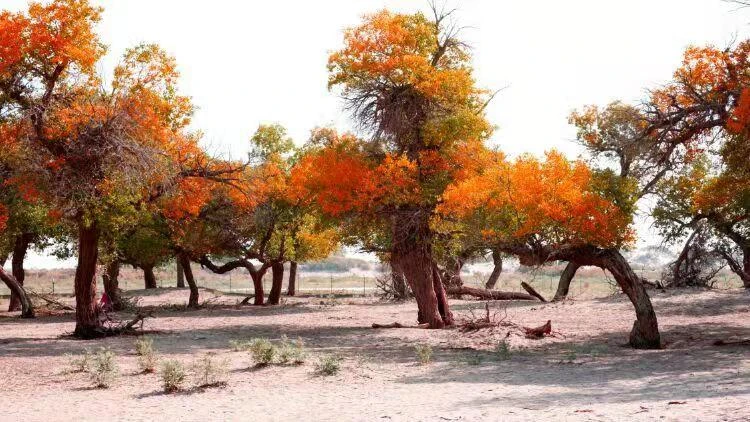
On September 28 at noon, we visited the Populus euphratica forest.
Ejin Banner now has 380,000 mu of Populus euphratica forest, one of only three major Populus euphratica forest regions in the world (the other two are the Sahara Desert in North Africa and the Taklamakan Desert in the Tarim Basin, Xinjiang). Among them, Yidaoqiao, Erdaoqiao, Sandaogiao, Sidaoqiao, and Qidaoqiao are ideal Populus euphratica viewing areas. Erdaoqiao is the best place to photograph reflections. Sidaoqiao is a paradise for photographers combining the edge of Badain Jaran Desert, Populus euphratica forest, camel caravans, and sunset. The end of Badaoqiao is the Badain Jaran Desert, which has actually become a Populus euphratica and desert scenic area.
Arriving at the banks of the Ejin River, you enter the kingdom of Populus euphratica. Here, green trees provide shade, hiding herds and sheep, winding and stretching for hundreds of thousands of mu, full of vitality, becoming a paradise in the desert. Populus euphratica forest is the main body of the Juyan Oasis and the basic condition for ecology. It can be said that without Populus euphratica, there would be no oasis; without the oasis, this 'hot, sandy, extremely cold' desert land would not have human survival and development. Populus euphratica is closely related to life here and is highly cherished by people. Hundred-year-old Populus euphratica are everywhere here.
Not moved by favor or disgrace, indifferent to the rolling clouds; wind, frost, cold, and heat; quietly watching people come and go. Competing with the sunset glow, competing with the setting sun. For passion burning, golden and brilliant, for enthusiasm, it is the ultimate expression of life. Military posture standing tall, shaping the spirit, reshaping the golden body as an old wood immortal. Enjoying the dust and sand, welcoming the blizzard, alone experiencing the flying sand in the Gobi. The oldest is the 'Sacred Tree,' already over 300 years old. Amazingly, this over 300-year-old 'King of Populus euphratica' is still lush and upright, with reproductive ability. Its descendants around are still laughing at the wind and sand, growing vigorously. The 'Sacred Tree' is a thousand-year-old Populus euphratica. Tree height 23 meters, trunk diameter 2.6 meters, requiring six people to hold hands to encircle. Although the 'Sacred Tree' is a thousand years old, it remains tall and vigorous. From its developed root system, five sturdy Populus euphratica trees have sprouted, so it is also called the 'Mother and Children Tree.' The 'Sacred Tree' family stands among the sand dunes, looking spectacular from afar. Every early spring, herdsmen devoutly offer hada to the 'Sacred Tree,' praying for favorable weather. Stretching thousands of miles of golden beauty, forming a scene itself, witnessing the vicissitudes.
Heavenly barren, weak trees with roots exhausted; old earth, solitary branches with leaves thriving. Standing tall for a thousand years with strong bones, lying down after death becomes a dragon. Laughing as the years pass by, happily singing in the Gobi. Long-lasting three thousand years, various postures of a lifetime. A oasis in the scorching desert, laughing at the wind and sand with ease? Old trunks and slanting branches experience vicissitudes, new buds and tender leaves endure wind and frost. An oasis in the desert, when will the harsh wind and sand stop? Unafraid of the yellow dragon blocking the sun, enduring the vicissitudes through the years. Saturated with natural wind and sand, retaining integrity through vicissitudes. Travel-worn under the sky, growing sturdy without rain. Leafless dead branches laughing for a hundred years, cold through spring and summer. How can poetry express the broken vicissitudes? Singing cannot relieve the remnants of time. Someone once said: If you love someone, take him to see the autumn of Ejin Banner, because it is a golden paradise; if you hate someone, take him to see the spring of Ejin Banner, because it is a black hell. No one can imagine that this is actually the birthplace of China's sandstorms. Sometimes between heaven and hell is only one step away. At the end of the Populus euphratica forest... [Badaoqiao Desert] [Badaoqiao Sand Sculpture]
On the morning of September 29, we went from Ejin Banner to Jiayuguan City. Jiayuguan is a prefecture-level city under Gansu Province, located in the northwest of Gansu Province, in the middle of the Hexi Corridor. It borders Suzhou District of Jiuquan City to the east, 776 kilometers from the provincial capital Lanzhou; to the west, it connects with Yumen City of Jiuquan, the oil city, 650 kilometers to Hami, Xinjiang; to the south, it leans against the Qilian Mountains and borders Sunan Yugur Autonomous County of Zhangye City; to the north, it rests on the Heishan Mountain and connects with Jinta County of Jiuquan City, with the western edge of the Jiuquan Oasis in the middle. Jiayuguan is the western starting point of the Ming Great Wall. It emerged as a new industrial, tourism-oriented modern regional central city due to the construction of the 'Jiuquan Iron and Steel Company,' a key project of the national 'First Five-Year Plan' in 1958. It is known as 'The First Grand Pass Under Heaven' and 'Key to the Border Frontier.' Jiayuguan is one of the four prefecture-level cities in China that do not have districts.
In the afternoon, we visited [Jiayuguan Pass City]. Jiayuguan Pass City is the western starting point of the Ming Great Wall. It is the most spectacular and best-preserved ancient military castle along the Ming Great Wall. It was an important military fortress along the Great Wall during the Ming Dynasty and later periods, known as 'The Key Defense of China and Foreign Countries' and 'The Hexi Defile.'
Along the Great Wall, there are many passes, the two largest being: one is Shanhaiguan in the east, and the other is Jiayuguan in the west. The latter surpasses the former, so Jiayuguan is the largest pass on the Great Wall and the largest pass in China. However, when Jiayuguan was first built, it was only a 6-meter-high earth city covering an area of 2,500 square meters. The existing pass city has a total area of over 33,500 square meters, several times larger than the original. It consists of an outer city, inner city, and barbican. The perimeter of the pass city is 733 meters, of which the inner city perimeter is 640 meters, the size of the original. The inner city is wide in the west and narrow in the east, slightly trapezoidal, with a height of 9 meters. It has two gates: 'Guanghua Gate' and 'Rouyuan Gate' to the east and west. Outside each gate, a barbican was built. The gate towers are symmetrical, three-story, three-eave, five-bay style, with corridors around, single-eave hip-and-gable roof, 17 meters high. At the four corners of the city are corner towers; at the middle of the south and north walls are watchtowers, one-story, three-bay with front corridor. Inside the two gates, on the north side, there are horse ramps to the top. In the center of the pass city is an official well, with an old pavilion now abandoned. Outside the west gate, a convex wall is built, forming a Luocheng (outer city). The outer city is 2.7 meters higher than the inner city. The central gate of the outer city is inscribed with three characters 'Jiayuguan.' Originally, there was a gate tower on top, similar in shape to the east and west towers, aligned east-west, with a plaque reading 'The First Grand Pass Under Heaven.'
Before Jiayuguan, Emperor Wu captured several rebel kings; the western pass of the Han Great Wall repeatedly blocked the barbarian soldiers.
Grinding bricks into fish-scale tiles; colorful decorations like jade buildings.
On September 30, we went from Jiayuguan to Dunhuang in the morning. In the afternoon, we visited Dunhuang [Mingsha Mountain and Crescent Moon Spring]. 'Mingsha Mountain and Crescent Moon Spring' have been famous throughout history for the奇妙 landscape of 'mountain and spring coexisting, sand and water共生.' It is known as 'One of the Unique Sceneries Beyond the Great Wall.' In 1994, it was designated as a national key scenic spot. Mingsha Mountain is formed by accumulated quicksand. When the sand body is rubbed or vibrated, it makes a sound, light like silk and bamboo, heavy like thunder, hence the name 'Mingsha Mountain' (Singing Sand Mountain). Crescent Moon Spring is located at the northern foot of Mingsha Mountain, shaped like a crescent moon, hence the name. For thousands of years, it has not been buried by quicksand nor dried up due to drought.
Crescent Moon Spring does not have the enchanting charm of West Lake, nor the splendor of Jiuzhaigou. A crescent moon floats in the sea of sand, the spring is clear like the bright moon, never full,远离 nobility, honor, and worldly affairs, sinking into the desert.
Standing quietly on the mountaintop, the wind passes by the ears, howling like ghosts and souls. The desert is vast; how many stories of swords and shadows, drums and horns are buried under the yellow sand. The earliest greatness, the earliest prosperity, the earliest civilization, and the earliest yellow sand are relentless and boundless. Isn't the desert a page of history?
Walking to the sand ridge, looking into the distance, sand mountains stretch beyond sand mountains, united into the desert. The desert extends in gentle curves, receiving the caress of the sun. Nature is wise and natural. At that moment, I felt my soul liberated, as if finding truth and light beyond虚假 life. You are the wind, I am the sand, tangling and lingering to Mingsha.
Riding the 'Ship of the Desert' across the desert, under the scorching sun, desert smoke, mountains叠嶂, long road, the sound of camel bells rings in the ears, sprinkling a cheerful sound...
In the evening, we watched the large-scale live performance 'Dunhuang Grand Ceremony.' 'Dunhuang Grand Ceremony' uses modern technology, unique aesthetic concepts, relying on its own brand advantage, in the form of original live song and dance, with the help of literature to reinterpret Dunhuang's regional cultural phenomena: the camel bells disappearing in the rustling wind of Mingsha; the hunting flags standing in the depths of the desert; the clear sounds crossing the Congling harmonizing with the rhythm of 'Huteng'; life meets, knows, loves, and misses each other in heaven and earth; memory engraves the distant world into eternity...
[City That Never Sleeps - Dunhuang]
[Dunhuang Symbol 'Rebounding Pipa'] Rebounding pipa is the most beautiful dance posture in Dunhuang art. It is vigorous and stretched, rapid and harmonious. Rebounding pipa actually plays and dances at the same time, combining superb playing skills and wonderful dance skills gracefully and elegantly on the shoulders of this dancer. Rebounding pipa is an eternal symbol of Tang culture.
'Rebounding Pipa' Tang Dynasty mural, Mogao Cave 112 in Gansu Dunhuang. This image is found in the 'Musician' mural of Cave 112, part of the 'Western Paradise Transformation' of that cave.
[Dunhuang] belongs to Jiuquan City, Gansu Province, located at the westernmost end of the Hexi Corridor, at the intersection of Gansu, Qinghai, and Xinjiang provinces. Dunhuang is famous for its former glory and profound cultural connotations. Dunhuang is located on the Silk Road, the important transportation route from ancient China to the Western Regions, Central Asia, and Europe. It once had prosperous commercial activities. It is famous for 'Dunhuang Caves' and 'Dunhuang Murals,' and is the site of the world heritage Mogao Caves and the Han Great Wall frontier passes Yumen Pass and Yang Pass.
[Mogao Caves] also known as 'Thousand Buddha Caves,' is one of the three major cave art treasures in China, known as the most valuable cultural discovery of the 20th century and the 'Eastern Louvre.' It is located in Dunhuang at the western end of the Hexi Corridor, famous for its exquisite murals and statues. It was first built in the Former Qin period of the Sixteen Kingdoms, and after successive construction through the Sixteen Kingdoms, Northern Dynasties, Sui, Tang, Five Dynasties, Western Xia, Yuan and other dynasties, it formed a huge scale. There are currently 735 caves, 45,000 square meters of murals, and 2,415 painted clay sculptures. It is the largest and richest Buddhist art sanctuary in the world. The artistic characteristics of Mogao Caves are mainly reflected in the organic combination of architecture, statues, and murals. The cave forms include meditation caves, hall caves, pagoda temple caves, dome caves, shadow caves, etc. The colored sculptures are divided into round sculptures, relief sculptures, shadow sculptures, and good karma sculptures. The mural categories include statue paintings, sutra transformation paintings, story paintings, Buddhist historical paintings, architectural paintings, landscape paintings, offering paintings, animal paintings, decorative paintings, etc., systematically reflecting the cultural exchanges between the Sixteen Kingdoms, Northern Wei, Western Wei, Northern Zhou, Sui, Tang, Five Dynasties, Song, Western Xia, Yuan and other dynasties and the East and West, becoming a rare cultural treasure of mankind. Mogao Caves is also a veritable treasure trove of cultural relics. In the Library Cave, more than 50,000 items of scriptures, documents, embroidery, and paintings were unearthed, with extremely high artistic value.
'Dun, great; Huang, prosperous.' The grand and prosperous Dunhuang has a history of more than two thousand years and was once the throat of the famous Silk Road at home and abroad.
Dunhuang is a crossing point of the convergence and collision of multiple cultures. Chinese, Indian, Greek, and Islamic cultures meet here. The Mogao Caves in Dunhuang are a World Cultural Heritage site and are known as the art museum of the Eastern world.
[Mogao Caves] were first built in the Sixteen Kingdoms period. According to the 'Tang Dynasty Li Kerang's Restoration of Mogao Caves Buddhist Shrine Stele,' in the second year of Jianyuan of the Former Qin Dynasty (366 AD), the monk Le Zun passed by this mountain, suddenly saw golden light shining like ten thousand Buddhas, so he dug the first cave on the cliff. Later, Master Faliang and others continued to build caves here for meditation, called 'Mogao Caves,' meaning 'the high place of the desert.' Later generations changed it to 'Mogao Caves' because 'Mo' and 'Mo' are interchangeable. Another saying is: Buddhist followers say that building Buddhist caves is of infinite merit; 'Mo' means impossible, not having; 'Mogao Caves' means there is no higher merit than building Buddhist caves.
The visiting process of Mogao Caves: First watch a movie to understand the history, then watch a second movie to understand the interior of Mogao Caves, and finally visit different caves under the guidance of a commentary docent.
In the scenic area, each commentary docent leads a team of about 15 people to visit 8 caves. No photography is allowed. Each person wears headphones to hear the commentary clearly, and the caves are not crowded. Carbon dioxide levels in the caves will not exceed the standard. The process is quite scientific and reasonable. After the tour, there are three large caves that can be visited independently, but there are more people in those large caves.
The murals of Mogao Caves are painted on the four walls, ceilings, and niches of the caves. The content is extensive and profound, mainly including Buddha images, Buddhist stories, Buddhist historical sites, sutra transformations, divine beings, donors, decorative patterns, and other themes. There are also many paintings depicting hunting, farming, weaving, transportation, war, construction, dance, weddings, funerals, and other aspects of social life at the time. Some of these paintings are magnificent and broad, others bright and colorful, reflecting the artistic styles and characteristics of different periods. Most Chinese paintings before the Five Dynasties have been lost. The murals of Mogao Caves provide important physical materials for the study of Chinese art history and also provide valuable images and patterns for the study of ancient Chinese customs. According to calculations, if these murals were arranged at a height of 2 meters, they could form a gallery 25 kilometers long.
It is a nine-story遮檐, also called 'Northern Giant Buddha,' located in the middle of the cliff, level with the cliff top, majestic and spectacular. Its wood structure is earthy red, with high eaves, staggered outline, bells on the eaves, ringing in the wind. Inside, there is a seated Maitreya Buddha, 35.6 meters high, made of stone core with mud and painted, the third largest seated Buddha in China after the Leshan Giant Buddha and the Rongxian Giant Buddha. The space accommodating the giant Buddha is large at the bottom and small at the top, with a square plan. Outside the building, there are two passages, allowing close viewing of the giant Buddha and also serving as light sources for the head and waist. This cave shelter existed before the first year of Wen'de of the Tang Dynasty (888 AD). At that time, it was five stories. In the fourth year of Qiande of the Northern Song Dynasty (966 AD) and in the Qing Dynasty, it was rebuilt and changed to four stories. In 1935, it was rebuilt again, forming the nine-story structure.
On the morning of October 2, we visited the [Yellow River Scenic Line] and [Zhongshan Bridge]. Zhongshan Bridge in Lanzhou is located on the north side of the middle section of Binhe Road. It is an ancient bridge with a long history in Lanzhou, known as 'the first bridge over the Yellow River under heaven.'
[Overlooking the centennial Zhongshan Bridge] Zhongshan Bridge is the oldest ancient bridge in Lanzhou and the first true bridge over the Yellow River. It was built by Germans in 1907. All bridge materials were originally produced in Germany. It has a history of over a hundred years. Zhongshan Bridge is located at the foot of White Pagoda Mountain in the north of Lanzhou city, in front of Jincheng Pass. It is one of the landmark buildings in Lanzhou. Standing on the bridge, you can see the White Pagoda reaching into the clouds and the Mother River flowing by.
White Pagoda Mountain Park is located on White Pagoda Mountain on the north bank of the Yellow River in Lanzhou. It gets its name from a white pagoda from the Yuan Dynasty on the mountain. White Pagoda Mountain is majestic and undulating, winding around the outskirts, with the potential to encircle Jincheng. The white pagoda was originally built to commemorate a Tibetan Sakya lama who died in Lanzhou on his way to visit Genghis Khan in Mongolia. The existing white pagoda was rebuilt by Liu Yongcheng, the eunuch guarding Gansu, during the Jingtai period of the Ming Dynasty (1450-1456).
[Huanghe Muqin (Mother Yellow River) Statue] The Mother Yellow River statue is located in the middle section of Binhe Road, on the north side of Xiaoxihu Park. It is currently the most beautiful among the many sculptures representing the mother river of the Chinese nation, the Yellow River, and has high artistic value. It won the 'Excellence Award' in the first national urban sculpture scheme evaluation. The sculpture was created by Ms. He E, a famous sculptor from Gansu, and carved by the Beijing Sculpture Factory on April 30, 1986. It is a granite round sculpture 6 meters long, 2.2 meters wide, and 2.6 meters high, with a total weight of over 40 tons. The composition consists of a 'mother' and a 'male baby.' The mother has flowing hair, a kind expression, a tall and well-proportioned figure, graceful curves, slightly smiling, with her head slightly tilted and right arm bent, lying on the waves. On her right side, a naked baby boy nestles, head slightly turned left, looking up with a naive smile, appearing playful and cute. The composition is concise, with profound meaning, symbolizing the Yellow River mother who has nurtured the Chinese nation endlessly and unyieldingly, and the happy, healthy, and thriving Chinese descendants. On the base of the sculpture, water wave patterns and fish patterns are carved.
[Ancient Yellow River Waterwheel] The waterwheel has a long history and strange shape. It originated in the Ming Dynasty and was the oldest irrigation tool along the ancient Yellow River in Lanzhou. The Lanzhou waterwheel is also called 'Tianche' (sky wheel), 'Fanche' (reversing wheel), 'Guangche' (irrigation wheel), and 'Laohuche' (tiger wheel).
[Treasure of the Museum 'Galloping Horse Treading on Flying Swallow'] Gansu Provincial Museum, located on the bank of the Yellow River, is one of the earliest comprehensive regional museums in China. Its predecessor was the Gansu Science Education Museum established in 1939. In 1950, it was renamed the Northwest People's Science Museum, and in 1956 it was renamed the Gansu Provincial Museum. The exhibition building has a total construction area of 28,500 square meters, with 18 exhibition halls. There are also cultural relics warehouses, cultural relic protection laboratories, and other facilities. The entire exhibition building is designed and constructed under the principle of 'solemn, elegant, beautiful, and humanized,' and is a modern comprehensive intelligent building.
Galloping Horse Treading on Flying Swallow, also known as Horse Surpassing Flying Dragon, Bronze Galloping Horse, Horse Attacking Crow, Eagle (Harrier) Sweeping Horse, Horse Treading on Flying Falcon, Soaring Horse, etc., is a bronze artifact from the Eastern Han Dynasty. It was unearthed in 1969 from the Leitai Han Tomb in Wuwei City, Gansu Province. It was excavated from the joint tomb of Zhang and his wife, a military commander guarding Zhangye in the Eastern Han Dynasty. It is now housed in the Gansu Provincial Museum.
'Galloping Horse Treading on Flying Swallow' is 34.5 cm high, 45 cm long, and 13 cm wide. Since its discovery, it has been regarded as a symbol of ancient Chinese superb casting technology. In October 1983, 'Galloping Horse Treading on Flying Swallow' was designated by the National Tourism Administration as the symbol of Chinese tourism.
'Golden Autumn Journey to Gansu and Inner Mongolia'
Eight-day golden autumn journey to Gansu and Inner Mongolia,
Treading on the Silk Road in search of songs;
The reclining Buddha sleeps long without waking,
Zhangye Danxia is printed with colors.
Gazing afar at Jiuquan's satellite launch,
The Black City ruins with urgent wind and sand;
The strange Populus euphratica trees for three thousand years,
Sunrise at Juyan connects to Beijing.
Golden Populus euphratica intoxicates people,
The shadow of sunset at Jiayuguan Pass;
The desert ship with singing sand sound,
Dreaming back to Dunhuang, retaining Buddha's heart.
Mother Yellow River and Zhongshan Bridge,
The treasure of the museum is the horse treading on swallow;
Ancient waterwheel and Ferris wheel,
An unforgettable journey expressing true feelings.


