Facing the Sea, Heading West — A 13-Day Northwest China Travel Diary ● The Land of Six Springs
2019.8.10 As a typhoon was approaching Shanghai, our international flight bound for Madrid, despite most flights being canceled, was delayed only half an hour, soared into the sky, and arrived safely in Xi’an. The first stop in Xi’an was the Office of the Eighth Route Army. Dong Biwu, Zhu De, Zhou Enlai, Ye Jianying, Deng Xiaoping and others had all worked there. Under the noses of the Kuomintang’s numerous spies, they transported over 20,000 young students to Yan’an—no small feat. The Bell and Drum Towers are extremely famous. A story fascinated me: long, long ago, the eight hundred li of Qin River was a vast ocean. The source of the sea was a spring under the Bell and Drum Towers. To bring peace and happiness back to the people, a god came, locked a divine turtle over the spring, and built the Bell and Drum Towers on top to hold it down. It is said that in the dead of night, at the foot of the tower walls, one can still hear the sound of the sea waves and the snoring of the sleeping turtle. My ears are not sharp enough; I didn’t hear it. That night we stayed at the Century Golden Resources Hotel.
2019.8.11 Twenty-seven years ago, I visited the Terracotta Warriors. Now, except for Pit 1, which I still recognized, I hadn’t seen the others. The Terracotta Warriors Museum was packed with people. The sweat on my dark blue T-shirt drew a strange picture in white lines on my chest. Listening to the guide, I felt Baidu’s descriptions were so pale. The area of Qin Shihuang’s mausoleum is equivalent to 73 Forbidden Cities in Beijing or 2 Macaus. The terracotta warriors unearthed from the three pits are only the peripheral army of the mausoleum, including the special forces in Pit 3. Due to the limitations of current technology, the entire excavation is still just beginning. Interestingly, the farmers of the village where the Terracotta Warriors were discovered in 1974, after relocation by the government, are now living in villas and running businesses. A couplet on their doors reads: "Don’t forget the Communist Party for our liberation; thanks to Qin Shihuang for our wealth." The horizontal scroll says: "Thank Old Yang" (the man who discovered the Terracotta Warriors). In the afternoon, we visited Huaqing Palace and took the cable car up Mount Li. Looking at the high Beacon Tower, I sighed. King You of Zhou played the "Beacon Fire Trick on the Vassals" to win a smile from Bao Si; Emperor Xuanzong of Tang, for Yang Guifei, "from then on the emperor no longer held early court"; King Edward VIII of England who loved beauty more than his throne, and the saying "I would give up my property to herd sheep with her"—history becomes romantic and wonderful because of these stories. The view that "beauty is a curse" is somewhat poisonous. What crime did a beautiful woman commit?!
2019.8.12 In front of the Giant Wild Goose Pagoda stands the Da Ci’en Temple. Over 1,300 years ago, the Giant Wild Goose Pagoda was built for the Tang monk Xuanzang to store the treasures he brought back from the Western Regions and to translate sutras. A Tang poet wrote: "The pagoda rises as if surging forth, solitary and towering into the heavenly palace." This shows how majestic and imposing the 64.5-meter-tall pagoda was in the Tang Dynasty. For centuries, people have wondered where all the sutras and over 10,000 relics Xuanzang brought back have gone. It is said they may be in the underground palace beneath the pagoda, but no one dares touch the foundation. The Small Wild Goose Pagoda is in a park, next to the Shaanxi Museum, which is free. The pagoda collapsed two stories in an earthquake and split open, retaining 13 stories. Miraculously, after another earthquake, the cracks completely closed, and even the seams became invisible. Scientists studied repeatedly and found that the pagoda’s base can self-repair under external forces. The wisdom of our ancient architects is truly remarkable. Today, our family group ended the Xi’an leg and took a bullet train late at night to Xining, checking into the Shenwang Hotel.
▲ Bronze statue of Tang Monk Xuanzang at the south gate of Da Ci’en Temple
▲ The 1,370-year-old Giant Wild Goose Pagoda, also known as Ci’en Temple Pagoda
▲ The Small Wild Goose Pagoda, originally called Jianfu Temple Pagoda, over 1,300 years old
2019.8.13 We visited the Kumbum Monastery (Tar Temple), the Golden Silver Beach Grassland, and the Erlang Sword Scenic Area of Qinghai Lake. We returned to the hotel after 10 p.m.—traveling is also tiring. The Kumbum Monastery is the birthplace of the Yellow Sect (Gelug) of Tibetan Buddhism and the center of Tibetan Buddhist activities in the northwest, covering an area of 450,000 square meters, grand in scale. While touring the Golden Silver Beach Grassland, the immortal melody "In That Distant Place" kept echoing in my ears. Wang Luobin composed this famous song here in 1940 and later wrote over 50 works. Qinghai Lake was beautiful, with golden rapeseed flowers. We took a yacht out to the peninsula, where we saw the blue sky, white clouds, and golden beach. Walking there gave a feeling of suddenly broadened vision. The scenery of Qinghai Lake can rival the bays and beaches of Northern Europe. That night we stayed at the Xiangying Hotel.
2019.8.14 Chaka Salt Lake, together with the Kumbum Monastery, Qinghai Lake, and Mengda Heavenly Pool, is one of Qinghai’s four great scenic spots, known as the "Mirror of the Sky." We arrived at noon, missing the most beautiful view. This may be the fate of most tourists, as it takes three hours to drive from the hotel to the attraction. Luckily, everyone wore bright clothes. On the vast white land, colorful scarves fluttered now and then—beautiful! In the evening, we entered Delingha. The sunny boy who wrote the poem "Facing the Sea, with Spring Blossoms" wrote a sad poem in Delingha—"Sister, Tonight I Am in Delingha": At the end of the grassland I am empty-handed, In grief I cannot hold a single teardrop... Sister, tonight I care not for humanity, I only miss you. This poem made Delingha famous. In memory of Haizi, there is a Haizi Museum in Delingha, and a Haizi Poetry Festival is held every two years. That night we stayed at the Senyuan Bayin River Hotel.
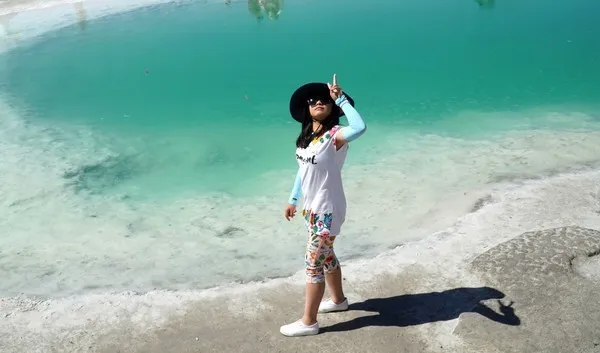
2019.8.15 Emerald Lake, also called Dachaidan Lake, is a rough jade being carved. It has the basic features of Chaka Salt Lake and some characteristics of Jiuzhaigou, with fewer tourists and no ticket required. Most travel agencies don’t go there—partly because it’s relatively small, and partly because they rush to Dunhuang; if they go to Emerald Lake, they would arrive in Dunhuang at 9 or 10 p.m. In Qinghai, for some reasons, foreigners are rarely seen. Infrastructure is much more backward compared to other provinces. Near Gansu, WeChat signals are often lost. From Delingha to Dunhuang, due to water shortage, large areas of land are barren, and the mountains are almost bare—environmental protection still has a long way to go. During our three days in Qinghai, we mostly stayed above 3,000 meters in altitude. As the guide advised, I didn’t drink any alcohol. Today in Dunhuang, I happily drank yellow wine with everyone. In the words of my child: "Heading west, facing the sea, with spring blossoms. Yesterday, today, and tomorrow, we will all be happy people." That night we stayed at Dunhuang Huaxia International Hotel.
2019.8.16 I have visited the South Wave Valley in the US and the Devil City in Xinjiang. Today, the Devil City in Dunhuang has a distinct character. There were Golden Lion Welcoming Guests, Peacock Displaying Its Tail, and a Sphinx, all lifelike; and a magnificent fleet sailing into the distance, breathtaking. Although the temperature reached 34°C and strong winds made everyone stagger, sand hitting our faces painfully, we still reveled in the uncanny workmanship of Dunhuang’s Yardang landform... At the Yumen Pass scenic area, facing the vast ruins, the poems "a lone city amid ten-thousand-foot mountains" and "the spring wind never crosses Yumen Pass" evoked a strong sense of solemn tragedy.
▲ The magnificent ocean-going fleet
▲ The one thing never lacking here is strong wind—endless wind "carves" the Devil City
2019.8.17 According to the local guide, the "Dunhuang fever" among mainland Chinese has only been around for five years. Before that, most of their visitors were Japanese and Hong Kong people. Speaking of Dunhuang, I recall Yu Qiuyu’s famous essay "Mogao Caves." The article has many brilliant descriptions of Dunhuang’s history. Describing the admiring tourists, Mr. Yu wrote: "It is proud because of its beauty, it hides away because of its richness. It insists that every pilgrim must pay with the hardship of a long journey to be rewarded." But the Mogao Caves, for travelers coming from afar, besides queuing for nearly two hours, only open four caves—isn’t that a bit stingy? Isn’t there a lack of the spirit of "Isn’t it a joy to have friends come from afar?" The sun shone for only a little while, then the sandstorm returned. In the afternoon at Mingsha Mountain and Crescent Moon Spring, I experienced a sandstorm for the first time: gale-force wind whipped yellow sand everywhere, like a yellow sea. The ridges of Mingsha Mountain were blurry, like an out-of-focus lens. I also wore a veil for the first time—what’s the use? Covered with sand, even my mouth filled with yellow sand—it tasted wonderful. Last month, a few friends successively arrived in Dunhuang and took cover-worthy photos at Mingsha Mountain. Today, I want to show everyone another side of Dunhuang—how Dunhuang people protect cultural relics and carry out greening projects in such an environment, and how difficult the road to development in the northwest still is. In the evening, the travel agency and family friends celebrated my birthday. This unexpected surprise added a festive color to the trip. Thank you, my brothers and sisters, and friends of the family group.
2019.8.18 As in the US, Canada, Northern Europe, Xinjiang, and Qinghai, scenic spots in Gansu are hundreds of kilometers apart. Today, we spent 11 hours on the road, visited Jiayuguan, and by the time we reached the second scenic spot, it was past 7 p.m., and tickets were no longer sold. Jiayuguan, together with Shanhaiguan and Zhenbeiguan, is one of the three great wonders of the Great Wall, known as the "First Fortress Under Heaven," and is very well preserved. The most discussed topic was how fierce the battles must have been—charging and defending such high and thick walls. Gansu’s infrastructure is significantly better than Qinghai’s. Take highway service areas, for example: Gansu’s have basic facilities, while Qinghai’s are quite primitive—some service stations don’t even have public restrooms, and private ones are unclean and charge one yuan. Tomorrow, the journey is still long, but fortunately, the program is exciting and worth looking forward to. That night we stayed at Zhangye Ducheng Holiday Hotel.
▲ The First Fortress Under Heaven
▲ One of the three great wonders of the Great Wall—Jiayuguan
2019.8.19 The morning temperature dropped sharply, the sky was gloomy, and light rain fell now and then. At the No. 1, No. 2, and No. 4 viewing platforms of Zhangye Danxia Landform, the spectacular rainbow-colored hills still amazed us. The Creator shaped a poetic and picturesque scene in the mountains, leaving us full of admiration. While crossing the highway at an altitude of 3,800 meters on the Qilian Mountains, two local guides told us about local customs and habits, arousing great interest. Herding families, despite their plain clothes, are quite well-off. A sheep sells for 1,500 to 2,000 yuan, a cow for 7,000 to 10,000 yuan. The rolling hillsides are contracted out to families, with goats strolling leisurely on the green grass. Some families graze hundreds of sheep and hundreds of cattle—definitely wealthy. So, that guy who said "I would give up my property to herd sheep with her"—besides being romantic, could he be pursuing a rich heiress with hundreds of sheep and cattle? That night we stayed at Menyuan Jieyun Hotel.
2019.8.20 From Menyuan to Lanzhou, it took nearly 11 hours. Almost half the time was in canyons. Due to yesterday’s rain, the large rivers beside the road were muddy. Steep canyons had shed many rocks, some quite large—fortunately, it was only a scare. It’s true: the best scenery is on the road. Looking at the canyon landscape reminded me of many small villages among towering mountains in Northern Europe. Their buildings are scattered in an orderly way, with colorful little villas dotting the green countryside. Unfortunately, the people here haven’t yet had time to think about these issues—but fortunately, someone has already set their sights on this land; a construction site resembling guesthouses is being developed. Gold will shine. When heading to the Zhutuo Mountain scenic area, we took the wrong road, and the tour bus couldn’t pass, so we just took a couple of photos. After three consecutive days of long drives, plus resting in Menyuan at an altitude of nearly 3,000 meters yesterday, everyone was a bit tired. That night we stayed at Lanzhou Legend Hotel.
2019.8.21 One of the eight scenic spots of Lanzhou, White Pagoda Mountain Park is an open garden. From the top, you can overlook the entire Lanzhou. Three members of our family led the way—from climbing to descending took less than 40 minutes. On the platform of White Pagoda Mountain, a group of aunties were dancing square dance in a circle. An old man carrying collected bottles and cans joined the aunties, dancing exuberantly—a heartwarming scene. At the foot of White Pagoda Mountain is the Zhongshan Bridge, known as the "First Bridge over the Yellow River." Built by Germans 110 years ago, it has withstood the tests of war and flood. It is said that on the bridge’s 80th and 100th anniversaries, German authorities wrote to the Lanzhou government reminding them of maintenance. Later, Lang Xianping revealed that the German company that built the bridge had already closed in 1946—so where could the reminders come from? This is similar to the story about Qingdao’s underground drainage system being built by Germans. Exaggeration makes it untruthful. Of course, German products are of good quality. In the afternoon, we visited the Gansu Provincial Museum and appreciated all the treasures featured on the national treasure show—a worthwhile visit.
▲ The Eastern Han bronze "Galloping Horse Treading on a Flying Swallow" unearthed in 1969, depicting the "lateral gait" of Hexi fine horses after training. A national treasure and a symbol of the Silk Road spirit.
▲ The human-headed pottery bottle with a mouth, reflecting the head decoration of primitive people in the Neolithic period.
▲ An imposing bronze chariot and horse guard team composed of 38 warriors riding 38 bronze horses, along with servants and other vehicles.


