In-depth Dunhuang Travel Guide
During the off-season amidst the pandemic, our trip to Dunhuang gave us the experience of 'only the two of us in the world'. We had originally planned to take the Sichuan-Tibet route or the Qinghai-Gansu Grand Loop, but worried that the weather would be too cold for a good experience, so we finally chose an in-depth tour of Dunhuang. Since there were still sporadic outbreaks in Chengdu, Shanghai, and other places, we only booked flights to Dunhuang and one night's stay at the Dunhuang Villa, so that even if the pandemic flared up, our cancellation losses would be relatively small.
On March 6, Spring Airlines flight 9C6162 (Quanzhou-Lanzhou 11:50-15:30), then 9C6185 (Lanzhou-Dunhuang 17:05-18:50), including 10 kg checked baggage, total for two tickets 1458 RMB. We took a taxi from the airport to the hotel, 14 km for 43 RMB, arriving in under 20 minutes. I had seen Dunhuang Villa on Douyin and was attracted by its grand design and distinctive local decorations, so I booked a king room for 801 RMB including breakfast for two. When checking in, the front desk recognized me immediately – it turned out there were so few guests that during peak season the huge villa would be fully booked, but now there were only five or six groups, yet the service was not compromised at all. Built in 1995, the Dunhuang Villa looks particularly charming, with classical Han-Tang style architecture and elegant furniture from the late Tang, Ming, and Qing dynasties, a traditional northwest enclosed courtyard made mainly of stone and earth, and a large mural in the lobby. The main building's top-floor restaurant, Star Picking Pavilion, is a popular check-in spot with views of Mingsha Mountain. Breakfast was also abundant, and the beef noodle soup left a lasting impression on me. Sitting in Star Picking Pavilion with a cup of coffee or a glass of wine, watching the sunset and stargazing, was such a slow-paced life. The only downsides were that the room was a bit small, and the air conditioning was a bit loud – due to the 1995 structure, the hardware couldn't be renovated, but the soft decoration and cultural touches were very warm, with a complimentary box of freshly made cake, a large box of red dates, and two small camel plushies.
On March 7, we carpooled from the hotel at 9:30 (20 RMB per person) to Mogao Caves, having pre-booked tickets for the 10:00 entry (140 RMB per person, half price in off-season). We bought the new Flying Apsaras special ticket, launched earlier this year, limited to 60 people per day, at the same price as regular tickets. The main difference is that each visitor is given a specially designed Huawei phone, and scanning at the entrance of important caves lets you see the murals and painted sculptures inside, and even take photos with 3D murals. In the off-season, we could visit about 10 caves. The guide said that in peak season they receive 10,000 to 20,000 visitors a day, but now it's only 100 to 200. I hadn't done any research before coming to Mogao Caves, so I just listened with common knowledge – it was fascinating. After returning, I bought some books and caught up on the knowledge; the art, people, and stories are truly remarkable. On the guide's recommendation, I bought a high-definition Dunhuang photo album for 368 RMB, only available at the research institute – a souvenir and an excellent inspiration book for me to explain Dunhuang to Qi Huanchang. At 2 PM we finished the tour and had a beef set meal at the Mogao Caves restaurant for 90 RMB total, which was satisfying.
On Ctrip, I found the newly renovated 4-star Feitian Hotel, a zero-pressure king room (223 RMB per night without breakfast). Both Mr. Deng and I were satisfied with this room – affordable, spacious, fully smart, with good bedding, and many restaurants nearby.
Mr. Deng and I were wandering the streets and got bored, so around 5:30 PM we decided to go to Mingsha Mountain and Crescent Moon Spring, entering just before 6 PM (55 RMB per person). It felt like we had the place to ourselves. Each of us rode a camel (100 RMB per person), and the camel driver led us for an hour. We paid the driver 60 RMB to take some photos and short videos of us. In the vast desert, only Mr. Deng and I were sitting on camels, swaying and leaving footprints step by step – it felt magical and romantic. It doesn't get dark in Dunhuang until after 8 PM. After the camel ride, we walked to Crescent Moon Spring, and before us was a large lake shaped like a crescent moon – so amazing, surrounded by drifting sand, with dense reeds on the south bank, and ancient buildings like temples by the spring, evoking an oasis in the desert. On the way back, we saw the desert ladder, and Mr. Deng challenged himself to climb to the top. He said, 'Endless desert, one mountain after another.' In the evening, we found a random stall at Shazhou Night Market and ordered Dunhuang specialty Hu Yang Men Bing (braised lamb with flatbread), etc., total 165 RMB for two.
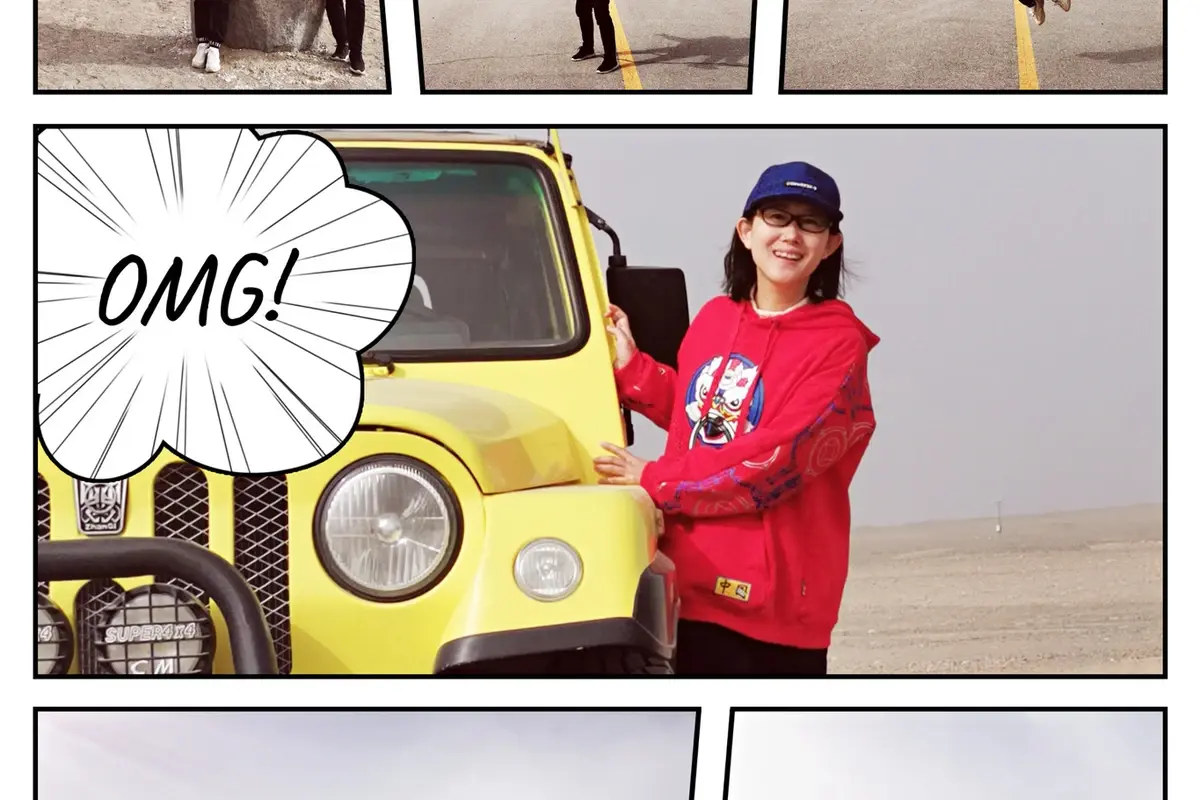
March 8 was the fullest day. We set off at 9 AM to Yadan Devil City, Yumen Pass (Han Great Wall), visited the First Desert Village to see the lives of villagers, and passed through Dunhuang Film City (a quick look), covering nearly 400 km round trip (chartered car 350 RMB). Thanks to the concierge at Dunhuang Villa who introduced us to a taxi driver and guide, Xiao Nian, a native of Dunhuang. Her explanations were professional and no less than a tour guide's, and we felt very comfortable with her. She suggested we go straight to Yadan and visit the other sites slowly on the way back. Crossing the endless, desolate Gobi, we arrived at Yadan Geopark at 11 AM (120 RMB per person). The staff said we were their earliest guests of the day. We had a scenic tour bus to ourselves with a beautiful guide, stopping at four small spots for photos. You can't help but be awed by the scene – even days after returning home, I still imagine the wind howling across this land like thousands of beasts raging, and the fear of being in the midst of it. Due to erosion, many Yadan formations are already collapsing; years later, it may all be flattened again. Because it was off-season, the restaurant at Yadan was closed, so lunch was pre-prepared bread. We took some road photos, touched and stepped on the Gobi, and arrived at Yumen Pass at 1:20 PM (90 RMB per person). 'The spring wind never reaches Yumen Pass' – spring comes late, and everything is desolate. From the starting point of the Maritime Silk Road to the 'throat' of the Land Silk Road, I thought of the prosperity of this land a thousand years ago, and felt awe for history! Seeing the scenic bus drivers taking guests from one small spot to another, I suddenly realized how high-pressure and stressful my own job is – I don't have a comfort zone either. Another interesting point on this day's itinerary was visiting Erdun Village, a rural village in the Gobi. I was always curious about what the countryside here was like. Row upon row of beautiful single-story houses, each family growing grapes, and sun-dried raisin sheds with earth-and-wood structures, the walls dotted with square ventilation holes. But there were few people on the streets, almost every house had its door closed, only at the village committee entrance a small shop had a few old people playing cards. Xiao Nian said each family in this village earns about 100,000 RMB a year. It seems the government's poverty alleviation campaign is serious. The Dunhuang Film City was shabby and deserted (40 RMB per person, tricycle 20 RMB). I wouldn't recommend it, unless you want to shoot a set of martial arts photos. For dinner, Xiao Nian recommended Daji's Braised Donkey Meat Yellow Noodle Restaurant – tasty and affordable, with nice decor. We ordered half a jin of donkey meat, yellow noodles, and a few other dishes, total 147 RMB.
March 9 started with breakfast at Xia Jia He Zhi, a popular old brand. It was essentially lamb soup with rice noodles – I didn't like the gamey smell, so it wasn't for me, but their side dishes were good, total 40 RMB. Xiao Nian picked us up at 9:30 AM to go to Aksai (chartered car 200 RMB), round trip about 200 km. Crossing the desert towards the snowy mountains, we arrived at Aksai, a beautiful autonomous county with around 10,000 people, very well built. The museum guide was enthusiastic and detailed, explaining the customs of Aksai and the Kazakh people, even sharing the joy of her 13-day marriage and her ethnic wedding dress. She said Kazakhs have no surnames; parents usually name their children after the Quran or nature. There were few people on the streets, and unfortunately, almost no one wearing traditional Kazakh clothing. Xiao Nian said that nowadays only the elderly and people on major festivals wear traditional costumes. I didn't see any real estate agencies on the streets either; restaurants were the most common. Locals said housing prices here are around 3,000 RMB per square meter. Rows of orange villas built jointly by the government and farmers stand around the mosque, each costing about 600,000 RMB. The Kazakhs were originally a nomadic people, but in Aksai, it feels like the government has invested heavily, and the people live in peace and contentment. For lunch, we had big plate chicken, lamb dumplings, and greens – delicious. The boss, a veteran, had run the restaurant for over 20 years in Aksai and chatted with us about current affairs. The meal was affordable, total 95 RMB. We wanted to visit the Aksai Desert Park, but it was closed due to the pandemic. We returned to Dunhuang city and did a nucleic acid test around 4 PM. Xiao Nian helped me arrange a Flying Apsaras photo shoot (1,000 RMB). The photo studio she found in the city center was better quality than the ones near Mingsha Mountain, though a bit more expensive. Spending 1,000 RMB on a photo shoot stung a little, but Mr. Deng said, 'You've lost so much in the stock market (that week the market crashed), why care about this 1,000? If you want to shoot, go ahead.' After an hour of makeup, we went to the back mountain of Mingsha Mountain for the shoot. The back mountain was stunning – I saw the desert camping tents I'd seen on Ctrip! Excitedly, I posed for a set of Flying Apsaras photos, while Mr. Deng explored the back mountain alone, leaving footprints in the sand. In the evening, I bought myself a small Dunhuang silk scarf with the nine-colored deer design as a souvenir (178 RMB). We were too full from lunch to have dinner, so we ordered fruit delivery to the hotel.
March 10 was the return day. During our days in Dunhuang, we kept hearing about the spread of the pandemic in Gansu. Mr. Deng wanted to end the trip and go back immediately. I analyzed the news and policies, thinking that since we had a rare vacation for two, we might as well stay and explore Dunhuang in depth, not going to Zhangye or Qinghai. We booked Spring Airlines 9C6138 (Dunhuang-Lanzhou 17:15-19:00), then the next morning fly from Lanzhou to Quanzhou (2 people 1,458 RMB). We agreed with Xiao Nian to go to the airport at 3:45 PM. With most of the morning free, we visited the Dunhuang Museum (free admission). The building, mainly ochre, resembles the Great Wall's walls and beacon towers from the outside; inside, it feels like entering a cave complex. The exhibition takes Dunhuang's history as the main thread, focusing on the Silk Road and Mogao Caves culture. For lunch, we went to the Dongyi Dunhuang Hotel (3,680 RMB per night on Ctrip), which I had been longing to see. We needed to reserve in advance so the gate guard would let us in. Perhaps because it was off-season, the menu was limited, but the prices were cheaper than I expected. Mr. Deng and I had lunch for 144 RMB total. After lunch, I strolled around the hotel. Through Dongyi, I felt the surprise of seclusion amidst thousands of years of history and natural landscape. The hotel's designers drew on traditional northwest dwelling forms like 'earth walls' and 'drying sheds' from Dunhuang, using rammed earth techniques with locally produced mud bricks, so the buildings 'hide' effortlessly in the surrounding environment, as if naturally grown. The isolated Dongyi Dunhuang Hotel in the desert exudes a cool temperament – from nature, to nature. I was not disappointed.
Our days in Dunhuang went smoothly, but in Lanzhou we could feel the tense pandemic atmosphere. We stayed at the Civil Aviation Guesthouse near the airport (261 RMB per night). After dinner around 7 PM, Spring Airlines suddenly cancelled the next morning's flight from Lanzhou to Quanzhou, and all flights to Quanzhou and Xiamen in the coming days were cancelled too. What to do? Mr. Deng and I made a snap decision: check out and rebook a flight to Shijiazhuang at 22:05 that same night, then the next afternoon fly from Shijiazhuang to Quanzhou. This extra leg cost us over 2,000 RMB. Fortunately, there is Zhengding Ancient City near the Shijiazhuang airport. I found a small tricycle to take me to Longxing Temple, Rongguo Mansion, and the ancient city wall – it somewhat compensated for the loss on airfare.
March is the time to visit Dunhuang! It rarely rains, sometimes there are sandstorms, and the sky is not very blue. The weather in March is pleasant. You need a medium-thick down jacket before 10 AM, but around noon it's about 17°C, very comfortable. I didn't wear sunscreen or use face masks; my skin got a bit dry, but not noticeably darker. Dunhuang's economy is based on tourism, so restaurants, hotels, and transportation are very convenient. The roads in the northwest are wide and empty, easier to drive than highways. A taxi between scenic spots usually costs just over 10 RMB. I am not a foodie, and Mr. Deng doesn't allow waste, so we only tried a few Dunhuang dishes. Shopping: books and silk scarves. I bought some local black goji berries from Xiao Nian, and she also gave me some local red dates. Tickets for Dunhuang's attractions feel a bit expensive, but seeing the infrastructure built into such a harsh natural environment, the costs must be high. The Chinese people are remarkable – everything is worth it! As society changed and the Land Silk Road was abandoned, Dunhuang was gradually forgotten and then remembered again. Yes, language, religion, and art spread through this route, creating the rich material and cultural landscape that remains today. 'Sacrificing oneself to feed the tiger.' Devoting his life to guarding Dunhuang – Mr. Chang Shuhong's extraordinary life, his biography is the most moving. Generations of Mogao people have taken up the baton of 'Guardians of Dunhuang', and the conservation of Dunhuang's cultural relics is no longer 'crisis-ridden', but has taken on a brilliant new look. Dunhuang is more than just a city!


