Journey to the West Chapter 31: The Hexi Corridor Where Wind Whirls and Sand Flies, Yumen Pass and Yang Pass in Desolate Dunhuang
All photos in this article are taken by the author of 'Black and White Touch'. All rights reserved. Unauthorized use is strictly prohibited!
The Hexi Corridor is named for its location west of the Yellow River, stretching from Wushaoling in the east to the ancient Yumen Pass in the west. It is flanked by the Qilian Mountains and Altun Mountains to the south, and the Mazong Mountains, Heli Mountains, and Longshou Mountains to the north. Approximately 900 kilometers long and ranging from a few kilometers to nearly a hundred kilometers wide, it is shaped like a corridor, also known as the Gansu Corridor.
Since ancient times, the Hexi Corridor has been a vital passage to the Western Regions. The Silk Road passed through here, and the Han Dynasty established the Four Commanderies of Hexi here, which were under the Longyou Circuit during the Tang Dynasty. From the Western Han general Huo Qubing's victory over the Xiongnu in the Hexi Campaign to the An Lushan Rebellion in the Tang Dynasty, a period of 800 to 900 years, the peak of the Han and Tang dynasties coincided with the prosperity of the Hexi Corridor. The Former Liang, Later Liang, Southern Liang, Northern Liang, Western Liang, and Great Liang successively established their capitals here.
After the An Lushan Rebellion, the Hexi Corridor gradually declined. The Yang Pass and Yumen Pass of the ancient Dunhuang Commandery have become ruins of broken walls. On both sides of the corridor stretch vast Gobi deserts with howling winds. Only the emerging industrial cities and the ancient Mogao culture quietly proclaim that this place was once rich in resources and civilization.
The Four Commanderies of Hexi no longer exist. Today, scattered along the corridor are the Five Cities of Hexi: Wuwei, Jinchang, Zhangye, Jiuquan, and Jiayuguan. Jinchang and Jiayuguan are new cities built on mineral resources. The Dunhuang Commandery and Jiuquan Commandery both belong to present-day Jiuquan. On our Gansu journey, we will visit all these cities. In the previous article, we have seen the landscapes of Jiuquan Commandery and Jiayuguan. Today, we continue westward for 400 kilometers to Dunhuang again, visiting famous historical sites outside the Mogao Caves.
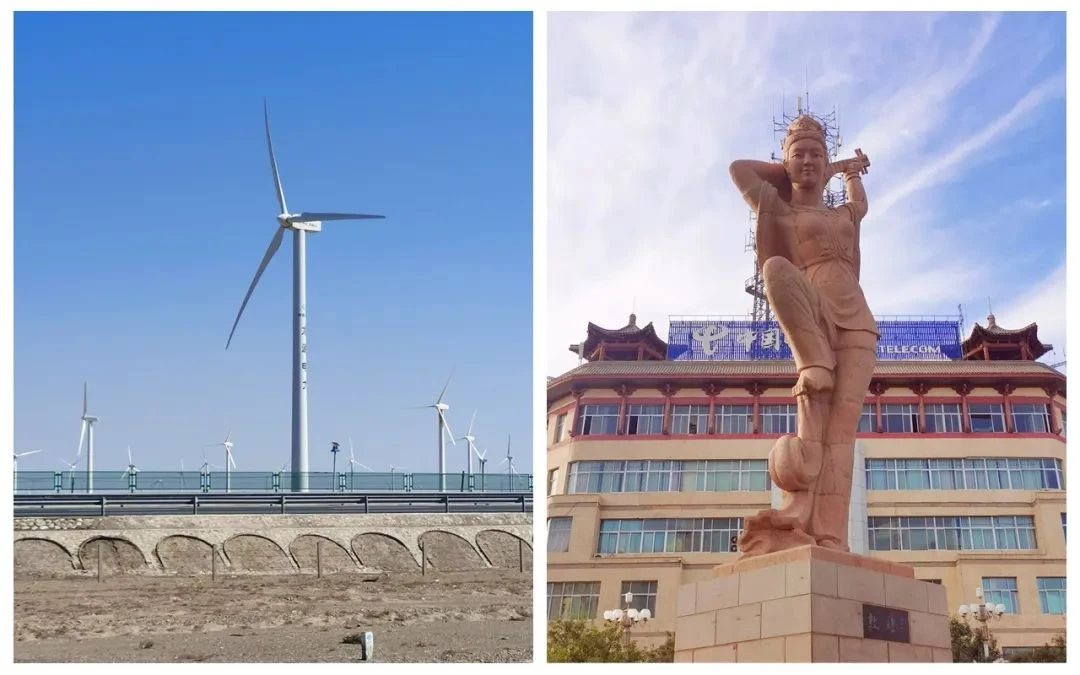
(The Hexi Corridor is abundant in wind energy resources, and wind turbines are commonly seen along the route)
(Dunhuang specialty—Donkey Meat Yellow Noodles)
'Dunhuang' is explained in ancient books as: 'Dun means great; Huang means prosperous... because it widely opened the Western Regions, it was named for its prosperity.' In 111 BC, the Han Dynasty officially established Dunhuang Commandery. This oasis city surrounded by desert became an important node on the Silk Road. Western civilizations entered the Central Plains through here, and Central Plains civilizations spread to the world from here. Thus, Dunhuang is known as the 'Place Where Four Civilizations Converge.'
Scenic spots like the Mogao Caves and the Crescent Moon Spring at Mingsha Mountain tell of Dunhuang's natural beauty and cultural grandeur, which we already experienced two years ago. In fact, there are many little-known sites in the Dunhuang city area, and even an ordinary street corner reveals the depth of civilization.
For example, the Shazhou City ruins in Baima Pagoda Village, Qilizhen, are relics surrounded by modern buildings and roads. The site is rectangular in plan, with intermittent remnant walls on the south, north, and west sides, and a city watchtower at the northwest corner.
During the Former Liang period of the Eastern Jin, Dunhuang, Jinchang, and Gaochang commanderies, along with the three military camps of the Western Regions Protectorate, Wuji Colonel, and Yumen Grand Protector, were combined to form Shazhou, so Dunhuang was anciently called 'Shazhou.' In the fourth year of Long'an of the Eastern Jin (400 AD), Li Hao established the Western Liang state, initially capitalizing in Dunhuang. He widely recruited talents, and some literati from the Western Liang region, such as astronomer Zhao Fei, educator Liu Bing, and historical geographer Kan Yin, all gathered in Dunhuang, making it a center for Confucian learning in the Western Liang.
Near the Shazhou City ruins is the Baima Pagoda (White Horse Pagoda), an octagonal white pagoda in Lamaist style. This was built in the Later Qin period (384-417 AD) when the eminent monk Kumarajiva from Kucha (present-day Kuqa) was spreading Buddhism eastward and passed through Dunhuang. His white horse died of illness, so it was buried here and a pagoda was built in memory. Around the White Horse Pagoda are green fields, green trees, and blue-tiled quiet houses. When the breeze blows, the sound of bells rings out—truly a wonderful sight in Dunhuang.
Thirty kilometers southwest of Dunhuang city lies the Western Thousand Buddha Caves. The route passes photovoltaic industrial parks, Sleeping Buddha, sand dunes, Westward Journey Monks, and other landscapes, with rugged, majestic, and vast scenery.
(Photovoltaic Industrial Park: Besides wind energy, the Hexi Corridor is also rich in solar thermal resources)
Below is a mountain resembling a sleeping Buddha, its head resting on the Danghe Reservoir and its feet on the Yang Pass Road. It is 2.2 kilometers long, lying horizontally on the vast Gobi. The peaks are arranged in a staggered manner. From a distance, the outline looks like a giant Buddha lying in deep slumber, vivid in form, graceful and serene.
Next, we visit the Western Thousand Buddha Caves.
The Mogao Caves are also called the 'Thousand Buddha Caves.' The Western Thousand Buddha Caves are named for being west of the Mogao Caves, carved into the cliffs along the Danghe River. Experts speculate that the Western Thousand Buddha Caves may have been founded earlier than the Mogao Caves, or at least built in the same period. There are 22 existing caves, spanning the Northern Wei, Western Wei, Sui, Early Tang, High Tang, Mid-Tang, Five Dynasties, Song, Shazhou Uyghur, and Yuan dynasties. There are 34 painted sculptures and over 800 square meters of murals, making it an important part of Dunhuang art.
The cave layouts of the Western Thousand Buddha Caves can be roughly divided into four types: central pillar caves, inverted-dome caves, flat-topped square caves, and open vertical rectangular niches. Among them, Sui Dynasty Cave 11 has a shape similar to a nomadic circular tent, which is unique among Dunhuang caves. The Buddha statue in the front niche of the central pillar in Northern Wei Cave 7 is distinctive, with mature sculpting techniques, elegant form, and a solemn expression, typical of the 'graceful bones and clear features' style, making it an excellent work of the Northern Wei.
The mural content and style of the Western Thousand Buddha Caves are basically the same as those of the Mogao Caves. The murals on the south wall of Cave 12, including the 'Conversion of the Six Non-Believers' and the 'Sama Jataka,' are representative works of the Northern Zhou. The murals in Cave 18, such as the 'Sutra of the Visualization of the Buddha of Infinite Life,' the 'Sutra of the Medicine Buddha,' and the 'Sutra of Avalokiteshvara,' are representative works of the Mid-Tang.
The Western Thousand Buddha Caves also retain a large number of murals painted during the Uyghur period (1070s to early 12th century). The content mainly features preaching scenes or portraits of Buddhas, Bodhisattvas, and Arhats. The figures have robust physiques, long round faces, plump cheeks, slender eyebrows and small eyes, high straight noses, and small mouths, clearly emphasizing the appearance and temperament of the Uyghur people.
Photography of the statues and murals inside the caves is not allowed. However, the guides' explanations are very detailed and comprehensive, and they answer all questions. Although the number of caves open for visitation is not large, you will surely benefit greatly.
Thirty kilometers west of the Western Thousand Buddha Caves is the Yang Pass Scenic Area. On the way, you pass the Shanshuigou Dadun Beacon Tower, built in the Han Dynasty, which has certain reference value for studying the military defense, historical evolution, and the evolution of beacon tower architectural forms at the Dunhuang border.
'Another cup of wine, my friend; West of Yang Pass, no old friends will meet your eyes.'
Wang Wei's timeless poem 'Weicheng Song' made Yang Pass a spiritual homeland for Chinese people. Once, it had a majestic pass, with caravans and envoys passing through; once, it had lush trees, crisscrossing streets, and heavenly horses galloping in the wild...
Yang Pass, named for being south of Yumen Pass, was first built during the Yuanding era of Emperor Wu of Han. The Western Han 'established four commanderies and held two passes,' and Yang Pass was one of them. As a gateway to the Western Regions, it was China's earliest customs, the throat of the southern route of the Silk Road, and a passage for cultural exchange between China and the West. In the minds of Chinese people, 'Yang Pass Avenue' is synonymous with brightness, hope, and a bright future.
Yang Pass was a strategic location that military strategists had to contend for. According to historical records, during the Western Han, it was the seat of the Yang Pass Commandant. During the Wei and Jin, Yang Pass County was established here. In the Tang, Shouchang County was established. After the Song and Yuan, with the decline of the Silk Road, Yang Pass was gradually abandoned.
(Sculpture of Zhang Qian's mission to the Western Regions)
Upon entering the scenic area, you can see a spirited sculpture of Zhang Qian. In 139 BC, he was sent as an envoy to the Dayuezhi in the Western Regions. He was captured by the Xiongnu, imprisoned for over ten years, escaped, walked to Dayuezhi, and returned to Chang'an in 126 BC. He was granted the title of Bowang Marquis and is regarded by later generations as the pioneer of the Silk Road.
On both sides of the Zhang Qian sculpture are museums of the Silk Road and the Han Dynasty Passes, showcasing the history and culture of the Silk Road, Yang Pass, Yumen Pass, and the Great Wall of Hexi. It is beneficial to learn about them before visiting the ruins.
In the mid-Western Han, Chinese feudal society entered its first period of prosperity. Zhang Qian's two missions to the Western Regions opened a new era of sino-foreign exchange. The route formed by his 'pioneering journey' was later named the 'Silk Road' by German geographer Ferdinand von Richthofen. In general, the Silk Road is a collective term for the routes from East Asia through Central Asia, West Asia to Europe and North Africa, a 'road of dialogue' connecting Eastern and Western civilizations.
Dunhuang, located at the node of the Silk Road, was where 'all roads converge at Dunhuang,' known as 'a meeting place of Chinese and barbarians.' Sino-foreign trade was exchanged and distributed here, and Eastern and Western civilizations learned from and integrated with each other, giving birth to the profound, brilliant, and unique Dunhuang culture. In the Han Dynasty, to reach the Western Regions, one had to pass through Dunhuang via two main roads: the southern route starting from Yang Pass, going west along the northern slopes of the Kunlun Mountains, crossing the southern Pamirs, and reaching Daqin (Rome). The northern route started west from Yumen Pass, going south of the Tianshan Mountains, crossing the northern Pamirs, reaching Yancai, and then Daqin. These two routes were the main arteries of economic exchange at the time.
After establishing commanderies and counties in Hexi, the Han Dynasty actively implemented measures such as immigration to border areas and military farming for defense, while strengthening friendly relations with the Western Regions. Advanced production technologies, tools, and methods from the interior were brought to the Hexi region and widely applied, promoting unprecedented economic, cultural, and social productivity development in Hexi.
(Fragment of Western Han embroidered fabric with auspicious beast and cloud pattern)
After the Wei and Jin, the Central Plains were plagued by frequent wars, while the Hexi region was relatively politically stable, with abundant resources and a prosperous economy, becoming a refuge for powerful Central Plains families. With the westward migration of Central Plains culture and the importance attached to academics and culture by the Five Liang rulers, 'Five Liang culture' centered on Dunhuang flourished, producing a large number of famous scholars, including the 'Ten Talents of Dunhuang.' At the same time, seeds of civilization from Central Asia and India spread to the Hexi region, which became a necessary passage for Buddhist culture to enter the Central Plains, forming the Buddhist cave complex represented by the Mogao Caves and the 'Liangzhou style.' Therefore, it is not an exaggeration to call the Hexi region the 'Molucca Strait on land in East Asia'
(Mural from Mogao Cave 103: Envoys from various Western Regions traveling on the Silk Road during the Tang Dynasty)
Dunhuang was originally a settlement of the Wusun and Yuezhi. The Xiongnu took advantage of the peasant uprisings at the end of Qin and the Chu-Han conflict to quickly become strong, drove away the Wusun and Yuezhi, occupied the entire Hexi, and constantly harassed the Han border. To eliminate the threat of Xiongnu invasion, Emperor Wu of Han sent Zhang Qian twice as envoy to the Western Regions and sent Huo Qubing on an expedition to Hexi, forcing the Xiongnu's Hunye King and Xiutu King to surrender, incorporating Hexi into Western Han territory. Dunhuang, commanding the two passes, became the gateway between China and the Western Regions.
Yang Pass on the southern Silk Road was a famous strategic pass on the northwestern border defense line of the Han Dynasty and one of the western gateways from China to the Western Regions and Central Asia. After Emperor Wu opened up the territory, it became the seat of a commandant and an extremely important transportation and military stronghold. During the Wei and Jin, Yang Pass County was established, and it had a glorious and prosperous history throughout the Han, Jin, Sui, and Tang periods.
Exiting the museum, passing through the Han-style gate tower, and passing the Yang Pass Commandant's Office, we arrive at the Yang Pass ruins.
The Yang Pass ruins currently retain many features from the Han and Tang periods, including ancient passes, ancient cities, ancient beacon towers, ancient roads, ancient border walls, and ancient kilns. This border pass, built in the 1st century BC and once a hub of brilliant civilization, is now a relic of broken walls in the vast Gobi, evoking a sigh at the changes of the world.
Wang Wei's 'Weicheng Song' from the Tang Dynasty and the poetic recitations of later literati made Yang Pass a place for expressing farewell emotions when leaving homeland and relatives or going on expeditions. To bless traveling relatives and friends, people hoped that Yang Pass Road would become a broad and flat 'Yang Pass Avenue,' giving rise to the saying, 'You take your broad road, I'll cross my single-plank bridge.'
However, whether 'Yang Pass Avenue' or 'single-plank bridge,' they have drifted away with the wind, becoming symbolic images in memory, leaving only spreading yellow sands to proclaim the power of time—a power that can make 'success or failure turn empty in a turn of the head...'
Sixty kilometers north of Yang Pass lies Yumen Pass, where 'the spring breeze never reaches.'
Yumen Pass was an important pass established by the Western Han at the western end of the Hexi Corridor, located on the Gobi south of the Shule River, west of the Qilian Mountains. It is the best-preserved and most complete pass relic on the Silk Road, witnessing the traffic management system, beacon tower system, and Great Wall defense system of the Han Dynasty. It was an outpost for the Han Dynasty's territorial expansion and a gateway for sino-foreign exchange.
There are also many ancient poems about Yumen Pass, such as Wang Zhihuan's 'Why should the Qiang flute complain about the willows? The spring breeze never reaches Yumen Pass,' Li Bai's 'Long winds of thousands of miles blow through Yumen Pass,' and Wang Changling's 'Dark clouds over Qinghai Sea cover snowy mountains; Lonely city gazes at distant Yumen Pass'... They create a grand and vast mood before one even arrives.
The Yumen Pass scenic area is not small. The Han Great Wall ruins, Xiaofangpan City ruins, and Dafangpan City ruins are distributed on the Gobi near the Shule River, covering about 20 kilometers. Below, we will take the scenic shuttle bus to visit them one by one.
First is the Han Great Wall ruins on the west side of the scenic area. The Han Great Wall was built during Emperor Wu of Han's conquest of the Western Regions. The Dunhuang Han Great Wall runs east-west, starting from Dongjiandun in Guazhou County in the east to Yushuquan Basin in Dunhuang in the west, about 136 kilometers long. The Danggu Beacon section of the Han Great Wall here is the best-preserved section of Han Great Wall wall in China, about 300 meters long, with a maximum height of 2.95 meters, built layer by layer with reeds and gravel, with a layer spacing of 0.2 meters.
(Danggu Beacon and Danggu Beacon section of Han Great Wall)
The Han Great Wall was a military defense system composed of barriers, fortified structures, beacons, passes, granaries, and border walls. It protected the stability of border society, ensured trade and cultural exchange on the Silk Road between East and West, and promoted socioeconomic development and cultural prosperity.
The image below shows 'jixin' (accumulated firewood), piles of firewood used for smoke signals and transmitting military intelligence beside beacon towers along the Great Wall. They were made of local materials such as reeds, tamarisk, and poplar. The dry climate of the Dunhuang desert Gobi has allowed these materials to be preserved for two thousand years.
On the east side of the scenic area is the Dafangpan City ruins.
Dafangpan City was first built in the Western Han as the storage site for the Chang'an Granary. It was built on a wind-eroded platform 2 meters above the bed of the Shule River, 134.8 meters long from east to west and 18 meters wide from north to south.
Inside the city, there are two north-south walls dividing it into three equal rows of warehouses, with triangular small holes on the upper and lower walls, possibly for ventilation. Outside, there are two layers of walls on the east, west, and north sides. The first layer still has broken walls, with traces of corner towers at the four corners; the second layer only retains traces of the corner tower on the north side.
Eleven kilometers west of Dafangpan City is Xiaofangpan City.
Xiaofangpan City was the seat of the Western Han Yumen Commandant's Office, and during the Eastern Han, it was the seat of the Yumen Marquis. There is one barrier, with the pass site walls intact, roughly square, about 26 meters per side, about 10 meters high, with gates on the west and north sides shaped like earth caves. The top of the city has a walkway 13 meters wide, and there is a step less than 1 meter wide in the southeast corner, leading up along the east wall to the top.
Outside the barrier, there is a courtyard; the east-west wall of the courtyard south of the barrier is still clearly visible. North of the barrier is a wind-eroded platform with beacon tower remains. This millennium-old pass witnessed Dunhuang's prosperity as a meeting point of Chinese and barbarians. Due to its special geographical and climatic conditions, Xiaofangpan City is one of the best-preserved Han Dynasty earth ruins in China.
These are the famous historical sites on the western route of Dunhuang. Returning to the city for a night's rest, the next day we traveled 120 kilometers east to Guazhou (Guazhou County). Sixty kilometers south of Guazhou County are the Yulin Caves and Suoyang City ruins, and along the Yulin Avenue there are several peculiar sculptures that attract tourists to stop and take photos.
First is the 'Gobi Ark.' An ark floats on the vast Gobi, with undulating mountains like waves, carrying humanity's hopes and expectations as it rides the wind and waves. This is the work of Zhao Meng, a professor at the Academy of Arts & Design, Tsinghua University, expressing that human destiny is always closely connected with nature, and the 'Ark Spirit' is a spiritual force with universal human value, fearless of difficulties and bravely moving forward.
Not far ahead, we see 'Heroic Spirit of Han Wu,' a sculpture made mainly of red sandstone, using advanced 3D scanning and digital technology to create data, then 3D carving in blocks, and finally assembling and installing piece by piece.
This work depicts the brilliant Emperor Wu of Han, who opened the Silk Road and for the first time directed the Chinese people's gaze to the world. Its style inherits the majestic spirit of the Han and Tang dynasties, achieving a perfect unity of simple aesthetics and the vast Gobi atmosphere, which is stunning.
The next sculpture is 'Son of the Earth,' a digital carving independently conceived and created by Professor Dong Shubing of Tsinghua University's Academy of Arts & Design in 2016, self-funded and completed over one year, with a similar method to 'Heroic Spirit of Han Wu.'
'Son of the Earth' lies prostrate on the ground with deep affection, symbolizing the symbiosis and harmonious coexistence of humans and nature, showing broad and profound humanistic feelings, and has become a cultural landmark of Guazhou. The Gobi wind is strong; it hurts the face when getting off the car, but tourists flock to take pictures around the Son of the Earth.
The strong wind of the Gobi not only touches your sense of touch but also shocks your hearing. Not far from the Son of the Earth is a steel pipe matrix, which acts as 'wind chimes' played by the Gobi wind. The rows of high pipes, hard to move by human force, play a Gobi symphony under the command of the wind.
Further ahead is a landscape called 'Boundless,' also known as 'Mirage,' also created by Professor Dong Shubing from Tsinghua University. 'Boundless' takes Silk Road civilization as its creative background, using the architectural forms of the High Tang transformation paintings in the Yulin Caves as its blueprint, with modern building materials as the carrier. It is built with over 200 tons of ultra-standard thickened stainless steel pipes, measuring 60 meters long and 45 meters wide.
The sculpture is inspired by the 'Heavenly Tower Pavilion' in the 'Sutra of the Visualization of the Buddha of Infinite Life' in Cave 25 of the Yulin Caves. It draws on traditional Chinese architectural forms such as 'four-linked gate towers, high halls, large sloping roofs, and seven-treasure railings,' constructing a 'mirage' with real materials and forms in the Gobi, merging reality and fantasy, history and reality, with traditional beauty and a futuristic sci-fi feel.
Continuing forward, a small river finally appears in the wilderness, with poplars turning yellow along the riverbank, bringing a touch of bright vitality to the desolate Gobi.
Continuing south for another half-hour drive, we arrive at the Yulin Caves.
At the end of the Western Han, Buddhism from India was first introduced to the Xinjiang region via the Western Regions, then spread eastward along the Hexi Corridor to the Central Plains. By the Northern Dynasties, Buddhism in the Guazhou area had reached a considerable scale. In the second year of the Jianyuan era of the Former Qin (336 AD), the monk Lezun and the Chan master Faliang carved caves on the eastern slopes of Mingsha Mountain in Dunhuang, creating the Mogao Caves. From then on, cave carving and statue making became popular in the Hexi Corridor and continued for a long time, reaching its peak in the Tang Dynasty. From the Northern Dynasties to the mid-Qing, five cave sites were carved in Guazhou territory: Yulin Caves, Eastern Thousand Buddha Caves, Small Thousand Buddha Caves, Hanxia Grottoes, and Jianquanzi Grottoes, which collectively reflect the religious cultural characteristics and artistic levels of various historical periods, forming the great treasure house of Dunhuang art.
The Yulin Caves are located in the Yulin River Gorge south of Guazhou County, also known as Wanfo Gorge (Ten Thousand Buddhas Gorge). The Yulin River flows through the gorge, with elm trees lining both sides, hence the name Yulin Caves (Elm Forest Caves).
The Yulin Caves were first built in the 7th century AD, undergoing construction through the Tang, Five Dynasties, Song, Western Xia, Yuan, and Qing dynasties. There are 43 caves, with a total mural area of about 5,200 square meters and over 270 painted sculptures, holding important historical, artistic, and technological value. They are outstanding representatives of middle and late period Buddhist cave temples in China.
The cave layouts of the Yulin Caves mainly include three types: central altar caves, central pillar caves, and giant Buddha caves. All these cave types began in the Tang Dynasty and became fixed forms later. During the Five Dynasties and Northern Song, 23 caves were built or repaired, with a large number of donor portraits, divided into three types: portraits of the rulers of the Cao family Guiyi Army and their relatives, and officials; portraits of rulers of minority local regimes related by marriage to the Cao family, such as the King and Queen of Khotan, and the processional scene of Murong Guiying of the Tuyuhun; and portraits of painters from the Cao family painting academy, which are important historical materials. From the Western Xia to the Yuan, donor portraits included figures of Tangut, Uyghur, and Mongol nobles and attendants with distinct appearances and costumes. The Western Xia and Yuan murals have unique characteristics in subject matter and style, influenced by Esoteric Buddhism, featuring themes like Water-Moon Avalokiteshvara and Mandalas, which were rare in earlier periods.
The image below shows an ivory statue unearthed from the Yulin Caves, carved from a section of ivory. Its appearance is a Samantabhadra Bodhisattva riding an elephant, holding a stupa with both hands in a reverent pose. It splits into two halves, carving 50 stories of Shakyamuni Buddha from birth to nirvana, with a total of 279 human figures, and 12 animals, pagodas, and chariots. The figures have slim waists and high breasts, with curves fully revealed, belonging to the Gandhara Buddhist carving style of India. Its conception is exquisite and unique, the knife work delicate and skillful. On a piece of ivory as small as a palm, so many vivid images are carved—it is a unique miniature carving art treasure.
Traveling north and then east from the Yulin Caves leads to the Suoyang City ruins, passing the Yulin River Reservoir, which has emerald green water, a rare beautiful waterscape in the Gobi.
Suoyang City was originally called Kuyu City (Bitter City). Outside the city is a sculpture of a general, depicting the Tang Dynasty famous general Xue Rengui, who 'shot three arrows to secure the Tianshan Mountains.' According to legend, when Xue Rengui was on a western expedition, he fought bitterly here against Hami Grand Marshal Su Baotong for several days, finally defeating the Hami army. During the battle, a local plant called 'suoyang' (Cynomorium songaricum), shaped like a radish, saved the soldiers' lives. Therefore, after his victory, Xue Rengui renamed Kuyu City to Suoyang City.
Suoyang City was first built in the Jin Dynasty and flourished in the Tang Dynasty. It was rebuilt and reused to varying degrees in various dynasties. Its shape retains the typical ancient city style of the Tang Dynasty. Located at the western end of the Hexi Corridor, it stood majestically between Suzhou and Shazhou, serving as a hub connecting the Central Plains and the Western Regions on the ancient Silk Road. The site includes ancient city ruins, ancient Buddhist temples, ancient canal systems, and ancient cultivated areas, preserving China's most complete ancient agricultural irrigation and water conservancy system, as well as a relatively complete military alarm system and urban construction system. It is an outstanding example of human land use in the Hexi Corridor and has important research, protection, and utilization value, listed as a 'World Cultural Heritage' site.
The image below shows the inner city ruins, irregularly quadrilateral, with a north-south partition wall dividing it into eastern and western parts. The relics inside include houses, roads, granaries, and wells.
The image below shows the Ta'er Temple ruins, a large Buddhist temple, believed to be a relic of the Western Xia period. The site consists of an outer courtyard and an inner temple. The inner temple from south to north includes the mountain gate ruins, main hall ruins, large pagoda, and small pagoda clusters, with symmetrical bell and drum tower foundations on both sides of the axis. The large pagoda is 14.5 meters high, built with adobe bricks, plastered with white lime, with a stupa-shaped top. The pagoda is solemn and magnificent, very impressive.
According to 'The Great Tang Records on the Western Regions,' when the eminent monk Xuanzang went to India to obtain scriptures, he passed through Guazhou and preached here for over half a month.
Speaking of Xuanzang, we have heard many stories about him along the way in Lanzhou, Xi'an, Kuqa, Tasha Ancient Road, etc. Now we return to Guazhou County town to learn more about Xuanzang's life at the Xuanzang Scripture Museum.
Most people may think of Xuanzang as just a monk who eats vegetarian and chants sutras. Also, because our era is dominated by science, religious faith is far from most people's lives, and they think religion is about asceticism or even ignorance and superstition.
In fact, whether Christianity or Buddhism, sincere believers, like us, do not blindly accept or reject things without thought. Christianity developed Scholasticism to defend faith from a rational and speculative perspective, and Buddhism has a vast and rigorous theoretical system; it is not simply chanting 'Amitabha' and praying for blessings from the Buddha.
(Bronze chakara stupa)
For example, Xuanzang, more than a 'high monk,' should be intuitively referred to as a 'Buddhist scholar,' 'philosopher,' and 'translator.' The Faxiang school (Dharma-character school) he founded is a profound 'discipline,' but unfortunately, it was too 'elite' and obscure and did not spread or become popular. After all, for the vast majority of believers, it is enough to be told that chanting sutras brings blessings; as for the underlying principles, who has the energy and brainpower to delve into them?
(Mogao Cave 45: Statues of Buddha and two disciples)
Guazhou was an important area on Xuanzang's westward journey to obtain scriptures. It retains the temple where he preached, the prefecture city where officials allowed him to pass, the place where he took disciples and bought a horse, and the site where he crossed the Hulu River at night... No wonder the Xuanzang Scripture Museum was built in Guazhou.
(Bas-relief of Xuanzang's life)
In the twentieth year of the Kaihuang era of the Sui Dynasty (600 AD), Xuanzang was born in Chenhe Village, Yanshi, Henan, with the secular name Chen Yi. Xuanzang was his Dharma name after becoming a monk. At age 13, he became a monk in Luoyang, the eastern capital. At 18, he traveled to Chang'an, Sichuan, Hubei, Hebei, and other places to study. Later, he studied under Fachang and Sengbian in Chang'an, who praised him as a 'thousand-li steed' of Buddhism. Then, Xuanzang visited famous masters across the country. At 27, he returned to Chang'an and lived at Dajue Temple. By then, he had mastered the Tripitaka (sutras, vinaya, and shastras) and was called 'Tripitaka Master,' with a widespread reputation. Later, he consulted masters of different schools and found inconsistencies in Buddhist theories, many involving the 'Yogacara-bhumi-shastra.' When he met an Indian monk named Bodhi in Chang'an, he learned that Master Shilabhadra at Nalanda Monastery in India was teaching the 'Yogacara-bhumi-shastra,' so he decided to go to India to seek the Dharma.
The following year, along with several like-minded monks, Xuanzang petitioned the court to travel west for the Dharma. Because the Tang dynasty was newly established and prohibited citizens from going abroad, his companions backed out, but Xuanzang did not retreat. He submitted two more petitions, both rejected. So he practiced asceticism in the wild while learning Sanskrit and making various preparations.
In the first year of the Zhenguan era (627 AD), Xuanzang set out from Chang'an, passing through prefectures and crossing deserts. In Guazhou, he took disciples and bought a horse, crossed the Hulu River at night, secretly passed Yumen Pass, and alone traversed the 800-li Moheyanqi Desert. He encountered sandstorms, lost his way, could not find water, went without a drop for four days and five nights, and eventually collapsed from exhaustion. At midnight, a cool wind revived him, and he continued. Led by his horse, he discovered a spring and saved his life. Later, he crossed snowy mountains, surviving many perils with unwavering determination. 'Rather die going west than return east alive' became his solemn vow on the journey.
The image below shows the scene 'Xuanzang Crosses the Hulu River at Night.' In Guazhou, Xuanzang was guided by a Hu (foreign) man named Shi Pantuo. They crossed the Hulu River at night. The river was swift and deep, with no bridge to cross. There were parasol trees on the riverbank. Shi Pantuo cut wood to build a bridge, spread grass and sand, and took one hour to build a simple wooden bridge, allowing the master and disciple and the horse to cross.
At that time, the king of Gaochang (Turpan), Qu Wentai, was a devout Buddhist. He had long heard of Xuanzang's fame and warmly invited him to stay and share wealth and honor. Xuanzang politely declined. Qu Wentai then threatened to send him back to China. Xuanzang fasted for three days, ready to die for his resolve. Helpless, Qu Wentai asked Xuanzang to preach the 'Renwang Boreboluomiduo Jing' (Perfection of Wisdom Sutra for Humane Kings) to the royal family for a month, and prepared supplies for twenty years of round trip, personally seeing him off. On his westward journey, Xuanzang encountered bandits many times but remained fearless, turning danger into safety with his firm faith.
Leaving Gaochang, Xuanzang traveled thousands of li and arrived at the Ling Mountains in the northern part of the Pamirs. This mountain was high and steep, with snow and ice accumulated all year round, never melting. Speaking loudly could cause avalanches. Xuanzang and his companions ate and slept on the ice, trudging for seven days and seven nights to get out of the snowy mountains. Among the companions, three or four out of ten froze to death on the snowy mountains.
Later, in places like Suyab and Kapisa, Xuanzang was warmly welcomed by local kings or khans. After leaving Kapisa, Xuanzang entered present-day Pakistan and India. He slowed down, visited temples and Buddhist holy sites, toured famous monasteries across the Five Indias, studied at Nalanda Monastery, met Master Shilabhadra, debated with heretics, and integrated various teachings. At the great debate in Kanyakubja (Kannauj), he was honored as 'Mahayana Deva' by Mahayana Buddhists and 'Hinayana Deva' by Hinayana Buddhists, making his name resound across the Five Indias.
In the spring of the seventeenth year of the Zhenguan era (643 AD), Xuanzang, carrying 657 Buddhist scriptures, started his return journey via present-day Pakistan, Afghanistan, and the Pamir Plateau, along the southern route of the Tarim Basin. He arrived in Chang'an, the capital, on the twenty-fifth day of the first month in 645 AD, warmly welcomed by the court and the public. Emperor Taizong of Tang, seeing his dignified bearing and extensive knowledge, thought he was a pillar capable of assisting the state and urged him to return to secular life and take up government. Xuanzang politely declined, expressing his desire only to translate the scriptures he had brought. On the first day of the third month of the same year, Xuanzang was ordered to begin large-scale translation work at Hongfu Temple in Chang'an, continuing until a month before his death.
Under Xuanzang's direction, a total of 75 Buddhist scriptures and treatises were translated, amounting to 1,335 volumes and over 13 million characters, making him the most prolific translator of scriptures in Chinese history. Xuanzang was also the founder of a new translation style and an outstanding representative in the history of Chinese translation.
(The Heart Sutra translated by Xuanzang)
Besides Xuanzang, Guazhou has a deep connection with another famous figure in history: Zhang Zhi, the renowned calligrapher of the Eastern Han Dynasty, known as the 'Saint of Cursive Script.'
In Guazhou, there is a 'Sage of Grass' Hometown Cultural Industrial Park, consisting of two lakes, two hills, an island in the lake, and a river of calligraphy culture, forming a culturally rich landscape belt with beautiful scenery. With Zhang Zhi's calligraphy as the main thread and the development of Chinese calligraphy as the background, it uses landscapes, gardens, halls, sculptures, and inscriptions to showcase the artistic spirit of the sage of cursive script. Whether you understand calligraphy or not, you will be influenced by the art of calligraphy.
Zhang Zhi, courtesy name Boying, studied calligraphy from Cui Yuan and Du Du, changed their methods, and excelled in cursive script. He simplified the dots and strokes of Zhangcao (clerical cursive) and created 'Jincao' (modern cursive), surpassing his predecessors and being later hailed as the 'Saint of Cursive Script.' Wang Xizhi of the Jin Dynasty, when discussing calligraphy, said: 'Besides Zhong (Yao) and Zhang (Zhi), the rest are not worth looking at.' Zhang Huaiguan of the Tang Dynasty, in his 'Shuduan' (Judgment on Calligraphy), commented on Zhang Zhi's cursive script: 'The forms of the characters are completed with one stroke; occasionally disconnected, but the veins never break; when connected, the energy flows through the lines... The world calls it one-stroke script.' This shows Zhang Zhi's very important position in the history of Chinese calligraphy. His 'Champion Tie' and 'Year-End Tie' are models for calligraphy enthusiasts to practice cursive script.
(Champion Bridge in the Sage of Grass Hometown, inscribed with 'Champion Momentarily Joyous,' from the 'Champion Tie,' meaning that achievement is only temporary joy, don't be excessive)
The image below is the Ink Pool, originating from the story of Zhang Zhi 'practicing calligraphy by the pool, making the water black.' According to legend, when Zhang Zhi was young, he studied diligently and loved cursive script most. He practiced by the pool, and the water turned black. 'By the pool' later became a synonym for learning calligraphy.
The image below shows the 'Feicaoshu' (Against Cursive Script) group sculpture, inspired by the calligraphy critique 'Feicaoshu' by the Eastern Han poet and writer Zhao Yi. It recreates the ecstatic state of a group of scholars in the Eastern Han who madly followed Zhang Zhi in practicing cursive script, losing themselves.
After Guazhou, we traveled 280 kilometers east back to Jiuquan, passing the Shuangta Reservoir, another 'emerald' embedded in the Gobi, breathtakingly beautiful.
(Shuangta Reservoir)
By the time we drove here, it was already late autumn. The Populus euphratica forest in Ejina Banner north of Jiuquan was at its most beautiful time of the year. So before continuing eastward along the Hexi Corridor, let us first go north to meet that haunting golden color.


