Retracing the Silk Road: Dunhuang Must-See Spots
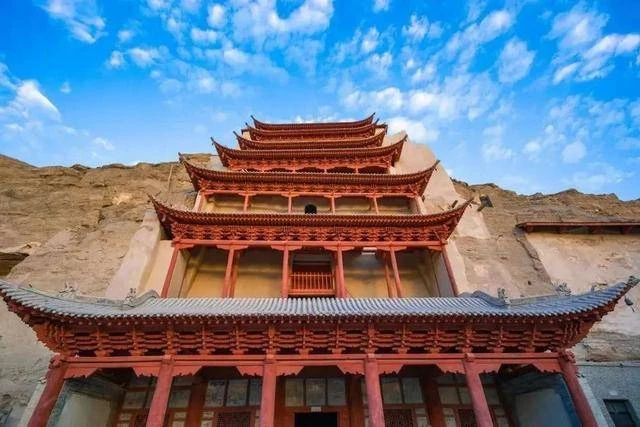
The Mogao Caves, commonly known as the Thousand Buddha Caves, are hailed as the most valuable cultural discovery of the 20th century and the 'Oriental Louvre.' They are located in Dunhuang at the western end of the Hexi Corridor, renowned worldwide for their exquisite murals and sculptures.
Construction began during the Former Qin period of the Sixteen Kingdoms and continued through the Sixteen Kingdoms, Northern Dynasties, Sui, Tang, Five Dynasties, Western Xia, Yuan, and other dynasties, resulting in a massive scale. Today, there are 735 caves, 45,000 square meters of murals, and 2,415 painted clay sculptures, making it the largest and richest Buddhist art sanctuary in the world.
||Mingsha Mountain and Crescent Moon Spring
Mingsha Mountain and Crescent Moon Spring are located 5 kilometers south of Dunhuang City, Gansu Province. The coexistence of sand and spring, a wonder of nature, has been renowned throughout history as a 'desert marvel.' Although Mingsha Mountain is not very tall, reaching the summit is no easy task. The fine, soft sand makes you advance one step but slip half a step back; only by using both hands and feet can you reach the top.
The most magical sight is Crescent Moon Spring nestled among the sand dunes. Its shape closely resembles a crescent moon, covering 13.5 mu (about 0.9 hectares) with an average water depth of 3.2 meters. The water is sweet and crystal clear, like a mirror. The sand does not enter the spring, and the water never becomes muddy or dries up.
||Yadan National Geological Park
Yadan Geological Park, also known as Yadan Devil City, is located in the uninhabited Gobi area 80 kilometers northwest of Yumen Pass, at the border between Gansu and Xinjiang. It features a vast expanse of unique Yadan landforms, appearing fantastical and spectacular against the Gobi. At dusk, when the setting sun bathes the area, it is an excellent spot for taking stunning photographs.
The park contains numerous large and small mounds formed by centuries of weathering. These are actually clusters of small rock peaks resembling earth mounds, with various shapes—such as the Sphinx, Peacock, UFO, Leaning Tower of Pisa, and West Sea Fleet.
The famous Tang dynasty poet Wang Wei's timeless verse, 'I urge you to drink another cup of wine; west of the Yang Pass, you will meet no old friend,' evokes a deep longing for the Yang Pass. Once a majestic pass with bustling caravans and envoys traveling along the road, it was a place of lush trees, crisscrossing streets, and galloping heavenly horses.
Yang Pass was first built during the Western Han dynasty under Emperor Wu, serving as the essential route on the southern Silk Road. Today, the ancient walls of Yang Pass have completely disappeared, leaving only a beacon tower standing proudly on Dundun Mountain. To the south of the mountain lies an endless sandy beach, where large remnants of rammed-earth foundations are neatly and clearly arranged, covering an area of about 10,000 square meters. This is the site of Yang Pass.
Yumen Pass, commonly called Xiaofangpan City, is located 90 kilometers northwest of Dunhuang City. It flourished with the prosperity of the Silk Road and was once a necessary stop for merchants from the Western Regions and the Central Plains. Because fine Hetian jade was transported through here to the Central Plains since ancient times, it was named Yumen Pass (Jade Gate Pass).
Those who come to Yumen Pass hoping to witness the grandeur and prosperity of an ancient fortress are often disappointed, as centuries of erosion have long since stripped it of its former appearance. Today, Yumen Pass looks like a rammed-earth relic in the shape of a square, about 10 meters high and over 20 meters on each side, consisting of four earthen walls with gates on the northwest and northeast sides.
The Yulin Caves, also known as the 'Ten Thousand Buddha Gorge,' are located in the Nanshan Valley about 75 kilometers south of Guazhou County, Gansu Province. The Tashi River (also called Yulin River) flows through the valley, and the banks are lined with elm trees, giving the caves their name. The Yulin Caves share a continuous lineage with the Mogao Caves in terms of content, artistic style, and painting techniques, making them sister caves.
The value of the Yulin Caves lies primarily in their exquisite murals, which include beautiful depictions of Buddhas and Bodhisattvas, grand-scale Buddhist narrative paintings, various flowers, birds, and animals, and highly refined decorative patterns. If the murals of the Mogao Caves are considered the crown of cave temple murals in China both in quantity and quality, then the Yulin Caves are the treasure house of mural art second only to the Mogao Caves.
Suoyang City served as the seat of Ming'an County in Dunhuang Commandery during the Han dynasty, became Jinchang County during the Western Jin, Changle County during the Sui, and Guazhou Commandery during the Tang. After repeated wars, it was abandoned when the Ming court closed the borders. The name 'Suoyang City' originated from folk usage during the Qing dynasty, deriving from the abundant, sweet Suoyang plant (a type of parasitic plant) found around the city, which locals used to name the city.
Suoyang City was a major ancient city at the throat of the Silk Road, but its former glory has now degenerated into ruins. Only the remnants of the city walls and the towering pagoda of the Tashi Temple still give a faint hint of its past grandeur.


