The Qinghai-Gansu Grand Loop: A New Self-Driving Adventure
It’s been a day since we returned from the Northwest. The reason I’m only now starting to record this trip is that after over a week of pure self-driving, I was utterly exhausted, and on the last day I came down with acute gastroenteritis, so I needed some time to recuperate before I could write. Before setting off, we did thorough research and drew up a very detailed itinerary and budget. But once we actually hit the road, we realized that the itinerary budget was just a reference—there were many uncertainties, surprises, disappointments, laughter, and frustration. I don’t intend to write a so-called travel guide or a ‘pitfall-avoidance guide’ because everyone’s experience is different; even the same attraction can evoke different feelings in different people. I just want to record what I saw, heard, and thought during this trip. If it can be of any help or reference to those who come after, I’ll be truly honored. But as I always say, the beauty of a journey needs to be discovered and felt by each person—what I’m saying is just my own feeling, not everyone’s.
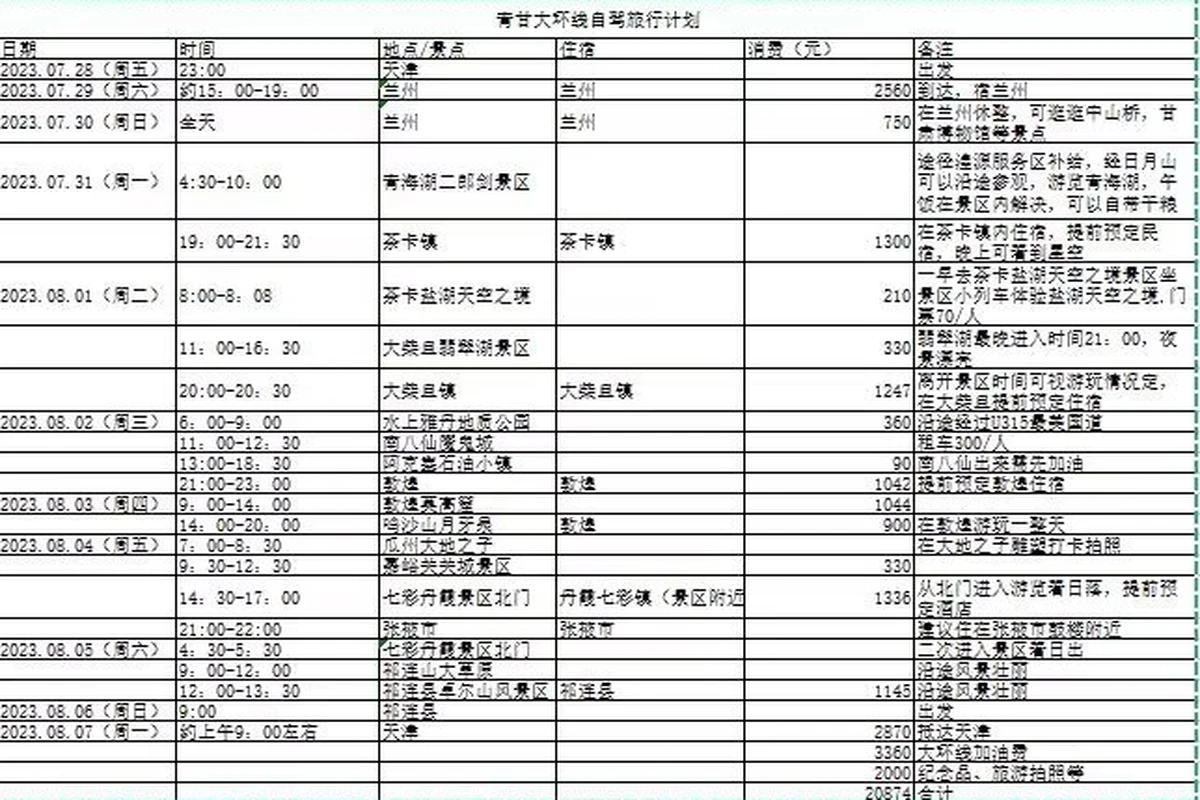
Before departure, we made a travel plan based on our research (see picture) and roughly calculated a budget. Overall, the actual trip was basically in line with the plan. There were a few hiccups and minor changes, but because the itinerary was relatively relaxed with a high margin for error, there were no major deviations.
**DAY 1: July 28-29, 2023 – Tianjin to Lanzhou**
We chose to drive the whole way from Tianjin to Lanzhou based on a budget comparison; it wasn’t because we particularly wanted to drive long distances. If we hadn’t driven all the way, we would have had to consider round-trip flights and car rental, and after comparing costs, we chose the former. Of course, we started preparing about half a month in advance, stocking up on supplies. Just the change of clothes, disposable towels, toiletries, etc., filled two large suitcases, not to mention snacks and drinks. Everything ready, we set off from Tianjin at exactly 11:00 PM on the 28th, planning to arrive in Lanzhou before dusk on the 29th. Driving long distances at night is very tiring, especially around 4-5 AM. I prepared several bottles of coffee and Red Bull, but they weren’t very effective. Eventually, around 4 AM, we rested for an hour at a service area and arrived at Lanzhou around 5:30 PM the next day. We checked into the Orange Hotel on Zhengning Road, mainly because it was relatively close to Zhongshan Bridge and Zhengning Road Night Market. However, it might have been a Saturday, so the street was packed with people, vehicles, and vendors—it was absolute chaos. If the hotel didn’t have its own parking lot, I have no idea where we would have parked. After checking in, we strolled around the area. The Zhengning Road Night Market truly lived up to its reputation, with an endless array of food and drink, but it was also incredibly crowded. There was hardly any room to walk. We barely made it through the crowd, only to realize we hadn’t bought or eaten anything. Eventually, we found a highly-rated beef noodle restaurant nearby called Squirrel House, where we had a bowl of Lanzhou-style beef noodles. To be honest, the noodles and broth tasted quite similar to the Lanzhou beef noodles we usually eat, but the sliced beef and chili oil poured on top really made it fragrant. Since we had been driving for over a day and night, we didn’t plan any activities for that night; we just ate and went back to rest. The next day was also scheduled for rest, though we had booked tickets for the Gansu Museum—we would decide based on how we felt. If still tired, we would rest another day and reserve our energy for the official start of the Qinghai-Gansu Grand Loop.
**DAY 2: July 30, 2023 – Lanzhou**
Originally, we planned to just rest in Lanzhou for the day. When we woke up, I felt fairly energetic, so we decided to go out for a walk. Navigation showed that Zhongshan Bridge was not far, so after a light breakfast near the hotel, we walked there, taking in Lanzhou along the way. This was my first time in Lanzhou. I have to say, after modernization, the differences between cities are shrinking, but you can still feel each city’s unique character. For example, the streets were lined with halal restaurants and beef noodle shops, and even in the city center, the grand mosque still tells you this is a place unlike others. After about a ten-minute walk, we arrived at Zhongshan Bridge. As Lanzhou’s landmark, this bridge has spanned the Yellow River for over a hundred years. When people mention Lanzhou, this Yellow River iron bridge is often the first thing that comes to mind. The bridge is made of steel trusses connected in sections, each supported by piers. On the other side of the bridge stands Baita Mountain Park. On both sides of the Yellow River near the bridge, there are recreational facilities for locals and tourists—you can take a boat ride, experience a sheepskin raft, or play in the sand and water. The Yellow River’s water, true to its name, is very yellow. With no specific schedule, we strolled along the riverbank, crossed the bridge, and visited Baita Mountain Park (which is free as an urban park). Around noon, we went to Zhangye Road Pedestrian Street and had a bowl of Liangpi (cold noodles), which tasted quite good. We also tried the local Lanzhou milk tea called “Lan Yu Cha.” I ordered a local specialty—sweet embryo milk tea—but honestly, the flavor was a bit weird, and it upset my stomach afterwards. Maybe it’s just not for a Northwestern stomach. After lunch, we took the subway about five stops to the Gansu Provincial Museum. I believe most visitors come here to see the Bronze Galloping Horse, unearthed from the Leitai Han Tomb in Wuwei, which is now a symbol of Chinese tourism. Indeed, there is a statue of this treasure at the museum entrance. Since we had booked tickets in advance, we got in without much trouble. The museum was still crowded. The air conditioning was off (it seems many public places in the Northwest don’t use AC, perhaps due to the climate), so it felt stuffy and hot inside. But after a while, we got used to it. The second floor houses the Silk Road exhibition hall, where the Bronze Galloping Horse is displayed in an inner room, clearly marked. The corridor to the inner room also features a statue of Zhang Qian riding a horse and holding a ceremonial staff, commemorating his pioneering contributions. Seeing the Bronze Galloping Horse in person is different from seeing it on TV. Although it’s not large, its open mouth as if neighing and its galloping posture make you feel as if you can see a thousand-li horse racing across the vast Northwestern plains. Besides the Bronze Galloping Horse, the exhibition also includes a bronze ceremonial procession also from the Leitai Han Tomb. Each figure holds a staff and rides a tall horse, neatly arranged—very exquisite. The only thing that bothered me was that many tourists, while looking and taking photos, kept using flash photography. The flash from their phones would go off frequently, and even though the staff repeatedly forbade it, it continued. I think turning off the flash when taking pictures in a museum should be basic knowledge and etiquette.
**DAY 3: July 31, 2023 – Qinghai Lake to Chaka**
Since we had to set off early for the plateau, we went to bed early the night before. Around 5 AM, before dawn—the Northwest sky always gets light later—we packed up and left, also to avoid Lanzhou’s morning traffic. By about 8:30 AM, we reached the Huangyuan service area in Xining, said to be the first checkpoint and an important supply station on the Northwest Grand Loop. This service area is called Riyue Mountain (Sun and Moon Mountain). There’s a cultural and creative studio, and both the road and the area are marked with Grand Loop signs. We had a short break, bought an oxygen canister (my wife didn’t want to buy one, but I strongly suggested it, and it turned out to be very useful later), and continued. Originally, we planned to visit Kumbum Monastery (Ta’er Temple), but considering that our child doesn’t like temples (he has never liked entering temples since he was little), we decided to skip such solemn places. Similarly, we canceled the planned stops at Mati Temple and the Great Buddha Temple in Zhangye. So our first stop was Qinghai Lake. After exiting the expressway onto the Qinghai Lake tourism route, we hit traffic—we didn’t arrive at the Erlangjian Scenic Area until 11:30 AM. In my research, I had considered the suggestion to avoid such official scenic spots and instead find a local herder to take us to the lakeshore. But since we were self-driving without a local guide, it wasn’t easy to find such a herder, so we opted for the Erlangjian Scenic Area. The ticket was 90 yuan per adult, and half price for children (45 yuan). To be honest, the lake view from the scenic area was quite beautiful. Although the large number of tourists affected the experience, the lakeshore was long enough that the farther you walked, the fewer people there were. The blue sky and white clouds reflected on the lake, creating a refreshing atmosphere. On the shore, there were prayer flags and Mani piles set up by local Tibetan Buddhist herders, as well as activities like yak and horse riding. It reminded us of Fuxian Lake in Yunnan, which we visited years ago—also with blue sky and a beautiful lake. But here we were on a plateau over 3,000 meters above sea level, adding a layer of desolation and grandeur. Then the first mishap occurred: my wife happened to be on her period, and combined with the plateau climate, which usually doesn’t affect her (she has been to plateaus before), she started experiencing altitude sickness. So we didn’t stay long at Qinghai Lake and quickly headed to Chaka. On the way, we crossed the Xiangpi Mountain Pass at over 3,800 meters, but because my wife wasn’t feeling well, we didn’t stop to take photos—we just drove through, which was a pity. Due to altitude sickness, my wife had a headache all the way. Fortunately, inhaling oxygen helped (thank goodness we bought that canister). Around 5 PM, we arrived in Chaka Town and checked into the previously booked Qinglang Inn. The owner, an Anhui native, was very hospitable. When he learned about the altitude sickness, he gave us a pack of glucose. We had no other plans for the day, so after dinner we went to bed early. After drinking the glucose water and resting overnight, my wife mostly recovered the next day.
**DAY 4: August 1, 2023 – Chaka Salt Lake to Emerald Lake**
Our plan for the day was to visit Chaka Salt Lake in the morning and then head to Emerald Lake (Da Qaidam) in the afternoon. Since the drive from Chaka to Da Qaidam takes about four hours, the schedule was a bit tight. We woke up feeling much better, had breakfast, and departed for Chaka Salt Lake around 8 AM. The day before, we had booked a combo ticket from the inn owner for 150 yuan per person, which included the scenic area entrance, round-trip mini-train tickets, and shoe rental. Children under 120 cm were free. Although my child was already over 130 cm, the owner said the entrance check wasn’t strict and we could just hold him as we entered, so we didn’t buy a ticket for him, saving the price of a discounted ticket. Chaka Salt Lake is a relatively mature scenic area with good facilities: shuttle buses, shops, and dining. The main gate is still some distance from the lake, so after entering, you take a shuttle bus to the area. I don’t understand why so many tourists were in such a hurry—the shuttle buses run continuously, one after another. If you miss one, just take the next. Everyone should queue and board orderly. But there were always some anxious tourists, especially older ladies, who would push and squeeze to get on, afraid the bus would leave. They almost knocked over my child. Once at the salt lake, you need to take a mini-train. I recommend taking the mini-train, at least one way, because it’s a long walk from the entrance to the far end. The mini-train has four stops. Many tourists take it to the last stop and then work their way back, which is more efficient and allows you to see everything. The main hassle is renting the shoe covers—the queue was very long. Although the rules say you can’t bring your own shoe covers, I later saw tourists with their own, so the regulation isn’t strictly enforced. But since our combo ticket already included the rental fee, we queued up. Besides the rental fee, each person also needed to pay a 100 yuan deposit, refundable when you return the covers. The weather at Chaka Salt Lake wasn’t great—the sky was overcast and gray, but it still created a sense of the sky and lake merging. We got off at the last stop, rented shoe covers, and stepped into the lake. My child had bought a water gun at Qinghai Lake, and now he could finally use it, squirting water everywhere. (Maybe that’s the joy of childhood.) We don’t like crowded places, so we walked toward the center of the lake where there were fewer people, enjoying the mirror-like effect of the salt lake. We strolled and took photos, feeling as if we were walking in a fairyland. We didn’t stop until we reached the station before the last one, where we returned the shoe covers. Since my wife had just recovered from altitude sickness, we decided to take the return mini-train from that station back to the exit, only seeing the salt sculptures from the train. At the exit, we exchanged our combo tickets for two bags of raw lake salt. After lunch, we set off for Emerald Lake in Da Qaidam. The drive was quite long, but that’s characteristic of the Northwest Grand Loop—the journey itself is often more exciting than the destinations. Along the way, we passed deserts, grasslands, and snow-capped mountains, always finding some surprises. Around 4-5 PM, we arrived at Emerald Lake. Fortunately, the sun doesn’t set until 8:30 PM here, so even though it was past 5 PM, the sky was still bright. We didn’t buy mini-train tickets this time, and it turned out to be the right choice. The beauty of Emerald Lake is best appreciated on foot. Although we didn’t have a drone, the view was still stunning. At first, we didn’t have high expectations—when we entered, we didn’t even see the lake, just a dry salt flat, which was slightly disappointing. But as we walked further, especially after crossing the mini-train tracks to the other side, we truly understood why it’s called ‘Emerald Lake’—green, red, blue patches of water glistening like gems embedded in the earth. The weather also cooperated, with a clear blue sky and white clouds, creating a heavenly scene. We didn’t know then that even more breathtaking sights awaited. To see the sunset, after walking around, we rested near the commercial area until about 8 PM, then slowly started heading back. At that moment, an awe-inspiring scene unfolded: the setting sun dyed the sky and clouds a brilliant red, and the entire lake was bathed in red, enveloping the world in an almost hallucinatory glow. (I heard it rained in Da Qaidam for the next two days, so that spectacle never reappeared. We were really lucky.) Carrying that beauty and wonder, we reluctantly left Emerald Lake and returned to Da Qaidam, checking into the Desert Gobi Train-themed Hotel we had booked earlier. Overall, accommodation and dining in Da Qaidam were mediocre and overpriced. We had a rather unpleasant dining experience that evening, which explains why many people recommend staying in Delingha instead. The weather had been good that day, and with the dry Northwest climate, we washed our clothes from the past two days and hung them on the train railing outside our room. To our surprise, a heavy rain woke us up in the middle of the night. We rushed to bring the clothes in, but they were soaked—all that washing and drying for nothing.
**DAY 5: August 2, 2023 – Water-Mottled Yadan to Nanyaxian Devil City to Aksay Oil Town**
We set off from Da Qaidam under heavy morning rain. The day’s itinerary was long: from Da Qaidam to Water-Mottled Yadan, then to Nanyaxian Devil City, then crossing the Dangjin Mountains to Aksay Oil Town, and finally arriving in Dunhuang, the major Silk Road city, by evening. We started the day in the rain. On the way to Water-Mottled Yadan, we passed the 315 U-shaped Highway, known as the ‘Most Beautiful Highway.’ It’s basically a winding road stretching into the desert. In my opinion, it’s a bit overhyped, drawing tourists from all over to take photos. But this is a national highway, and in the desert, many vehicles—including trucks—travel at high speeds. I saw people, even children, running and stopping on the road to take photos. If a driver is the least bit careless, it could cause a tragedy. I strongly disapprove, so we didn’t stop; we just drove slowly past, both to avoid the tourists and to snap a souvenir photo from the car—after all, we were here. Honestly, I regretted visiting Water-Mottled Yadan. Maybe it was the weather. We arrived around noon; the heavy rain had stopped but there was still occasional drizzle, and the sky was not as clear as the day before. This attraction is better suited for aerial photography—essentially, it’s a wetland with yardang landforms. We didn’t feel its charm, and the area was littered with trash left by thoughtless tourists, ruining the environment and the experience. Leaving Water-Mottled Yadan, we took National Highway G215 (Xisha Line) to Nanyaxian Devil City. Nanyaxian was originally an uninhabited desert area. In the early days of the People’s Republic, eight female geologists from the south came to survey here but were lost in a sandstorm and never returned. To commemorate them, the area was named ‘Nanyaxian’ (Eight Southern Immortals). The yardang landforms here are continuous and spectacular, with strange rock formations and strong winds that howl like demons at night, hence the name ‘Devil City.’ Strictly speaking, this is just a landform group, not an official scenic spot, though some locals have set up a paid parking lot and rent out off-road motorcycles for touring (reportedly 300 yuan per person). I don’t think it’s necessary, because the same scenery stretches for about 20 kilometers along G215. You can stop and explore at flat areas by the roadside, but always watch for traffic and safety. Also, don’t go too far from the road—there’s no cell signal, and the special magnetic field can make compasses unreliable, posing some risk. Although Water-Mottled Yadan was disappointing, Nanyaxian Devil City was truly stunning. The devil city landforms, combined with the rolling clouds overhead, looked just like scenes from an American disaster movie, both frightening and exciting. After driving through Nanyaxian Devil City, we took the Liuge Expressway and crossed the Dangjin Mountains. It was another long stretch, about 300 kilometers. After passing through the Dangjin Mountains tunnel, we soon reached Aksay, where we visited Aksay Oil Town, the filming location for the movie ‘The Ghouls.’ We later learned that not only ‘The Ghouls’ but also about a dozen other films and TV series were shot here, such as ‘Hero’ and ‘Special Warfare Glory.’ Yet, for some reason, people always associate this place with ‘The Ghouls.’ Indeed, there are many props from that movie, like a monster model on an overturned bus and a sign for the Oil Club. The town is small—you can walk through it in about an hour, taking photos along the way. Leaving Aksay Oil Town, we arrived in Dunhuang around 8:30 PM. We checked into a pre-booked hotel, the Yuanmengyuan Hotel. The room was very small, but the public area was spacious, reminiscent of the ancient Xuanquanzhi post station. From the rooftop, you could see Mingsha Mountain in the distance—the hotel was only about 2 kilometers from the Mingsha Mountain scenic area. But it was late, so we had a simple dinner at the hotel and went to bed, ready for the next day’s exploration of Dunhuang.
**DAY 6: August 3, 2023 – Dunhuang Museum, Mogao Caves, Mingsha Mountain Crescent Spring**
Dunhuang, an important city on the Silk Road, was the starting point for all three routes (north, middle, south) passing through the Western Regions. For a time, it was a cosmopolitan hub where Eastern and Western civilizations and religions converged, fostering commerce and religious prosperity. It was in this context that the Mogao Caves were created. Since our Mogao Caves tickets were for the afternoon session, we spent the morning visiting the Dunhuang Museum, designed by China’s renowned architect Master Cui. I had previously visited the Yinxu Museum, also designed by Master Cui. Honestly, the two museums share some similarities, mainly in the visitor circulation: the Dunhuang Museum spirals upward from the ground floor, while the Yinxu Museum spirals downward from the ground floor. I don’t remember which was designed first, but I’m sure the former influenced the latter. The exterior facades use locally representative styles: Yinxu uses bronze patterns, while Dunhuang uses the earthy desert color of the Northwest Gobi, with vertical scratched textures to evoke a sense of weathering. The Dunhuang Museum mainly covers the history of the Silk Road. We saw a familiar model of the Xuanquanzhi site, which was featured in an entire episode of the documentary ‘He Xi Zou Lang’ (The Hexi Corridor). Seeing it in person gave a sense of connection. After the museum, we drove to the Mogao Caves. First, you must go to the Mogao Caves Digital Center to pick up your reserved tickets. Without a reservation, you can only queue for emergency tickets, but I heard that the caves accessible with emergency tickets are different from those with regular tickets. After collecting tickets and entering the Digital Center, you are guided to watch two documentary films, about 45 minutes in total, introducing the history of the Mogao Caves and the main caves. Then, a shuttle bus takes you to the actual site. Once there, you still have to queue, as each group of 20 people is led by a guide. With a regular ticket, you can visit 8 caves (I heard emergency tickets only allow 4, and not in the same area). Since the Mogao Caves are mainly murals, which are vulnerable to air and disease erosion, I heard that the Dunhuang Research Academy plans to eventually stop displaying the caves in person and use digital means for visitors to explore them via electronic devices. While this is understandable, I feel that on-site visits are much more impactful. Even though we only saw 8 caves, the exquisite murals, masterful artistry of the painters, and lifelike Buddha statues were profoundly impressive—I didn’t want to leave. Following the guide from cave to cave was quite tiring, especially with Dunhuang’s scorching heat (a stark contrast to the Qinghai plateau). It was suffocating. Even our guide, a young woman, was parched and seemed on the verge of exhaustion. But my child managed to keep up with the group, evidently captivated by the ancient craftsmen’s skills, oblivious to the heat. Leaving Mogao Caves, we arrived at the Mingsha Mountain Crescent Spring scenic area around 4 PM, the hottest time of the day. The Mixue Bingcheng (a popular ice cream chain) at the entrance hadn’t even opened for business—it wouldn’t open until evening. The owner of a nearby noodle shop told us that a few days ago, a tourist bought an ice cream at noon, and it melted within two minutes, so the shop had started opening only in the evening. I don’t know if that’s true, but it shows how hot Dunhuang summers are, especially near the desert. Around 4:30 PM, we bought our tickets and entered. We didn’t take the scenic shuttle or camels; instead, we decided to climb the sand mountain on foot to overlook the entire area. To be honest, I wasn’t sure we could make it, especially with an 8-year-old boy in tow. But to my surprise, although tired and wobbly-legged at the end, our little guy managed to reach the top of Mingsha Mountain. I really want to give him a thumbs-up! Standing on the summit and overlooking Crescent Spring gave a great sense of accomplishment. We didn’t wait for the sunset at Crescent Spring because we planned to visit the Shazhou Night Market in the evening. After resting on the mountain top, we descended, returned to the hotel for a short rest, and then headed to Dunhuang’s Shazhou Night Market. I initially thought Shazhou Night Market was just a street of snacks like Zhengning Road, but I found it full of all sorts of things—not only snacks but also souvenirs and handicrafts. The camel figurine I bought at the Dunhuang Museum for 50 yuan (medium size) was sold at the night market for 65 yuan for a set of three (large, medium, small), and you could even bargain. I instantly felt ripped off. That day was intense—we went from the museum to the Mogao Caves to Mingsha Mountain to the market, non-stop walking. Our step counts all exceeded 20,000 steps. What impressed me most was that our little guy kept up. Though we were exhausted and our legs ached when we returned to the hotel, the journey was incredibly rewarding. Even though it was a whirlwind tour, we could still feel the charm of this former Silk Road hub.
**DAY 7: August 4, 2023 – Xuanquanzhi Site (aborted), Child of the Earth, Jiayuguan Pass, Zhangye**
Due to time constraints, we didn’t plan for in-depth sightseeing in any one place. Besides Mogao Caves and Mingsha Mountain, Dunhuang has western line attractions like the Western Thousand Buddha Caves and the Dunhuang Old City, but we had to skip them all. Maybe if we come back for a deeper tour someday. Early that morning, we set off for the Child of the Earth sculpture in Guazhou. At our child’s request, we made a last-minute change to our subsequent itinerary. Originally, we planned to head to Zhangye’s Rainbow Danxia after Jiayuguan to watch the sunset, but our child wanted to go to Pingshan Lake Grand Canyon. So we changed plans: we would go directly to Zhangye city that night and head to Pingshan Lake the next morning. This made the originally tight schedule a bit more relaxed. Checking the route, we decided to first visit the Xuanquanzhi site, about 40 kilometers from Dunhuang, before going to Child of the Earth. After all, every time we watch the Hexi Corridor documentary, it features Xuanquanzhi prominently, and we saw it at the Dunhuang Museum yesterday. So we decided to make a detour to pay respects to this ancient relay station buried in the Gobi. Travel is like that: you have a plan, but unexpected things always happen, forcing you to change on the fly. That’s part of the fun and charm. And sure enough, an unexpected event occurred. The road to Xuanquanzhi had a detour under construction, blocking a highway crossing. We couldn’t reach our destination and almost got stuck in the desolate desert. The map showed our goal was just on the other side of the highway, but we couldn’t get there. Maybe it wasn’t meant to be. With disappointment, we continued along the highway to the Child of the Earth. The Child of the Earth sculpture is located in the Gobi desert of Guazhou County, Gansu. It was created by Professor Dong Bingshu from the Sculpture Department of Tsinghua University Academy of Arts & Design, using red sandstone as the main material. 3D scanning was used to obtain model data, then the pieces were carved separately and assembled on site. Nearby, there are two other sculptures: Mirage and a giant head of Emperor Wu of Han. They all stand in the desert, with a winding mountain road passing by—adding to the sense of desolation. Unfortunately, the noise of tourists shattered the tranquility. Around the Child of the Earth, visitors crowded to take photos, and some even climbed onto the sculpture, touching its various parts (like touching Buddha’s leg for blessings in temples). It was both amusing and sad, completely destroying the loneliness of the desert. After Child of the Earth, we drove to our next stop, Jiayuguan Pass, about 300 kilometers away. We arrived at the Jiayuguan Pass scenic area around 3 PM. Before coming, I had only seen Jiayuguan on TV and online, and it didn’t impress me much. But when I actually stood beneath it, I felt the grandeur of this ‘First Pass Under Heaven.’ Most of the fortifications have been restored, but the lower parts of the old walls still show their age. We entered through the gate, climbed the towers, and walked along the walls. We also visited the General’s Mansion. Outside the pass, there were more civil structures like the Wenchang Pavilion and Guandi Temple, showing the daily life of soldiers and civilians guarding the frontier. Outside the pass, my wife and child rode camels for a while. I imagined that hundreds of years ago, merchants from Europe and the Western Regions would have traveled this very road, riding horses and camels through Jiayuguan into the heart of China. It reminded me of the Portuguese Jesuit Bento de Góis, who followed in the footsteps of Matteo Ricci to find ‘Cathay’ (China). But due to the strict entry policies of the Ming Dynasty, he was trapped inside Jiayuguan, unable to move forward or backward. After years, he finally got permission to enter, but fell ill and died there. It’s a poignant story. This ancient pass was not just a gate; it was the boundary between the Ming Empire and the Western countries. Countless tragic, heroic, or sorrowful tales must have unfolded here. Leaving Jiayuguan, we drove straight to Zhangye, arriving in the evening and checking into a pre-booked hotel. I must say, Zhangye was the most comfortable city we stayed in during the entire trip. The hotel was nice (4-star standard, reasonably priced, much cheaper than Chaka and Da Qaidam). The city has a high greening rate, even with a wetland park, in stark contrast to desert cities like Dunhuang and Jiayuguan. It truly deserves the reputation of ‘Jiangnan beyond the Great Wall.’
**DAY 8: August 5, 2023 – Pingshan Lake Grand Canyon, Qilian Mountain Grassland**
Originally, we planned to watch the sunset at Rainbow Danxia the previous evening and then stay in Zhangye, returning early the next morning to watch the sunrise (since tickets from the previous day allow re-entry before 8 AM the next day). But at our child’s request, we changed our plan and set off early for Pingshan Lake Grand Canyon, north of Zhangye city. Pingshan Lake Grand Canyon is about 60 kilometers from Zhangye city center. According to Baidu Baike, it is the closest comprehensive scenic area to a city in China, featuring natural wonders, canyon exploration, geological research, ethnic culture, and self-driving off-roading. It is considered one of the most beautiful landscapes in Zhangye’s landform park, praised by China National Geography magazine and experts as ‘comparable to Zhangjiajie,’ ‘rivaling the Grand Canyon,’ and a new discovery on the Silk Road. To be honest, I knew little about it before this trip. According to online bloggers, because it’s not as famous (most tourists to Zhangye go to Rainbow Danxia, Binggou Danxia, Mati Temple, or the Great Buddha Temple), it draws fewer visitors, making the experience more enjoyable. Only after hiking the 6-kilometer canyon (about 3-4 hours) did I truly appreciate nature’s craftsmanship. There are two ticket options: a regular ticket (about 130 yuan) and a deep tour ticket (300 yuan). The regular ticket gives you access by shuttle bus to the canyon entrance, where you walk on your own. The deep tour includes horse-drawn carts, camel carts, and other vehicles for the entire tour, which is more relaxing. After weighing our options, we chose the regular ticket. After entering, we walked along a ridge trail until we saw the canyon entrance sign, then descended step by step into the canyon. The walls were reddish-brown, with distinct rock layers, making us feel like we were in the American Grand Canyon. At the bottom, near Lingzhi Valley, we came to a fork with three routes: Route 1 is called ‘Yixiantian’ (a narrow crevice), with a 90-degree vertical steel ladder, spectacular but dangerous, and only allowed for children over 12. I wanted to try it, but our little guy is only 8, so we gave up. Route 2 was the stairs we came down—very easy. The staff at the entrance didn’t recommend it, so we opted for Route 3. Route 3 was relatively flat, with wide paths winding through the rock walls. Walking there, I was reminded of scenes from ‘Romance of the Three Kingdoms’ like Huarong Trail and Luofeng Slope. I wondered if the Three Kingdoms film crew ever shot here. If a general like Guan Yu stood in the middle, he could indeed hold the pass against ten thousand. At the end of the valley, instead of a vertical ladder like Yixiantian, there was a spiral steel ladder rising dozens of meters. It looked quite high and steep, with open steps. I held my son’s hand all the way up; he was a bit scared near the top. I kept encouraging him not to look down. It was not only a physical test but also a mental one. In the end, our little guy persevered, reaching the top—Viewing Platform No. 4, also the shuttle bus stop for the exit. It was the end of our tour. I felt that Pingshan Lake Grand Canyon was definitely worth it. Since we didn’t visit Rainbow Danxia, I can’t say whether Pingshan is better, but in terms of the experience, it wasn’t overcrowded—at least we didn’t encounter large crowds. Except for a group of students on a study tour we met near Lingzhi Valley, there were never more than ten other visitors around. We could truly enjoy the pristine, deep natural canyon atmosphere. After leaving Pingshan Lake, we went back to Zhangye city for lunch. It was actually around 2-3 PM, more like afternoon tea. We had a local specialty called ‘beef small rice,’ which was quite filling. Despite the name, it’s not rice—it’s wheat dough cut into small grains resembling rice. Then we headed to our final stop, Qilian Mountain Grassland. The road to Qilian was eventful. The grassland is actually a valley within the Qilian Mountains, with abundant water, lush trees, and ample rainfall. It has been a natural pasture since ancient times. The Xiongnu once grazed their horses here. Later, the Han Dynasty general Huo Qubing captured the Hexi Corridor by crossing this area through the Biandukou Pass and established the Shandan Horse Ranch. To this day, the Shandan Horse Ranch claims Huo Qubing as its first manager. To reach Qilian, after exiting the Zhangwen Expressway, we had to take a winding mountain road (Route 227) crossing the Biandukou and Ebao Passes. This section was quite treacherous—recent heavy rains had washed away part of the road, which was still under repair, causing slow traffic and the need to yield to oncoming vehicles, especially on the 80-kilometer stretch from Biandukou to Ebao. After passing through Ebao Town, we officially entered the Qilian River Valley. The view opened up: green mountains as far as the eye could see, vast grasslands, yurts, flocks of sheep, yaks, Tibetan Buddhist temples—everything along the road. It was a magnificent prairie scene, a sharp contrast to the Gobi desert. Some yaks even crossed the highway in groups to reach the other side, forcing us to stop and wait. Around 6:30 PM, we arrived in Qilian County and checked into our pre-booked inn. In the evening, we visited Qilian’s night market for barbecue: lamb skewers, lamb ribs, yogurt… I must say, for barbecue, you have to eat in places where herders live. (Unfortunately, I paid for it the next day.)
**DAY 9: August 6-7, 2023 – Zhuor Mountain Scenic Area, Back to Tianjin**
Today was the last day of our Qinghai-Gansu Grand Loop trip. We chose Zhuor Mountain Scenic Area in Qilian, known as ‘Little Switzerland of the East.’ Especially in July and August, colorful rapeseed flowers and other blossoms cover the mountainside, creating a vibrant landscape. We didn’t follow online advice to go to the back side of Zhuor Mountain, which requires a local guide to go through Ladong Village on a muddy road. Considering time and safety—since it was a family trip—we avoided risky activities. So we bought regular tickets at the main gate (80 yuan for adults, half for children). The scenery at Zhuor Mountain was very beautiful. Although we were worried about rain when we entered Qilian yesterday, today turned out surprisingly sunny. Plateau weather is indeed unpredictable. However, I’m not sure if it was because I ate too much or something (probably both), but I started feeling gastrointestinal discomfort in the morning—very bloated. I only had a thin porridge for breakfast, so climbing Zhuor Mountain was a struggle. In the end, I rested halfway up, while my wife and son continued to the top. I had to wait on a terrace, missing many wonderful views—a regret. After descending, we drove to a restaurant in Qilian for lunch. Mainly my wife and son ate; I couldn’t eat anything due to my stomach issues. After lunch, we set off for home. We arrived at our home in Tianjin around 11 AM on August 7, concluding this week-long Northwest Grand Loop journey.
The entire trip lasted about 10 days, from the evening of July 28, 2023, to noon on August 7, 2023, including travel time. The route was: Tianjin – Lanzhou – Qinghai Lake – Chaka Salt Lake – Emerald Lake – Da Qaidam – Water-Mottled Yadan – Nanyaxian Devil City – Aksay Oil Town – Dunhuang – Dunhuang Museum – Mogao Caves – Mingsha Mountain Crescent Spring – Child of the Earth – Jiayuguan – Zhangye – Pingshan Lake Grand Canyon – Qilian Mountain Grassland – Zhuor Mountain Scenic Area – Tianjin, covering about 6,000 kilometers round trip. It was our first long-distance journey of this scale—from planning to execution to completion took about half a year. Even now, it feels a bit surreal. It’s amazing that we managed to complete it. Before departure, I was worried about the intensity and possible mishaps, but overall, things went smoothly. The trip took us through plateaus, deserts, Gobi, sand dunes, river valleys, and grasslands, covering both natural landscapes and cultural heritage. Although we didn’t have in-depth tours, we gave our child a tour of the Qinghai-Gansu region, letting him experience the desolation of Qinghai and the ancient history of the Hexi Corridor firsthand. I believe this journey gave him a deeper impression of the Northwest and the Hexi Corridor he had seen in documentaries. Finally, we tallied the actual expenses. We didn’t travel on a shoestring, nor did we splurge—just normal spending, trying to provide ourselves with the best possible food and accommodation within our budget. In the end, our actual spending was about 20% less than the budget, meaning our budget was fairly comprehensive and can serve as a reference.


