Switzerland & France: A Journey of Scenery, Culture, and Reflections
July and August are typically holiday months in Europe, with each country having its own vacation culture. Europeans generally travel in a leisurely way. Following the local custom, we decided to visit just two countries: Switzerland and parts of France. These two are fairly representative of Europe. Switzerland stands for natural scenery, precision, strong brands, high quality, and hard work. France embodies romance, culture, art, and celebrity. And Paris encapsulates the essence of Europe.
My trick for beating jet lag is to set my watch to the destination time the moment I board the plane, completely forgetting about the departure time, and start adjusting during the flight. This way, even a very long day doesn't wear you out too much. We landed on time at Zurich Airport, collected our luggage, and headed straight to the car rental company. It was just past 7 a.m., and a friend's flight wasn't due until after 8. Knowing that when I returned the car days later from out of town it wouldn't be this early, I hoped to start the rental at 9:30. The rental agent said it would get busy later, and if I returned the car a bit late, the price would be calculated the same. Indeed, N days later, I returned the car after 10 a.m. and wasn't charged extra. It seems the Swiss, while precise, can also be flexible when the situation calls for it.
Pasturelands – Emmental
When I was young, I'd occasionally see foreign landscape photos on calendars. Swiss scenery appeared quite often, and I used to think living there would be paradise. Now that I had the chance to visit Switzerland, I had to experience that feeling firsthand. Switzerland is full of pastures—but which one is iconic? Look at a cheese wrapper: Emmental is a famous cheese-producing region. Find that place, and you'll find the classic pastures. Only after returning did I learn it's praised as 'Switzerland's most beautiful countryside.' L40 Photos
Emmental is in the Bern region, a two-hour drive from Zurich. On the way, we passed through a small town. Since it was Sunday and most shops would be closed, we stopped for lunch there. Just then, a parade of vintage tractors passed by—maybe the rural version of a classic car rally? L40 Photos
L40 Photos
Around 7 a.m., farmers delivered freshly milked milk to a nearby factory. We got to taste some straight from the udder. L40 Photos
Cowbells—every cow wears one. From morning to night, you hear their chimes everywhere. Here are some souvenir cowbells at our host's house. L40 Photos
Cheese factory. Outside the production area, there are plenty of flies—where there are animals, there are flies. The workshop is sealed; we peered through the viewing window. L40 Photos
L40 Photos
Tea in the yard, enjoying the pasture views. The cups had chocolate smeared on them—a hit with the kids.
L40 Photos
Every farmhouse grows flowers and fruit in their garden. The size of the yards varies, and so do the varieties.
On summer Sundays, restaurants nearby close as early as 6 p.m., though the sun doesn't set until 10 p.m. After dinner, there's still plenty of time for a stroll.
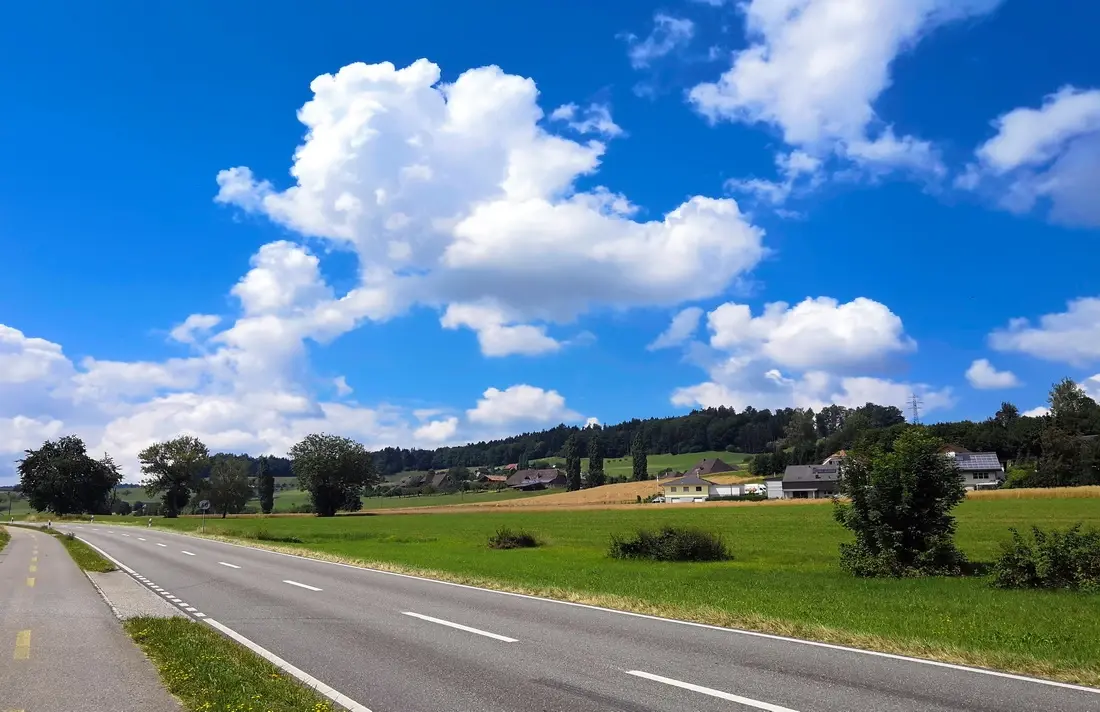
Rolling hills, changing weather, pristine surroundings, and a well-educated populace create a uniquely beautiful landscape. The pasture's beauty is such that you can capture it with a phone at any moment.
A temporary sign for cows crossing the road.
Every cow wears a bell and has a unique number on its ear tag.
Twenty-some dairy cows, a few sheep, pigs, turtles, dogs, and cats, on about 1.6 acres (11 mu) of mostly grass, plus two suites for short-term rental. Without large-scale farming, how can one live a high-quality life in Switzerland? This pragmatic question nagged at me; I hadn't found a chance to ask yet.
The host walking the dog.
This traffic light, set on a one-lane closed construction road, controls alternating two-way traffic—very effective. Drivers, take note and obey.
Two-way national roads, flat but with many undulations and curves, naturally tempt you to speed up. Speed limits are reasonable; drive normally and glance at the signs, and you'll often find you're at just the right speed. We handed the wheel to a lady in our group, and she drove fast yet smoothly. I'm not a professional driver, but I have hundreds of thousands of kilometers of experience. Why could she drive so smoothly? Her license was from North America, and her driving habits matched those here. She told me that on a main road, you must not yield to cars entering from side roads. During the test, touching the brake means failure. I thought, if everyone follows the rules, it maintains main-road speeds and saves fuel—perfect! But we can't drive that way back home. Every advantage exists only under certain conditions; change the environment, and it becomes a disadvantage.
L40 Photos
A dung heap. Cow patties, flies, and cowbells are all part of the rural flavor.
Drama advertisements in the fields.
Up on the hill is our accommodation this time. Finally, I got to experience what living in 'paradise' feels like.
L40 Photos
An old man often sat here, greeting us whenever we passed. We called him 'the wise old man.' I sat there for a photo, but it didn't have the same flavor—too little wisdom. It felt like this country could package wisdom and sell it as a commodity.
L40 Photos
L40 Photos
Many people hike and cycle for exercise; working out here is pure pleasure.
All the tourist signs use the same color scheme as the national flag—consistent branding. That's Switzerland!
Every household has farm tools like these.
What's inside those big rolls? Hay for the animals in winter. They say the grass must retain some moisture and is actually fermenting inside. The long winter yields no harvest, forcing people to prepare in summer. Could this be the origin of the savings and investment tradition?
Emmental cheese—a local specialty. Breakfast was sumptuous; the price was normal for locals but for us equivalent to a five-star hotel at home. In Switzerland, food and accommodation basically cost double that of neighboring European countries. Not because things are expensive, but because the world's wealthy stash their money in Switzerland, keeping the Swiss franc strong. A strong franc makes our money worth less. Foreign tourists feel the pinch. Locals earning francs find shopping in nearby countries cheap. A strong currency, with spending abroad, boosts their living standards. What do the rich worry about? Asset safety. A powerful country like the U.S. can target the rich in various ways; a weak country has political instability, unsafe assets. Switzerland has a weak government but stable politics, low risk of invasion, and a banking secrecy tradition.
Still puzzled about how a good life is possible without scale, I chatted with the hostess. The 'tourist paradise' image is only skin-deep; most material comfort is built on hard work. The husband devotes 100% of his time to farming; the wife runs the B&B, does housework, and works part-time nearby (45% of her time). Agricultural and livestock workers must also study at specialized schools. The government strictly regulates the entire production process, and everyone must follow the rules. Of course, following strict standards guarantees quality but also raises costs. If losses result, subsidies kick in. It seems all developed countries have various forms of agricultural subsidies.
If on your travels you need to pause and reflect, this mountain in eastern Switzerland is just right. In winter it's a skiing mecca, crisscrossed by cable cars. In summer, the setting is also lovely, with only a few hikers and paragliders drifting gently down from the heights.
Surrounded by mountains, the air and water go without saying. A half-hour drive up from the foot of the mountain, but be careful—some sharp bends lack guardrails. Global warming shortens the skiing season, and with high prices for visitors, Swiss tourism faces new challenges.
Local residents still follow the traditional rhythm of 'rising with the sun and resting at sunset.' It's as if the world has stepped back into the era of natural non-action described in Laozi's Tao Te Ching, yet in reality you're in one of the world's most developed and materially abundant countries, enjoying 'natural mineral water' straight from the tap—a unique and wonderful feeling. A local friend said the tap water here is far better than that E-brand mineral water imported from 'backward' France. A comparison proved it true. Switzerland is the source of several major European rivers.
Tourist signs clearly mark hiking times. Sometimes we want clear guidance, but could too much clarity and precision diminish the joy of travel? The same goes for life.
A winding path leads up to a mountain pasture, split into a hiking trail and a mountain bike track. Surrounded by mountains, it's nice to stroll here, or just stand or sit quietly for a while.
L40 Photos
Patiently watching a paraglider drift down to land in the beautiful countryside.
Beside the mountain road.
Farmers habitually go to bed early and rise early. Passing by at 9 p.m., tiptoe required.
Some scenes from the hike.
There are also some motorized sports activities.
Lucerne (Luzern)
On the drive to Lake Lucerne, a view from the car window at a traffic light. It's still nicer to watch the scenery while riding.
On the way to Lucerne, we pulled off the highway for a break, to refuel on water and snacks. At a parking lot, we asked about a nearby supermarket. A lady actually drove us two kilometers to the store and then got out to patiently give directions. The supermarket was right by a lake; we rested there for an hour, so peaceful. I've forgotten what lake it was—where or what it was doesn't matter. Even this photo is blurry, but the memory is crystal clear and lovely.
L40 Photos
By Lake Lucerne, a hotel converted from an old house, with just ten rooms. Only the owner and two staff run it. The owner is a devout Tibetan Buddhist; most of the hotel's decor and books relate to Tibetan Buddhism. During an afternoon break, the owner was reading related texts. We'd been to Lhasa three years before, so we could share some conversation.
L40 Photos
Outside St. Peter's Chapel by Lake Lucerne, near the famous Chapel Bridge. Just steps away, very peaceful. Photos show the interior and exterior.
L40 Photos
Lake Lucerne—you can see a bicycle at the bottom in the shallows. In terms of natural beauty alone, many lakes in China surpass this one. Lake Lucerne is famous because of its surrounding cultural richness.
L40 Photos
At nine in the evening, sunlight bathes the Chapel Bridge.
The oil paintings on the Chapel Bridge—are they replicas after the fire?
Around Lake Lucerne, it's both quiet and lively. Scenery needs its cultural context.
Climbing Mount Rigi, you overlook Lake Lucerne.
Conversations on the balcony.
Bahnhofstrasse stretches from Zurich's main train station to Lake Zurich. Known as 'Switzerland's Wall Street,' it's one of the world's largest gold trading hubs, home to over 200 bank branches—including several of the world's top ten banks—with forex and securities trading volumes among the highest in continental Europe.
The Swiss flag is one of the world's most frequently seen. Behind it, the blue-and-white one is a cantonal flag; both are often flown together. You see Swiss flags everywhere, even abroad—unusual for a small, peaceful nation that rarely makes headlines. Switzerland is a federation, with the presidency rotating annually among the seven members of the Federal Council, wielding very little power. It's a classic small government, with much work done by civil society, a sense of 'the people use it daily without knowing it.' The flag also serves as a powerful national brand, endorsing Swiss high-quality, high-price products like Swiss Army knives and Swiss watches. Landlocked, with high industrial transport costs and a mountainous landscape ill-suited for large-scale farming, Switzerland was a poor mountainous region two centuries ago. People went abroad to earn a living, the ultimate form being mercenary service.
Today, Swiss industry, brands, and finance all occupy unique positions. The wisdom of how Switzerland transformed from a 'poor mountain area' into a developed country is worth studying.
L40 Photos
A triathlon was just happening that Sunday.
L40 Photos
Bahnhofstrasse
Bahnhofstrasse on a Sunday—all shops closed. Normally, it's a prime spot for tourists to buy luxury goods. Many shop doors have Chinese advertisements.
Famous Swiss chocolate shop at Zurich HB (main station).
We booked high-speed train tickets from Zurich to Paris through Ctrip back in China—very convenient and reasonably priced. Printed the tickets at home; no need to exchange at the station. The conductor was multilingual and simply scanned the QR code on our home-printed tickets. France's TGV has been around for ages; our double-decker ran at 220–280 km/h, with a passenger-friendly layout. Since four of us booked together online, we automatically got four facing seats with a little table in between—ideal for families.
(Photo by sshrivas)
At the Paris rental office, after completing the paperwork, we had to go down to the B5 level parking. I expected to find the car on my own, as in Switzerland, and braced myself for a dark, grimy underground lot. But when the elevator doors opened at B5, there stood a professionally dressed lady right by the elevator. She greeted us in fluent English, then warmly took the keys, walked over, and drove the car right up to us. The whole process felt like an executive assistant fetching a document in a high-end office. Who knew that fetching a car in a parking garage could be so elegant? That's Paris! It instantly made me forget the dimness and age of the garage. I hadn't driven this model before, so I quickly asked about the gear shift. When we inquired about an important local driving rule, she smiled and said, 'It depends... enjoy your driving.' That put me at ease—just drive flexibly, like back in China. Great customer experience!
(Note: The photo of the lady was taken elsewhere; the garage lighting was dimmer and the setting older. When we returned the car, a young man did the same job with equal professionalism.)
The diesel seven-seat Grand Picasso was spacious and comfortable. Its large windshield offered a wide view of the sky—without deliberately craning your neck, you couldn't see the window frame, much more practical than a sunroof. Diesel is also considered clean energy in Europe. This trip took me through flat French countryside, along back roads, and on a few highways; the diesel car handled great. By late July, many Parisians had already left for vacation, so the city wasn't crowded, and the feared traffic jams never materialized. Occasionally, cars would cut in and speed without signaling—ah, a true driving experience! Now this was the road style we're used to. Great! The previous days in German-speaking Switzerland, everyone followed the rules so meticulously that it became tedious. The Chinese and French share many traits: flexibility, turning cooking into an art, tolerance and assimilation of outsiders... In these similarities, our ancient civilization seems to outdo them on every front.
On our first day in France, we saw rainbows multiple times.
From a small mountainous country to the French plains—so open! The natural endowments of the two countries are incomparable. But which is richer?
Fontainebleau means 'blue spring' in French, originally 'beautiful spring.' The Chinese translation is spot-on. Many housing estates in China now copy the name.
Inside is the French royal family tree. In an age without photography, nobles had portraits painted. The rooms and furniture of the time are well-preserved. Seems being a king is a dangerous job anywhere.
Sculptures inside the Palace of Fontainebleau
L40 Photos
Compared to other châteaux, the rear garden isn't big, but it's exquisite.
However luxurious the palace, there's always an even more imposing royal chapel beside it—a subtle interplay of royal and divine power...
Fontainebleau town center is packed with restaurants and food everywhere.
We drove over 100 kilometers to reach this B&B, which sits amid real farmland. It's raved about online; the hostess speaks only French, has a business degree, and is very friendly. The rooms are booked every night, mostly by French locals. She's had Chinese guests too. During our stay, we had a great chat with the French guests next door.
Buying food from a village supermarket a few kilometers away and having the host heat it up is a great idea—not only cheaper but more comfortable than a restaurant, and rural eateries close early. We snagged a €4.50 red wine; it was delicious. Turns out the region is nearby BUZET, and the wine sells as mid-to-high-end back home.
This 13-year-old boy, Louis, reminded me of Forrest Gump. We stayed two days, and one night we talked late. When we got up early the next day, the father came over specially to say goodbye before work. As we got in the car to leave, the boy's face showed a complicated expression. A brief stay, yet full of stories... This became my favorite photo of the entire trip.
L40 Photos
After 100 kilometers of country lanes, we reached Château de Chambord. The Loire Valley is where many French nobles lived; Chambord and Chenonceau are the most representative.
The back garden stretches endlessly—it was a hunting ground, roughly the size of central Paris.
Outside Chambord, walking, sitting and chatting, or exercising—all were delightfully refreshing.
L40 Photos
L40 Photos
L40 Photos
Chartres Cathedral (La Cathédrale Notre-Dame de Chartres) sits in the quiet town of Chartres, and it's no less impressive than Notre-Dame in Paris.
Suspended crosses and stained glass. Away from the crowds, you can soak it in peacefully.
L40 Photos
Compared to the Louvre, I prefer the Musée d'Orsay, a converted old train station. It bridges the old and new, with works from various periods. Key point: it's simply laid out and not overwhelmingly large.
A huge canvas in the main hall: 'The Romans in their Decadence,' depicting the debauched life of Roman nobility. A fortress always crumbles from within. A cautionary tale for posterity. – Musée d'Orsay
On the second floor of the Musée d'Orsay hangs a painting that only went on display in 1988: 'The Origin of the World' (L’Origine du monde). It bluntly depicts where life comes from. Art is always controversial. – Musée d'Orsay
L40 Photos
Upstairs, Rodin's huge unfinished sculpture 'The Gates of Hell'—still incomplete after 37 years. Many standalone sculptures in public spaces came from this piece. Rumor has it he drew inspiration from Chinese ink painting. – Musée d'Orsay
Strolling along the Left Bank, we spotted a huge P20 ad on a Paris street. Chinese elements abound in Paris: in busy areas, real estate ads in Chinese; garbage trucks are Dongfeng-branded; even the hotel mirrors are made in China.
L40 Photos
This is easy to understand: a minute ago, someone was here... Along the Seine, especially under the bridges, you occasionally catch a whiff of urine.
It's called the 'New Bridge' (Pont Neuf), but it's actually a famous old bridge.
By the Seine, near Pont Neuf. The bike-sharing system worked seamlessly with the app I'd already installed at home—so convenient.
L40 Photos
Inside the Louvre (old photo)
Paris doesn't have a dedicated Chinatown; the 13th arrondissement is where many Chinese are clustered. 'Chinese' here is broadly defined—from the mainland, Hong Kong, Taiwan, and ethnic Chinese from Southeast Asia who speak Chinese. Treating the kids to a Chinese meal and observing overseas Chinese life is part of the travel experience. If you want to visit, remember this Métro station on Line 7. Here you'll find Chinese restaurants catering to Chinese palates.
Chinese supermarket (old photo)
At the University of Paris at dusk, students are training.
I didn't feel drawn to photograph the exteriors of famous Parisian landmarks—I'd shot them before. So I'm using old film photos for those. The human scenes inside, however, are always different and thus captivating. Here are the exterior and interior of the Sacré-Cœur basilica on Montmartre.
Inside and outside the Opéra Garnier. Last year I watched the film 'Ballerina' (Leap!), which is set here. Above, an old photo of the exterior; below, the chandelier and ceiling painting.
Outside the Centre Pompidou
Visited a photography exhibition mainly featuring Sabine Weiss. Many classic shots have Paris as the backdrop. (Centre Pompidou)
We found this French restaurant through Google Maps—good and not pricey, even in a tourist area. Big data can recommend based on taste. The next day, the same method failed: restaurants were either closed or not to our liking. Instead, we randomly stumbled upon a great place by the roadside. Seems even with the right tools, being too deliberate can backfire.
Riding a motorbike in Paris is très cool.
From our hotel in the 15th arrondissement, a 20-minute walk brought us to the Seine, with views of the Eiffel Tower and the Statue of Liberty. The one in New York was a French gift; here there's a smaller version. Rumor has it the prototype is near Luxembourg Gardens. A speedboat zipped by on the Seine—stylish, up close!
The Eiffel Tower at night, and from the Tower looking down toward the Arc de Triomphe.
Paris Métro trains and stations are being upgraded; the new ones are quiet and air-conditioned. Paris doesn't throw huge sums at once, but invests steadily year by year. I noticed clear improvements.
Just seconds ago, this very 'Parisian' lady was cycling through traffic—like a scene from an ad. Parisian style is everywhere.
L40 Photos
At the gates of Sorbonne University
Observing closely, black people in France seem well-integrated and at ease.
The Latin Quarter, Luxembourg Gardens, and Luxembourg Palace. Reading, painting, leisure. We even saw older folks earnestly learning to rollerblade, full of passion.
Evening stroll in Paris's 1st arrondissement
Auvers-sur-Oise
My visit to Van Gogh's former home was completely unplanned. My flight was canceled, freeing up half a day. Over dinner, I asked the Chinese person next to me, then rented the cheapest car from a small airport company and drove there. I'd heard it might be closed on Mondays, and indeed the whole town shuts down—restaurants and public restrooms included.
By the way, most Chinese I encountered on this trip were well-dressed, polite, and poised. Whether they were studying avidly or out shopping, they weren't too quiet or too loud—just right, in line with our middle way.
Van Gogh's house is in Auvers-sur-Oise, 38 kilometers from Charles de Gaulle Airport. It was here he painted his last 80 works. Besides the house, you also see the actual scenes from his paintings.
Lovely scenery by Van Gogh's house
Being here, I thought of Van Gogh's 'Wheatfield with Crows.' If he were still alive, would he paint tractors?
The cemetery didn't rest on Monday—probably open seven days a week, year-round. A fitting reflection of death's eternity.
On the way to the cemetery, a muscular guy in a black T-shirt and sunglasses enthusiastically offered to guide us. His eagerness made me think of scams, robbery, horror scenarios. At the very least, a shady tour guide? But I figured, even if so, it'd only cost a bit. Uneasily, we walked a few hundred meters along a deserted village lane and came upon a large cemetery. A couple of people were tending graves; when they saw we were tourists, they pointed us toward Van Gogh's tomb. We searched for over ten minutes before finding, in an obscure corner by the wall, the graves of the great artist and his brother. Why was it so hard to find? So unassuming. Many graves had beautiful statues, tall headstones, bright flowers. Van Gogh's remained as modest as it probably always was. The flowers and crosses in the photo belong to the neighboring grave. Thinking of how he died poor and under mysterious circumstances, the grave should look like this. The local authorities didn't give him a grand reburial despite his fame. There are said to be other notable figures in this cemetery.
In the cemetery, we met an old man visiting his wife's grave; she'd passed away over twenty years before, and he came every year. He was drinking water from a tap in the cemetery, calling it the best water in Paris. A former professional footballer with decent English, he drove us back to our parking spot. Only then did it sink in how warm and genuine the locals are. None of the terrors I'd imagined came true.
L40 Photos
Dr. Gachet lived right next door to Van Gogh's inn. Being a doctor, he had quite a big house. Van Gogh considered him a kindred spirit. The doctor also painted and collected many artworks, especially Impressionist pieces. Today, everything was closed, so we couldn't go in. Does everyone need a soulmate and a doctor?
Display aircraft at Charles de Gaulle Airport
Travel is never perfect. For instance, the Saturday before we left, we went to the PSG store at the Parc des Princes, only to find it closed.
This trip was nearly a zero-shopping affair. A friend had asked me to check at a Longchamp store (I rarely visit such places), but they were out of stock, so I bought nothing.
Lugging heavy gear and waiting hours for the perfect light to capture finely textured, painterly landscapes wasn't the aim of this trip. All photos here were casually snapped. I've included 190 of them just to share what I saw.
Travel is not just about relaxation; it's also a great learning process. It gives us more chances to recognize our limits, to know there's so much we still don't understand, and to draw fresh inspiration from the people, events, and things we encounter. In a foreign land, paying attention to everything definitely enriches the experience.
All the scenery is on the road, and this journey has given me more than enough.
The tap water from the Swiss mountains still lingers in my memory...
September 2018


