Discovering the Romantic Charm of Paris, the Flower City (Photo)
Discovering the romantic charm of Paris, the Flower City, was the second stop on my European journey. Around noon on June 14, 2017, after wrapping up our visit to Munich, Germany, my 'Travel Europe' group had lunch and then hit the highway toward France.
On the road to France (Photo: Feng Ganyong)
En route, at first it seemed lucky that the opposite direction was badly jammed, but soon our side got just as congested, if not worse.
Traffic jam (Photo: Feng Ganyong)
The heavy congestion slowed us down a lot. In Europe, bus drivers follow strict working hours, and the vehicle has a device like a black box. So the driver had to rest every two hours or so. With two rest stops along the way, it wasn’t until 18:40 that we finally crossed from Germany into France. At the border, all I saw was a sign with the 12-star EU emblem. If you weren’t paying attention, you’d miss it—it hardly felt like entering another country. But my phone buzzed with a message confirming I was now in France.
Scenery along the way (Photo: Feng Ganyong)
Summer days in France are very long. When we reached our hotel in the small town of Metz that evening, it was 22:00, but the approaching sunset still made it feel like dusk. The next morning, I woke up after six, washed up, and stepped outside to find another beautifully sunny day, the air carrying a faint, delicate fragrance. The hotel in the small town was modest but in pleasant surroundings. After a quick breakfast, we set off for Paris.
Sunset view (Photo: Feng Ganyong)
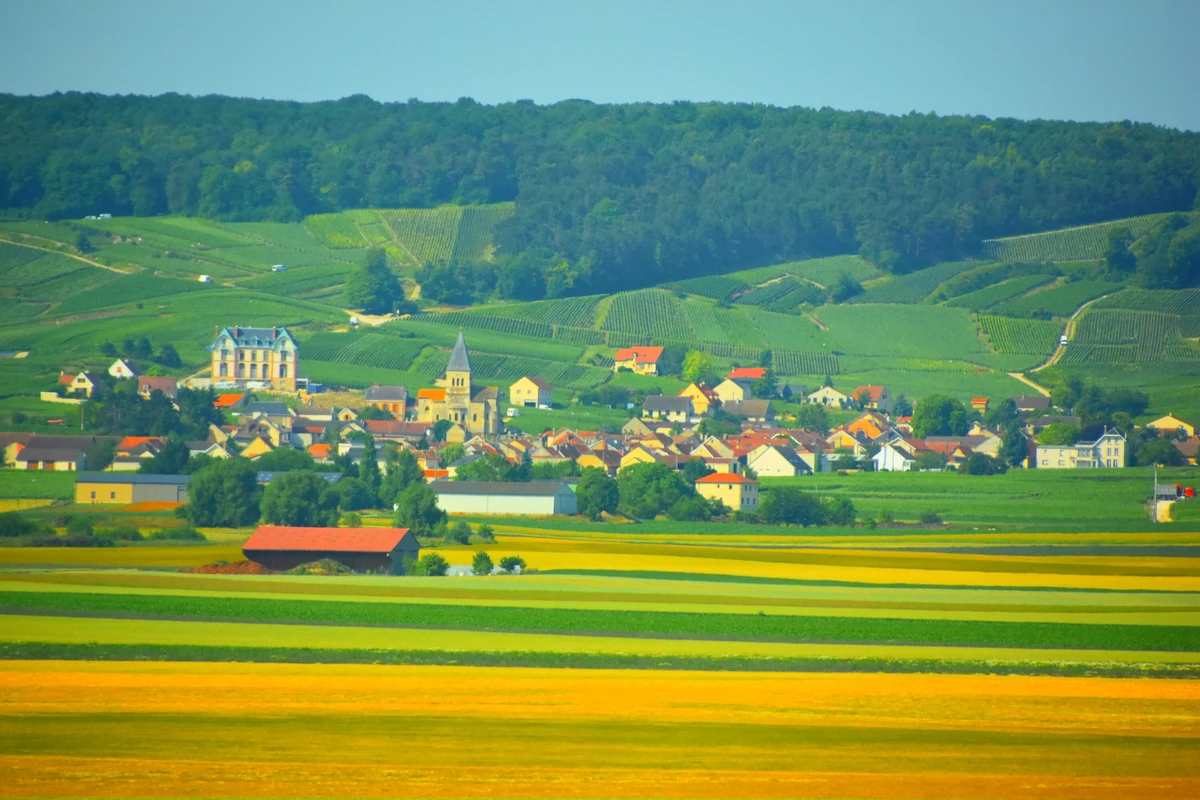
Driving on the highway to Paris, the scenery was a feast for the eyes. Fields of endless green stretched to the horizon, and the road itself—seldom straight—wound endlessly before us. Occasionally, we spotted clusters of houses perched on distant hillsides. After over four hours on the road, we reached the French capital, Paris, around noon.
Overlooking Paris (Photo: Feng Ganyong)
On the way to lunch along the Seine, our guide, Mr. Jin Guangzhe, told us about Paris. Straddling both banks of the Seine, Paris is the capital and largest city of France, its political, economic, cultural, and commercial heart. The city has been the seat of power for over 1,400 years, and its urban history stretches back more than 2,000. When people wander through Paris, their deepest impression is that it holds world-famous historical relics alongside magnificent modern structures—hence its nickname, the 'Flower City.'
City scenes of Paris (Photo: Feng Ganyong)
Paris’s cultural landmarks include what was then the world’s largest computer-controlled modern arts center—the Centre Pompidou—and many other world-renowned historical sites and artistic buildings, like the Eiffel Tower, Notre-Dame Cathedral, Place de la Concorde, the Louvre, and the Palace of Versailles. All these famous spots were must-sees on our itinerary.
Street views of Paris (Photo: Feng Ganyong)
Paris is a city radiating outwards from the Place du Châtelet. From there, the area extending to the Champs-Élysées forms the city center, which is both the oldest and liveliest part of Paris. The 'heart' of the center is the Île de la Cité, home to Notre-Dame and the Palais de Justice.
Obelisk at Place de la Concorde (Photo: Feng Ganyong)
To the north of Île de la Cité lie Place de la Concorde, the Opéra Garnier, the Madeleine Church, the Louvre, and the Tuileries Garden. From the Arc de Triomphe du Carrousel, through the Tuileries, past the obelisk at Place de la Concorde, down the Champs-Élysées to the solemn Arc de Triomphe, and onward to the Grande Arche in La Défense—this axis is one of the world’s great scenic lines.
Paris Opera House (Photo: Feng Ganyong)
If you take the Champs-Élysées as a dividing line, looking west, the symbol of Paris—the Eiffel Tower—and Les Invalides lie on the Left Bank. Further north, on the hill of Montmartre, the white dome of Sacré-Cœur stands like a beacon, the second-tallest landmark after the Eiffel Tower.
Lawn beneath the Eiffel Tower (Photo: Feng Ganyong)
As Mr. Jin’s vivid commentary flowed, we grew more and more excited about our upcoming Paris adventure. Our bus inched through the bustling streets, and everyone eagerly watched the beautiful cityscape outside. Despite the heavy traffic, spirits remained high. Finally, we arrived at a floating restaurant on the Seine. After lunch, we immediately began our first Paris activity: a Seine river cruise.
Street-side café (Photo: Feng Ganyong)
We boarded a two-deck sightseeing boat and set sail on the Seine. Along the banks, lots of people were relaxing. Some waved at us warmly from the shore, filling the river with cheer. Over the speaker, a male and female voice took turns introducing the Seine in Chinese, giving vivid explanations of every famous building and bridge we passed.
Friendly tourists along the Seine (Photo: Wang Jue)
The Seine is a major river in Northern France, 780 kilometers long, with a total basin area of 78,700 square kilometers. It is one of Europe’s historically significant waterways, and its transport network handles most of France’s inland shipping.
Photo on the Seine cruise (Photo: Wang Jue)
Since the early Middle Ages, the Seine has been Paris’s river. The city grew up around its main crossings, and the river and city are inseparable.
Cruising the Seine (Photo: Wang Jue)
Plane trees line both banks; behind them stand stately buildings. The Grand Palais and Petit Palais on the right bank, the university district on the left bank, the Eiffel Tower to the west, and Notre-Dame on the Île de la Cité in the east—all display their ornate styles through distinctive architecture.
Buildings along the Seine (Photo: Feng Ganyong)
At a bend in the river, on what looked like a peninsula, I suddenly saw a Statue of Liberty holding a torch aloft. The design was identical to the one in New York. The statue in New York Harbor was a gift from France in 1876 to mark the centennial of American independence; it took ten years to build and was inaugurated on October 28, 1886. The one here on the Seine, though identical in shape, was clearly much smaller.
Pont Alexandre III (Photo: Feng Ganyong)
Cruising the Seine, you see a treasure trove of bridges—reportedly 36 in total, each with its own character. The most magnificent is Pont Alexandre III. Its unique steel arch links the Champs-Élysées and the Esplanade des Invalides. Built around 1900 to celebrate the alliance between Russia and France—two nations that had been enemies a century earlier, when Napoleon invaded Russia and Moscow burned. Now, a hundred years later, old grudges were forgotten, and the bridge even leads toward Napoleon’s tomb.
Statue on the bridge (Photo: Wang Jue)
At each end of the bridge, gilded statues of cherubs support the pillars, their ornate design and colors particularly striking in Paris. The three oldest bridges are Pont Marie, Pont Royal, and Pont Neuf—all built before the 17th century, now over 300 years old. Pont Marie dates to the time of Louis XIII in the early 17th century and is named after its architect, Marie. Each pier has sculpted alcoves. The southern bank leads to Île Saint-Louis, where the houses look as ancient as the bridge and some lean. The studio of Camille Claudel, a female disciple of the sculptor Rodin, has peeling plaster and visible cracks.
Railway museum along the Seine (Photo: Feng Ganyong)
Pont Royal was built during the reign of Louis XIV in the late 17th century, paid for by the king himself. It later became a site for Parisian festivities. The wedding of Princess Élisabeth of France to Prince Philip of Spain was celebrated here, drawing half a million spectators. On the south bank stands the building where Voltaire worked and died on May 30, 1778. Nearby is where writer Anatole France wrote for a decade.
Tour boats on the Seine (Photo: Feng Ganyong)
Pont Neuf is the most famous, though its name means 'New Bridge'—it’s actually the oldest, nearly 400 years old. Begun in 1578 under Henry III, it was finished in 1606 under Henry IV after an interruption by civil war. At 238 meters long and 20 meters wide, it’s the longest bridge over the Seine in Paris. It has 12 arches, each adorned with a carved head, some glaring, others with closed eyes in thought. Pont Neuf spans the Île de la Cité, its shape slicing the river like a dagger.
Floating restaurant on the Seine (Photo: Wang Jue)
For two whole centuries after its completion, Pont Neuf was the commercial hub of Paris, bustling with booksellers, street performers, vendors, and even tooth-pullers. It still inspires artists today. Walking across, you see semicircular stone benches along the sidewalks, their worn surfaces bearing the marks of time.
Notre-Dame seen from the Seine (Photo: Wang Jue)
Not far from Pont Neuf is the pedestrian-only Pont des Arts, built mainly of metal. It’s planted with flowers and lined with works by artist Francis Gazeau, earning it the nickname 'garden on the Seine.' From here, you see the Louvre to the north, the Institut de France to the south, the Palais de Justice (where Queen Marie Antoinette was imprisoned) to the east, and Pont Royal to the west. Photographers and painters often seek inspiration here, and artists’ works are sometimes displayed on the bridge.
Yacht by the riverside (Photo: Wang Jue)
In May 2010, the city decided to remove all the 'love locks' that visitors from around the world had attached to the Pont des Arts to protect the bridge. Paris is known as the City of Romance, and many couples had hung padlocks engraved with their names on the bridge to symbolize their lasting love. Understandably, the decision upset some people.
Tricycle on the street (Photo: Feng Ganyong)
After the cruise, we went by bus to the Louvre. Since many places don’t allow buses to stop, we got off near the Place de la Concorde, at one side of the Louvre complex. We walked about a kilometer to the museum. Along the way were numerous statues, lush lawns, and a small fountain. From the fountain’s axis, to one side you could see the towering obelisk of Place de la Concorde, and to the other, the grand Louvre building not far off.
A family of tourists (Photo: Feng Ganyong)
Walking up the pathway to the Louvre, the first thing we saw was an arch, and behind it, the transparent glass pyramid at the main entrance designed by Chinese-American architect I.M. Pei. This world-renowned art palace was originally built at the end of the 12th century for defensive purposes and later expanded and renovated into a magnificent royal residence.
Arch at the Louvre (Photo: Feng Ganyong)
Beginning in the 16th century, King Francis I started collecting artwork on a large scale. Successive rulers continued this tradition, enriching the Louvre’s holdings.
Photo in front of the Louvre (Photo: Wang Jue)
Today, the Louvre’s collection includes 400,000 works, spanning seven categories: sculpture, painting, decorative arts, ancient Near Eastern antiquities, ancient Egyptian antiquities, and Greek and Roman antiquities. In 1981, the French government undertook a major renovation, turning it into a professional museum.
The Louvre, Paris (Photo: Feng Ganyong)
These art treasures are displayed in six main wings: Oriental Antiquities, Greek, Etruscan and Roman Antiquities, Egyptian Antiquities, Decorative Arts, Paintings, and Sculpture. The Paintings wing is the largest. The Louvre has 198 rooms; the longest hall measures 205 meters. It’s impossible to see all the rarest pieces in just a day or two.
A corner inside the Louvre (Photo: Feng Ganyong)
Despite its vast collection, few visitors get to see much of it. Only on Mondays and Wednesdays are all six wings open; on other days, they open in rotation, and on Sundays, only half are open. Moreover, only one-third of the collection is on display. For example, of its 15,000 paintings, fewer than 2,000 are usually exhibited. So very few people ever witness the Louvre’s full riches. Surrounded by 400,000 masterpieces, anyone would be lost in thought, whether about the art itself or the layers of history they embody. That is the Louvre’s magic.
Paintings in the Louvre (Photo: Feng Ganyong)
As a result, my two-hour visit was just a whirlwind tour. Yet the countless, stunning oil paintings and sculptures inside were deeply moving and breathtaking. What left the deepest impression were two extremely famous pieces: the Mona Lisa and the Venus de Milo. Not just for me, but surely for people from all over the world who come to the Louvre to catch a glimpse of these genuine treasures.
The Mona Lisa (Photo: Feng Ganyong)
Without exaggeration, among all the paintings, the most outstanding and attention-grabbing is Leonardo da Vinci’s immortal Mona Lisa, completed in 1503. It hangs in a hall on the second floor, framed in an exquisite, specially protected case. Soft lighting illuminates it so viewers can see every detail.
Visitors admiring the art (Photo: Feng Ganyong)
The Mona Lisa, also called Eternal Smile, is considered the first painting in Western art history to emphasize psychological depth. It represents da Vinci’s greatest achievement, portraying a woman of the urban bourgeoisie during the rise of capitalism. The figure sits with elegant poise, her smile subtle, set against a deep, misty landscape, showcasing the painter’s extraordinary sfumato technique.
Selection of paintings (Photo: Feng Ganyong)
Looking closely and thinking deeply, you can feel how the artist combined her rich inner world with beautiful outward appearance. Her facial features, especially the corners of the eyes and lips, capture an exquisite balance between precision and reserved expression—achieving a spiritual quality. The Mona Lisa’s smile has a mysterious, timeless charm, that dreamlike, captivating smile that art historians call a 'mysterious smile.' Strangely, no matter where you stand, her gentle eyes always seem to be smiling directly at you, as if she’s right there with you.
Selection of paintings (Photo: Feng Ganyong)
Similarly, seeing the Venus de Milo in the Sculpture wing stirred deep emotion. In Roman mythology, Venus is the goddess of love, beauty, and fertility; in Greek myth, she is Aphrodite. She rules over love, marriage, childbirth, and all living things’ growth. Born from the sea, she is famed for her beauty.
The Venus de Milo (Photo: Feng Ganyong)
The Venus de Milo statue is 204 cm tall. It is believed to have been carved by Alexandros of Antioch between 150 and 50 BC. Discovered in February 1820 beside an ancient tomb on the Greek island of Melos in the Aegean, it is a marble sculpture missing both arms. The half-nude figure has a beautiful face, well-proportioned body, and drapery falling to the hips; the missing right arm still reveals the classic curves of a woman, both dignified and alluring. After France bought it at great cost and displayed it in a special room at the Louvre, its matchless charm captivated the world. Since then, the Venus de Milo has become a symbol of love and beauty.
Sculpture on the ceiling (Photo: Feng Ganyong)
It is said that the Venus came to the Louvre by chance. In 1820, a farmer on the Greek island of Melos dug up the goddess. Word spread, and a French warship happened to be anchored in the port. The captain rushed to the scene and tried to buy it but had no cash. A Greek merchant purchased it and planned to ship it to Constantinople. The French, unwilling to lose the treasure, intercepted the ship. A scuffle broke out, damaging the statue and breaking off the arms. The dispute was settled by local authorities: the French bought the statue and presented it to the king. Brought to France, it caused an immediate sensation.
The goddess’s features embody the classical Greek ideal: an oval face, straight nose, full forehead, gently curved lips, and smooth chin. Her expression is dignified, quiet, and calm, with a tall, slender form and a slight bend in the left leg that highlights the rhythm of her curves. She is full and holy, soft and pure, elegant and noble, brimming with youth and life—a perfect union of spirit and flesh, a harmonious blend of love and beauty, a natural unity of mortal and divine. She is the cosmos of human physical beauty, the idealization of the female form. The French sculptor Rodin exclaimed: 'This is real flesh; you can feel its warmth when you touch it!'
Distant view of the Palace of Versailles (Photo: Feng Ganyong)
That evening, after our first day in Paris, our European tour group checked into the LE CHATEAUBRIAND hotel. Following a night’s rest, we continued our Paris sightseeing the next day. On the morning of June 16, 2017, we first headed to the famous Palace of Versailles.
Photo at Versailles (Photo: Jin Guangzhe)
The Palace of Versailles lies in the town of Versailles, southwest of Paris in the Yvelines department. It’s known worldwide for its extravagant luxury and imaginative design. The complex spans 580 meters, including the main palace, gardens, and the Grand Trianon. Versailles is one of Paris’s grandest palaces and one of the world’s five great palaces (alongside the Forbidden City in Beijing, France’s Versailles, Buckingham Palace, the White House, and the Kremlin). It was added to the UNESCO World Heritage list in 1979.
A corner inside Versailles (Photo: Feng Ganyong)
Originally a royal hunting lodge, it became the seat of government under Louis XIV from 1682 until the French Revolution—a must-see for anyone visiting Paris. For the tour, each of us was given an audio guide with Chinese commentary, keyed to numbers in different rooms.
Photo in the square before Versailles (Photo: Wang Jue)
Following the regular visitor route, a clear commentary began in my ear: Versailles was built during the reign of Louis XIV (1643–1715). He strengthened autocratic rule and centralized power. He waged two wars, leaving the treasury empty, and peasant uprisings flared, marking the decline of the French absolute monarchy. Construction began in 1661 and was completed in 1756, giving it a history of over 330 years.
Painting of Versailles (Photo: Feng Ganyong)
Versailles covers 1.11 million square meters, including 110,000 square meters of buildings and one million square meters of gardens. The palace buildings are majestic, with a tight, harmonious layout. The main wing runs east–west, connecting at each end to the South Wing and North Wing, forming symmetrical geometric patterns. The flat roof, rejecting the Baroque dome and traditional French spire, appears dignified and solid. The exterior walls are lined with marble statues of figures, beautifully sculpted and lifelike.
Giant painting (Photo: Feng Ganyong)
Inside, Versailles is grand and magnificent, its interiors richly artistic. Over 500 rooms, both large and small, are resplendent with gilding and luxury. The interiors feature carvings, vast oil paintings, and tapestries, complemented by furniture from the 17th and 18th centuries of superb craftsmanship. There are also priceless artifacts from around the world, including ancient Chinese porcelain brought from across the seas.
Ceiling paintings (Photo: Feng Ganyong)
A highlight is the Hall of Mirrors, created by royal painter and decorator Charles Le Brun and architect Jules Hardouin-Mansart. It is 72 meters long, 10 meters wide, and 13 meters high, connecting two large salons. One side has 17 huge arched windows overlooking the garden; the opposite wall is covered with 17 mirrors composed of over 400 panes, matching the windows. The ceiling is covered with Le Brun’s sweeping paintings, depicting turbulent historical scenes. Walking through, the clear sky and tranquil garden are reflected in the mirror wall, making you feel surrounded by lush greenery, as if you were in a garden of fragrant grass and thick trees.
A garden corner (Photo: Feng Ganyong)
Looking out the windows, you see a uniquely styled French formal garden. The trees and flowers are artfully arranged, creating a beautiful, peaceful atmosphere that soothes the heart. From the front of the main palace, you can gaze out over a ribbon-like man-made canal sparkling with ripples and dotted with sails, flanked by towering, leafy trees and goddess statues standing gracefully in the shade. In the foreground are two ponds, surrounded by bronze sculptures in varied, lovely poses.
Notre-Dame Cathedral (Photo: Feng Ganyong)
Around noon on June 16, 2017, after finishing the Versailles tour, we took the bus to Notre-Dame Cathedral on the Île de la Cité. To be honest, most Chinese people know this place from Victor Hugo’s famous novel Notre-Dame de Paris, and especially from the dubbed film version shown in China in the 1970s. That’s why nearly every visitor to Paris comes to see this majestic building.
Sculptures on the wall (Photo: Feng Ganyong)
When we arrived, tourists from around the world waiting to enter formed a long queue in the square. Pigeons strolled freely around, indifferent to the crowds. Police officers were stationed everywhere to ensure safety. Despite the large number of visitors, everything was orderly.
Bell towers of Notre-Dame (Photo: Feng Ganyong)
Construction of Notre-Dame began in 1163 on the Île de la Cité, the birthplace of Paris, and took 400 years to complete. It is the cathedral of the Catholic Archdiocese of Paris. As a masterpiece of Gothic architecture, it is one of the most representative churches of the Île-de-France region. The interior is solemn and restrained, with striking stained-glass windows and intricately carved flying buttresses and gargoyles.
Entering Notre-Dame (Photo: Feng Ganyong)
Guide Jin Guangzhe explained: Notre-Dame is a hallmark of early Gothic architecture and sculpture, encompassing religion, culture, and architecture. It was originally built to honor Jupiter, the chief Roman god, and over time became an early Christian church. The term 'Gothic' originally came from the Goths, meaning barbaric northern tribes and was used pejoratively. Later, it lost that connotation and simply became a name for that style of culture.
Notre-Dame’s windows (Photo: Feng Ganyong)
The most important feature of Gothic architecture is height and verticality, so it’s sometimes called vertical style. The floor plan of a Gothic cathedral resembles a Latin cross. The top of the cross is the altar, and the long arm is a rectangular nave for worshippers. The ceiling uses a series of pointed arches that appear slender and airy. Often, two bell towers flank the façade. Gothic cathedrals look ethereal yet balanced, adhering to principles of unity, proportion, rhythm, and harmony, creating strong aesthetic appeal.
High vaulted ceiling (Photo: Feng Ganyong)
Notre-Dame is famous mainly because it marks an epoch in European architectural history. Before it, churches were mostly heavy and crude, with massive vaults, squat pillars, thick walls, and dark spaces that felt oppressive. Notre-Dame broke those constraints, pioneering a new, light framework of rib vaults. The vaults became lighter, the interior taller, and light flooded in. This unique style quickly spread across Europe.
Stained glass and painting (Photo: Feng Ganyong)
Up close, you see three deeply carved portals illustrating the Bible: the Portal of the Virgin, the Portal of the Last Judgment, and the Portal of Saint Anne. The cathedral has three levels; the top offers superb views. Standing on the Seine, Notre-Dame embodies the ancient history of Paris. From the top, you can overlook the entire city and admire the lovely Seine.
Statue on the wall (Photo: Feng Ganyong)
Inside, devout worshippers can be seen everywhere, hands clasped and heads bowed in prayer, emphasizing the cathedral’s solemnity. The splendid interior overwhelms you with its grandeur. Five rows of massive pillars, five meters in diameter, divide the interior into five naves, with double aisles around the transept and choir. The two rows of pillars, 24 meters high, reach to the roof; they are less than 16 meters apart, while the ceiling is 35 meters high, creating a narrow, lofty space that gives the illusion of drawing closer to heaven.
Photo in front of Notre-Dame (Photo: Jin Guangzhe)
Above the arcades, a gallery of double windows runs along, and above that, large windows let streams of light quietly into the nave. In the side chapels, art from the 17th and 18th centuries fills the space. After visiting Notre-Dame, the group took its first group photo of the trip here.
A little girl playing (Photo: Feng Ganyong)
After lunch that day, we had free time. A stroll through the busy streets was a must. Since our meeting point was near the Opéra Garnier and the famous Galeries Lafayette department store, I photographed the magnificent opera house and later went up to the seventh-floor viewing terrace of Galeries Lafayette, capturing a series of Paris street scenes.
View of the opera house from the department store (Photo: Feng Ganyong)
The Paris Opera, also known as the Palais Garnier, seats 2,200 people. It’s the largest lyric theater in the world, covering 11,237 square meters. Designed by Charles Garnier in 1861, it blends Greek and Roman colonnades with Baroque and other styles, creating a grand, intricate, gilded space hailed as a theater of paintings, marble, and gold—an iconic structure of the Napoleon III era.
Galeries Lafayette department store (Photo: Feng Ganyong)
The Galeries Lafayette group is world-famous. Even Beijing has a branch in Xidan. Naturally, we had to visit the original Paris store on Boulevard Haussmann, next to the opera house. Founded in 1893, its full name is Galeries Lafayette Haussmann.
View from the observation terrace (Photo: Feng Ganyong)
Galeries Lafayette once caused a sensation with its palace-like luxury. Under its massive Byzantine-style gilded dome, shoppers glide about as if at a medieval gathering, making shopping a real pleasure. Taking the escalator to the seventh floor, there’s an open-air terrace where you can look out over parts of Paris. The Eiffel Tower is clearly visible in the distance, while the green-roofed opera house is right next door. Especially impressive is the famous stained-glass dome inside—whether seen from below or above, it’s resplendent and magnificent.
Tour Montparnasse (Photo: Feng Ganyong)
After supper that evening, we visited the Tour Montparnasse. Built in 1972, it has 59 floors and stands 209 meters high—the tallest building in Paris apart from the Eiffel Tower, and the city’s only skyscraper. Thanks to the long summer daylight, it was still bright at past 20:00. A high-speed elevator took us to the 56th-floor observation deck in just 39 seconds. Then we walked up three more floors to the highest terrace, roughly equivalent to the 59th floor. From there, a sweeping panoramic view of Paris unfolded. The well-lit side was clear and sharp, while the Eiffel Tower, silhouetted against the setting sun, was backlit—less defined but softly tinted with twilight hues.
Overlooking Notre-Dame (Photo: Feng Ganyong)
Speaking of the Eiffel Tower, our group had glimpsed it many times since our first day in Paris—from the floating restaurant on the Seine, during the river cruise, and while riding through the city. Twice we had lunch at Chinese restaurants near the tower, giving us time to admire it up close from the surrounding lawns.
Photo at Tour Montparnasse (Photo: Feng Ganyong)
Guide Jin Guangzhe explained: The Eiffel Tower was built in 1889 for the World’s Fair celebrating the centennial of the French Revolution. Named after its designer, the engineer Gustave Eiffel, a bronze bust of him stands at its base. At the time, many criticized it as a heap of scrap metal ruining Paris’s beauty. Today, this tower—once the world’s tallest for over four decades, second only to Tokyo Tower in height—has become the most important symbol of Paris. Romantic Parisians call it the 'Shepherd of the Clouds.'
The tower at dusk (Photo: Feng Ganyong)
Our group’s last sight in Paris was the Arc de Triomphe. At 21:30 on June 16 Paris time, we left Tour Montparnasse and drove to the foot of the Arc on the Champs-Élysées. Though evening, the sun hadn’t set, but the front was backlit for photos.
Avenue des Champs-Élysées (Photo: Feng Ganyong)
The Arc de Triomphe stands in the middle of the Place Charles de Gaulle, a grand traffic circle. True to its name, it is a triumphal arch welcoming victorious armies home. It’s the largest round arch in the world. I’d always imagined it with two faces; here I learned that, situated in a roundabout, it has four rectangular sides. Standing beneath it, looking up, was truly awe-inspiring.
Close view of the Arc de Triomphe (Photo: Feng Ganyong)
The Arc marks the end of the Champs-Élysées and the highest point of the Chaillot hill. From the Place Charles de Gaulle, twelve avenues radiate outward. The majestic arch rises from the central island. Commissioned by Napoleon in 1806 and designed by Jean Chalgrin, it was built to honor the Grande Armée and completed in 1836. It has a single arch with a barrel vault, larger than Rome’s Arch of Constantine. It stands 50 meters high and 45 meters wide, each side adorned with huge relief sculptures.
Relief on the arch (Photo: Feng Ganyong)
The most famous and exquisite relief is on the lower right side facing the Champs-Élysées, depicting the departure of the volunteers in 1792—entitled La Marseillaise. Above it are scenes of Napoleon’s triumphs, and at the top, shields bear the names of major battles.
Photo on the Champs-Élysées (Photo: Wang Jue)
Beneath the arch, the Tomb of the Unknown Soldier was installed in 1920, with an eternal flame burning. Inside is a small museum recounting the monument’s history, where visitors can see the names of 558 generals; those underlined died in battle.
Photo with the Eiffel Tower (Photo: Jin Guangzhe)
On the morning of June 17, 2017, our European tour group left Paris for Switzerland. On the bus, I still didn’t feel ready to leave, and I browsed through the street scenes I’d captured over the past few days.
Arc de Triomphe at dusk (Photo: Feng Ganyong)
The Opéra Garnier, the Galeries Lafayette windows, sightseeing buses, countless statues, the glamorous Seine, and the dusky Eiffel Tower—these photos encapsulate the endless charm of Paris, making it hard to tear myself away. (Text and photos: Feng Ganyong)


