The Light of the Renaissance: European Civilization (I)
From 2800 BC to the present, Europe's splendid civilization has illuminated the skies. From Alexander the Great to Julius Caesar; from Constantine to Cleopatra; from the decline of the Persian Empire to the Ottoman invasion; from 1914 to the anti-fascist war; the civilizations of Europe have succeeded one another, with countless figures taking the stage and making indelible contributions to human civilization.
After World War I, the Austro-Hungarian Empire collapsed, and in 1918 the Czechoslovak Republic was established. In 1992, Czech and Slovakia separated, and in 1993 the Czech Republic became an independent sovereign state.
In 1968, a political democratization movement in Czechoslovakia was called the "Prague Spring." But Czechoslovakia did not yield to the dark rule of the former Soviet Union; Eastern Europe underwent upheaval, and the Soviet Union dissolved.
St. Vitus Cathedral is located in Prague Castle, a typical Gothic masterpiece that took centuries to complete; it is the pride and symbol of the Czech Republic.
Soviet tanks once rolled into this place, Prague Square.
It was New Year's Day, and the square was packed with people.
A great masterpiece, the Astronomical Clock.
In 1918, after the end of World War I, the defeated Austro-Hungarian Empire gave way to the First Austrian Republic. In 1955, Austria declared itself permanently neutral. After the dissolution of the Soviet Union in 1989, Austria developed rapidly; it joined the European Union in 1995.
The capital Vienna boasts one of the world's most famous opera houses, the Vienna State Opera. It is the highest honor for an artist to be invited to perform here.
Austria has produced many world-class music masters: Haydn, Mozart, Schubert, Johann Strauss, and Beethoven, who was born in Germany but lived in Austria for a long time.
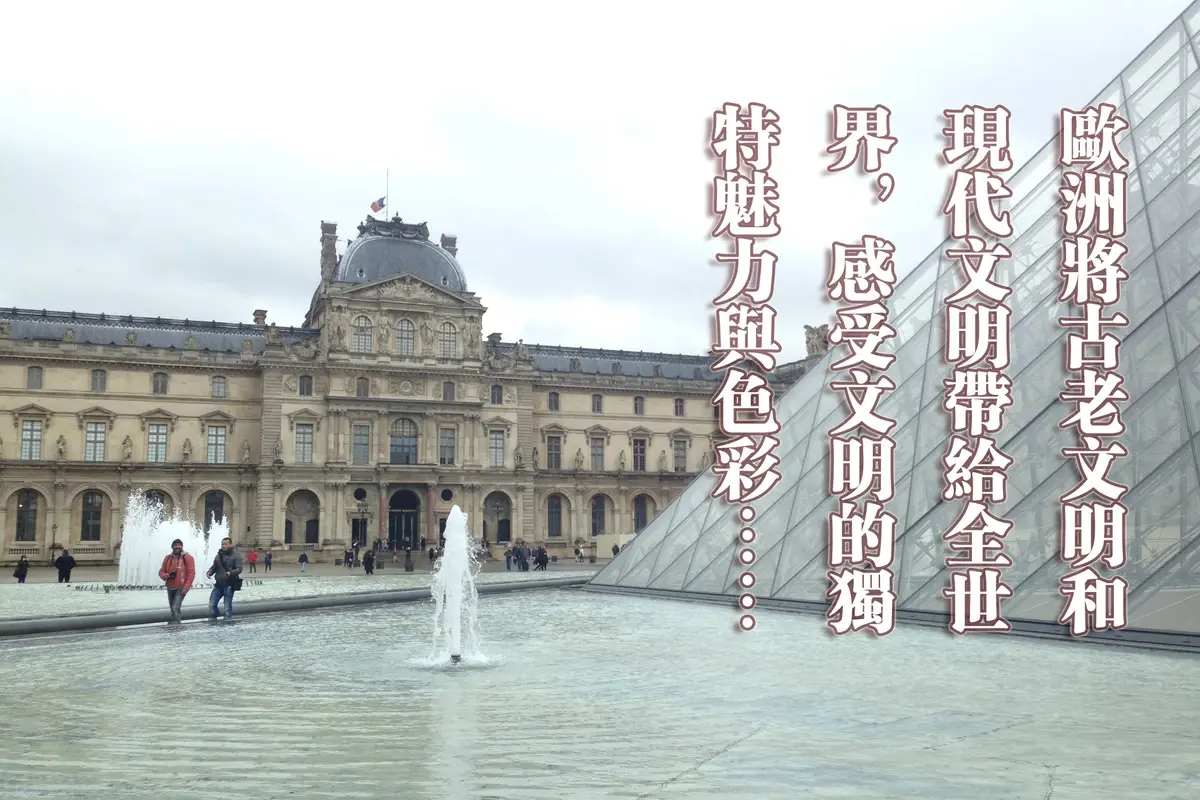
The Louvre's artifacts and artworks are probably the greatest in the world, totaling hundreds of thousands of pieces.
Europe and even the world have been deeply influenced by ancient Greek civilization. From 2800 to 2200 BC, the delicate and graceful Cretan civilization lit up the Aegean Sea.
Legend has it that Zeus, the king of the gods, took a liking to Europa, the daughter of the Phoenician king. Zeus transformed into a bull, carried Europa away, and fathered Minos, who built the Palace of Knossos on Crete. Later, the wife of King Minos was cursed by Poseidon and gave birth to the Minotaur, a bull monster. The Minotaur was imprisoned in a labyrinth, and Theseus slew it before going to Athens to become king. Although it is a legend, Crete introduced "gods" to the land of Greece, and the continent facing Crete hence got the name Europa, abbreviated as "Europe."
From 1900 to 1700 BC, the robust and bold Mycenaean civilization began, with the Pelasgians entering the Peloponnese peninsula. In 1500 BC, the Achaeans from the north conquered the Pelasgians and built Mycenae, gradually replacing Cretan civilization.
Pelops of the Peloponnese family fancied Hippodamia, daughter of the king of Elis. The king demanded a chariot race, and the winner would gain the kingdom and the princess. Pelops prayed to Poseidon, obtained the sea god's chariot, and bribed the son of Hermes to loosen the axle of the king's chariot. The king died, and Pelops won the kingdom and the princess. But he did not keep his promise and even pushed the god's son off a cliff, bringing a curse upon the Peloponnese family for generations.
Agamemnon, king of Mycenae from the Peloponnese family, launched the Trojan War and sacrificed his own daughter to Artemis. However, Agamemnon's wife and her lover killed him upon his triumphant return. Then Agamemnon's son Orestes killed his mother and her lover. The Furies pursued Orestes, but Apollo sent him to the Areopagus to be judged by Athena and twelve elders. Athena and six elders acquitted Orestes, establishing legal order over blood ties — the earliest court in human history.
In the "Theogony" of the bard Hesiod, the Olympian gods are mentioned as having been brought by Mycenae, forming a vast divine civilization that people have believed in to this day.
Zeus the thunder god, Hera the queen, Apollo the sun god, Poseidon the sea god, Athena the goddess of wisdom, Hermes the god of commerce — the new generation of gods defeated the Titans, perhaps symbolizing the succession of civilizations.
Peleus married the sea nymph Thetis, but forgot to invite Eris, the goddess of discord. Eris threw a golden apple inscribed "For the most beautiful goddess." Zeus's wife Hera, Athena, and Aphrodite all claimed it. They went to Troy's outskirts to ask a shepherd boy to award the apple. Hera promised to make him the mightiest king; Athena, the wisest man; Aphrodite, the most beautiful wife. The boy gave the apple to Aphrodite without hesitation. Power and wisdom didn't matter — to the Greeks, beauty was paramount.
From the 12th to the 8th century BC, due to invasions by northern barbarians, Greece entered the "Dark Ages." Greeks migrated throughout the Mediterranean, spreading Greek civilization to many countries in Eurasia, and the age of Greek city-states began to flourish.
Athens is the most famous Greek city-state. Before it had a name, Athena and Poseidon both wanted to be its patron deity. Zeus decided that whoever brought the people what they most desired would guard the city. Poseidon struck a rock with his trident and brought forth a warhorse; Athena struck a rock with her spear and produced an olive tree. The people chose the olive tree, a symbol of peace, and thus the city was named Athens after Athena.
The city-state of Athens pioneered humanity's earliest democratic politics. Terms like democracy, socialism, individualism, and politics all originated from ancient Greek. The system of a 500-member council, rule by ten generals, and 6,000 law enforcers formed the earliest separation of powers, a democratic system still largely used by all developed countries today.
In 776 BC, the first Olympic Games were held. The Games attracted people from all Greek city-states and stimulated the development of literature, art, philosophy, and economy. During the Greco-Persian Wars, the Greeks sent 300 Spartans to hold off tens of thousands of Persian troops. The Persians were baffled: you forsake power, land, and wealth, yet so revere honor. From then on, the Persians admired the Greeks.
Greece contributed countless master figures to posterity. Three of the world's four great tragedians came from ancient Greece, along with Socrates, Plato, Aristotle, Alexander, and many others.
In the 3rd century BC, Alexander built a vast empire, but around 48 BC, it was completely conquered by Rome's Caesar, ending the Greek era.
Today, many luxury goods bear the imprint of ancient Greek civilization. Nike is named after the goddess of victory; Hermès after Hermes, the god of commerce; Givenchy's logo features Medusa; the Starbucks logo is a Siren, symbolizing the irresistible allure of its coffee. Greek civilization surrounds us at all times, exuding a unique charm.
In the 14th century, Europe began a great movement, known as the Renaissance, which inherited and carried forward everything of Greek civilization. Leonardo da Vinci, Raphael, Michelangelo, Botticelli, Dante, Boccaccio, Giotto, Shakespeare, Cervantes, Masaccio, Titian, and many other world-class masters gathered in this era. Marvel at the charm of literature and art, and be grateful for Greek civilization's spread from the Aegean Sea to the rest of the world, shining with eternal light.
Travelogue Directory: 1. Czech Republic - Capital Prague; 2. Austria - Capital Vienna; 3. France - Capital Paris - Louvre. Travel Information; Hotel Index; Tips Index; Flight Index; Website Navigation; Travel Index; Cruise Index; Corporate Travel Index; Join & Cooperate; Distribution Alliance; Partner Links; Corporate Gift Card Purchase; Insurance Agency; Agent Cooperation; Hotel Partnership; Destination & Scenic Spot Cooperation; More Cooperation; About Ctrip; Ctrip Highlights; Contact Us; Talent Recruitment; User Agreement; Privacy Policy; Business License; Security Center; Ctrip Content Center; Intellectual Property; Trip.com Group; Algorithm Disclosure.


