16-Day Italy, Switzerland, France Summer Trip
A long-planned European journey finally came true this summer.
Originally scheduled for 2020, it happened three years later.
Food, accommodation, and transport were all pricier than before—but we went anyway. The six of us spent about 40,000 yuan each.
Over 16 days (17+ including round trips),
airfare totaled 90,000 yuan, hotels were mostly 4-star, two rooms for 65,000,
train tickets + Swiss Travel Pass + cable car tickets around 30,000,
the rest on food, drink, and shopping.
————————————————————————————————————————
The itinerary:
July 1: Fly Hong Kong to Milan, arrive in the morning. Visit Milan Cathedral — Galleria Vittorio Emanuele II — Castello Sforzesco.
They are close together, so all three can be seen in about four hours. Afternoon 3-hour train to Rome.
July 2: Castel Sant’Angelo — Piazza Navona — Pantheon — Trevi Fountain — Baths of Diocletian Museum
July 3: Colosseum — Palatine Hill — Trajan’s Forum — Piazza Venezia, afternoon: Mouth of Truth — Tiber Island — Turtle Fountain — Largo di Torre Argentina — Pantheon —
July 4: Piazza del Popolo — Villa Borghese (park) — Spanish Steps. After lunch, train Rome to Venice. Evening stroll in old Venice, San Marco pier.
July 5: Rialto Bridge — traditional market — church — Accademia Bridge — St. Mark’s Square — Lido island
July 6: Burano — Murano — (afternoon) Accademia Bridge — San Marco district — San Marco pier
July 7: Venice — Milan — Spiez, Switzerland — Interlaken — Grindelwald
July 8: First mountain, hike to Bachalpsee Lake — take the cable car midway, ride the mountain cart to Bort station, then walk down
July 9: Go down, check in Interlaken — Lake Thun boat cruise to Thun — train back to Interlaken
July 10: Train to Lauterbrunnen — Wengen — Männlichen — Grindelwald — Interlaken
July 11: Midday train to Lucerne, afternoon: Lion Monument, Chapel Bridge, Lake Lucerne
July 12: Lake Lucerne cruise — Mt. Rigi — train back to Lucerne — Spreuer Bridge
July 13: Lucerne — Zurich — Paris
July 14: Louvre — Notre-Dame Cathedral — Place de la Concorde — Eiffel Tower — Arc de Triomphe
July 15: Disneyland Paris
July 17: Place de la Bastille — market — Victor Hugo’s House — Tuileries Garden
————————————————————————————————
With so many cities in Italy steeped in dazzling history, and because Rome is there and my mother is a Christian, I’d always wanted to take my parents to see Rome.
After the pandemic, only direct flights to Milan were available, so we gave ourselves half a day to skim through Milan. Italy’s economic capital, the airport wasn’t large. We took a shuttle to Milano Centrale station to store luggage—the station is a century old, with high, ornate vaulted ceilings and frescoes or emblems of Milanese lords.
From the station, we took the metro to Milan Cathedral. The ticket machines were vintage—slowly spitting out tickets one by one, and we had to queue.
Exiting the station, the cathedral exploded in intricate splendor. As someone who once studied art, my first thought was of Monet’s many paintings of Milan Cathedral—changing light and shadow, his impressionist genius turning white marble into shifting blocks of color.
The queue for tickets wasn’t long, about 25 minutes for 7 euros. Inside, nothing left a deep impression—the interiors felt similar.
The piazza in front was under renovation, and the Royal Palace Museum next door (home to the Last Supper) was out of time, so we went to Galleria Vittorio Emanuele II. Not very long, and we weren’t planning to buy anything, so we walked on to Castello Sforzesco. That castle was quite interesting, built of red brick, with a moat, stone cannons, and fortified towers—a fine example of a medieval fortress. There are artworks inside we didn’t see, but the Sforza family castle, who also sponsored the cathedral, was truly distinctive. Their banners can still be spotted all over Milan.
Then we rushed to catch the train to Rome, hurrying back to Milano Centrale. The pizza and flatbreads in the station’s underground were surprisingly delicious.
Three hours later we arrived in Rome just past 6 p.m., staying at a hotel near Termini station.
At reception, an arrogant man claimed he couldn’t find our other room booking, refused to look at our voucher, and insisted we go back to the booking platform. Booked at the same time, the hotel lost the reservation, offered no solution, just passed the buck—quite a disappointing example of Italian hospitality.
Eventually, Ctrip sorted it out. Though my overseas calls cost nearly 600 yuan, Ctrip compensated 800, a reasonable outcome. This was the most unpleasant part of the trip.
Once settled, we went to soothe our hunger. From departure to now, more than 30 hours without proper rest or a good meal. Dinner: salads, pasta, seafood rice, pizza on the street—nothing special.
In Italy, toilets cost money (1–2 euros), and in restaurants, water is charged (3–5 euros). We often sighed, “Living is not easy… haha.”
The first day of sightseeing in Rome: St. Peter’s Square and St. Peter’s Basilica were utterly stunning. Seen many times on screen, sacred and grand, though from ground level the impression was a bit diminished, the double colonnade of the square still majestic. At about 9 a.m. we took the metro and found a queue, but within 10–15 minutes we were inside the square. We then went clockwise to the basilica—truly an exquisite, breathtaking church, its position as the world’s finest fully deserved: ornate, sacred, refined. My mother said, “This was built by people of faith. If humans build a temple for their God, they do it with the utmost care, devotion, and reverence.”
The basilica is simply too beautiful. Having visited so many churches, this one is the crowning synthesis of architecture, sculpture, art, and religion. Every corner has been meticulously polished by art—from Raphael to Michelangelo and countless masters who poured their genius here, inviting us to marvel at the pinnacle of human artistry.
We also saw the baldacchino and the tombs below. We sat quietly in the nave for a while. Even amid the throngs, when you sit still and look and truly feel this supreme sanctuary of religious art, your heart swells with honor. As if awakened, immersed, the visit was deeply worthwhile.
In the square stands an Egyptian obelisk, uninscribed. By then I had already seen five Egyptian obelisks in Rome, some covered with ancient Egyptian writing. I’ve never quite understood why Western powers so love these stone pillars, hauling other people’s treasures to the center of their own living rooms—a lot of effort and nothing really to boast about. Wouldn’t it be better to place their own art and monuments in their city centers? Even after some research, I found no satisfying explanation.
On the square’s edges, there were sculptures of refugees, and seagulls strolling.
Walking forward from the square, you reach Castel Sant’Angelo, with its unique circular form—first a mausoleum, then a papal fortress, prison, and castle. It was around 1 p.m., blazing sun, and the queue was long. Worried the elderly and little ones would tire, we skipped going in. Admired the fine sculptures on Ponte Sant’Angelo, snapped a few photos, and moved on.
Crossing the bridge into Rome’s centro storico, we sat down for lunch at a streetside restaurant. The waiter enthusiastically recommended their seafood pasta, 19 euros. It arrived and was mediocre. The pizza, too—only the vegetable soup was tasty. When we paid, I realized the owner was Chinese, in Rome for over 20 years. How to put it? In Paris, the street-side Japanese restaurants are almost all run by Chinese (and quality is limited). And this Italian meal was similar—probably not as authentic as a native would make it.
With full bellies, we continued. The streets are lined with five-story buildings, a century old or more. Piazza Navona, an elongated rectangle, with its fabulous Fountain of the Four Rivers in the middle—sculptures vivid, though I only learned their meaning after returning home. Rome’s fountains often appear in piazzas, the city’s living rooms, big and small. Like wells in old Chinese villages, I imagine people once gathered around these fountains to chat, just as “wherever there’s a well, one can sing Liu Yong’s lyrics.”
On toward the Pantheon, the lanes filled with more shops. We bought sweets and gelato. A long queue snaked outside the Pantheon, but it moved fast and we were soon inside. Remarkably well-preserved ancient Roman architecture, its most special feature is the open oculus in the dome—you can see the sky, light pours straight down, even dust motes floating. A building completed 1,500 years ago still leaves you in awe. I hadn’t done my homework: only back home did I learn Raphael is buried there. I’d once analyzed his Madonnas in an art appreciation essay, yet we met without knowing. Regret.
This Italy trip, we visited no museums at all. From The Last Supper to the Sistine Madonna, none. With old and young, we were too afraid of queues. In Paris, we sat outside the Orangerie Museum until closing time before realizing Monet’s giant Water Lilies were inside—I’d even written about that work. Fate sometimes keeps you blind. A small regret. I hadn’t pre-booked museum tickets, and witnessing the long standby lines discouraged us—except at the Louvre, where I queued over an hour with my parents.
Exiting the Pantheon, we passed a few churches, then walked to the Trevi Fountain. At the end of winding alleys, a tiny square jam-packed with people. The fountain’s sculpture was grand, as if carved onto the back of a building, vastly different from what I’d imagined of the “wishing well.” From a distance, I saw few coins, so we didn’t squeeze to the front, just took quick photos and left.
Rome has so many magnificent fountains, everywhere. Streets, buildings, churches, bridges, fountains—all canvases for art. I’m not entirely sure why Westerners love sculpture so much. A romantic notion of eternity? So the stone figures endure, and centuries later we meet them.
Around 3 p.m., the heat was too much, and my parents felt tired, so we returned to the hotel to rest. I went alone to the nearby Baths of Diocletian Museum. Rome has several huge baths. What made Rome “Rome” two thousand years ago, that legendary city? Astonishing water supply and drainage systems. Only when these were solved could Rome become the global city of its age.
In the evening, I took the family to a Chinese restaurant run by Chinese. Six people, 80 euros, average-tasting food.
The second day in Rome started with the Colosseum. The biggest shortcoming of this trip was not pre-purchasing skip-the-line tickets for many must-see sights. Online tickets didn’t offer free entry for children, so I couldn’t decide. Plus, my past experience of low crowds abroad hit a wall in Rome—a world-famous historic city, packed with tourists.
We arrived at the Colosseum at 8:30 a.m. to queue. Already a line of a hundred meters. Tickets went on sale at 9, we got them at 10. Due to crowd control, entry wasn’t until 11. Departing the hotel, three hours wasted in the scorching sun. Though we saved 26 euros for two kids (they issue 0-euro tickets at the ticket office), the time cost was too high. And the ticket window requires everyone to be present—no buying on behalf—to prevent scalping.
The Colosseum was spectacular, even grander inside—ruins of ancient Rome’s wealthy playground. Many stands collapsed, the arena floor hollowed. Two thousand years; the world has changed so much.
Ancient Romans truly knew leisure: baths, racetracks, amphitheaters.
Opposite is Palatine Hill, one of Rome’s seven hills, the very core of ancient Rome—old palaces, temples, and houses, now broken walls and scattered stones, yet the scale of the structures still palpable. Everyone knows the legend of Romulus and Remus, twins raised by a she-wolf, set against this hill and the nearby Tiber River. The ruins on Palatine are extensive, a two-hour open-air museum, the political and religious center of ancient Rome. Coming out onto Via dei Fori Imperiali, across is Trajan’s Market—ancient Rome’s marketplace, now only remnants.
The Imperial Fora boulevard is simply stunning, paved with dark stone; everywhere you look, two-thousand-year-old buildings. It felt like being in that long-ago flourishing capital. In Rome, you can see 60–70% of the sights from outside without a ticket. Rome’s trees also fascinated me: slim trunks topped with a flat cloud of foliage, called stone pines or Italian umbrella pines—very apt, elegantly shaped.
Moving on to Piazza Venezia, the Altare della Patria, Trajan’s Column: splendid sculptures, immense grandeur. This must be Italy’s spiritual center, like Tiananmen Square for China.
Walking is the best way to explore Rome—sights strung together like beads, just stroll and enjoy. By 3 p.m., the sun blazed again, so we retreated to the hotel to nap. For lunch, a Michelin-starred Korean restaurant—the owner was indeed Korean, and the food was excellent. After rest, we ventured out again after 5 p.m.
Waking at 5:30, we hurried to see the Mouth of Truth, which closes at 6 p.m. At 6:05 we were allowed to queue. It turned out to be set in the porch of a small church, originally perhaps a fountain drain. You leave a donation and snap a photo. The church was small but tidy and heartfelt.
Afterward, we crossed to the Tiber to see the broken bridge and Isola Tiberina. The river wasn’t deep, flowing fast. The island’s architecture was beautiful—I thought it a hotel, later learned it’s a hospital. We sat on the stone steps, eating ice cream, soaking up a very local Roman scene. That was truly experiencing Rome.
Wandering by the river, we then saw the Turtle Fountain and Largo di Torre Argentina. My son wanted pasta from a certain place, so we ended up back at the Pantheon. By then, lights were on, restaurants had set candles on outdoor tables. Achille Al Pantheon di Habana’s pasta was genuinely delicious and not expensive.
The third day we had only a half-day for sightseeing—tidying up loose ends. Piazza del Popolo, Villa Borghese, and a final glance at the Spanish Steps. Far too crowded, but the fountain at its foot was lovely.
Picked up luggage, had lunch, and headed to the station for the 2 p.m. train to Venice. Then a memorable episode:
We encountered a thief! I’d been very careful on metros and buses, but boarding a long-distance train, my guard dropped. Immediately a pretty young woman grabbed my suitcase, pretending to help push it to my seat. I said no, she persisted. Midway I saw my shoulder bag’s zipper was half open, so I quickly zipped it. She kept asking my seat number. I tried to pull my case back, turning to look for her companion—an older woman—thinking, “Aren’t you going to control your daughter?” But the older woman’s hand was inside my bag, already touching my wallet. Caught, she withdrew. The young one dropped my suitcase and they escaped. My family behind didn’t see what happened. When I told them, we all felt a chill. My husband said, “Such a pretty girl, why be a thief.”
So they strike during boarding, knowing it’s costly to chase them. They target foreigners, and locals probably notice but never warn. On the train, that woman behind me kept tugging at my bag—did none of the other passengers see? A team operation, one distracts while the other picks. They didn’t succeed, but might have stolen a suitcase before we got off. So, open station platforms abroad are pickpocketing hotbeds.
As for Rome’s buses: we bought a 48-hour pass, valid for metro and bus. Buses had no card readers; everyone hopped on and off as if they all had tickets. Only once at the train station two inspectors boarded—and indeed some hadn’t paid. Whether fines followed, I don’t know.
Rome to Venice, about four hours, arriving at Venezia Santa Lucia station in the old city. The sea bridge didn’t impress. But stepping out of the station, right onto the Grand Canal, felt magical. At the vaporetto ticket booth, we bought three-day passes (children get a youth discount). Bottom line: in Venice, a travel pass is essential—for getting to and from the station, island-hopping, or just a boat ride. Many types of water buses.
Our hotel was hidden in a deep alley near St. Mark’s Square, Hotel Al Piave. Dragging suitcases off the boat, we already tasted Venice’s charm: narrow lanes of varying widths, bridges rising and falling, a small piazza with a well appearing around the corner.
The room was lovely. Since we had a triple, they gave us the two largest attic rooms. The hotel was immaculate, tasteful, reflecting the owner’s care; the man at the front desk was very nice. The only tiny quibble was the small elevator—otherwise, perfect. A place that stays in your memory, special and beautiful.
Evening, after dropping bags, we went out to St. Mark’s Square—the square of my dreams! But reality didn’t match expectation. I’d long been captivated by its classical grandeur, eager to experience it. Yet during our days there, the square was a mess: restaurant tables, concert fencing and rows of seats, construction scaffolding for restoration. In three days, I never saw the wide open space, and that was a letdown.
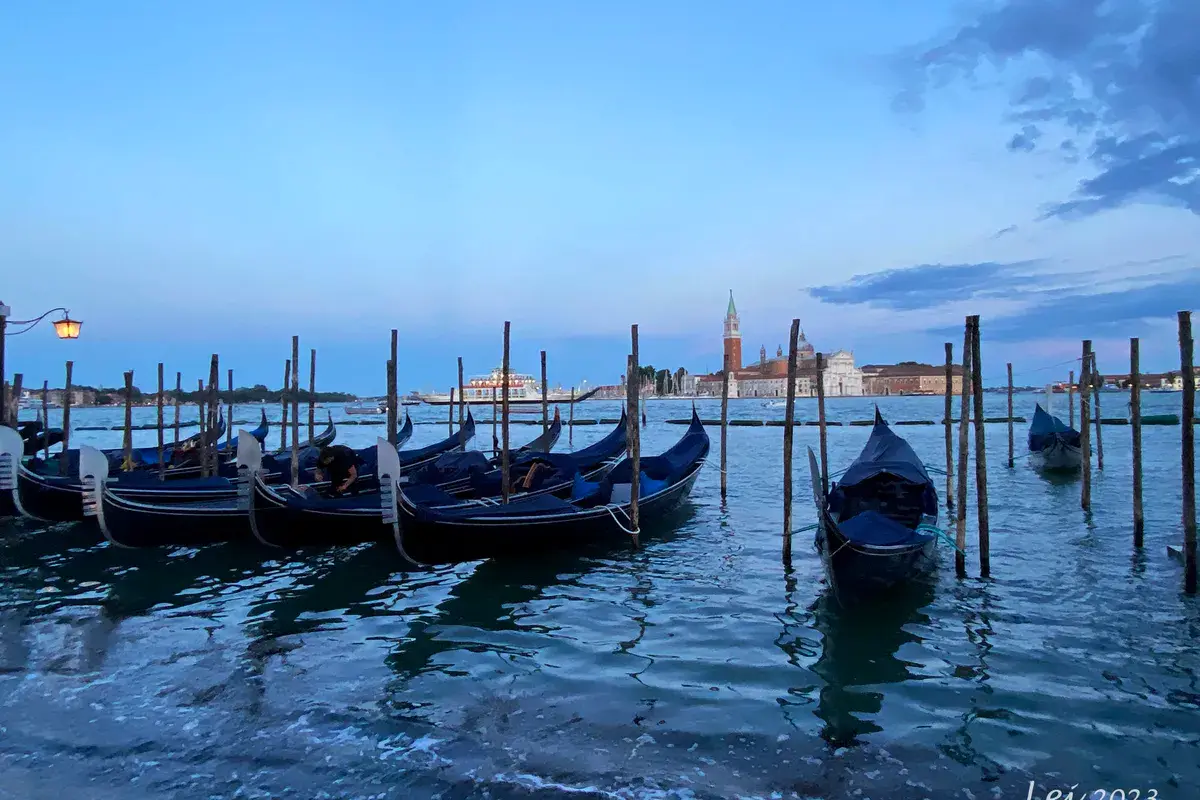
The basilica, the columns of St. Mark and St. Theodore—guardians and gateway of Venice—the Doge’s Palace with its distinctive style, the pier lined with gondolas: iconic images of Venice. Once a watercolor subject, now I sat peacefully on the pier in the sapphire dusk, tourists gone, gondolas clattering against posts in the small waves, my family on the stone ledge, absorbing it all. A beautiful moment.
After dark, the crowds thin, lights glow, the sky still blue, photos feel almost medieval. Dinner at a canalside table—pizza and pasta—our first real taste of Venice.
Day two: leaving the hotel, we looped anticlockwise: Basilica dei Santi Giovanni e Paolo — Rialto Bridge — Rialto Market — Chiesa di San Stae — water bus — Basilica di Santa Maria Gloriosa dei Frari — Accademia Bridge — Campo Santo Stefano — Santa Maria del Giglio — St. Mark’s Square — back.
Standout memories: the marble Rialto Bridge, truly Venice’s most luxurious span—broad, ornate. Early morning, delivery men were already crossing. The unplanned fresh market felt wonderfully real: seafood arriving by boat, seagulls waiting in back alleys for discarded fish. A city alive, better than many water towns in China, though scale differs.
Viewing the Basilica di Santa Maria della Salute from Accademia Bridge is another definitive Venice image. All the pictures came to life; now I knew.
After resting in the afternoon, at 4 p.m. we took the boat to Lido Island—quick like a ferry, Lido is long with buses. We saw the beach, nothing special, merely the Adriatic side of Venice, Croatia opposite. The sand was coarse, water chilly, few people; private beaches filled with deckchairs. The Venice Film Festival is held here. The island serves as a barrier protecting the lagoon.
Venice day two: cloudy, rain, cold. Early morning, we boarded the boat at Fondamente Nove to Burano, about an hour. The colorful houses are charming—not ornate, more rural simplicity, painted in every hue. Worth a visit. Same bridges and canals, different style.
In heavy rain, we persisted to Murano. My daughter shivered. We found a restaurant right off the dock, pizza, pasta, burgers to warm up. As we ate, the rain stopped, sun emerged. Murano was where Venice’s glass production moved to prevent fires. Architecture sits between Venetian and Burano style—neither grand nor plain. Shops everywhere selling glass art, prices high. I hoped to see a blowing workshop but didn’t; small regret.
In the afternoon, I took my daughter to Liberia Acqua Alta, the so-called most beautiful bookshop. It’s nice, small, creatively upcycling. But almost all books were in Italian, hard to buy. A line of tourists for photos. The owner must be tired, daily chaos, probably earning little.
Later, we boated to Accademia Bridge again, hoping for softer evening light and better photos. Wandered unexplored alleys. Venice’s beauty is that every lane is beautiful, each perspective different, every canal similar yet distinct. Time slips away. I imagined being a girl born here centuries ago, walking these paths, claiming a canal-side house as my childhood home, the small square and well with chatting elders. I’d even choose my favorite house. A dreamlike ancient city, Venice induces a feeling of stepping into another century—love at first sight. My daughter said, “If I had money, I’d buy a house in Venice.” The highest praise. Evening, my son’s birthday: we ate at a place he’d researched, tasty.
————————————————————————————————————————————
Next day, a grueling transfer: four train journeys from Venice to the dreamy alpine village of Grindelwald at the foot of the mountains. Heading to Switzerland, my long-awaited fairy-tale kingdom.
Changing trains in Milan, Spiez, and Interlaken, leaving at 7 a.m., we arrived exhausted at our Grindelwald hotel at 5 p.m. The scenery along the way was breathtaking. Even on the flight into Milan, we’d seen the snowy crests of Europe’s rooftop; now we were right before them.
Our hotel in Grindelwald sat beside the First cable car station. Pushing open the window, the Eiger greeted us. A long day, from water city to snowy peaks. Dusk comes late. We went to COOP for takeaway: bread, fruit, milk, roast chicken—90 francs! Outrageously expensive! Eating out would be 25–30 francs per person, and even coming from Hong Kong I found it unaffordable.
Next morning after breakfast, up First Mountain. Cable car tickets not too costly, three quick stages. On top, it was windy and chilly, need a jacket. But the scenery made us all giddy: wildflowers everywhere, the majestic Eiger as backdrop, small cliffside view. We chose to hike to Bachalpsee alpine lake. The sign said 50 minutes, but the altitude and uphill climb made it strenuous. Yet the views along the path were superb, leftover snow visible. At the lake, with good weather, we saw distant snow-capped peaks mirrored, and yellow globe flowers near the water. I thought similar scenes are common on the high plateau of western Sichuan, but there it’s hard to reach; here a cable car gets you to 2,000 meters without altitude sickness.
Returning was easier, downhill, the route familiar. We rested on a flower-strewn meadow, embraced by the mountains.
On the cable car descent, we got off at the second station. My husband took the kids on mountain carts—not a single photo taken. I waited at Bort station while they finished. Bort has a playground, great viewing platform, and a path down on foot, though too steep for the elderly. My parents took the cable car straight back to the hotel. With the kids, we walked down, wanting more time on that magical slope—truly a once-in-a-lifetime experience. The sunshine and alpine pastures will stay in memory.
Halfway down, a bus stop took us to the hotel doorstep. A beautiful, sunny day, wildflowers in bloom, hugged by the mountains—forever etched in mind.
On the second day in Grindelwald, my husband had to go to Germany first, so he dropped us at Interlaken. By 10 a.m. we checked into a splendid but pricey hotel with air conditioning and a balcony, a historic property. Left luggage, then took a Lake Thun cruise. Boats every hour; we arrived just as boarding started. Not too crowded, Swiss Travel Pass got us on. Sitting outside, midday sun broiling—coinciding with the hottest week on record, even in the European rooftop it was scorching. The boat made multiple stops: people swimming, visiting caves, taking cable cars—lots of options, though the lake water remained cool. Visibility wasn’t great, a constant haze obscuring distant peaks.
About an hour later, we reached Thun, right in the middle of a triathlon. By the water, people clapped for competitors under shady trees. High noon, too hot. The train station was just by the dock. We ate Subway, then explored the small old town, a castle on a hill. Watched local boys queuing to dive off a bridge—so carefree, plunging into the turquoise torrent. On another bridge, older kids surfed a standing wave. That’s youth to envy.
Brief stay, everyone was done with the fierce sun, so we trained back to Interlaken, passing Spiez. After a while, small towns all looked alike, same topography and chalets, the novelty faded.
Back in Interlaken, fierce sunshine still—news spoke of a European heatwave. We went out after 6 p.m., the sun still brilliant, casting long shadows on golden streets. Took my daughter for ice cream near the central green, then sat on a bench, gazing at the meadow and the snowy peaks behind, chatting. Lovely.
Dinner at an Asian restaurant by the hotel: staff from Southeast Asia, so the Chinese and Korean food wasn’t authentic, yet still expensive, around 25 francs a head.
Day three in Switzerland: back up the mountains, this time to Lauterbrunnen, the valley of waterfalls. Using the Swiss Travel Pass, we took the train up the right fork. The village stretches along a glacial stream, with paths leading to Mürren by cogwheel train.
First, we checked the waterfall—not full flow, just a slender ribbon. For a photo, I climbed high to snap the village panorama; the kids waited below.
Then the cogwheel train to Wengen, a smaller, higher-up village. Both Lauterbrunnen and Wengen have hotels, but I worried about medical access at night and avoided staying too remote. From Wengen, some continued to Kleine Scheidegg for Jungfraujoch. Not going to Kleine Scheidegg was a tiny regret—I first heard that name in Mark Twain’s account of climbing Jungfrau.
From Wengen, we took a cable car to Männlichen, then another down to Grindelwald—an effortless journey. The view from Männlichen’s summit was too beautiful: snowy peaks, alpine meadows, blue sky and white clouds—picture-perfect. Sitting there, enjoying the heavenly scenery, the mountain breeze. I took the kids to the crown overlook, with views of Lake Interlaken far below and villages at our feet. That day, the sun shone and the mountains were painted perfectly.
The kids played at the summit playground. Wheelchair users also rode the cable car up—Swiss transport is incredibly developed: mountain rail and various cable cars weave an amazingly convenient network, allowing even those with mobility issues to sit before snowy peaks.
The descending gondola was mid-sized; we watched hikers along the route, families out with children, cow-spotting, with stations to hop off.
Day four in Switzerland: train to Lucerne, the big city of lakes and mountains. And the Golden Pass route! One train per hour, not crowded this summer. Sit on the right facing forward for better views. First passing Lake Brienz, only opening up at its end. The weather was hazy, photos didn’t turn out well. Later, Lake Lungern appeared—unexpectedly stunning, a peacock-blue sheet of water so calm it looked dyed, a fairy-tale lake.
Two hours to Lucerne, which felt metropolitan. In the afternoon, near the hotel, we saw the Dying Lion—incredibly lifelike, though restoration work was ongoing; at least we saw the real thing.
Then to the old town and Chapel Bridge (Water Tower Bridge). I came here because of this bridge; it is beautiful, a romantic sentiment, festooned with flowers, the interior painted with scenes. A pursuit of spiritual richness.
Evening, we sat by Lake Lucerne, glittering in the light, layered distant hills—this landscape more graceful than the Three Gorges, grander than West Lake. Switzerland: magnificent lakes and mountains!
Next day, a boat across Lake Lucerne to Mount Rigi, a free trip with the Swiss Travel Pass. From the station pier 1 to Vitznau, then cogwheel train up. Midway up, a storm hit—howling wind, thunder and lightning. The train even stopped, power off, waiting it out.
Temperature at the summit was low, with rain. My daughter felt cold, so we didn’t linger, nor take the cable car/boat back in the chill. Took the warm train down to Arth-Goldau, then rail to Lucerne. The two-carriage cogwheel train in torrential rain through a deep forest—a memorable peculiarity.
After resting, we headed out again to see the Musegg Wall. Coincidentally, another thunderstorm, then a heavy hailstorm. My son saw hail for the first time. We couldn’t find the entrance and didn’t go in. Spreuer Bridge looked ancient; it had been rebuilt after fires, yet kept its old appearance. Under its roof, many triangular paintings depict the 14th-century Black Death, skeletons encircling people—thus called the Dance of Death.
Rain came in waves, temperatures low. As dusk fell, streets grew quiet. We sheltered on Chapel Bridge, leaving a memory of dodging rain on the long covered bridge. Watched ducks paddling, the restaurant lights reflected in rain-slicked cobblestone, the distant sheets of rain blurring the bridge. Cold, like deep autumn, not summer. A high-mountain country—a rainstorm felt like fall. People without umbrellas ran into the bridge to hide. That’s why this covered bridge exists: romantic and practical.
I love sunny Switzerland for its high peaks and lakes; I also love rainy Switzerland for its drifting emotions.
Chinese food in Lucerne also wasn’t cheap, 22–25 francs a head, and not particularly tasty.
Day six in Switzerland, transferring to France. We clumsily bought a train to Zurich, then a 13:34 Zurich to Paris Gare de Lyon train. Better would have been direct to Basel, then Paris.
After a long morning rest, we didn’t explore Zurich. At Zurich station, we had delicious grilled sausage hotdogs. Arriving in Paris around 6 p.m., our Holiday Inn was close to the station—clean, neat rooms with a balcony. We were on the top floor, looking over Paris’s spreading rooftops of similar height, plane trees out front, many leaves fallen.
——————————————————————————————————————————
Paris dusk comes late. In the evening, we ate at a nearby bistro called “That Little Restaurant.” Finally, food freedom in Paris—everything seemed cheap. 8 or 10 euros a dish, we ate heartily, finally satisfying my Chinese palate.
Next day was July 14, Bastille Day. In the morning, nothing went smoothly. Military parade, many roads near Place de la Concorde closed, eight metro stations shut. Couldn’t exit, so we backtracked to the Louvre station, emerging just in time for the flyover—jets trailing red, white, and blue smoke. A first for me, seeing the parade.
Last time in Paris was also Bastille Day, watched the Eiffel Tower fireworks at midnight. This year, the parade. Complete.
Then took my parents to see Notre-Dame, now just a shell after the fire. No longer the same. Strolled along the Seine, tour boats passing. Near the Jardin des Plantes we hopped on a boat, heading back towards the Eiffel Tower.
Got off at Place de la Concorde, the Pont Alexandre III with its gilded sculptures dazzling, the square still cordoned by police. Sat under riverside trees, then resumed the boat to the Eiffel Tower—closed after 2 p.m. for the national holiday, only a distant view. Metro to the Arc de Triomphe, draped with a huge French flag. Massive, undeniably beautiful in its strength!
After sightseeing, back to the hotel. Evening, so-called Japanese food, mostly Chinese-run, mediocre taste—no respect for raw seafood. In Paris, many street-side Japanese places are Chinese-run, perhaps easy to operate, but nowhere near Japan, even far from Hong Kong, just family-style.
Next day, took my parents to the Louvre. Didn’t book in advance, arrived at 8:30, queued an hour. Afterwards, took the kids to Disneyland Paris, two parks, entered at noon, finished at 8 p.m. (park open until 11 p.m.). Disneyland Paris is brilliant—cool, pleasant weather, not very crowded, longest queue under 20 minutes. Varied rides, plenty of show seating. Highly recommended, compared to sweltering Hong Kong and packed Shanghai.
Day three, preparing the journey home. Flight at 11 p.m. Skipped Versailles; parents felt palaces are similar, kids and I had been before. Headed nearby to Place de la Bastille, then free entry to Victor Hugo’s House. Happened upon Marché Bastille, a weekend street market: flowers, fruit, vegetables, grilled sausages and flatbreads, small goods—my kids and I were sorely tempted.
Victor Hugo’s house was small; my daughter bought an English edition of Notre-Dame de Paris.
Strolled, relaxed, like an ordinary Parisian, tasting local life rhythms. To the Tuileries Garden, where a carnival was on. Tried the Musée d’Orsay, but with two hours until closing and still a long queue, we gave up. Returned to the Tuileries, napped on the famous green metal chairs, waiting for departure time.
Seventeen days total, fifteen days of travel. A European journey with my parents: Italy’s Renaissance architecture, Switzerland’s snowy peaks, tranquil lakes and villages, Paris’s effortless elegance. France, Italy, Switzerland—Europe’s representatives. The trip was safe and smoothly completed.
Back home, I scroll through countless brilliant photos, those moments frozen. What a beautiful present—live well in the moment.


