Hokkaido – Otaru, Sapporo – A World of Snow, A Paradise of Desserts
Transit through Nagoya to Sapporo. Two-plus hours is enough to clear customs, collect luggage, and switch terminals. You need to fill out a form before clearing customs. You can fill it out in advance or scan a QR code and fill it online. If the online form doesn't work, you can fill out a paper one—no need to waste time. The main content is personal information and your hotel address in Japan. Landing in Nagoya, the first impression is still cleanliness. Small as it may be, it has all the essentials. The airport restrooms have everything you need, and there is even a prayer room. Nagoya Airport has a 'Flight of Dreams' exhibit featuring a Boeing 787 that you can board and tour.
I chose to stay at the Tokyu Stay hotel. This is a Japanese chain; I've stayed at one in Tokyo before. The room is not large but still has a bathtub. Downstairs, there are free toiletries and tea bags. Importantly, the room has a washer-dryer. I'm not sure if all rooms have one, but the ones I stayed at in Tokyo and Sapporo did. It is incredibly convenient. Especially after skiing, when clothes and pants are soaked, you can dry them right in the room.
Otaru. You can take a bus or train from Sapporo to Otaru. The bus was more convenient from where I stayed: direct and cheaper, 730 yen. The train requires a transfer and costs 1,800 yen. The trip takes about one and a half hours. The bus from the airport to Sapporo accepts cash and gives change. The bus to Otaru accepts cash but does not give change, so you need to have exact change ready. You can also pay with a Suica card—tap on and tap off. I bought a Suica card at Otaru Station; it was quite convenient to tap for the return trip. Funezaka Slope, Otaru Canal, the various shops in Denuki Koji, the Music Box Museum selling all sorts of music boxes—a dazzling display. Kitaichi Glass is a world of glass. LeTAO, Rokkatei, and others are a world of food. At the same time, I once again experienced the thickness of Hokkaido snow. Before the trip, I read other travelers' tips and prepared crampons, which proved very useful.
The bus makes three stops in Otaru. We got off at Otaru Station, and right next to it is Sankaku Market, a seafood market where you can buy and have it cooked on the spot, or eat a set meal. Not far from the market, cross the railway tracks, and you'll reach Funezaka Slope. Then walk towards Otaru Canal; following the canal will lead you to Denuki Koji. At the end of Denuki Koji is the Music Box Museum. A few minutes' walk from there, you'll find Kashiwa Shrine Station, where you can catch the bus back to Sapporo.
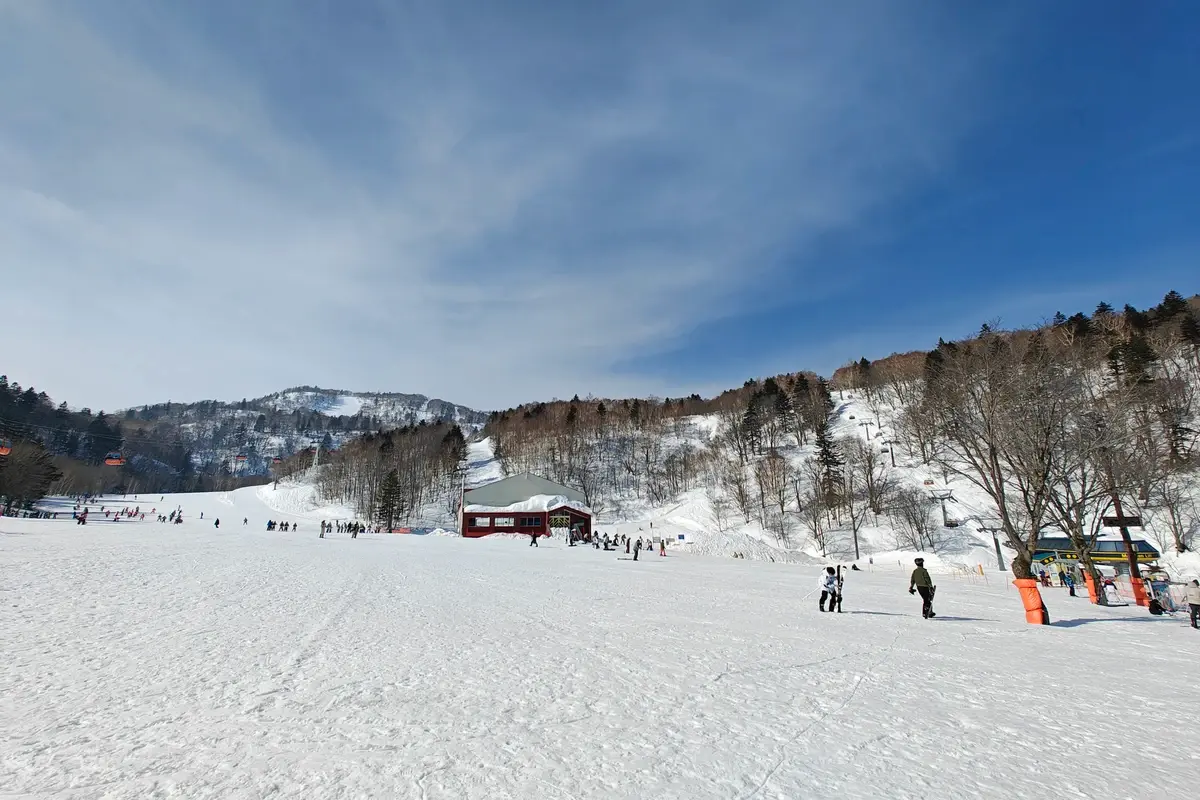
Sapporo International Ski Resort. It seems that Japanese ski resorts don't have buses that go directly to the resort entrance; the last few kilometers require walking or a taxi, which is expensive. Sapporo International Ski Resort has a dedicated bus that picks up and drops off at several stops within the city. See Figure 1 for the bus schedule and stops. I boarded at Sapporo Bus Terminal, platform 9. The bus was already nearly full, so I could only get a seat by the window. To be safe, it's better to board at an earlier stop. A one-way ticket costs 1,300 yen. You can buy a round-trip ticket plus a one-day lift pass package for 6,000 yen. After arriving at the resort, first go to the basement level to fill out a form (mainly personal information, ski or snowboard, boot size, whether you're renting only boots, skis/snowboard, and poles, or including a ski suit and helmet), then pay at the cashier. Take the receipt to get your equipment. Change in the locker room; lockers cost 400 yen per use (once you lock it and open it, that counts as one use). After changing, head into the ski area. Inside, you buy a magic carpet ticket or a lift ticket. A magic carpet ticket for the whole day is 1,500 yen. Looking at it, it's a very short stretch, not really worth it. A lift ticket for the whole day is 5,000 yen. If you add a 980 yen lunch voucher, the combo is 5,500 yen. A single ride is 390 yen; a 4-hour pass is 3,900 yen—you can choose based on your skill level. After buying the lift ticket, you get a card that automatically senses when you go through the lift gate. I'm a total beginner, so it took me over an hour to tumble down from the summit. I should have bought a per-ride pass. Although there are beginner slopes (green runs) coming down from the summit and mid-mountain, there are still several steep sections and big turns. I fell in all sorts of poses. After skiing, first change in the locker room, then return the equipment. Be sure to bring dry underwear. A ski suit and pants are also necessary; otherwise, your clothes and pants will be soaked through—whether from snowmelt or sweat. Next to the service center is an automatic card return machine; insert the lift card, and it will automatically refund the 500 yen deposit. The return bus is right at the right side of the ski center exit. This was my first experience at such a ski resort—painful but happy. At the same time, I wasted quite a bit of money.
Shiroi Koibito Park. It's a small garden, with a four-story building. Admission is 800 yen (the garden is free). Just follow the tour route. The first floor is the ticket counter and a theater showing the history of chocolate. The second floor is the professor's collection. On the third floor, you can see the production process of Shiroi Koibito. The fourth floor has an experience hall (reservation required; mostly children making cookies), etc. On the second floor at the exit is a café, and on the first floor is a souvenir shop and a chocolate product store.
Three stops from Shiroi Koibito is Maruyama Park, which houses Hokkaido Shrine. Covered in heavy snow, it's nice for a leisurely stroll. In winter, crampons are very practical in Hokkaido. I don't know why there are so many crows here; even in busy areas like Odori Park, Susukino, and Tanukikoji, you can hear their caws.
At the exit near the park's subway station, there is a soup curry shop that tastes very good.
Sapporo's Tanukikoji is very much like Osaka's Shinsaibashi. Susukino's entertainment district is not far from Tanukikoji—perpendicular to it.
Sapporo also has streetcars.
Before leaving Hokkaido, I learned why the snow is so thick: Hokkaido's snow is like London's rain—it starts and stops at a moment's notice. After just one hour of snowfall, small snowplows are already clearing the streets. Highways remain open, and elderly bus drivers don't slow down. New Chitose Airport has all kinds of delicious food: desserts, ice cream, chocolate, and more. However, the popular 'Sapporo Nōgakkō' pastry requires a 20–30 minute wait. The airline I took, Spring Airlines, only opens check-in one and a half hours before departure, which is a bit different from domestic flights in China. So if you arrive early, you can browse first and check in when it's time. Unlike in China, where you check in hours in advance and then go shopping. I don't know how other airlines handle this.
Hokkaido has so many delicious things, especially desserts. In Otaru's Denuki Koji and almost every major shopping mall in Sapporo, there are many shops selling pastries and sweets. LeTAO, Rokkatei, Beigourou, Shiroi Koibito, ROYCE, Sapporo Nōgakkō, Ryūgetsu, and many more. Soup curry, Kanihonke (reservation required, otherwise you usually can't get a seat), Kanishōgun—countless options. But if you see something, buy it—many items are not available outside Hokkaido.
I've never seen such set meals at Yoshinoya in China.
Hokkaido's drugstores are not as numerous as those in Osaka, and the selection is average. Importantly, language communication in Hokkaido is a challenge: neither Chinese nor English works very well, though a combination of Chinese, English, and gestures can get the gist across. If you bought a transportation card in Hokkaido and want to refund it, you can only do so in Hokkaido; it cannot be refunded in Tokyo. However, you can still use it in Tokyo.
Travel diary table of contents: 1. Otaru 2. Sapporo International Ski Resort 3. Sapporo – Shiroi Koibito Park, Maruyama Park, Hokkaido Shrine 4. New Chitose Airport 5. Paradise of Desserts 6. Final Notes Travel information Hotel index Strategy index Ticket index Website navigation Travel index Cruise index Corporate travel index Alliance cooperation Distribution alliance Friends links Enterprise gift card procurement Insurance agency Agent cooperation Hotel franchise Destination and scenic area cooperation More alliances Cooperation about Ctrip About Ctrip Ctrip highlights Contact us Careers User agreement Privacy policy Security center Ctrip content center Intellectual property Trip.com Group Algorithm disclosure


