Are You Ready for a Time-Travel Journey Across Ancient and Modern Seoul?
Study tour keywords: tracing ancient times + development + future + fun, traversing past and present to experience urban changes
Route: National Museum of Korean Contemporary History - Gyeongbokgung Palace - Cheonggyecheon Stream - SK Telecom T.um ICT Experience Center - Running Man Theme Experience Center
Every day we live, we travel through time; all we can do is make the most of this extraordinary journey.
——"About Time"
I think you must love the national changes described in history class, the mighty tide surging forward, transforming a flat land into rows of towering buildings and vast, wide roads. Then you begin to fantasize: can you one day ride a time machine back to the past? Yes, we did it. In our wonderful study tour plan, there is a magical place that lets you travel through time and experience different moments. That place is Seoul, South Korea. This grand time-travel journey across ancient and modern times not only allows you to feel the magnificent changes of history but also lets you experience novel and different things, learning a lot of interesting and valuable knowledge. It is especially suitable for middle and high school students' study tour plans. So why not? Hop on the time machine and journey with us. I know you are intrigued.
First stop spanning ancient and modern times: The treasure trove of historical archives – National Museum of Korean Contemporary History
The National Museum of Korean Contemporary History officially opened on December 26, 2012. This treasure trove of Korean history records major events in Korea from the late 19th century to the present. To share culture with the people, the museum was established through exchanges, research, surveys, and data collection, showcasing the history of the Republic of Korea that has continuously developed through hardships and adversity.
The museum explains Korean history from different eras through four exhibition halls. Hall 1 introduces "The Stirring of the Republic of Korea," Hall 2 introduces "The Establishment of the Foundation of the Republic of Korea," Hall 3 introduces "The Growth and Development of the Republic of Korea," and Hall 4 introduces "The Republic of Korea's Progress and Move Toward the World." In "Our Historical Treasure House," visitors can experience and learn about Korean modern history. In addition, there are special exhibitions on various themes of modern history, allowing deeper understanding of the content and meaning of Korean modern history. The museum also operates various educational programs and cultural activities, adding more educational value to our study tour, expanding our knowledge, and allowing us to empathize with the vast history of Seoul's development.
Address of National Museum of Korean Contemporary History: 198 Sejong-daero, Jongno-gu, Seoul
Opening hours: 10:00-18:00 (extended to 21:00 every Wednesday and Saturday; closed on January 1, Lunar New Year, and Chuseok)
Second stop of splendid elegance: Ancient cultural palace – Gyeongbokgung Palace
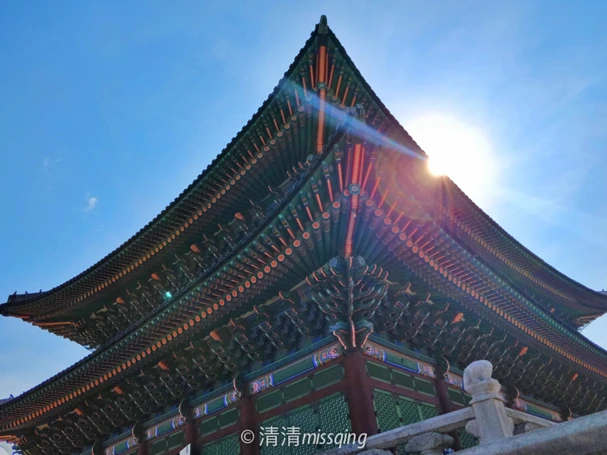
Gyeongbokgung Palace is one of the five grand palaces of Seoul during the Joseon Dynasty (1392-1910) and the main palace of the Joseon Dynasty. It was built in 1395 by Yi Seong-gye (reigned 1392-1398), the founder of the Joseon Dynasty, when he moved the capital from the previous Goryeo Dynasty. It has a history of 500 years. The name Gyeongbokgung comes from a verse in the ancient Chinese Classic of Poetry: "May the lord live ten thousand years, and may his blessings be as vast as the land." It is also called "Bukgwol" (North Palace) because it is located in the northern part of Hanyang (old name for Seoul).
Gyeongbokgung is one of the largest and oldest palaces in Seoul and was the political center of the late feudal period in Korea. It comprises over 200 buildings, with architecture resembling Chinese palace gardens. The main hall is Geunjeongjeon Hall, the central building of Gyeongbokgung, where kings of the Joseon Dynasty handled state affairs. Other halls include Sajeongjeon Hall, Gangnyeongjeon Hall, Gyotaejeon Hall, and more. There is also an elegant ten-story stone pagoda called Gyeongcheonsa Pagoda, one of Korea's national treasures.
The stone pavilion built on a lotus pond, Gyeonghoeru, was used by kings to host banquets. In 1553, a fire destroyed part of the palace's northern corner. In 1592, during the Japanese invasions, most of the palace's buildings were damaged. When it was rebuilt in 1868 (the 5th year of King Gojong's reign), only ten halls remained intact. The buildings that have survived to this day include Geunjeongjeon Hall, where the king's coronation and court ceremonies were held, and the two-story Gyeonghoeru, which served as a reception hall.
Entrance to Gyeongbokgung requires a ticket, priced at 3,000 won per person. However, wearing a hanbok allows free entry. Taking photos in hanbok gives a sense of being in ancient Korea. It is recommended to consider renting a hanbok nearby. If visiting in winter, keep warm. Here, I’d like to introduce a hanbok shop near Exit 4 of Gyeongbokgung Station called "YES Hanbok." The hanbok designs there are very new, prices are reasonable, and they also do hairstyles, etc. You can check it out.
Gyeongbokgung occupies a large area and is also a filming location for many Korean dramas. There are many museums nearby, and commercial facilities are convenient. The alley to the west has many restaurants. After visiting Gyeongbokgung, I recommend walking to the famous Tosokchon Samgyetang for a meal. This restaurant is very famous in Korea and usually has long queues. The entire restaurant is designed in a hanok style, and you need to take off your shoes to enter. There are Chinese-speaking staff, so language is not a problem. Their chicken is fresh, using young chickens weighing about half a kilogram, and the soup is delicious, simmered for a long time and rich in nutrition. Many high-ranking government officials are regular customers. Besides samgyetang, their dolsot bibimbap and kimchi jeon are also delicious; I recommend trying more dishes.
This history-rich study tour fills our hearts with warmth, perhaps because the stories of Seoul deeply moved us.
Address of Gyeongbokgung Palace: 161 Sajik-ro, Jongno-gu, Seoul
Opening hours: January–February & November–December: 09:00–17:00; March–May & September–October: 09:00–18:00; June–August: 09:00–18:30; closed every Tuesday
Ticket price: Adults 3,000 won, Minors 1,500 won
Third stop of winding streams: Urban ecological symbol – Cheonggyecheon Stream
Cheonggyecheon is a stream in the heart of Seoul, South Korea, with a total length of 10.84 km and a total watershed area of 59.83 km². During the Joseon Dynasty, it was called "Gaecheon." After Japan's occupation of Korea, it was renamed "Cheonggyecheon." Before Seoul was designated as the capital in 1394, Cheonggyecheon was a natural stream. The geographical feature of being surrounded by mountains caused water to naturally converge in the low-lying city center of Seoul. Therefore, even before the Joseon Dynasty improved the city's waterways, a natural stream already flowed there. From the 1950s to the 1960s, due to economic growth and urban development, Cheonggyecheon was covered and turned into an underground sewer. The water quality deteriorated due to sewage discharge, causing a foul smell. Starting in 2003, through the Cheonggyecheon Restoration Project, it was rebuilt into a leisure area combining landscape and urban ecology in the heart of Seoul.
It is worth mentioning that from November 1 to November 17 every year, beautiful lantern decorations line about 1.2 km from Cheonggyecheon Square. Each lantern has a screen introducing its origin or telling a fairy tale. You can also purchase materials to make your own DIY LED water lantern and release it into the stream, creating a dreamy atmosphere. This is the famous Lotus Lantern Festival in Seoul. This study tour not only enriches historical knowledge but also allows you to experience a traditional Korean festival, making it truly meaningful.
Address of Cheonggyecheon Stream: 31-1 Taepyeong-ro 1-ga, Jung-gu, Seoul
Opening hours: 24 hours
Fourth stop of rapid change: Modern technology – SK Telecom T.um ICT Experience Center
T.um means "taking root and sprouting" in Korean, which fits perfectly with SK Telecom's future-oriented experience theme at the ICT Experience Center. The goal is for SK Telecom's cutting-edge technology to take root and sprout everywhere in the future development. The center features a 4G high-speed internet environment, and various state-of-the-art devices present a unique online world to visitors. Unlike traditional exhibition halls focused on performance experiences, this center emphasizes IT technology as the core, building a convergent future industry, providing visitors with a new sensation through high-end network technology, expanding broader business cooperation fields, and guiding the future direction of the network industry.
The experience center is divided into two floors. The first floor is the "Now Hall" (Virtual Reality Zone, Self-Driving Vehicle Zone, Smart Zone, 5G Base Station), and the second floor features a future-type capsule high-speed train, space control center, shuttle flying medical room, hologram conference room, etc. The center also operates a story-based experience program called "Highland," where you can experience the world 30 years in the future and enjoy a scientific feast.
Photography is not allowed inside the experience center. However, if you participate in an experience, you can take a 360-degree group photo, which is sent to visitors via email. The combination of science and practice enriches our study tour, enhancing our actual experience while making us feel the powerful charm of science. It is a worthwhile trip, and we grow through happy learning!
Address of SK Telecom T.um Experience Center: 65 Eulji-ro, Jung-gu, Seoul
Opening hours: Monday to Friday, 9:00-18:00 (closed on weekends, public holidays, and the last Monday of each month)
Ticket: Free (reservation required; maximum 10 people per group per day)
Fifth stop igniting passion: Energetic – Running Man Theme Experience Center
Located on the basement floor of SM Duty Free Shop in Insa-dong, the Running Man Theme Experience Center is very conveniently situated. After arriving at the entrance of SM Duty Free Shop, walk down the stairs, and you will gradually enter the world of Running Man. At the entrance, you'll see a Running Man backdrop for photos, as well as introductions to various challenge zones. These challenge zones are game levels designed based on classic scenes from Running Man over the past ten years! If you are a die-hard fan, you will surely feel nostalgic once inside.
After entering, you can store your luggage in lockers and then head to the counter. Please note that because the games are physically demanding, it is recommended to minimize outerwear and personal belongings. After a brief explanation from the on-site staff, choose your team and officially start the game.
In addition to tourists from various countries, there are also many Korean students playing here. Truly worthy of being the representative variety show of the Republic of Korea, its influence is immense.
During the game, if you don't understand the rules, you can ask staff to assist and explain. After the challenge time ends, there's no need to rush off. You can take a break, take photos in the game area, etc. The Running Man Theme Experience Center is a fun attraction suitable for all ages. Whether you are a hardcore RM fan or not, this experience will leave a deep impression during this study tour.
Address of Running Man Theme Experience Center: B1, SM Duty Free Shop, 41 Insa-dong 5-gil, Jongno-gu, Seoul
Opening hours: Daily 10:00-20:00
Ticket: 16,000 won per person
In a brief moment, like a fleeting glimpse, you ride the time machine through the heart of Seoul, crossing the past, present, and future. You feel regret seeing the filthy, dirty Cheonggyecheon of the past but are relieved by its present state; you feel pain seeing the dilapidated Gyeongbokgung of the past but are happy for it now; the SK Telecom T.um Experience Center opens a door for you to peek into the future world, letting you experience the wonders of technology... Time is unpredictable, and we travel through every day. The various sights of Seoul surely give you a memory of time. You love this time travel and thus gain more life insights. We promise to meet again in Seoul.
Meeting you in the endless flow of time makes me stronger than anything else.
——"The Girl Who Leapt Through Time"


![[Jia You Station] April 2014 -- Seoul, South Korea, Leisure Trip](/img/71e55889d3e90c3c_s.webp?src=https%3A%2F%2Fdimg04.c-ctrip.com%2Fimages%2Ftg%2F553%2F846%2F888%2F03c8c0ac5b104d108ab6ef884058352f_W_320_0_Q80.jpg)
