Seoul Art Restaurant—Shihuatan
Turn your ordinary life into a poem, a painting, a beautiful story long remembered.
Poem? Painting? Conversation? —"Shihuatan"
As a design capital, Seoul is filled with design everywhere—from traditional clothing design to architecture, from book covers and binding to the decorative storefronts of cafes on every street. It keeps us living in design aesthetics every moment. And one of the newest buzzwords in Korea—food styling—is the inevitable result of design extending into the culinary world. In the field of food styling, “Shihuatan,” which already has two fine-dining Korean restaurants in Seoul, is undoubtedly a leader.
Located in Itaewon, Yongsan-gu, Seoul, Shihuatan looks nothing like a restaurant from the outside or inside. Even when the dishes arrive, we still wonder: Is this a restaurant? Is this food edible? The floor-to-ceiling glass windows and the stylish, minimalist white tone make it look more like a chic art boutique. Pushing the door open seems to confirm that impression: the first floor may be small, but it displays antique furniture from the Joseon period, famous paintings, modern Western artworks, ceramics, and other antique treasures. The large room on the second floor is not only a dining space but also a stage for enjoying traditional Korean music, and at times it transforms into a gallery, breaking down spatial barriers to become a true multi-cultural space. The third floor, with its ceramic gallery and open kitchen, brings culinary art closer to the diner. Room names here include “Gathering Abundant Azaleas,” “For the Blooming of Chrysanthemums,” and “Plum Blossoms of Seomjin River.” At this point, we have only had a first taste of “poetry.”
The Korean government-led “Korean Food Globalization” project has, after years of international refinement, elevated Korean cuisine from the level of color, aroma, and taste to a realm imbued with Eastern spirit, telling a unique culinary language, showcasing a fresh impact on both sight and taste. At Shihuatan’s table, poetic sentiment flows and painterly imagery blossoms. Every dish tells a story with a plot, surprising us again and again.
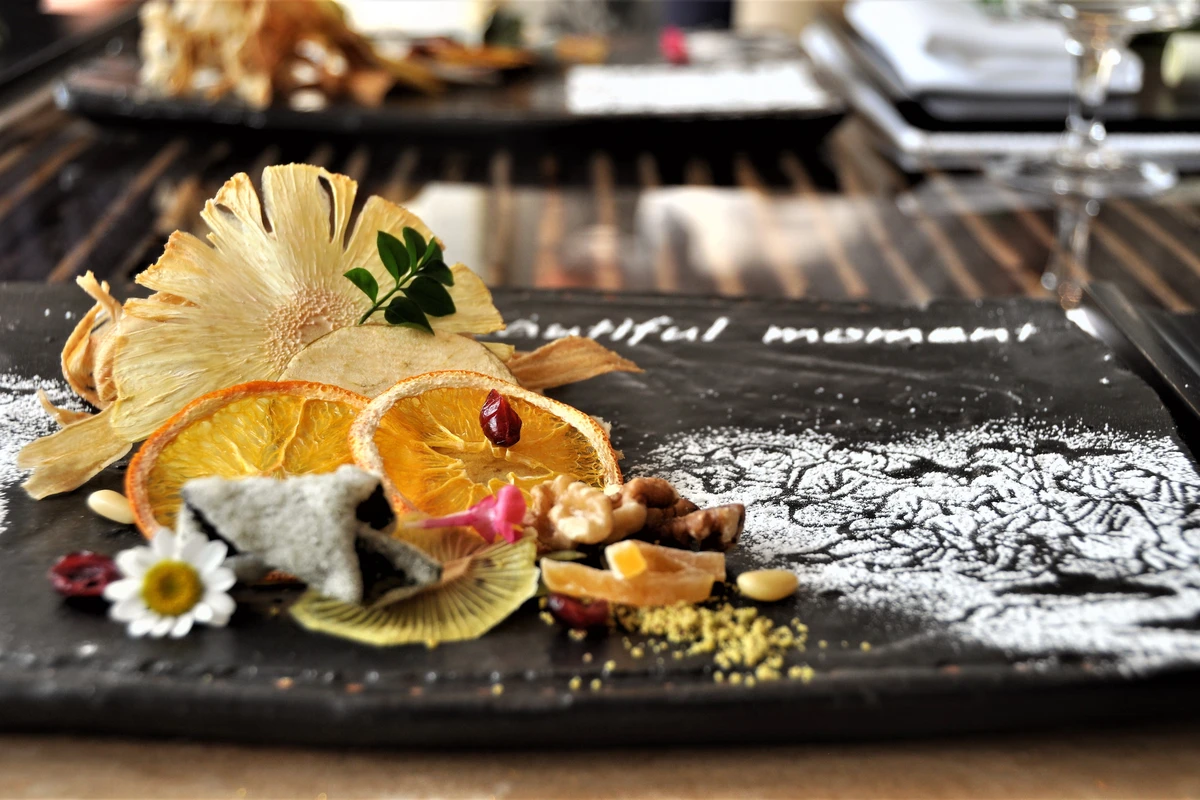
In the waiting area, we tasted a sweet-and-sour plum drink that seemed to awaken every sense in our mouths. Then a cup of “White Lotus in Full Bloom” brought us back to a tranquil state—this tension and release felt like the prelude to an artistic feast! Finally, after much anticipation, even though our expectations were high, this healthy appetizer still struck us with awe from every angle. Using powdered sugar, they painted a refined lady in hanbok, a long-sleeved dancer, and a line from pop art master Roy Lichtenstein’s famous work “Happy Tears”: “Who stole my heart?” All accompanied by colorful seasonal fruits and dried vegetables, leaving us utterly unable to touch this exquisite dish that was like poetry and painting.
Hwang Jini, the famous gisaeng of the Joseon period, even became the name of a dish. The foods placed on these three white vessels are presumably Hwang Jini’s “headpieces”: on the left, a small skewer of nuts serves as a hairpin; in front, cucumber slices, precious mullet roe slices, and pear slices form a comb; below, a double strip of mullet roe is a hair clasp; and black garlic represents a floral hair ornament. After dressing up, she drinks with her beloved the pear-ginger wine designated as a Korean intangible cultural heritage. Because pear-ginger wine is a medicinal liquor brewed through a special process, it doesn’t easily intoxicate, but immersed in such poetic and picturesque surroundings, one gets drunk not on the wine but on the atmosphere.
After experiencing the Joseon-era charm, the beautiful scenery of the Seomjin River in southern Korea can also be glimpsed through the dishes. The liquid on the plate symbolizes the Seomjin River; the pink chive blossoms not only add color and aroma but also reduce the greasiness of the meat. Although chives are common, chive blossoms are a rare ingredient for most guests, sparking curiosity and attracting them with their fragrance. The scattered chive blossoms resemble falling plum petals. “The mountain is warm, no plums to pick; the Han River alone holds feelings to cherish. Eating three hundred poems and paintings a day, I’d never tire of being a peninsula man.” Just as we were imagining joyful images, we received a second poem:
Could love be just like this,
Coming and going so?
On the surging Seomjin River, like a plum petal,
Like waves, like water.
Though we were in the midst of fine food and beautiful scenery, our mood was tinged with melancholy by the poem—perhaps this is the bittersweet nature of life.
A dish that makes one find surprises in life’s casual searches is none other than “I Found Ginseng!” When this dish, evoking a deep mountain forest, arrived, our first question was, “What parts are edible?” That thing that looks like beef turned out to be a stone—could the only edible part in this huge platter be that ginseng? It turns out the dish tells the story of a ginseng digger who discovers a wild ginseng deep in the mountains. In Korea, when someone finds a wild ginseng in the deep mountains, they can’t help but shout “SHIMBATDA!” meaning “I found something amazing!” So first, enjoy this dish with your eyes, experience the ginseng digger’s joy of discovery among rocks or grass, and then taste the branch ginseng dipped in honey with your palate!
Every dish at Shihuatan contains the designer’s story. For example, “The Scene of Wheat Ripening” evolved from a painting the owner created in first grade that was praised by his teacher. The earth is marinated stir-fried pork, the rocks are stir-fried garlic, the wheat is nutrient-rich chives embedded with sesame oil and sesame, the sun is represented by kimchi rolls, and the sunlight is expressed with kimchi juice.
Park Gyeongwon, director of Shihuatan, explains: “I particularly pursue a high degree of harmony between food and tableware. When I see a beautiful plate, I want to design a dish that suits it, researching and developing it. Other times, I might want to design the most suitable tableware for a dish, personally designing it and working with the most skilled artisans to create the plates. Infusing poetry, paintings, and stories into the works is like giving soul to the food, allowing them to be reborn.”
What Shihuatan provides is not just a poetic table, but the transformation of time spent here with friends into beautiful memories like poetry and painting. How boring would life be without stories? Shihuatan prepares the table with rich stories—here are your stories, my stories, and more…


![[Jia You Station] April 2014 -- Seoul, South Korea, Leisure Trip](/img/71e55889d3e90c3c_s.webp?src=https%3A%2F%2Fdimg04.c-ctrip.com%2Fimages%2Ftg%2F553%2F846%2F888%2F03c8c0ac5b104d108ab6ef884058352f_W_320_0_Q80.jpg)
