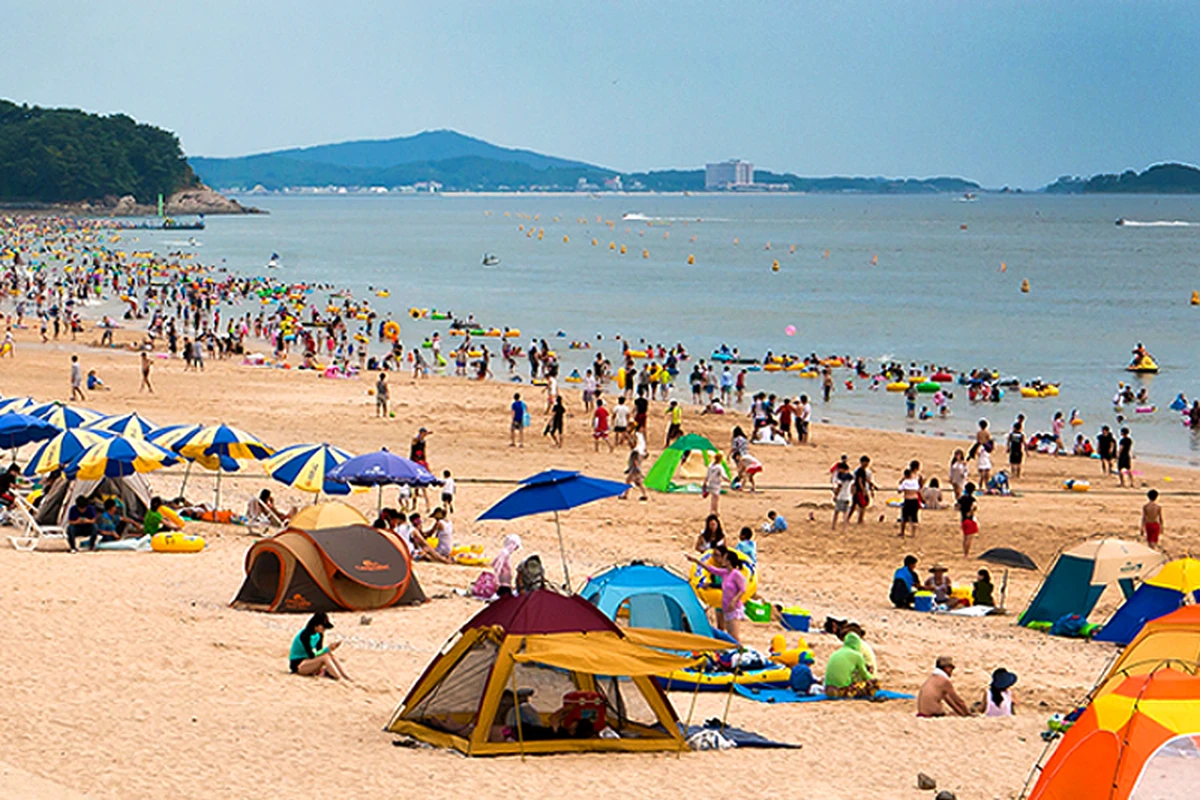
Mud Mass Battle, Dare You Take the Challenge?
South Korea's Boryeong Mud Festival is a very interesting cultural event, attracting tourists from around the world every year. The Mud Festival is a celebration of the arrival of summer. This year's Mud Festival will start on July 21, 2023 and run until August 6, and many people are already looking forward to this grand event.
The main activity of the Mud Festival is the "Mud Battle." Tourists can put on swimsuits, jump into the mud pools, and enjoy the狂欢 with others. The Mud Battle not only makes people feel happy and excited but also cleanses the skin and relieves muscle fatigue. Another benefit of playing in the mud pools is escaping the hot summer weather.
Besides the "Mud Battle," the Mud Festival also features many other activities, such as concerts, mud slides, mud soccer, and mud wrestling. Additionally, the festival offers a variety of food and special handicraft exhibitions, where visitors can taste various traditional Korean dishes and purchase interesting handicrafts as souvenirs.
Mud is a semi-solid mixture of water and soil, with stickiness and viscosity. Mud usually consists of soil, water, and some organic or inorganic substances, such as plant residues, minerals, microorganisms, and salts. Mud can form naturally in environments like rivers, lakes, and oceans, and can also be artificially made.
Mud has a wide range of uses in fields such as medicine, beauty, and construction. For example, in medicine, mud is used to treat arthritis, skin diseases, and other conditions. In beauty, mud is used for skincare, cleansing, and purifying the skin. In construction, mud is used in the production of concrete and bricks.
Although mud has many uses, it also has some potential dangers, such as possibly containing bacteria, heavy metals, and toxic substances. Therefore, when using mud, appropriate safety measures should be taken, and the source and quality of the mud must be ensured.
There are many types of mud, among which the more famous ones include Israel's Dead Sea mud, Canada's Columbia Coast glacial mud, Russia's Baikal mud, California's Kramer mud, and New Zealand's volcanic mud. Before South Korea could produce mud raw materials domestically, it had to import mud raw materials from abroad to produce mud products. Boryeong mud was launched in 1996, allowing South Korea to no longer rely entirely on imports and to produce mud products independently. This not only helps improve South Korea's domestic manufacturing level but also gives South Korea greater say and competitive advantage in the mud product market.
Clay and mud are widely used in beauty, skincare, clothing dyeing, and sauna baths. For example, Cleopatra clay and white clay powder from Chinese mud have been widely used for skin beauty and skin treatment for a long time. With the development of science and technology and the increasing demand for beauty, mud cosmetics have gradually entered people's lives, becoming a choice for daily skincare for many. Additionally, mud and clay can be used as raw materials for cosmetics, clothing dyeing, and sauna baths. Mud and clay play an important role in human life and have a broad impact on human life.
The effects of mud are indeed very diverse. Typically, mud contains a large amount of natural minerals and other effective ingredients, which can prevent skin aging, promote skin elasticity and vitality, and keep the skin young and healthy. Mud is also rich in colloidal components (such as collagen) and crystalline components, which can be used for physical treatments like sand therapy or sauna baths, providing soothing and repairing effects on the skin. Furthermore, mud has antibacterial and bacteriostatic properties, and is also effective in treating external injuries.
In the early 1990s, Daecheon Beach was considered dirty and messy, and even had some negative slogans. Additionally, the beach was neglected by tourists due to issues like arbitrary fees. Subsequently, the government implemented measures to rationalize the coal industry, leading to the closure of coal mines in the Boryeong area, which put the regional economy in a very severe situation. Against this backdrop, the development of Daecheon Beach was also greatly affected.
Starting from July 1994, an experience center called "Daecheon Natural Mud Massage House" was established at Daecheon Beach. This center mainly promoted mud massage services to ordinary beachgoers. Although it was a relatively small-scale activity, the promotional effect was significant because most visitors were foreigners.
Leveraging these successes, Boryeong mud received enthusiastic responses after media coverage. In September 1955, the Boryeong Mud Mask business achieved great success by winning the Grand Prize at the National Administrative Conference hosted by the Ministry of Home Affairs under the management philosophy of the civilian-elected autonomous era.
In July 1995, during the term of Mayor Kim Hak-hyeon, the first civilian-elected mayor, the "Boryeong Natural Marine Mud Project" was promoted. From 1996 to 1997, eight types of mud cosmetics, including mud masks, were developed, but sales stagnated due to lack of recognition.
In 1997, Boryeong City held five festivals (Crab Festival, Manse Boryeong Cultural Festival, Stepping Stone Bridge, Cheonbuk Oyster Festival, and Daecheon Beach Cultural Festival). Later, the Manse Boryeong Cultural Festival transformed into a tourist-centered cultural festival. In 1998, the Mud Festival was first proposed as a special theme for the representative festival of Chungcheongnam-do. Afterwards, the mud experience program was organized by Boryeong City.
The 1st Boryeong Mud Festival was held at Daecheon Beach from July 16, 1998, for four days, achieving results beyond expectations. Since then, with the continuous passion and efforts of related public officials and citizen volunteers, the Boryeong Mud Festival has developed into the most grand festival in South Korea designated by the Ministry of Culture, Sports and Tourism, giving birth to the Boryeong Mud Festival.
The location of the Boryeong Mud Festival is in the Mud Road area of Boryeong City, Chungcheongnam-do, South Korea. Mud Road is a rural area of Boryeong City, known for its mineral-rich mud, making it the main venue for the Boryeong Mud Festival. During the festival, the Mud Road area turns into a joyful mud kingdom, attracting tourists from around the world to experience various mud activities such as mud battles, mud slides, and mud dancing.
Popular Festival Among Foreigners: The Mud Festival is beloved by both domestic and international people, attracting tourists from around the world every year.
Selected as "Representative Festival of the Republic of Korea": In the national festival evaluations of 2008, 2009, and 2010, it was selected as a "Representative Festival of Korea," and from 2011 to 2014, it was selected as an "Honorary Representative Festival of Korea."
Various Experience-Oriented Festival: Korea's most representative memory and health festival offers free mud massage and various other experience-oriented activities.
Special Activities: Visitors can engage in various extreme mud experiences at the mudflats near Daecheon Beach, such as mudflat extreme experiences and mudflat marathon races.
Boryeong City Tour: Major tourist attractions in the Boryeong area offer city tours and nighttime activities, among other entertainment options.
Sea Bathing: Daecheon Beach, known for its shell powder sand, allows visitors to enjoy both sea bathing and festival activities.
Convenient Transportation: About a two-hour drive from the capital, accessible from anywhere in the country.
Selected as "Global Cultivation Festival": In 2015, 2016, and 2017, it received the "Korea Festival Theme Grand Prize" from the Ministry of Culture, Sports and Tourism.
High-quality sea mud collected from the coast around Boryeong Daecheon Beach is the main raw material for Boryeong mud. After processing, it becomes mud powder and mud water, which have beauty effects such as preventing skin aging and removing dead skin cells. These products are OEM-produced by well-known domestic cosmetic companies and sold under quality assurance by Boryeong City.
Mud Monsters Mopi and Mouti are two famous mascots of Boryeong City, South Korea. They are the mascots of the Boryeong Mud Festival and represent the symbol of Boryeong mud culture. Mopi is an orange little monster covered in yellow and brown mud, while Mouti is a pink little monster also covered in mud. During the festival, these cute and friendly mascots make people feel the unique charm of Boryeong mud culture. The above is an introduction to the Boryeong Mud Festival. If you plan to attend the Mud Festival, remember to bring enough swimsuits and towels, as you may want to soak in the mud pools multiple times at various locations. Also, don't forget to bring sunscreen and a hat to protect yourself from sunburn.
In the狂欢 of the Boryeong Mud Festival, people fully释放 their inner passion and enthusiasm, enjoying this unique feast. After the event, you can also use a Go City Pass to explore South Korea's capital, Seoul, a charming city. Here are the most popular attractions in Seoul:
Lotte World and Folk Museum
Lotte World is one of the largest indoor theme parks in South Korea, a comprehensive entertainment venue featuring various rides, performances, shopping, food, etc., suitable for visitors of all ages. The Folk Museum is a museum showcasing Korean traditional culture, displaying traditional folk customs, traditional weddings, traditional houses, and traditional crafts from various regions of Korea. Visitors can learn about Korean traditional culture and history here, experiencing the traditional lifestyle and cultural characteristics of Korea. Lotte World and the Folk Museum are two completely different tourist attractions—one is a modern entertainment venue, and the other is a traditional cultural museum—each with its unique charm, attracting many visitors to come and explore.
Korean Demilitarized Zone Tour
The Korean Demilitarized Zone Tour is a unique travel experience that gives visitors the opportunity to learn about the Korean War and Korean history, and to personally experience the reality of the division between North and South Korea. The Demilitarized Zone (also known as the DMZ) is a 4-kilometer-wide, 240-kilometer-long area that divides North and South Korea. In this uneasy buffer zone, you can see barbed wire and electric fences, and have the chance to overlook this highly contested vast land. The DMZ Tour stops at the most important areas of the DMZ, allowing you to understand the political tensions between these two politically opposed countries and gain a deeper insight into Korea's modern history. Highlights of the DMZ Tour include Imjingak Pyeonghoa-Nuri Park, the Bridge of Freedom, the Third Infiltration Tunnel, and Dora Observatory.
N Seoul Tower is one of the iconic landmarks of Seoul, South Korea, located on the top of Namsan Mountain. It is not only a communication tower but also an observation tower, entertainment center, and cultural exhibition center, attracting many visitors each year to enjoy the city's scenery and other entertainment activities. Visitors can overlook the entire city of Seoul from here.
Travel Note Directory: 1. What is Mud? 2. Types of Mud 3. Uses of Mud 4. Effects of Mud 5. Origin of Boryeong Mud Festival 6. Location of Boryeong Mud Festival 7. Unique Features of Boryeong Mud Festival 8. Characteristics of Boryeong Mud 9. Introduction to Boryeong Mud Festival Mascots 10. Seoul Attractions Travel Information Hotel Index Strategy Index Ticket Index Website Navigation Travel Index Cruise Index Corporate Travel Index Franchise Cooperation Distribution Alliance Friendly Links Corporate Gift Card Procurement Insurance Agency Agency Cooperation Hotel Cooperation Destination and Attraction Cooperation More Cooperation About Ctrip About Ctrip Ctrip Hotspots Contact Us Career Opportunities User Agreement Privacy Policy Business License Security Center Ctrip Content Center Intellectual Property Trip.com Group Algorithm Disclosure


![[Jia You Station] April 2014 -- Seoul, South Korea, Leisure Trip](/img/71e55889d3e90c3c_s.webp?src=https%3A%2F%2Fdimg04.c-ctrip.com%2Fimages%2Ftg%2F553%2F846%2F888%2F03c8c0ac5b104d108ab6ef884058352f_W_320_0_Q80.jpg)
